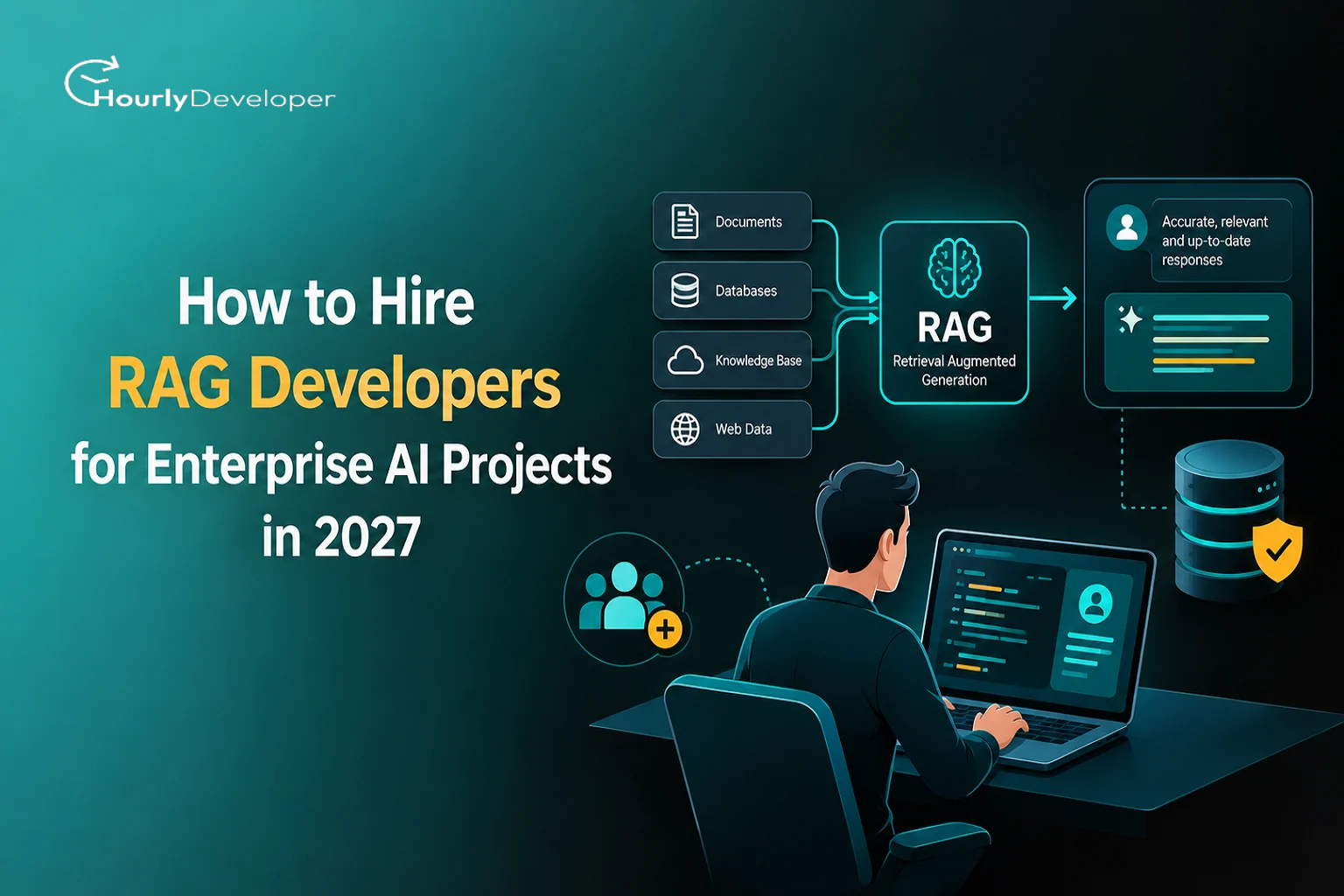
How to Hire RAG Developers for Enterprise AI Projects in 2027
In May 2024, researchers at Stanford's RegLab tested the AI research tools that LexisNexis and Thomson Reuters sell to lawyers. Both products used retrieval-augmented generation, or RAG, a method that makes an AI model look up real documents before it answers. Some legal tech vendors had marketed this approach as a way to avoid made-up answers. The study found the tools still gave wrong or misleading information between 17% and 33% of the time. The paper was later published in the Journal of Empirical Legal Studies in 2025.
These were well-funded products with enormous document libraries behind them. The lookup step was there. It just wasn't enough on its own.
That result says a lot about hiring. RAG is easy to demo and hard to run well. A developer can connect a chatbot to a folder of PDFs in an afternoon. Getting that same system to give correct, sourced answers across millions of documents, with access permissions, outdated versions, and people asking odd questions, is a different job. Working out How to Hire RAG Developers for Enterprise AI Projects mostly means finding people who understand that second job.
This guide covers what these developers build, where enterprise projects tend to break, how to test candidates, what the rate data says, and which hiring setup suits which kind of company. It's written for founders, managers, and anyone who has to make the hiring call without being an engineer.
What a RAG Developer Actually Builds
Start with the problem RAG solves. A large language model, the kind of AI behind ChatGPT or Claude, learns from a huge amount of public text. It knows a lot about the world in general. It knows nothing about your refund policy, your internal wiki, or the contract your team signed last Tuesday. Ask it anyway and it may guess, and its guesses often sound confident.
RAG adds a research step. When someone asks a question, the system first searches your company's documents, pulls out the most relevant passages, and hands them to the model along with the question. The model then writes an answer based on those passages, ideally with links back to the sources.
One way to think about it: the model is a skilled writer who has never seen your files. The RAG system is the assistant who goes to the filing cabinet, finds the right pages, and puts them on the writer's desk. If the assistant brings the wrong pages, the writer will still produce a polished answer. It will just be wrong.
RAG Development is mostly the work of building and tuning that assistant. The main parts are:
▪ Ingestion: pulling documents in from wherever they live (SharePoint, Google Drive, Confluence, databases, email archives) and turning them into clean text. Scanned PDFs and tables make this harder than it sounds.
▪ Chunking: cutting long documents into smaller passages. Cut too small and a passage loses its meaning. Cut too large and the search gets fuzzy.
▪ Embeddings: turning each passage into a list of numbers that represents its meaning, so the system can find passages that say the same thing in different words.
▪ Vector database: a database built to store those number lists and search them quickly. Pinecone, Weaviate, Qdrant, Milvus, and pgvector (an add-on for PostgreSQL) are common choices.
▪ Retrieval and reranking: finding a set of candidate passages, then using a second, more careful step to put the best ones at the top.
▪ Generation: writing the instructions for the model, sending it the passages, and making sure the answer cites where each claim came from.
▪ Evaluation: measuring whether answers are correct, and noticing quickly when they stop being correct.
Most tutorials cover the first six. The seventh is where experienced developers stand apart.
Numbers Worth Knowing Before You Budget
Here's where the market stands, based on published research. Some of these figures disagree with each other, which is worth noticing.
Figure
What it measures
Source and date
$1.2 billion
Global RAG market size in 2024, projected to reach $11.0 billion by 2030 (49.1% yearly growth)
Grand View Research, 2025
$1.92 billion
Global RAG market size in 2025, projected to reach $10.2 billion by 2030 (39.66% yearly growth)
Mordor Intelligence, August 2025
51%
Share of surveyed enterprises using RAG in their AI systems in 2024, up from 31% in 2023
Menlo Ventures, November 2024
76%
Share of enterprise AI use cases bought rather than built in 2025, up from 53% in 2024
Menlo Ventures, December 2025
60%
Share of AI projects Gartner expects organizations to abandon through 2026 when they lack AI-ready data
Gartner, February 2025
46%
Developers who actively distrust the accuracy of AI tools, versus 33% who trust it
Stack Overflow Developer Survey, 2025
The two market estimates use different base years and definitions, so their growth rates differ even though their 2030 numbers land close together. Other firms publish far bigger long-range figures. Precedence Research, for example, projects about $67.42 billion by 2034. Treat any single forecast as one firm's model, not a settled fact. They do agree on direction: spending is rising, and RAG is moving from test projects into daily use.
Mordor Intelligence's report also makes a point that matters for hiring. It notes that production RAG needs skills across information retrieval, prompting, and deployment, and that competition for this limited talent favors companies able to pay premium salaries. Mid-size firms, it says, often end up relying on managed services instead.
Where Enterprise RAG Breaks, and What a Good Developer Does About It
A demo usually runs on fifty clean documents and friendly questions. A real company has hundreds of thousands of documents, many outdated, and users who ask things nobody planned for. The five pressure points below decide whether a project survives past the pilot, and they make the most revealing interview topics too.
Data gaps: when the answer isn't in the documents
An employee asks about the parental leave policy for contractors. There is no such policy. A weak system finds the closest passage, which is the policy for full-time staff, and the model writes an answer as if it applies to contractors too. The employee believes it.
Good developers plan for missing answers. They set a relevance threshold so the system replies "I couldn't find this in our documents" when the best match is weak. They also log those misses, because a list of questions the system couldn't answer doubles as a list of holes in the company's documentation. HR, legal, and support teams can use that list as much as engineers can.
Data gaps also come from the ingestion step. Text inside images, scanned contracts, charts, and complicated tables often gets lost or scrambled when files are converted to text. Ask candidates how they'd handle a 40-page PDF where the important figures sit inside a table. If the answer is "the parser handles it," keep asking.
Conflicting signals: when two documents disagree
Companies are full of contradictions. The 2023 price sheet says one thing and the 2025 version says another. The US employee handbook differs from the UK one. A sales deck promises a feature the legal terms don't cover.
Basic vector search has no idea which document is current or official. It only finds text that sounds similar to the question. So the model may receive both versions and blend them into one smooth, wrong answer.
The fix is mostly metadata, meaning labels attached to every passage: its date, owner, region, document type, and status (draft, approved, or retired). A skilled developer uses those labels to filter and rank results before the model ever sees them. Where a real conflict remains, the answer should say so and show both sources instead of quietly picking one. For a policy question, "these two documents disagree, and here are both" beats a confident guess every time.
Real-time decisions: when speed and freshness matter
Every step in the pipeline adds delay: the search, the reranking, the call to the model. For an internal research tool, a five-second answer is fine. For a support agent on a live call or a shopping assistant at checkout, it's too slow.
Freshness is the other half of the problem. Many teams update their search index once a night. That works for handbooks. It fails for stock levels, prices, order status, or anything that changes by the minute. An experienced developer knows that fast-changing data usually shouldn't go into the vector database at all. The better design has the system call a live API or run a database query for those facts, and uses RAG for the slower-moving explanations around them.
A useful interview question: "If answers must come back in under two seconds, what would you cache, shrink, or skip?" Strong candidates will talk about caching common questions, using a smaller model for simple queries, and limiting how many passages get reranked.
Exceptions and edge cases
These are the cases that catch teams off guard most often:
▪ Permissions. If a junior employee can read a document through the AI that they can't open directly, you have a data leak. Access rules have to be checked at search time, for each user, on every question.
▪ False premises. Someone asks "Why did we cancel the Denver office lease?" when no lease was cancelled. The Stanford legal study found that tools often went along with mistaken assumptions instead of correcting them. Good systems get tested with trick questions like this before launch.
▪ Acronyms and internal jargon. "PTO," "the Q-form," or a project codename may mean nothing to an embedding model. Combining keyword search with meaning-based search, known as hybrid search, often catches these.
▪ Questions that span many documents. "Which vendors have contracts ending this quarter?" isn't a lookup. It needs structured data or a method that reads across many files. A simple pipeline will return three random contracts and call it an answer.
▪ Mixed languages, where a question typed in Hindi needs to find an answer written in English.
Under pressure and at scale
What works with 10,000 passages can quietly fall apart at 10 million. Search quality tends to drop because more near-matches compete for the top spots. Costs climb with every query, since you pay for embeddings, database hosting, and model usage. Model providers also set rate limits, so a traffic spike can cause errors unless the system queues requests or falls back to a smaller model.
Two less obvious problems show up later. First, switching to a newer embedding model usually means converting every stored passage again, which for a large library can take days and a real budget. Plan for it early. Second, stuffing more passages into the prompt doesn't always help. A 2023 study titled "Lost in the Middle," by Nelson Liu and colleagues at Stanford and other institutions, found that language models use information at the start and end of a long input better than information buried in the middle. More context can mean worse answers.
That's why evaluation matters so much. A 2024 paper by Scott Barnett and colleagues, "Seven Failure Points When Engineering a Retrieval Augmented Generation System," concluded that a RAG system can only really be validated while it's running, and that its reliability develops over time. You find out whether it works by measuring it with real questions, repeatedly.
The Skills That Matter Most
When companies set out to hire RAG developers, the job post often reads like a shopping list of tools: LangChain, LlamaIndex, Pinecone, OpenAI. Tools change every year. The skills underneath them change much more slowly. Use the scorecard below instead.
Skill
What it looks like on the job
How to check it in an interview
Search fundamentals
Knows keyword search (such as BM25), meaning-based search, and when to combine them
Ask why a search for an internal product code returns nothing useful
Data cleanup
Turns messy PDFs, tables, and web pages into clean text with reliable Python pipelines
Hand over a messy sample file and ask how they'd process it
Evaluation
Builds test sets and measures search accuracy and answer correctness over time
Ask for real numbers from a past project and how they got them
Security and access
Checks each user's document permissions every time the system searches
Ask how they'd stop an intern from seeing payroll files
Cost and speed awareness
Estimates cost per question, uses caching, picks model sizes sensibly
Ask what a million questions a month would cost in their last design
Production engineering
Monitoring, logging, retries, safe rollouts, and quick rollbacks
Ask what broke after their last launch and how they found out
Communication
Explains trade-offs to non-engineers in plain words
Notice whether you understood their answers
The last row is easy to dismiss. Don't. RAG projects touch legal, HR, support, and IT at once, and a developer who can explain to a compliance lead why an answer cited a retired document saves weeks of back-and-forth.
Degrees matter less than many hiring managers expect. Plenty of strong RAG engineers came from search, data engineering, or backend development rather than AI research. Someone who has built product search for an online store often brings more relevant experience than a machine learning PhD, because retrieval is a search problem first.
In-House, Freelance, or Agency? Comparing Hiring Models
There are four common ways to hire AI developers for RAG work. Each suits a different situation, and the right choice depends more on your timeline and internal skills than on price alone.
Hiring model
How you pay
Speed to start
Works best for
Main risk
Full-time in-house
Salary, benefits, recruiting, and equipment
Usually the slowest route
Long-term products where RAG sits at the core of the business
Hard to judge skill if nobody on staff has built RAG before
Freelancer
Hourly or fixed price per task
Fast, often days
Small pilots, prototypes, and specific fixes
You vet and manage everything, and availability can change
Development company or agency
Project fee or monthly retainer
A few weeks
Firms without an AI team that need a production system
Knowledge can leave with the vendor unless handover is planned
Staff augmentation
Monthly rate per engineer through a provider
A few weeks
Adding RAG skills to an engineering team you already have
Quality varies by provider, and you still need internal direction
One trend changes this decision for many companies. Menlo Ventures found that 76% of enterprise AI use cases in 2025 were purchased rather than built in-house, up from 53% the year before. If you're buying a platform, you may need someone skilled at connecting it to your data, setting permissions, and testing it, rather than someone who builds every part from scratch. That's a different profile, and it's often easier to find.
A mixed approach works well for a lot of mid-size firms. An experienced development partner builds the first production version while one or two of your own engineers work alongside them, then the partner hands over. The knowledge stays in the company, and you skip a long search for a senior hire before you know what the project needs.
Whichever model you pick, compare AI Developer Hourly Rates only after matching the model to the work. A cheap freelancer on a project that needs six months of steady attention often ends up costing more than an agency or a full-time hire.
What RAG Talent Costs Heading Into 2027
A straight answer first: there's no reliable public dataset that tracks pay for RAG specialists as a separate category. What exists are broader figures for AI and machine learning engineers, and even those don't fully agree.
▪ Upwork's cost page for AI engineers lists a median rate of $50 an hour, with typical contracts between $35 and $60.
▪ Upwork's page for machine learning engineers shows higher bands: $50 to $80 an hour for beginners and $80 to $120 for intermediate engineers.
▪ The US Bureau of Labor Statistics reported a median yearly wage of $133,080 for software developers in May 2024. That's roughly $64 an hour before benefits.
Why do Upwork's two pages differ? Both describe historical contracts worldwide, and the "AI engineer" label covers everything from chatbot setup to production systems. Location matters too: engineers with similar skills can charge very different rates depending on where they live.
Production RAG work sits closer to the machine learning band than to basic chatbot setup, since it combines search, data engineering, and deployment. So use published AI Developer Hourly Rates as a starting point, then adjust for seniority, location, and how much of the job is production engineering versus quick prototyping.
The developer's rate is only part of the bill. Many teams that hire AI developers budget for people and forget the running costs:
▪ Model usage fees, which are charged per token (roughly, per small piece of text the model reads or writes)
▪ Embedding costs when documents are first indexed, and again whenever they're re-indexed
▪ Vector database hosting, which grows with the size of your document library
▪ Time from subject experts who review answers during testing
▪ Ongoing maintenance as documents, models, and user questions change
That last item is the one budgets forget most often. A RAG system keeps needing attention after launch. Policies get rewritten, model providers release new versions, and users start asking kinds of questions nobody tested for. If you hire RAG developers only for the initial build, set up a support arrangement before the project ends.
An Interview Process That Tests the Real Job
Standard coding interviews won't tell you much here. A candidate can solve algorithm puzzles quickly and still build a system that cites retired documents. The four-step process below takes more planning, but it filters far better.
Step 1.Run a short, paid take-home with messy data. Give candidates 20 to 30 non-confidential documents, including one scanned PDF, two versions of the same policy, and a file with an important table. Ask them to build a small search pipeline and answer ten questions, two of which have no answer in the set. Pay for their time, since good candidates have other options.
Step 2.Walk through their work together. Ask why they split the documents the way they did, how they handled the two policy versions, and what their system said for the questions with no answer.
Step 3.Hold a design conversation about scale. Take their small system and ask what changes at 5 million documents, 2,000 users, and a two-second response target.
Step 4.Dig into a past project. Ask for real numbers: how accuracy was measured, where it stood at launch, and what broke afterward.
Three questions worth asking
Question A user says the AI gave them the wrong refund policy. How do you work out what happened?
What a good answer sounds like: Good answers trace the chain. Was the right document indexed at all? Was it found but ranked too low? Did the model get the right passage and still write a wrong answer? Each cause needs a different fix.
Question How do you know your system got better, and not worse, after a change?
What a good answer sounds like: Listen for a fixed test set, automatic scoring, and regular human spot checks. "We tried it and it seemed better" is a weak answer.
Question When would you not use RAG?
What a good answer sounds like:Strong candidates will name clear cases. Structured data is usually better served by a database query. Teaching a model a particular writing style or format may call for fine-tuning, which means further training the model on your own examples. And a small enough document set can sometimes go straight into the prompt.
That third question tells you a lot about judgment in RAG Development, because a developer who reaches for RAG every time will build it in places where it doesn't belong.
RED FLAGS DURING INTERVIEWS
✗ The candidate claims RAG "eliminates hallucinations."
✗ They can't explain how they measure quality in simple terms.
✗ They talk only about frameworks and never about data quality.
✗ They have no plan for document permissions.
✗ Every past project is a demo or hackathon entry with no real users.
The First 90 Days After the Offer Letter
Most advice on How to Hire RAG Developers for Enterprise AI Projects stops once the contract is signed. The first three months decide whether the hire pays off, so it helps to know what progress should look like.
Weeks
Focus
What you should see
1 to 2
Data audit
A list of sources, their formats, owners, and how often they change, with known gaps and conflicts flagged
3 to 6
Pilot on one use case
A working system for one team, checked against your test questions, with accuracy numbers attached
7 to 10
Hardening
Permissions enforced, monitoring in place, clear "no answer" replies, and response times within target
11 to 13
Controlled rollout
A wider group of users, a feedback button on every answer, and a weekly review of failures
Choose a first use case that's narrow and has a clear owner. An internal IT help desk or a policy assistant for one department works better than "search everything." Gartner's warning about AI projects that lack AI-ready data applies directly here. If the documents behind your first use case are a mess, the audit in weeks one and two will show it, and fixing those documents may matter more than any choice of model.
What Changes in 2027
Three shifts are worth planning for as you hire.
Search is becoming more agent-like. Instead of one search followed by one answer, newer systems let the model decide to search again, rephrase the query, or check a database before replying. This helps with complicated questions but adds new ways to fail, such as loops that keep searching and run up costs. Developers who understand plain RAG well are best placed to keep these versions under control.
Longer context windows won't make retrieval obsolete. Models can now read far more text at once. For a small document set, that can remove the need to search. For an enterprise library, sending everything with every question is slow and expensive, and the "Lost in the Middle" findings suggest accuracy can suffer as well. Something still has to decide what the model reads.
Buying is replacing building. With most enterprise AI now purchased, more RAG Development work in 2027 will be integration: connecting vendor platforms to internal data, enforcing permissions, and running evaluations. That's still skilled work, and it rewards the same basics covered above.
Where to Start
The tools are the easy part to check. What's harder to find is a developer who asks about your data before talking about models, who plans for missing and conflicting answers, and who can show quality with numbers. That's the core of How to Hire RAG Developers for Enterprise AI Projects, whatever hiring model you end up using.
Start by collecting your test questions. Pick one narrow use case with a clear owner. Decide whether you need someone to build a system or someone to connect and test one you're buying. Then run candidates through a take-home that looks like your real documents, messy parts included. It will tell you more than any résumé.
WHAT TO TAKE AWAY
✓ RAG lowers the rate of made-up answers but doesn't remove it, so testing never stops.
✓ Missing data, conflicting documents, freshness, permissions, and scale are where projects fail.
✓ Hire for search, data, and evaluation skills before tool familiarity.
✓ Build a test set of real questions before the first interview.
✓ Budget for running costs and maintenance, not just the build.
Digital Marketing Manager: With a passion for data-driven strategies and an instinct for spotting trends, Radhika navigates the virtual realm with finesse. Her commitment to staying ahead of the curve ensures our brand's message reaches the right audience at the right time.
Frequently Asked Questions
It depends on how clean your documents are and how many teams the system serves. A pilot for one narrow use case can often be ready within the first couple of months, as the 90-day plan above shows. Wider rollout takes longer. For context, Gartner's 2024 AI Mandates for the Enterprise Survey, published in June 2025, found that generative AI projects took an average of 29.3 weeks to go from idea to production, and only 41% of generative AI prototypes reached production at all.
Many companies hire AI developers with a general background and do fine for a prototype. For a production system with thousands of users and sensitive documents, look for someone with hands-on search, data cleanup, and evaluation experience. Those skills matter more than a specific job title.
Published AI Developer Hourly Rates vary widely. Upwork lists a $50 median for AI engineers and $80 to $120 an hour for intermediate machine learning engineers, and US software developers earned a median of $133,080 a year in May 2024, per the Bureau of Labor Statistics. Production RAG work usually sits toward the higher end of those ranges, and location shifts the numbers a lot.
It reduces the problem but doesn't end it. Stanford's study of commercial legal research tools built on RAG found error rates between 17% and 33%. Clear "no answer" handling, source citations, and regular testing are what keep mistakes low.
More companies are buying. Menlo Ventures reported that 76% of enterprise AI use cases were purchased in 2025. Buying makes sense when your needs are common, like internal search or support answers. Building makes sense when your data, security rules, or workflows are unusual. Either way, you'll still need to hire RAG developers or a partner to connect the system to your data and test it properly.
Find exceptional developers at Hourlydeveloper. Get the expertise, solutions, and teamwork you need for success. Hire developers easily and boost your projects today!
 Back to Blog