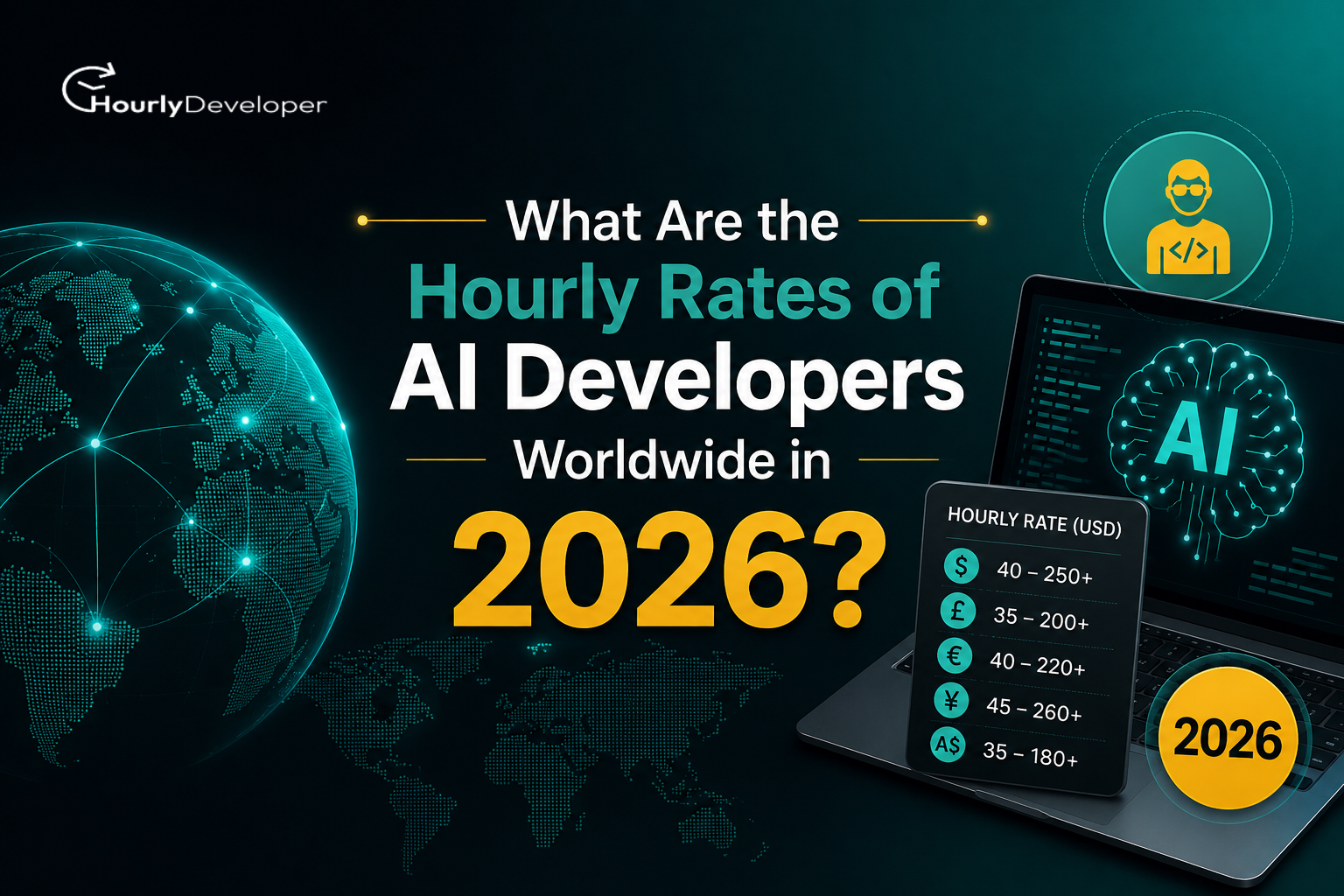
What Are the Hourly Rates of AI Developers Worldwide in 2026?
Introduction
What Are the Hourly Rates of AI Developers Worldwide in 2026?
1.Why AI Developer Hourly Rates Vary More Than You Expect
Before looking at the numbers, it helps to understand why the variation in AI developer cost is so wide compared to, say, a frontend web developer or a backend engineer. There are a few structural reasons.
The talent pool is genuinely smaller. Artificial Intelligence developers and Machine Learning engineers with real commercial experience are far less common than general software developers. The demand for generative AI capabilities, in particular, has grown much faster than the number of qualified practitioners. That imbalance pushes rates up at every seniority level.
Specializations within AI are priced differently. An AI developer who builds recommendation systems is not priced the same as one who fine-tunes large language models or builds computer vision pipelines for industrial applications. These are distinct skill sets with different market supply levels, and the rates reflect that.
The geography gap is real but narrowing in certain areas. Offshore rates have historically been the primary reason companies look outside their home market. That still holds in 2026, but the gap between regions is tighter at the senior and specialist end, because top AI talent in emerging markets increasingly commands near-Western rates.
Engagement model shapes the effective hourly cost. A dedicated AI developer hired through a technology partner at $55 per hour is not the same cost as a freelancer at $55 per hour once you account for what is included. Management overhead, IP ownership, continuity, and accountability all factor into the real cost equation.
2.AI Developer Rates by Country and Region in 2026
The table below breaks down average AI developer hourly rates across major hiring regions in 2026, organized by seniority level. These figures reflect market data for professionals focused on AI and machine learning work, not general software development rates.
Region
Junior
Mid-Level
Senior
Specialist/Lead
North America (USA/Canada)
$80 $110/hr
$120 $160/hr
$170 $220/hr
$230 $300/hr
Western Europe (UK/Germany/Netherlands)
$60 $80/hr
$85 $120/hr
$130 $170/hr
$180 $250/hr
Eastern Europe (Poland/Ukraine/Romania)
$30 $45/hr
$50 $70/hr
$75 $100/hr
$110 $140/hr
India
$18 $28/hr
$30 $45/hr
$50 $70/hr
$75 $100/hr
Southeast Asia (Philippines/Vietnam/Indonesia)
$20 $32/hr
$35 $50/hr
$55 $75/hr
$80 $110/hr
Latin America (Brazil/Mexico/Colombia)
$28 $42/hr
$45 $65/hr
$70 $95/hr
$100 $130/hr
Middle East (UAE/Saudi Arabia)
$45 $60/hr
$65 $90/hr
$95 $130/hr
$140 $180/hr
Australia/New Zealand
$70 $90/hr
$95 $130/hr
$135 $175/hr
$185 $240/hr
A few things worth noting about these numbers. First, India remains the most cost-competitive region for dedicated AI developers cost globally, especially at the senior level where $50 to $70 per hour can get you a professional with five or more years of machine learning and AI delivery experience. That said, the best engineers in India are now more selective about the projects they take on, and the very top tier is edging closer to Eastern European rates.
Eastern Europe, particularly Poland, Romania, and parts of the Czech Republic, has seen sustained rate increases since 2023. The region now occupies a clear middle tier that offers strong technical depth, significant timezone overlap with Western clients, and cultural alignment for product-focused work. For companies that want a balance between cost and proximity, this region continues to be a strong choice.
Latin America deserves more attention than it typically receives in global hiring conversations. Brazil, Mexico, and Colombia have developed strong AI engineering talent communities, and the timezone compatibility with North American companies is a genuine operational advantage. The average cost to hire AI developers globally from this region is competitive, particularly for US-based companies managing remote teams.
3.Generative AI Developer Hourly Rates and Other Specializations in 2026
Not every AI developer does the same work. The table below shows how rates differ by specialization, which matters significantly when you are scoping a specific project rather than building a general AI team.
AI Specialization
Global Rate Range (2026)
Demand Level in 2026
Generative AI / LLM Engineers
$80 $200/hr
Extremely High
Machine Learning Engineers
$70 $180/hr
Very High
Computer Vision Specialists
$65 $160/hr
High
NLP Engineers
$65 $155/hr
High
AI Product Architects
$100 $220/hr
Extremely High
MLOps / AI Infrastructure Engineers
$75 $170/hr
Very High
AI Data Engineers
$55 $130/hr
High
Reinforcement Learning Specialists
$85 $190/hr
Moderate to High
The generative AI and large language model engineering category deserves special attention. Generative AI developer hourly rates are the highest in the AI development space right now, and the premium is justified. Engineers who understand transformer architecture, can work with model fine-tuning, understand inference optimization, and have delivered production-grade generative AI applications are genuinely rare. If your project involves building AI products that incorporate LLMs, RAG pipelines, or AI agents, budget accordingly.
MLOps and AI infrastructure engineers are often underpriced in initial budgets. Companies tend to focus on the model-building phase and underestimate the ongoing cost of deploying, monitoring, and maintaining AI systems in production. These engineers do not just run models. They manage the entire operational layer that keeps an AI product reliable and scalable. Their rates reflect a combination of software engineering depth and AI-specific knowledge that is not easy to find.
4.How Your Engagement Model Changes the Real Artificial Intelligence Developer Cost
This is the part most rate guides skip entirely. The hourly rate you see quoted is rarely the full picture. How you structure the engagement changes what you actually pay and what you actually get.
Engagement Model
Effective Hourly Cost
Best For
Typical Premium/Discount
Full-Time In-House Hire
$50 $150/hr (all-in)
Long-term, core product teams
None (but add 25-40% for benefits/overhead)
Freelancer (Marketplace)
$40 $200/hr
Short tasks, defined scope
0 to +15% (platform fees)
Dedicated AI Developers via Agency
$35 $120/hr
Sustained team augmentation
Savings of 20 35% vs in-house
AI Development Company (Project-Based)
$50 $180/hr blended
Full-cycle product builds
Managed risk, predictable scope
Staff Augmentation
$40 $130/hr
Filling skill gaps quickly
Slightly higher than direct hire offshore
Working with an AI Development Company on a project basis typically means a blended rate that reflects the combined cost of different profiles on your team: a lead architect, a few mid-level engineers, a data scientist, possibly a QA engineer. The hourly rate you see in a proposal is an average across those roles, not a single individual rate. That context matters when comparing quotes across vendors.
The dedicated AI developers cost model is increasingly popular for companies that want the cost savings of an offshore or nearshore team without the overhead of building and managing that team themselves. You get continuity, accountability, and a team that is genuinely integrated into your delivery process. The effective hourly rate is typically lower than staff augmentation through a marketplace and significantly lower than building an in-house team in a Western market.
5.What Justifies Paying a Rate Premium in 2026
If you have been given a proposal where the rates are at the higher end of the ranges above, it does not automatically mean the vendor is overcharging. There are specific factors that legitimately command a premium.
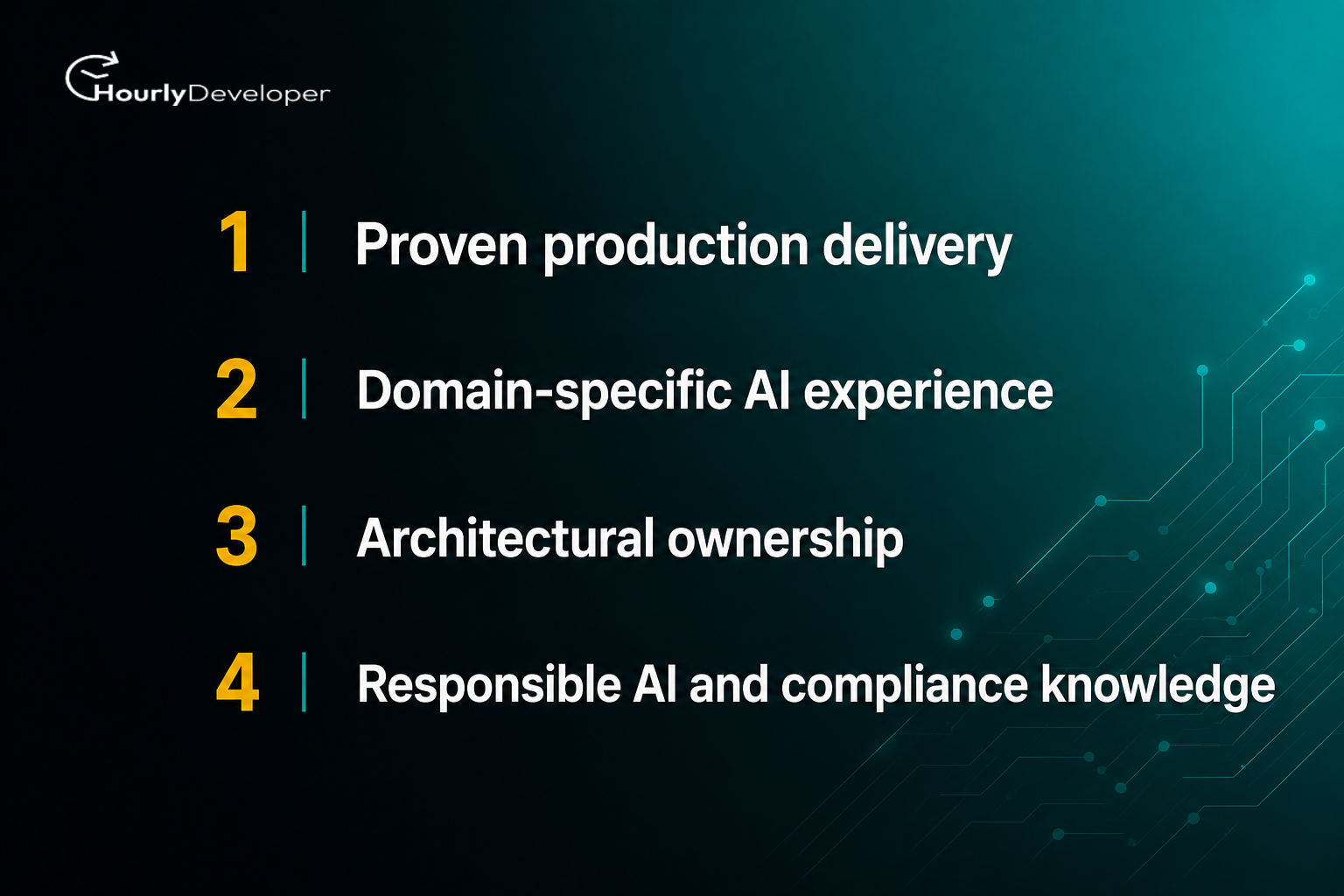
Proven production delivery. Many engineers have worked on AI projects in research or experimental contexts. Fewer have delivered AI systems that handle real user load, require ongoing monitoring, and get maintained over a multi-year product lifecycle. Developers who have done this carry more value.
Domain-specific AI experience. A Machine Learning engineer with ten end-to-end projects in logistics optimization is worth more to a logistics platform than a generalist with the same number of years of experience. Sector-specific knowledge shortens onboarding, reduces mistakes, and improves the quality of decisions made during development.
Architectural ownership. Some AI developers execute tasks. Others design the system. If you are building something substantial, the cost difference between a developer who can architect your AI stack and one who needs that architecture handed to them is meaningful over the full project lifetime.
Responsible AI and compliance knowledge. In 2026, AI systems being deployed in regulated industries, consumer products, or public-facing applications increasingly need to be built with bias assessment, explainability, and regulatory alignment in mind. Developers who bring this knowledge reduce downstream risk. That has real value that justifies higher rates.
6.How AI Developer Rates Have Shifted Since 2023 and Where They Are Heading
The AI developer hiring market moved faster between 2023 and 2026 than almost any other technical category. Understanding that trajectory helps you interpret what you are seeing in proposals today and what to expect when you plan ahead.
Key Rate Shifts: 2023 to 2026
Year
What Changed
Impact on Rates
2023
Generative AI adoption created sudden demand for LLM engineers
Senior GenAI rates jumped 30 40% in under 12 months
2024
Remote hiring normalized; Western companies hiring offshore specialists directly
Mid and senior offshore rates increased by 20 25% across India and Eastern Europe
2025
Junior AI developer pipeline grew; mid-level market began stabilizing
Junior and mid-level rates plateaued; specialist rates kept climbing
2026
Domain-specific AI experience now commands a clear premium
Generalist AI rates stable; niche specialists (MLOps, LLM architects) still appreciating
7.AI Development Companies Worth Considering When Evaluating Partners
If you are at the stage of shortlisting partners rather than hiring individual developers, here are companies that have established credibility in AI development work. These are not the only options, but they represent a useful cross-section of the market in terms of geography, specialization, and engagement model.
Backend Development Company has built a strong reputation for AI and machine learning integrations within complex backend systems. Their team is well-suited for companies that need AI capability embedded into existing infrastructure rather than greenfield AI product builds. Their developer rates reflect mid-tier offshore market benchmarks, making them a practical choice for sustained AI development work.
HireFullStackDeveloperIndia offers a model that works well for companies looking to hire dedicated AI developers at India-based rates with project management structures that reduce coordination overhead. Their strength lies in the breadth of their team, which includes both full-stack engineers with AI integration capability and specialists focused on ML pipelines and data engineering.
HireAIDevelopers is specifically positioned for companies that need AI-first talent. The firm focuses exclusively on artificial intelligence and machine learning roles, which means the bench of available engineers skews toward specialization rather than generalist capability. If you are building something that requires deep AI domain knowledge, this narrower focus is an advantage rather than a limitation.
DataEximIT brings strong data engineering and AI development capability together, which matters more than it sounds. A significant number of AI projects fail not because the model does not work but because the data infrastructure behind it is poorly designed. DataEximIT’s combined data and AI delivery experience makes them relevant for companies in data-heavy industries like finance, healthcare, and retail.
WebClues Infotech has a longer history in product development that now extends into AI application development. They are a reasonable choice for companies that want to build AI-enabled products rather than standalone AI systems, given their experience delivering user-facing applications with AI features integrated throughout. Their rates are competitive at the mid-tier offshore level.
8.Rate Red Flags That Should Make You Ask More Questions
Not every low rate represents good value, and not every high rate represents quality. Here are a few signals that warrant closer scrutiny regardless of where the quoted rate falls.
A single blended rate for a team that allegedly includes senior architects, ML engineers, and data scientists. These roles price differently. A proposal that treats them the same is either not being transparent or is cutting corners on seniority.
No clear split between the build phase and the maintenance phase in cost estimates. AI systems are not static. Models drift. Data pipelines require monitoring. A vendor whose cost model does not account for post-launch operations has not thought through the full engagement.
Very low rates for generative AI development. The market for engineers who can genuinely deliver production-ready LLM applications is tight. Rates well below $40 per hour for this work in most offshore markets should prompt questions about the actual seniority of the team.
Rates that look identical across every role on a proposed team. Real delivery teams have rate diversity. Everyone pricing the same usually means the team is more uniform in seniority than the proposal suggests.
9.A Practical Budgeting Framework for AI Development Engagements
If you are building a budget from scratch, here is a framework that accounts for the full cost of an AI development engagement rather than just the quoted hourly rate.
Step 1: Define the work type. Generative AI, computer vision, ML model development, AI integration, and MLOps all price differently. Clarify which category or categories your project falls into before benchmarking rates.
Step 2: Apply regional benchmarks by seniority. Use the table in this blog as a starting point. Apply the appropriate region based on where you plan to hire or partner, and weight the seniority distribution based on the complexity of your project.
Step 3: Add engagement model overhead. If you are hiring through an agency or AI Development Company, factor in the management and delivery overhead they provide. If you are hiring directly, factor in your own management cost.
Step 4: Budget for operations, not just delivery. A rule of thumb for AI products: allocate 20 to 30 percent of your initial build budget annually for ongoing model monitoring, retraining, infrastructure, and incremental improvements. This is not optional and it is almost always underestimated.
Step 5: Validate with a discovery engagement. Before committing to a full build, a paid discovery phase with your shortlisted partner will surface scope assumptions and team capability signals that no rate table can give you. The cost is usually recoverable if you proceed and invaluable if you catch a misalignment early.
10.Questions to Ask Before You Agree to an AI Developer Rate
Rate benchmarks tell you whether a number is in the right ballpark. They do not tell you whether that number represents what you think it does. This table covers the questions that give you the clarity the headline figure does not.
Question to Ask
Why It Matters
Is this rate for a named individual or a role?
Some vendors quote based on the developer introduced during sales. The person actually assigned may have a different experience. Confirm which one the rate is tied to.
What does the rate include beyond coding hours?
Standups, documentation, code reviews, and rework may or may not be billable. A 40-hour week can produce far fewer deliverable hours than expected without this clarity.
How is rate escalation handled over time?
Long-term dedicated AI developer engagements often include annual escalation clauses. Get the mechanism in writing before month one so there are no surprises by month ten.
Are senior and junior hours differentiated on invoices?
Blended team rates are common but not always transparent. Confirm whether invoices break down hours by seniority so you can verify the rate mix you are actually being billed for.
What rate applies to out-of-scope work?
AI projects expand in scope more than most. Some vendors bill change requests at a premium. Knowing this before you need it avoids friction mid-project.
Is there a minimum hour commitment behind this rate?
Competitive rates often come with monthly minimums. A rate that looks attractive may require 160 hours per month regardless of actual workload. Confirm before signing.
What is the post-launch support rate?
The build rate and the maintenance rate are often different. Model monitoring, retraining, and incremental improvements are ongoing costs that need their own budget line.
11.Conclusion
Rates are information. They are not the decision. And that shift in framing is worth sitting with for a moment before you close this tab and go back to your shortlist.
When you set out to hire AI developers for something meaningful, whether that is a product your customers will interact with or an internal system your business will rely on, you are not really making a purchasing decision about hours. You are making a judgment call about who is capable of solving a specific problem, in a specific timeframe, with a specific set of constraints. The average cost to hire AI developers globally is a useful benchmark. What your project actually costs will be shaped far more by the decisions you make about team structure, scope definition, and partner selection than by where any individual developer falls on a rate table.
The Generative AI developer hourly rates at the top end of the market exist because the people who command them have demonstrated something that is hard to replicate: the ability to take an AI initiative from early-stage ambiguity to production reality without losing either the technical integrity or the business objective along the way. Whether that level of capability is what your project needs is a judgment call only you can make. But it is the right question to be asking. The rate is just the number that comes after you answer it.
The AI development market is mature enough now that those questions have clear answers from credible partners. The rate is just the starting point.
With a love for connecting with people and a flair for communication, Prachi's expertise in digital marketing is unmatched. Her strategic approach to campaigns ensures our brand's story reaches far and wide, making an impact on the lives of countless individuals.
Frequently Asked Questions
No. Developer hourly rates cover labor only. The cost of APIs such as OpenAI or Anthropic, cloud compute for training and inference, vector databases, and monitoring tools are billed separately as project infrastructure costs. For AI-heavy projects, these can represent 15 to 40 percent of the total build cost and should be budgeted independently from developer fees.
Hiring a team through an AI Development Company typically results in a blended rate that is slightly lower per hour than sourcing individual specialists independently. Volume and continuity discounts often apply at the team level. However, team-based engagements usually include a minimum monthly commitment, so the flexibility tradeoff versus individual contractors is worth evaluating for your project timeline.
Yes, but not always where you expect them. Junior developers in the lower range can deliver solid work on well-defined, narrower tasks with proper oversight. The higher range typically reflects more architectural experience, the ability to navigate ambiguity in problem definition, and familiarity with production-scale constraints that simpler projects do not expose. The question is whether your project requires the latter.
Regulated industries typically pay a 15 to 25 percent premium for AI developers who understand compliance requirements such as HIPAA, GDPR, or financial model governance. This is not just about legal knowledge but about experience designing AI systems where auditability, explainability, and data handling controls are built into the architecture from the start rather than retrofitted later.
Partially. AI coding assistants and automated ML platforms can reduce the time required for certain development tasks by 20 to 35 percent in favorable conditions. However, they do not reduce the need for senior oversight, architectural judgment, or domain-specific AI expertise. The practical result is more output per developer hour, not a significant reduction in the number of skilled developers a serious AI project requires.
Find exceptional developers at Hourlydeveloper. Get the expertise, solutions, and teamwork you need for success. Hire developers easily and boost your projects today!
 Back to Blog