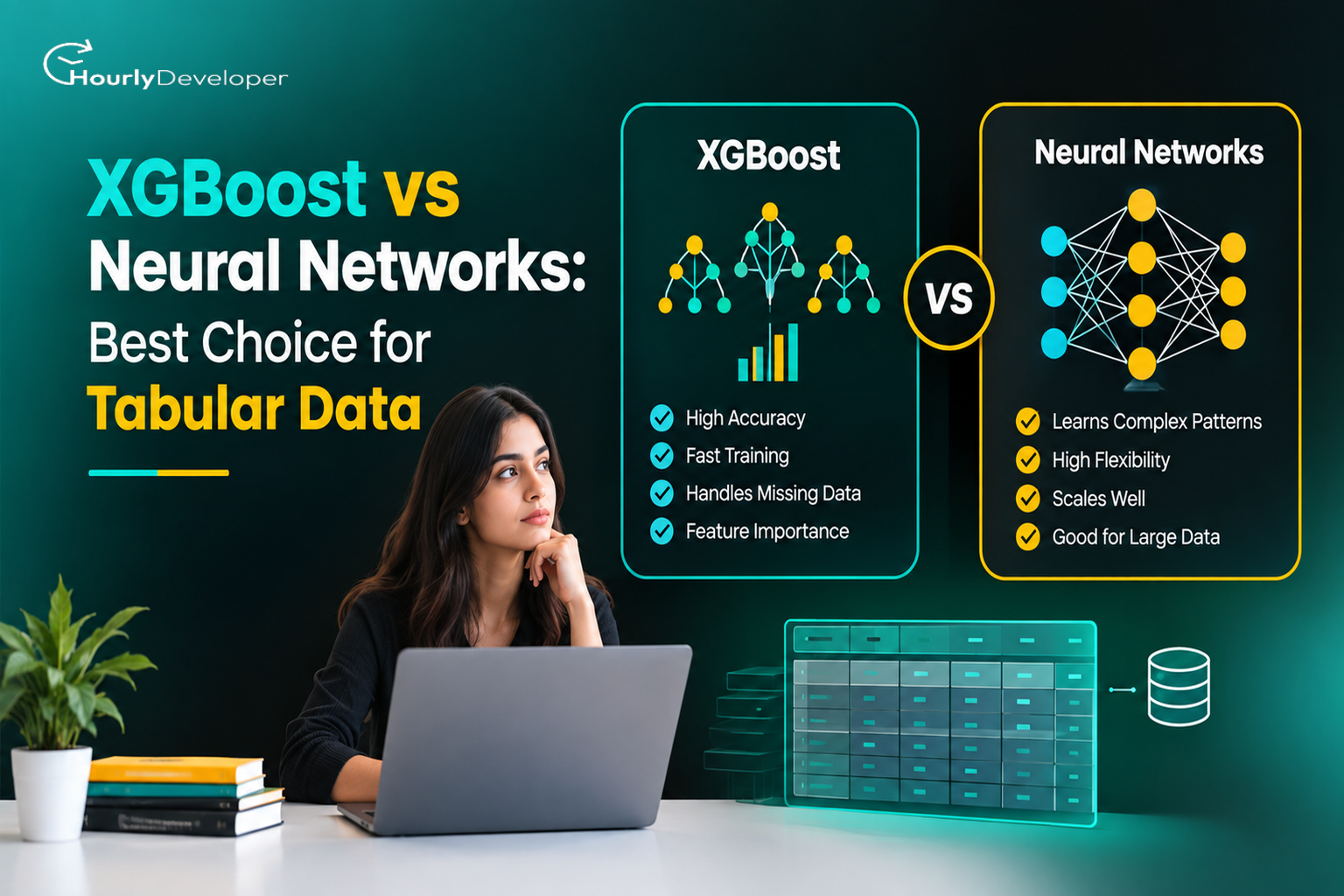
XGBoost vs Neural Networks: Best Choice for Tabular Data
Why this question keeps coming up
Every few months, a new deep learning paper claims to have finally cracked tabular data. Then a data scientist runs it against a well tuned XGBoost model on their own dataset, and XGBoost wins anyway. This has happened often enough that it has become a running joke in machine learning circles, and also often enough that the opposite is now starting to happen too, with newer architectures closing the gap or beating gradient boosting outright on certain problems.
If you build models on spreadsheets, database exports, CRM records, or sensor logs rather than images or free text, the choice between XGBoost vs neural networks for tabular data is not academic. It affects your training time, your infrastructure bill, how much data you need before a model is usable, and how easily your team can explain a prediction to a compliance officer or a client. This guide walks through how each approach works, what independent research actually shows, where each one wins, and how to make the decision for your own project without guessing.
What counts as tabular data, and why it behaves differently
Tabular data is anything organized in rows and columns: a customer table with age, income, and purchase history; a hospital record with lab values and diagnosis codes; a manufacturing log with sensor readings and machine IDs. Each column can be numeric, categorical, or a mix, and columns rarely share a common structure the way pixels in an image or words in a sentence do.
This last point matters more than it sounds. Images have spatial structure, so a convolution that recognizes an edge in one corner recognizes the same edge anywhere else. Text has sequential structure, so a transformer can learn that "not" changes the meaning of the word after it regardless of where the sentence appears. Tabular columns do not share this kind of structure. Column 3 might be a customer's age and column 4 might be a zip code, and there is no reason a pattern learned in column 3 should transfer to column 4. Deep learning architectures were built around the assumption of shared structure across inputs, and tabular data mostly does not offer that assumption for free. This is the root cause of the entire debate this article is about.
Tabular datasets also tend to be smaller than the datasets deep learning was designed for. A retailer's churn dataset might have 40,000 rows. A hospital dataset might have 5,000 patients. Compare that to the millions of images or billions of words used to train modern vision and language models, and it becomes clearer why tree based methods, which need far less data to find useful splits, have held their ground for so long.
How XGBoost works, without the jargon
XGBoost stands for Extreme Gradient Boosting. It builds a sequence of small decision trees, where each new tree is trained specifically to correct the mistakes of the trees before it. The first tree makes rough predictions. The second tree looks at where the first tree was wrong and focuses on fixing those errors. This continues for hundreds or thousands of rounds, and the final prediction is a weighted combination of every tree in the sequence.
A few design choices explain why XGBoost became the default tool for tabular problems:
• It handles missing values natively, learning the best direction to send a missing value at each split rather than requiring you to impute beforehand.
• It splits on raw categorical codes and numeric thresholds without needing normalization, scaling, or one hot encoding in most cases (though encoding categorical columns is still common practice for accuracy).
• Its regularization terms (L1 and L2 penalties on leaf weights) reduce overfitting without much manual tuning.
• It trains fast on CPUs and scales well with GPU acceleration for larger datasets.
• A handful of hyperparameters (max depth, learning rate, number of trees, subsample ratio) usually get you 90 percent of the way to a strong model, and grid search or Bayesian optimization can close the rest of the gap in a few hours.
LightGBM and CatBoost are close cousins that use the same underlying idea with different engineering tradeoffs. LightGBM grows trees leaf by leaf instead of level by level, which is faster on large datasets. CatBoost handles categorical features with less preprocessing. For the purpose of this comparison, what applies to XGBoost mostly applies to this whole family of gradient boosted decision tree (GBDT) models.
How neural networks approach tabular data
A basic multilayer perceptron (MLP) takes each row, flattens it into a vector of numbers, and passes it through several layers of weighted connections and activation functions. Categorical columns are usually converted into embeddings, a technique borrowed from natural language processing where each category is mapped to a small vector of learned numbers instead of a single integer.
Plain MLPs on tabular data have a mixed track record, which is part of why researchers built more specialized architectures:
• TabNet uses a sequential attention mechanism to pick which features matter at each decision step, aiming to mimic how a tree chooses split points while still training end to end with gradient descent.
• FT-Transformer (Feature Tokenizer Transformer) turns each column into a token, similar to how a sentence is tokenized into words, then applies the same self attention mechanism used in large language models.
• NODE (Neural Oblivious Decision Ensembles) builds differentiable decision trees directly inside a neural network, an attempt to get the best of both worlds.
• TabPFN, a newer entrant, is not trained per dataset at all. It is pretrained once on millions of synthetic tables and then makes predictions on a new dataset through a single forward pass, without any hyperparameter tuning on your data.
Neural networks bring a few genuine strengths to tabular problems. They can share information across related tasks (multi task learning), they can be fine tuned on new data without retraining from scratch, and they integrate naturally when tabular features need to be combined with images or text in the same model, something GBDTs cannot do directly.
What the research actually says
This is the part most blog posts skip, and it is the part that actually matters if you want an answer grounded in evidence rather than opinion. Several independent research groups have run large, controlled comparisons. The results are more nuanced than either camp likes to admit.
Study
What it tested
Main finding
Shwartz Ziv and Armon (2021)
XGBoost vs NODE, TabNet, 1D CNN, DNF Net on 11 datasets
XGBoost outperformed deep models on 8 of 11 datasets; no single deep model was consistently competitive
Grinsztajn, Oyallon, and Varoquaux (2022), "Tabular data: Deep learning is not all you need"
GBDTs vs several deep architectures across dozens of datasets, with heavy tuning budgets for both
GBDTs outperformed deep models on medium sized datasets (under roughly 50,000 rows); deep models needed far more tuning time to get close
Kadra et al. (2021)
Regularized MLPs ("regularization cocktails") vs XGBoost
Well regularized MLPs matched or beat XGBoost after 30 minutes of hyperparameter search per dataset
Gorishniy et al., TabR (2023)
TabR (a retrieval augmented neural network) vs tuned GBDTs
TabR outperformed GBDT on average on a well known benchmark, a reversal of most earlier results
Hollmann et al., TabPFN 2.5 (2025)
TabPFN 2.5 vs default XGBoost
TabPFN 2.5 won essentially every match on datasets under 10,000 rows and 500 features, and won the large majority of matches up to 100,000 rows
Two things stand out. First, the answer to XGBoost vs neural networks for tabular data depends heavily on dataset size, tuning budget, and which specific architecture is being tested, which is exactly why generic claims like "neural networks always lose on tabular data" have gotten harder to defend with each new paper. Second, the gap has been closing. The 2022 Grinsztajn study is often cited as the final word in favor of GBDTs, but it predates TabR, TabPFN 2, and TabPFN 2.5, all of which report real wins against tuned XGBoost on parts of the same territory that study covered.
None of this means neural networks have overtaken gradient boosting in practice. Kaggle competitions on structured data, where thousands of practitioners compete on real business problems with real time and compute constraints, are still won almost exclusively by XGBoost, LightGBM, CatBoost, or ensembles built around them. A 2017 Kaggle survey of over 14,000 data scientists found that 65 percent worked daily with relational or tabular data, and anecdotal write ups from competition winners for years running have pointed to gradient boosting as the backbone of nearly every top submission. The research gap and the practice gap are not the same thing, and the difference usually comes down to tuning time, deployment simplicity, and how much a team trusts a black box.
XGBoost vs neural networks for tabular data: a head to head comparison
Factor
XGBoost (and other GBDTs)
Neural networks
Typical accuracy on datasets under 50,000 rows
Strong out of the box, minimal tuning needed
Competitive only with careful architecture choice and tuning; newer foundation models like TabPFN can beat GBDTs with zero tuning
Accuracy on very large datasets (millions of rows)
Still strong, but scaling gets slower
Often closes the gap or wins, since more data plays to deep learning's strengths
Training speed
Minutes to a few hours on CPU for most business datasets
Often slower to train and more sensitive to learning rate and batch size choices
Hyperparameter sensitivity
Low; default settings are usually usable
High; poor architecture or learning rate choices can produce a much worse model than a default XGBoost run
Handling missing values
Built in, no preprocessing needed
Requires imputation or explicit missingness indicators
Handling mixed numeric and categorical columns
Native support, especially in CatBoost
Requires embeddings or one hot encoding, adds pipeline complexity
Interpretability
Feature importance and SHAP values are mature and widely trusted
Harder to explain individual predictions; attention weights help but are not the same as a clear decision path
Multimodal data (tabular plus images or text)
Cannot combine modalities directly
Can combine tabular features with other data types in one model
Transfer learning across related tasks
Limited, each model is trained from scratch
Strong, pretrained models can be fine tuned quickly
Compute cost at inference
Very low, runs comfortably on a CPU
Can be low for a small MLP, but transformer based models need more memory and often a GPU for low latency
When XGBoost is the better choice
• Your dataset is small to medium sized. Most business tabular datasets fall under 100,000 rows, which is squarely in the range where GBDTs have historically won.
• You need to explain individual predictions. If a loan officer, doctor, or auditor needs to know why the model flagged a specific case, feature importance scores and SHAP values are easier to produce and easier to defend than attention maps from a transformer.
• You have limited time to tune the model. A default XGBoost run often lands close to its best achievable performance. A neural network usually needs real experimentation with architecture and learning rate before it is competitive.
• You are working with a lot of missing data or messy categorical columns. GBDTs, especially CatBoost, handle this with far less preprocessing work.
• Your infrastructure budget favors CPU inference. Deploying a GBDT model rarely requires a GPU, which keeps hosting costs down for many production systems.
When neural networks make sense
• You have a very large dataset, generally in the millions of rows, where deep architectures have room to find patterns that shallow trees cannot represent as efficiently.
• You need to combine tabular data with images, text, or audio in a single model, such as predicting insurance claim outcomes from both structured claim data and adjuster notes.
• You want to reuse a pretrained model across similar tasks, fine tuning it on new data rather than starting from scratch each time.
• Your dataset is very small (under a few thousand rows) and you can use a foundation model like TabPFN, which is specifically built for this scenario and skips hyperparameter tuning entirely.
• You are already running a deep learning pipeline for other parts of the product and want one consistent framework rather than maintaining two separate model types.
Key takeaway
There is no universal winner between XGBoost vs neural networks for tabular data. The right choice depends on dataset size, how much tuning time you have, whether interpretability matters to your stakeholders, and whether the data is purely tabular or needs to be combined with other formats. Teams that treat this as a settled question in either direction usually end up leaving accuracy or engineering time on the table.
A simple decision framework
Use this as a starting checklist rather than a strict rulebook:
1. Count your rows. Under roughly 50,000, lean toward XGBoost or a foundation model like TabPFN. Over a few hundred thousand, a neural network becomes more competitive.
2. Check how much missing data and how many categorical columns you have. More of either points toward GBDTs.
3. Ask whether anyone outside the data team needs to understand individual predictions. If yes, GBDTs make that conversation easier.
4. Ask whether tabular data needs to be fused with images, text, or audio anywhere in the pipeline. If yes, a neural network is likely unavoidable somewhere in the system.
5. Estimate your tuning budget honestly. A rushed neural network usually loses to a default XGBoost run. A well tuned neural network can win, but it needs real time invested.
6. If none of the above gives a clear answer, run both. Training an XGBoost baseline takes an afternoon in most cases, and having that baseline number makes every later decision easier to justify.
How this plays out across industries
The theory behind this comparison is useful, but seeing how it plays out in practice makes the tradeoffs easier to judge.
• Banking and lending. Credit scoring and fraud detection models are almost always built on gradient boosting. Regulators frequently require a clear explanation for why a loan was denied or a transaction was flagged, and SHAP values on an XGBoost model are far easier to defend in an audit than attention weights from a neural network. Several large banks that experimented with deep learning for credit scoring in the past decade eventually settled back on tree based models for exactly this reason.
• Retail and e commerce. Demand forecasting and churn prediction usually run on tabular data with tens of thousands to a few million rows, a range where GBDTs remain competitive and cheaper to retrain daily as new sales data comes in. Larger retailers with hundreds of millions of transaction rows and a need to combine purchase history with product images or descriptions are more likely to bring in neural networks, often as part of a recommendation system rather than a pure tabular model.
• Healthcare. Clinical datasets are frequently small, sometimes just a few thousand patients for a rare condition, which plays directly to the strengths of gradient boosting and, more recently, foundation models like TabPFN. Interpretability also carries extra weight here, since a clinician needs to trust and understand a prediction before acting on it.
• Manufacturing and predictive maintenance. Sensor data from industrial equipment can reach millions of rows per machine per year, and some of it benefits from architectures built for sequences, such as recurrent networks or transformers, rather than a plain XGBoost model trained on flattened windows of readings. Teams in this space often end up using GBDTs for early anomaly flags and neural networks for the more complex, sequence aware forecasting layer.
• Insurance. Claims data mixes structured fields (claim amount, policy type, location) with unstructured adjuster notes, which is a natural fit for a neural network that can combine both formats. Pure claims triage on structured fields alone, however, still tends to run on gradient boosting for speed and cost reasons.
Evaluation metrics: how to know which model actually won
Choosing a winner between the two approaches only means something if the evaluation is done correctly. A few habits separate a trustworthy comparison from a misleading one.
• Match the metric to the business problem. Accuracy alone is a poor choice for imbalanced datasets, such as fraud detection where positive cases might be under 1 percent of rows. Precision, recall, F1 score, and area under the ROC curve usually tell a more honest story.
• Use the same cross validation splits for every model tested. Comparing an XGBoost model evaluated with 5 fold cross validation against a neural network evaluated on a single train and test split is not a fair comparison, and it is a common source of misleading blog posts and internal reports.
• Report variance, not just a single score. Small tabular datasets are noisy. Running the same model with five different random seeds can produce a meaningful spread in the final score, and the "winning" model on one seed sometimes loses on another.
• Track training and inference cost alongside accuracy. A model that scores 1 percent higher but costs 5 times more to train and serve is not automatically the better choice, depending on the budget and latency requirements of the project.
• Watch for data leakage separately from model choice. A surprisingly high score on either model type is more often a sign of leaked information (a feature that indirectly encodes the target) than a sign of a genuinely strong model. Check this before concluding either architecture "won."
Training time, cost, and infrastructure
Cost comparisons rarely show up in these debates, but they matter as much as accuracy for most production teams.
XGBoost models typically train in minutes to a couple of hours on standard CPU instances for datasets under a few million rows. Inference is fast enough to run in real time within a typical API request, and most cloud providers price CPU compute well below GPU compute per hour.
Neural network training times vary widely. A small MLP on a modest dataset might train in a similar timeframe to XGBoost. A transformer based architecture like FT-Transformer, or a foundation model that requires GPU inference, adds real cost: GPU instances commonly run 3 to 10 times the hourly price of equivalent CPU instances on major cloud platforms, and larger models add memory and latency overhead at serving time.
For a team weighing thebest machine learning model for tabular data purely on a cost basis, XGBoost usually wins by a wide margin unless the accuracy gain from a neural network translates into clear business value, such as a fraud detection system where a 1 percent accuracy improvement prevents losses well beyond the added compute cost.
Common mistakes teams make when choosing
• Picking a neural network because it feels more modern. Model choice should follow the data and the business constraint, not trends. A well tuned XGBoost model beats a poorly tuned neural network on almost every practical benchmark.
• Skipping the XGBoost baseline entirely. Even teams committed to a deep learning approach benefit from a quick baseline, since it sets a bar and catches data quality problems early.
• Assuming interpretability is automatically solved with SHAP on any model. SHAP works on neural networks too, but the explanations are noisier and slower to compute than on tree based models, particularly with high dimensional inputs.
• Ignoring dataset size when picking an architecture. Applying a large transformer to a dataset with 2,000 rows almost always overfits, no matter how careful the regularization.
• Not accounting for retraining costs over time. A GBDT retrain is often cheap enough to run weekly or daily. A large neural network retrain may need to be scheduled and budgeted more carefully.
Pro tips for getting more out of either model
Pro tip: Start every tabular project with a default XGBoost or LightGBM model before touching any deep learning architecture. It takes an hour, and it tells you what score you actually need to beat.
Pro tip: For neural networks on tabular data, normalize numeric columns and use embeddings for categorical columns rather than one hot encoding once you have more than roughly 10 unique categories per column. This alone fixes a large share of underperforming MLP results.
Pro tip: If your dataset has fewer than 10,000 rows, try TabPFN before investing time in a custom architecture. It requires no tuning and often matches or beats a tuned XGBoost model on small classification tasks.
Pro tip: When comparing models, use the same cross validation folds and the same evaluation metric for both, and report a confidence interval, not just a single accuracy number. Small tabular datasets produce noisy single run comparisons that can flip the "winner" on a different random seed.
Pro tip: Do not discard GBDT feature importance scores even if you end up shipping a neural network. They are a fast, cheap way to catch data leakage and irrelevant columns before they waste training time in a more expensive model.
Can you combine both? Yes, and it often works best
The strongest tabular results in research and in competitions frequently come from ensembles that blend GBDT predictions with neural network predictions rather than picking one model type exclusively. The 2021 XGBoost benchmark study referenced earlier found that an ensemble of XGBoost and deep models outperformed either approach alone across the datasets tested, even though XGBoost beat the deep models individually.
This works because the two model families make different kinds of errors. A gradient boosted tree splits the data into rectangular regions and can struggle with smooth, continuous relationships between features. A neural network can represent smooth relationships more naturally but can miss sharp threshold effects that a tree captures in a single split. Averaging or stacking predictions from both often cancels out each model's weak points. AutoML platforms such as AutoGluon build this idea into their default pipeline, training both families and combining them automatically, and this combined approach frequently tops public tabular leaderboards over either model type used alone.
The tradeoff is operational complexity. Maintaining two model types in production means two training pipelines, two sets of dependencies, and two monitoring setups. For many teams, this cost is only worth it when the accuracy gain has a clear dollar value attached, such as in fraud detection, credit risk, or large scale ad targeting, where a small improvement compounds across millions of predictions.
When to bring in outside help
Choosing between XGBoost vs neural networks for tabular data is only the first decision in a longer project. Feature engineering, data cleaning, evaluation design, and deployment usually take more time than model selection itself, and getting any of them wrong can undo the benefit of picking the right algorithm.
Teams without an in house data science group often reach a point where building this in house takes longer than the project timeline allows, or where an internal model has been shipped but is not performing as expected in production. This is usually the point where working with an AI development company makes sense. A team that builds tabular models regularly can benchmark XGBoost, LightGBM, CatBoost, and neural network approaches on your actual data in days rather than weeks, since they are not starting the comparison from scratch each time.
When evaluating an AI development company for a tabular data project, ask about their track record with structured data specifically, not just their general machine learning or generative AI experience. A team that mostly builds chatbots or image models will not necessarily have hands on experience tuning gradient boosting models or picking the right categorical encoding strategy for a messy CRM export. Ask for a sample of past feature importance reports or model evaluation writeups, since these reveal more about a team's tabular data experience than a general portfolio does.
Key takeaways
• Gradient boosted models like XGBoost remain the strongest default choice for most tabular datasets under roughly 50,000 to 100,000 rows, and they require far less tuning to reach strong performance.
• Neural networks close the gap or win outright on very large datasets, when tabular data needs to be combined with images or text, or when using newer foundation models like TabPFN on small datasets.
• Research findings on this topic have shifted over the past few years and continue to shift as new architectures are published, so treating either model type as a permanent winner is a mistake.
• Kaggle competition results and industry surveys still favor gradient boosting for practical, resource constrained projects, even where research benchmarks show neural networks winning under generous tuning budgets.
• Ensembling both model families frequently beats either one alone, at the cost of extra engineering and maintenance work.
• Dataset size, tuning budget, interpretability needs, and whether data needs to be combined with other formats should drive the decision, not general trends in the field.
Making the final call
If you take one thing from this guide, let it be this: run the cheap baseline first. Train a default XGBoost model on your data before committing engineering time to a neural network architecture. In the majority of real tabular projects, that baseline turns out to be close to the best achievable result, and in the cases where it does not, you now have a concrete number to beat rather than a guess.
The broader debate over XGBoost vs neural networks for tabular data is not going to settle permanently in either direction. Foundation models like TabPFN are already changing the calculus for small datasets, and larger, messier datasets keep showing up in industries like logistics and telecom where deep learning has more room to work. The practical answer for most teams today is to start with gradient boosting, measure honestly, and reach for a neural network only when the data, the scale, or the business problem actually calls for it.
If you remember nothing else from this guide, remember that the best machine learning model for tabular data is rarely the newest one. It is the one that matches your dataset size, your tuning budget, and your interpretability needs, and the only way to know which model that is for your project is to test it against a baseline rather than assume.
Nainesh Pandya, our astute Director, navigates our team toward unprecedented success. With a fervent dedication to innovation and a sharp business acumen, Nainesh propels our company forward with resolute determination. His strategic foresight and compassionate guidance motivate us to scale new heights collaboratively.
Frequently Asked Questions
For most business datasets under 100,000 rows, yes, XGBoost still wins with far less tuning effort required to get there. The exception is very small datasets, where newer foundation models built specifically for tabular problems, such as TabPFN, have shown strong results against default XGBoost without any hyperparameter search on the user's part at all.
Rarely with standard multilayer perceptrons, but foundation models built specifically for tabular data, such as TabPFN, are a different story entirely. These are pretrained once on millions of synthetic tables and applied directly to new data, and recent versions have reported very high win rates against default XGBoost on datasets under 10,000 rows and 500 features.
Yes, and many top performing tabular pipelines do exactly this through ensembling or stacking rather than picking a single model type. AutoML tools like AutoGluon train both model families automatically and combine their predictions, which often outperforms either model used alone, at the cost of running two separate pipelines instead of one.
XGBoost and other tree based models are generally easier to explain to a non technical audience. Feature importance scores and SHAP values map cleanly to plain language explanations of why a prediction was made. Neural networks can also be explained with SHAP, but the process is slower and the results are harder to translate into a clear business reason.
There is no single fixed threshold, but most published research points to somewhere in the hundreds of thousands of rows before deep learning architectures reliably outperform tuned gradient boosting on purely tabular problems. Below that range, unless you are using a purpose built foundation model like TabPFN, gradient boosting remains the safer default choice.
Find exceptional developers at Hourlydeveloper. Get the expertise, solutions, and teamwork you need for success. Hire developers easily and boost your projects today!
 Back to Blog