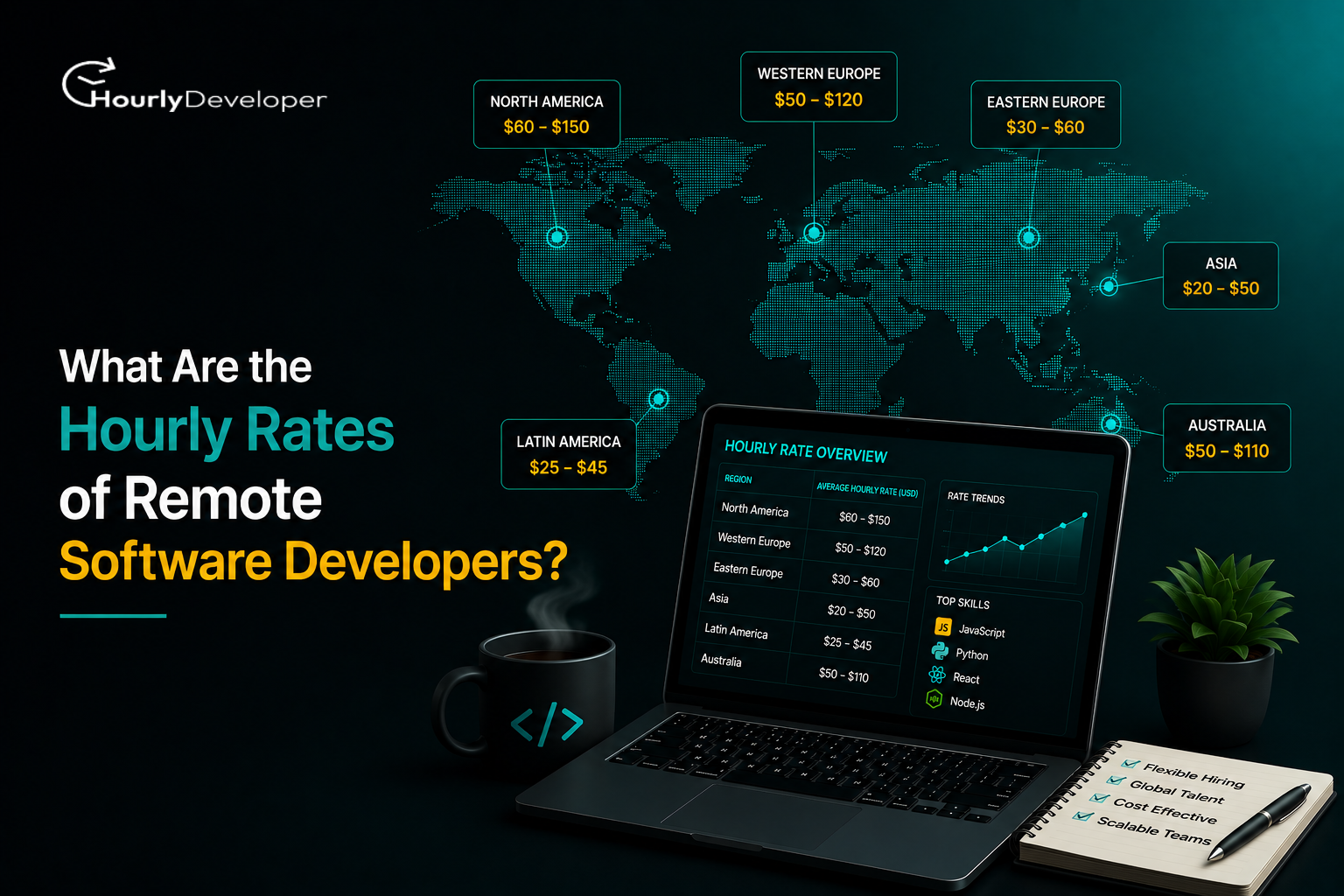
What Are the Hourly Rates of Remote Software Developers?
Introduction
What Are the Hourly Rates of Remote Software Developers?
1.What Are the Hourly Rates of Remote Software Developers?
Here is a number that surprises almost every founder the first time they hear it. The exact same task, building a clean REST API with proper authentication, can cost $12/hr or $150/hr depending on which city the developer happens to be sitting in. Same skill. Same output. Same deadline. The only variable is geography, and that single variable is responsible for one of the biggest line items in any software budget.
We have been tracking remote software developer hourly rates for clients across three continents, and the pattern that keeps showing up is not what most rate guides tell you. It is not simply that India is cheap and the US is expensive. In 2026, the gap between a junior developer in Manila and a senior architect in Warsaw can be wider than the gap between Warsaw and San Francisco. Rates have started splitting along a new axis entirely, how well a developer works with AI assisted coding tools, on top of the older axis of geography and experience.
This blog walks through what you will actually pay in 2026, country by country, with real numbers instead of vague ranges pulled from a single freelancing platform. If you are trying to decide whether to hire dedicated developers from India, Eastern Europe, Latin America, or closer to home, you will find the comparisons, the trade offs, and the quiet details that most pricing guides leave out, like why a thirty dollar an hour developer sometimes costs more than a fifty dollar an hour one once you add up the full picture.
2.Why Remote Software Developer Hourly Rates Vary So Much
Four things decide what you pay, and they rarely move in the same direction at once.
The first is plain economics. A developer in Buenos Aires or Bengaluru is not earning less because they know less, they are earning less because rent, healthcare, and daily expenses cost less where they live.
The second is experience and specialization. A generalist who builds simple CRUD apps will always charge less than someone who has spent five years shipping production grade AI pipelines or fintech systems that need to pass a compliance audit.
The third factor is the engagement model. Hiring through a staffing agency, working with a freelancer directly, or going through a dedicated development company all carry different overheads, and that overhead shows up in the final rate even when the developer doing the actual coding earns the same paycheck.
The fourth factor, and the one nobody was talking about two years ago, is AI fluency. Developers who use coding assistants well are shipping thirty to forty percent more output per hour in 2026, and clients are increasingly willing to pay a premium for that speed rather than hiring two slower developers to match it.
1. United States
The United States remains the most expensive place to hire a software developer, and also the place with the deepest concentration of senior talent working on cutting edge products. If your project needs someone who has already solved the exact problem you are facing, US talent is hard to beat, but you will pay for that certainty.
Why Hire Developers From United States
Direct access to engineers who have built and scaled products at companies most of the tech world already trusts
Zero time zone friction for teams based anywhere in North America
Strong familiarity with US data privacy, compliance, and enterprise procurement requirements
Easiest market for face to face meetings, conferences, and in person onboarding when needed
Key Advantages
Exceptional depth in emerging fields like AI infrastructure and large scale distributed systems
Native level business English and cultural alignment with US stakeholders
Strong legal protections and straightforward contract enforcement
Key Disadvantages
By far the highest hourly cost of any region covered in this blog
Talent shortages in specific niches push wait times up, sometimes six to eight weeks for a strong senior hire
Smaller cost advantage even when working with contractors compared to full time hires
Average Hiring Costs and Pricing Considerations
Junior developers typically bill between twenty eight and forty five dollars an hour when working through vetted remote platforms, though local junior salaries converted to hourly rates can run higher in major metros. Mid level developers fall in the fifty five to eighty dollar range, and senior engineers commonly charge between eighty and one hundred eighty dollars an hour, with specialists in AI, machine learning, and security sometimes exceeding two hundred dollars an hour at the top end.
Talent Pool and Technical Expertise
The US produces a steady stream of computer science graduates each year, but demand for senior engineers, especially those with applied AI experience, continues to outpace supply. This is part of why so many US companies now blend a small core team of US based architects with offshore or nearshore developers handling implementation work.
Time Zone and Communication Factors
No time zone factor at all for companies based in the US, which makes daily standups, pair programming, and live debugging sessions effortless. This convenience is one of the strongest, and most underrated, reasons companies still pay a premium for local talent on time sensitive projects.
United States at a Glance
Average Hourly Rate
$28 to $200+
Best For
Senior architecture, AI and ML specialists, compliance heavy projects
Time Zone Overlap
Full overlap for US based teams
English Proficiency
Native
Key Advantage
Deepest senior talent pool, zero communication lag
Key Drawback
Highest cost in the global market
2. India
India has spent over two decades building the largest English speaking technology workforce in the world, and in 2026 it remains the single most popular destination for companies that want to Hire Remote Developers India wide for cost efficient, scalable teams. This is not just about cheap labor anymore, it is about genuine depth across nearly every modern stack.
Why Hire Developers From India
One of the largest pools of computer science and engineering graduates produced anywhere each year
Mature outsourcing ecosystem with companies experienced in working under US and European time zones
Strong coverage across web, mobile, cloud, and increasingly AI and machine learning roles
Flexible engagement models, from individual freelancers to fully managed dedicated teams
Key Advantages
Some of the lowest remote software development costs relative to skill level anywhere in the world
Massive scalability, companies can go from two developers to twenty without searching for months
Wide availability of niche skills including Java, Python, React, DevOps, and AI integration
Established legal and IT services framework that makes contracting straightforward
Key Disadvantages
Quality varies sharply between top tier firms and lower cost vendors, so vetting matters more here than almost anywhere else
Limited live overlap with US Pacific or Eastern time unless the team adjusts shift hours
Communication style can require an adjustment period for teams used to a more direct Western feedback culture
Average Hiring Costs and Pricing Considerations
This is where the numbers genuinely shift the budgeting conversation. Average hourly rates of remote software developers in India in 2026 range from around twelve to fifteen dollars an hour for entry level contract roles up to sixty five dollars or more for senior architects at premium firms. Mid level developers with three to five years of experience typically bill between twenty two and forty dollars an hour. Remote full stack developer rates in India commonly land between twenty five and sixty dollars an hour depending on the framework, with React, Node.js, and cloud native skills sitting toward the higher end of that band.
Talent Pool and Technical Expertise
India’s talent depth goes well beyond junior generalists now. There is a fast growing supply of engineers with hands on AI integration experience, cloud architecture certifications, and fintech specific knowledge covering payment systems and regulatory compliance, all of which command a thirty to fifty percent premium above standard rates.
Time Zone and Communication Factors
India sits roughly nine and a half to thirteen hours ahead of US time zones, so real time overlap is limited to a small evening window for Indian teams and early morning for US teams. Most teams solve this with async workflows, detailed documentation, and a short daily overlap call, which works well once the rhythm is established.
India at a Glance
Average Hourly Rate
$12 to $65
Best For
Scalable teams, cost efficient full stack and mobile development
Time Zone Overlap
Limited, 1 to 3 hours typical with US
English Proficiency
Strong, widely business fluent
Key Advantage
Best balance of cost, scale, and skill depth
Key Drawback
Vetting quality requires extra diligence
3. Ukraine
Ukraine continues to be one of the most respected engineering hubs in Eastern Europe, known for strong computer science education and a deep bench of mid to senior developers comfortable working with Western European and US clients. Despite ongoing regional challenges, the country’s tech sector has shown remarkable resilience, with the large majority of contracts staying intact and delivery timelines holding steady.
Why Hire Developers From Ukraine
Rigorous engineering education that produces developers comfortable with complex system design
Long history of serving Western European and US clients, so cultural and communication friction is low
Strong representation in product focused roles, not just outsourced implementation work
Resilient delivery record even through difficult conditions, supported by distributed infrastructure
Key Advantages
High technical quality at a noticeably lower cost than Western Europe
Good overlap with European working hours, partial overlap with US East Coast mornings
Strong fluency in modern frameworks and a growing presence in AI and cloud roles
Key Disadvantages
Some clients apply a small risk premium given regional instability, even though delivery has stayed stable
Talent pool is smaller than India’s, so very large team scale ups can take longer to staff
Power and connectivity disruptions, while rare now thanks to backup infrastructure, are a factor some risk averse clients still weigh
Average Hiring Costs and Pricing Considerations
Junior developers in Ukraine generally start around twenty to thirty five dollars an hour. Mid level engineers fall between thirty five and fifty five dollars an hour, and senior developers typically charge fifty five to eighty dollars an hour, with specialized cloud or machine learning engineers reaching seventy five to one hundred dollars an hour. These remote software development costs sit comfortably below Western Europe while staying close in technical depth.
Talent Pool and Technical Expertise
There are still hundreds of thousands of active IT professionals in the country, with strong concentrations in Kyiv, Lviv, and Kharkiv. The market skews toward mid and senior level talent rather than a large junior pool, which suits companies who want experienced hands rather than developers who need heavy mentoring.
Time Zone and Communication Factors
Ukraine sits in Eastern European time, giving a comfortable full day overlap with the UK and most of continental Europe, and roughly four to five hours of overlap with the US East Coast in the morning. This makes it a strong fit for European companies and a workable option for US teams willing to shift meetings slightly earlier.
Ukraine at a Glance
Average Hourly Rate
$20 to $100
Best For
Mid to senior engineering, European focused teams
Time Zone Overlap
Full overlap with Europe, partial with US East Coast
English Proficiency
Strong, especially among mid and senior developers
Key Advantage
High technical quality with strong resilience track record
Key Drawback
Smaller talent pool than South Asian markets for rapid scaling
4. Poland
Poland has quietly become the premium choice within Eastern Europe, commanding slightly higher rates than its neighbors while delivering some of the most consistent quality on the continent. Its membership in the European Union adds a layer of legal and data protection comfort that matters a great deal to clients in regulated industries.
Why Hire Developers From Poland
EU membership simplifies contracts, data protection compliance, and tax handling for European clients
Exceptionally high density of trained software engineers relative to population size
Strong presence in fintech, enterprise software, and increasingly AI driven products
Excellent track record working with large Western European and US enterprises
Key Advantages
Among the most reliable delivery quality in the offshore and nearshore market
Comfortable full day overlap with the rest of Europe and a workable morning overlap with the US
Deep specialist availability in niche areas like blockchain, embedded systems, and cloud architecture
Key Disadvantages
The highest rates within Eastern Europe, eroding some of the typical offshore cost advantage
High local demand means top developers are often already committed to long term contracts
Less of a cost gap compared to the US than many companies expect going in
Average Hiring Costs and Pricing Considerations
Entry level Polish developers typically start around forty dollars an hour. Senior developers commonly charge fifty five to seventy five dollars an hour, and in major hubs like Warsaw, rates for top tier senior talent have climbed to the fifty five to seventy five dollar range and beyond for specialized roles. This places Poland firmly in the mid to upper tier of remote software development costs globally, just below Western Europe proper.
Talent Pool and Technical Expertise
Poland produces tens of thousands of IT graduates every year, and its developer community is known for strong fundamentals in computer science theory paired with hands on enterprise experience. Warsaw and Krakow are the two dominant hubs, both home to a healthy mix of startups and large enterprise delivery centers.
Time Zone and Communication Factors
Poland operates on Central European time, giving full overlap with the rest of the EU and roughly five to six hours of overlap with the US East Coast during the morning. For European companies this is essentially a same time zone experience.
Poland at a Glance
Average Hourly Rate
$40 to $75+
Best For
Enterprise grade projects, EU compliance sensitive work
Time Zone Overlap
Full overlap with Europe, morning overlap with US
English Proficiency
Strong, widely fluent in business contexts
Key Advantage
EU level reliability and legal clarity
Key Drawback
Premium pricing within the Eastern European market
5. Brazil
Brazil anchors the Latin American nearshore market with the largest developer population in the region and a tech scene that has matured rapidly across fintech, online retail, and mobile engineering. For US companies wanting daytime overlap without European level pricing, Brazil sits right in the sweet spot.
Why Hire Developers From Brazil
Largest software developer population in Latin America, giving genuine scale options
Strong specialization in fintech and online retail platforms, two of the most in demand build categories right now
Comfortable time overlap with US business hours throughout most of the day
Growing AI and data engineering talent base in major cities
Key Advantages
Real time collaboration with US teams without the late night or early morning calls that Asia based hiring requires
Solid mix of startup energy and enterprise grade delivery experience
Cultural affinity with North American business norms, built over years of nearshore partnerships
Key Disadvantages
Costs have risen noticeably over the past two years, narrowing the gap with parts of Eastern Europe
Currency volatility can occasionally affect long term fixed price contracts
Senior talent in São Paulo and Rio gets pulled toward well funded domestic startups, creating retention competition
Average Hiring Costs and Pricing Considerations
Junior developers in Brazil generally earn between twenty and twenty eight dollars an hour. Mid level professionals fall in the twenty eight to thirty five dollar range, and senior developers command forty to sixty dollars an hour, occasionally reaching higher for specialized cloud or AI roles. This makes Brazil a strong middle ground between South Asian affordability and Eastern European or US pricing.
Talent Pool and Technical Expertise
Talent concentrates heavily in São Paulo, Rio de Janeiro, and Curitiba, with both frontend and backend expertise well represented. A meaningful share of Brazilian engineers hold formal degrees in computer science or related engineering fields, supporting consistent baseline quality across the market.
Time Zone and Communication Factors
Brazil sits one to two hours ahead of US Eastern time for most of the year, making it one of the easiest international markets for live daily collaboration with North American teams. Meetings rarely require either side to take an inconvenient call time.
Brazil at a Glance
Average Hourly Rate
$20 to $60
Best For
Fintech, online retail, real time collaboration with US teams
Time Zone Overlap
Near full overlap with US Eastern time
English Proficiency
Good, strongest among senior and mid level talent
Key Advantage
Largest LATAM talent pool with strong US time alignment
Key Drawback
Rising rates and growing domestic competition for senior talent
6. Mexico
Mexico has become the default nearshore choice for companies on the US West Coast and in Central time zones, combining a deep talent base with the tightest possible time alignment to US business hours. It sits at what many hiring teams now call the cost to quality midpoint of the global market.
Why Hire Developers From Mexico
Closest practical time zone alignment to the US among all major nearshore and offshore markets
Rapidly growing specialization in AI, Python, and data engineering roles
Established outsourcing infrastructure across Mexico City, Guadalajara, and Monterrey
Increasing number of US companies opening dedicated nearshore engineering hubs in country
Key Advantages
Virtually zero time zone friction for teams based in Texas, California, or the Central US
Strong specialization premium available for AI and data roles without paying full US rates
Easy travel access for in person workshops or kickoff meetings when needed
Key Disadvantages
Mid tier commodity skills like standard frontend work have largely plateaued in price, less room for negotiation there
Top senior talent in Mexico City and Guadalajara is increasingly competitive to land due to high local and remote US demand
Slightly smaller overall talent pool than Brazil or India for very large team builds
Average Hiring Costs and Pricing Considerations
Junior developers in Mexico typically charge between twenty and thirty five dollars an hour. Mid level engineers fall in the twenty six to forty five dollar range, and senior developers commonly bill thirty three to fifty dollars an hour, with strong seniors in AI, Python, or data engineering clearing higher than that average. Mexico City and Guadalajara post the highest local rates, while Monterrey and Queretaro typically run ten to fifteen percent below them.
Talent Pool and Technical Expertise
The market has shifted noticeably toward AI, Python, and Node.js backend specialization in 2026, while standard full stack and frontend rates have stayed comparatively flat. This means companies hiring for commodity skills get excellent value, while those hiring for AI specialization should expect rates trending upward.
Time Zone and Communication Factors
Mexico operates across Central and Pacific time zones that align almost perfectly with major US business hubs, making it arguably the easiest country on this list for daily standups, pair programming, and live problem solving with a US based team.
Mexico at a Glance
Average Hourly Rate
$20 to $65+
Best For
AI, Python, and data engineering with full US time overlap
Time Zone Overlap
Near identical to US Central and Pacific time
English Proficiency
Strong in major tech hubs
Key Advantage
Best in class time zone alignment with the US
Key Drawback
Senior AI talent is increasingly competitive to secure
7. Argentina
Argentina rounds out the strongest tier of the Latin American market, prized for its engineering education and a developer culture that leans heavily into modern frameworks and clean architecture practices. It is frequently the most budget friendly of the major LATAM markets without sacrificing much on quality.
Why Hire Developers From Argentina
Strong engineering education system producing well rounded, framework fluent developers
Generally the most cost competitive option among the larger Latin American markets
Established remote work culture, with a large share of the workforce already used to distributed teams
Good representation in React, Node.js, and modern JavaScript heavy stacks
Key Advantages
Attractive pricing relative to Brazil and Mexico at a similar quality level
Reasonable overlap with US Eastern time for most of the working day
Active developer community contributing to open source and modern tooling adoption
Key Disadvantages
Currency instability has historically made long term local contract pricing harder to predict, though USD denominated remote contracts avoid most of this
Smaller total talent pool than Brazil, so very large hiring sprints can take longer
Occasional broader economic disruptions can affect local infrastructure and banking timelines
Average Hiring Costs and Pricing Considerations
Junior developers in Argentina typically start around twenty five to thirty dollars an hour. Mid level developers fall in the thirty five to fifty five dollar range, and senior developers usually charge between forty five and seventy dollars an hour for strong, production tested experience. These rates make Argentina one of the more approachable entry points into nearshore hiring for companies just starting to explore options beyond domestic talent.
Talent Pool and Technical Expertise
Buenos Aires and Cordoba are the two leading hubs, both known for strong computer science programs and a healthy pipeline of engineers comfortable working directly with international product teams rather than purely as implementation resources.
Time Zone and Communication Factors
Argentina sits roughly two hours ahead of US Eastern time for most of the year, preserving a comfortable working day overlap that supports live meetings, demos, and pair programming sessions without major schedule gymnastics on either side.
Argentina at a Glance
Average Hourly Rate
$25 to $70
Best For
Cost conscious nearshore hiring with strong framework skills
Time Zone Overlap
Strong overlap with US Eastern time
English Proficiency
Good, particularly in tech hub cities
Key Advantage
Most budget friendly of the major LATAM markets
Key Drawback
Currency related volatility for non USD local arrangements
8. Philippines and Vietnam
Grouping these two together makes sense because companies usually compare them directly when evaluating Southeast Asia. The Philippines leans on its long history of English language business process work, while Vietnam has built a strong reputation specifically around software quality and reliable delivery, especially for Japanese and broader Asia Pacific clients.
Why Hire Developers From Philippines and Vietnam
Some of the most affordable rates available anywhere while still maintaining solid mid level technical competence
The Philippines offers the strongest English fluency in Southeast Asia along with workable US time overlap
Vietnam has built a strong track record in outsourced software quality, particularly for Japanese and regional clients
Both markets offer significant cost savings compared to nearly every other region covered here
Key Advantages
Extremely competitive entry and mid level rates, ideal for budget constrained projects or large scale staff augmentation
Mature business process and call center heritage in the Philippines translates into strong written and spoken English
Vietnam’s growing AI and data talent base is expanding quickly, with rising interest from international firms
Key Disadvantages
Senior level depth is thinner here than in India, Eastern Europe, or Latin America, especially for highly specialized roles
Time zone overlap with the US is minimal, requiring async heavy workflows or a willingness to shift hours
Quality varies more between vendors, so reference checks and trial projects matter more here than in more mature markets
Average Hiring Costs and Pricing Considerations
In the Philippines, developers typically earn between eighteen and fifty five dollars an hour, with mid level developers clustering tightly in the twenty two to twenty seven dollar range and seniors stretching from thirty to forty dollars, occasionally reaching higher for AI or modern JavaScript specialists. In Vietnam, rates generally run from ten to forty five dollars an hour, with an overall average closer to twenty dollars, and full stack contract rates commonly falling between twenty two and fifty dollars an hour depending on experience.
Talent Pool and Technical Expertise
Manila and Cebu dominate supply in the Philippines, while Ho Chi Minh City and Hanoi anchor Vietnam’s developer population. Both countries are investing heavily in STEM education, and demand for AI and machine learning skills is rising quickly in both markets, even though senior specialist availability still trails larger regions.
Time Zone and Communication Factors
Both countries sit roughly twelve to fifteen hours ahead of US time zones, leaving little to no live overlap during standard US working hours. Teams that succeed here typically lean on strong documentation, asynchronous updates, and a short overlap window early in the US morning or late in the Southeast Asian evening.
Philippines and Vietnam at a Glance
Average Hourly Rate
$10 to $55
Best For
Budget efficient staff augmentation and high volume implementation work
Time Zone Overlap
Minimal, async workflows recommended
English Proficiency
Strong in the Philippines, improving steadily in Vietnam
Key Advantage
Among the lowest remote software development costs globally
Key Drawback
Thinner senior and specialist talent depth
3.Remote Software Developer Hourly Rates by Country: The Bigger Picture
Lay all eight markets side by side and a clear pattern emerges. Remote software developer hourly rates by country are not just about cheap versus expensive, they reflect a genuine trade off between cost, time zone convenience, and depth of senior talent. The United States sits at one end with unmatched seniority and zero time zone friction at the highest price. India, the Philippines, and Vietnam sit at the other end with the strongest cost advantage but a need for more deliberate vetting and async workflows. Eastern Europe and Latin America occupy the middle ground, each trading a bit of cost savings for stronger overlap with European or US working hours.
There is no universally correct answer here, only the right answer for your specific project, budget, and how much live collaboration your team actually needs versus how much can comfortably happen asynchronously.
4.How to Hire Dedicated Developers Without Overpaying
Once you know the going rate in a given country, the next challenge is making sure you actually pay a fair price for the skill level you need, instead of overpaying for a generalist or underpaying for someone who cannot handle the complexity of your project.
Start by separating your project into pieces that genuinely need senior judgment, like architecture decisions and security sensitive work, from pieces that a capable mid level developer can execute well under light supervision. Most teams overspend by hiring senior level talent for the entire scope when only twenty to thirty percent of the work actually requires that level of experience.
When you decide to hire dedicated developers for an ongoing engagement rather than a single project, ask specifically how the vendor handles ramp up time, replacement guarantees, and intellectual property assignment. These details rarely show up in the advertised hourly rate, but they directly affect your total remote software development costs over a six month or one year engagement. A slightly higher rate that includes a fast replacement guarantee and clear IP terms is often cheaper in the long run than a lower rate with neither.
Finally, treat dedicated remote developers as a long term relationship rather than a transactional hire whenever your project has any real complexity. Developers who stick around for a year or more build context about your codebase and your users that no amount of documentation fully replaces, and that accumulated context is worth paying a small premium to protect.
5.Final Thoughts
If there is one thing worth remembering after all these numbers, it is this. The cheapest hourly rate and the cheapest total project cost are almost never the same thing. A thirty dollar an hour developer who needs constant guidance, misses deadlines, or leaves after four months can end up costing far more than a fifty dollar an hour developer who ships clean, well documented code on the first attempt.
Average hourly rates of remote software developers in 2026 give you a useful starting map, not a final decision. Use the country breakdowns above to shortlist two or three regions that fit your budget and your time zone tolerance, then spend real time vetting the specific people or team you are about to bring on, because that is where the actual value gets decided. Whether you land on a fast scaling team out of India, a senior architect in Poland, or a nearshore squad in Mexico, the goal is the same, pay a fair rate for real, verifiable skill, and build the kind of long term working relationship that makes the hourly number almost beside the point a year from now.
With a love for connecting with people and a flair for communication, Prachi's expertise in digital marketing is unmatched. Her strategic approach to campaigns ensures our brand's story reaches far and wide, making an impact on the lives of countless individuals.
Frequently Asked Questions
Usually not when hiring through a freelance platform or direct contractor agreement, since the quoted rate covers labor only. However, agencies and dedicated development companies often build payroll taxes, insurance, and admin overhead into their hourly rate, so always ask whether the number you are seeing is fully loaded or just base pay before comparing two quotes.
Full time hires typically work out twenty to thirty five percent cheaper per hour than the same skill level hired hourly, since hourly arrangements carry a flexibility premium. The trade off is commitment, hourly hiring lets you scale up or down within days, while full time hiring usually involves notice periods and a longer offboarding process if priorities shift.
Yes, especially for longer engagements. Vendors and freelancers commonly offer five to fifteen percent discounts for contracts running six months or longer, paid in advance, or covering a guaranteed minimum number of hours per week. Rates for short, urgent, one off tasks are almost never negotiable since they carry their own overhead for the developer.
Developers fluent in AI assisted coding tools are measurably shipping more output per hour, so clients increasingly pay more per hour for fewer total hours rather than hiring additional developers to match that output. This premium currently runs fifteen to fifty percent above standard rates depending on region and how specialized the AI work actually is.
It depends entirely on the task. For architecture, security, or performance critical work, one senior developer almost always finishes faster and with fewer costly mistakes, making them the better value despite the higher rate. For high volume, well defined tasks like building out repetitive UI components, two mid level developers often deliver more total throughput for the same combined budge.
Find exceptional developers at Hourlydeveloper. Get the expertise, solutions, and teamwork you need for success. Hire developers easily and boost your projects today!
 Back to Blog