7.The Honest Truth About Hiring Models in 2026
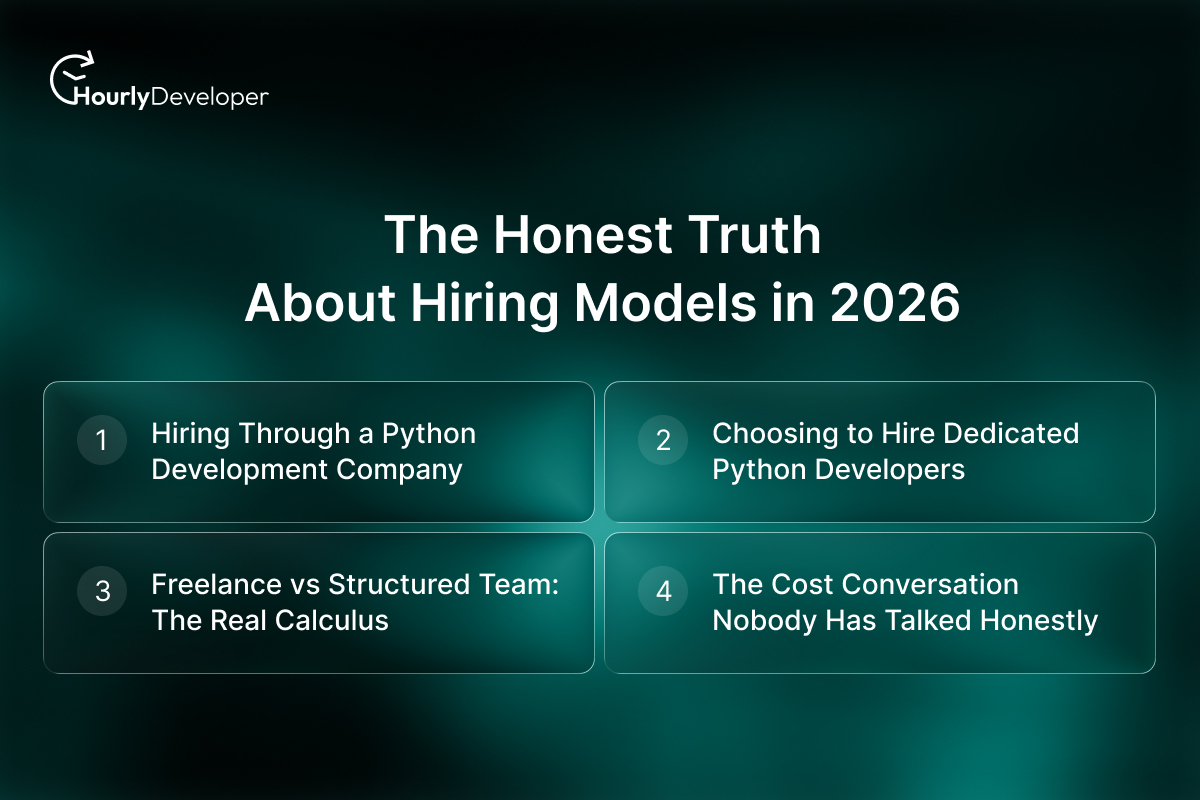
There are three main ways to bring Python talent into your project, and none of them is universally right. The “best” model depends on factors most blogs gloss over: your timeline, how defined your requirements are, how much technical oversight you have in-house, and honestly, how much organizational patience you have for managing distributed teams.
Hiring Through a Python Development Company
Working with an established Python development company gives you a team, not just a person. The major advantage is that you get combined experience, someone to cover for individual absences, and usually a more defined process around code review, testing, and delivery. The hidden cost that few people talk about is management overhead on the vendor side. You are paying for the team’s coordination time, not just coding time. This is worth it when your requirements are complex and evolving. It is not great value when you need something narrow and well-defined.
The best Python development company for your project is not necessarily the largest or the most decorated. It is the one whose past work most closely resembles what you are trying to build. A firm that has spent five years building logistics optimization backends has fundamentally different intuitions than one that specialized in SaaS subscription platforms, even if both are technically proficient.
Choosing to Hire Dedicated Python Developers
When you hire dedicated Python developers, you are effectively adding people to your team. They work exclusively on your project, learn your codebase, and develop context that a rotating project team never builds. For products that are going to run for years, this model often ends up being more cost-effective than it looks on paper, because the ramp-up cost amortizes over a longer engagement.
The risk here is that you need enough work to keep dedicated people genuinely engaged. A developer who sits idle or context-switches to fill time is going to produce mediocre work. Be honest with yourself about your project pipeline before going this route.
9.The Cost Conversation Nobody Has Talked Honestly
Most blogs on this topic give you a rate table. “Junior developer: $50 to $80 per hour. Senior developer: $100 to $150 per hour.” This is technically not wrong, but it tells you almost nothing useful. Here is the framing that actually helps.
The cheapest developer is rarely the cheapest outcome. This is not a platitude. It is an observation from how technical debt actually accumulates. A senior Python developer who writes clean, well-tested, well-documented code at $130 per hour will almost always cost you less over 18 months than a junior developer at $55 per hour who ships fast but leaves behind a system that requires constant firefighting. The junior developer’s code compiles. It often even works. But it will not scale, it will be brittle in unexpected ways, and the next person to touch it will spend 40% of their time deciphering it.
The meaningful cost comparison is not hourly rate. It is the total cost per working feature over the lifetime of your product. And when you frame it that way, the calculus shifts. When you hire Python developers with genuine seniority, the time they save you in architecture decisions alone often pays for the rate premium in the first month.
Location matters, but not always in the direction people assume. USA-based expert Python developers for hire typically command higher rates, and for good reasons beyond just market wages: timezone alignment, communication fluency, and shared professional norms around things like code documentation and testing culture. If your team is distributed across time zones anyway, a US-based developer may not give you the collaboration advantages that justify the premium. If your team is synchronous and US-based, the coordination benefits can be very real.
One more cost factor that almost nobody mentions: the cost of a bad hire is not just the salary you paid them. It is the code they wrote that now lives in your system, the decisions they made that your next team inherits, and the time your engineers spend reviewing and unwinding their contributions. Budget for this reality when you are making hiring decisions.
10.Top 45 Python Development Companies in USA You Should Know About in 2026
Finding the right partner starts with knowing who is actually worth your time. Here is a curated list of companies that have earned a genuine reputation in the Python development space, each with a brief snapshot of what makes them notable.
1. HourlyDeveloper
HourlyDeveloper stands out for its transparent, flexible engagement model that lets businesses hire Python developers on hourly, part-time, or full-time terms without long-term lock-ins. They are particularly well-regarded for matching clients with pre-vetted senior developers who can integrate into existing teams quickly. Their process-first approach means you spend less time onboarding and more time shipping.
2. HireFullStackDeveloperIndia
HireFullStackDeveloperIndia brings strong Python backend expertise combined with full-stack delivery capability, making them a practical choice for businesses that need end-to-end product development rather than isolated backend work. Their talent pool covers Django, FastAPI, and REST API development with solid experience in cloud deployment. They are known for competitive rates without compromising on communication standards.
3. Webclues Infotech
Webclues Infotech has built a consistent reputation for delivering Python-powered web and enterprise applications with a strong emphasis on scalable architecture. Their team has experience across both Django and FastAPI ecosystems and has handled complex integrations involving third-party APIs, payment systems, and data-heavy backends. Clients frequently cite their structured project management as a standout quality.
4. HireAIDevelopers
HireAIDevelopers sits at the intersection of Python development and artificial intelligence, making them a strong fit for businesses building AI-integrated backends, ML pipelines, or LLM-powered features. Their developers have real production experience with tools like LangChain, OpenAI APIs, and vector databases alongside traditional Python backend work. If AI is central to your product roadmap in 2026, they deserve serious consideration.
5. Toptal
Toptal maintains one of the most rigorous developer screening processes in the industry, accepting only a small fraction of applicants. For businesses that need proven senior Python talent quickly and cannot afford a lengthy vetting process, their network offers a reliable shortcut. Rates are premium, but the quality floor is consistently high.
6. Andela
Andela has evolved into a serious global tech talent platform with a strong pool of Python developers across backend and data engineering disciplines. Their matching process has improved substantially and they now serve companies ranging from early-stage startups to large enterprises looking for reliable distributed team members.
7. Intellectsoft
Intellectsoft brings deep enterprise software experience to Python development with a track record across healthcare, fintech, and logistics verticals. Their developers are strong on backend architecture and API design, and the company has a structured delivery process that suits clients who need predictability alongside technical quality.
8. Turing
Turing uses an AI-driven vetting system to source and match Python developers from a global talent pool. Their model works particularly well for companies that want remote developers who have been pre-tested on practical coding challenges rather than just credentials. Time-to-hire is faster than most traditional staffing approaches.
9. Itera
Itera is a Nordic-rooted software company with strong Python delivery capabilities, particularly for clients in regulated industries. They bring solid engineering discipline, a consultative approach to requirements, and a reputation for honest scoping conversations before a project begins.
10. Lemon.io
Lemon.io focuses specifically on vetting and placing freelance developers for startups with a strong contingent of Python backend talent. Their process is faster than traditional agencies and the quality bar is meaningfully higher than unvetted freelance platforms. A practical option for early-stage companies that need reliable senior help without agency overhead.
11. Iflexion
Iflexion offers Python development as part of a broad software engineering practice with notable strength in enterprise application development and custom backend systems. Their teams are experienced with Django and have delivered complex projects in the retail, real estate, and professional services sectors.
12. DataArt
DataArt is a global technology consultancy with deep Python expertise in data engineering, analytics platforms, and financial systems. They are particularly strong when projects require both Python development skill and domain knowledge in regulated industries like healthcare or capital markets.
13. Softura
Softura brings a Michigan-based US presence combined with offshore delivery capability, giving clients the accessibility of a domestic partner with cost-competitive execution. Their Python work spans web application backends, API development, and integration projects with established enterprise systems.
14. Trigent Software
Trigent Software has over two decades of software delivery experience and a Python practice that covers both web development and data science applications. They work well with mid-sized businesses that need a dependable delivery partner rather than a cutting-edge experimental team.
15. Simform
Simform is a product-focused development company with strong Python backend capabilities and a clear process orientation. They are known for detailed discovery phases that reduce mid-project scope surprises and have delivered high-traffic Python applications for clients across the US market.
16. Saritasa
Saritasa is a US-based development firm with in-house Python talent and a reputation for direct, honest client communication. They handle projects from architecture to deployment and have a strong track record with startups and growth-stage companies that need a reliable technical partner to move fast without cutting corners.
17. Zibtek
Zibtek operates a distributed development model with Python expertise across backend development and API design. They are known for transparent pricing, predictable timelines, and a dedicated team model that suits businesses wanting consistent developers rather than rotating project staff.
18. Brainhub
Brainhub is a European software company with strong Python delivery capability and a particularly good track record in building scalable SaaS backends. Their engineering culture emphasizes code quality and they publish technical content that gives you a genuine sense of how their developers think before you engage them.
19. Relevant Software
Relevant Software has built a solid reputation for Python development with a focus on long-term product partnerships rather than project-by-project engagements. Their developers have experience with complex data-driven applications and they bring genuine architecture thinking to the projects they take on.
20. Sloboda Studio
Sloboda Studio is a strong option for startups building Python-backed products who need experienced developers without the overhead of a large agency. They have a focused team, fast communication, and a portfolio that demonstrates real product thinking alongside technical execution.
21. Cleveroad
Cleveroad brings Python development experience across healthcare, logistics, and e-commerce verticals with a process that puts requirements documentation and system design ahead of coding. Their structured approach means fewer surprises during delivery and cleaner handoffs at the end of an engagement.
22. Django Stars
Django Stars has deep specialization in the Django ecosystem and has delivered Python-powered products for some notable clients including Depositphotos and SABO. Their technical depth in Django is genuinely above average and they are a strong fit when that framework aligns with your architecture needs.
23. Steelkiwi
Steelkiwi has over a decade of Python development experience and a portfolio that spans SaaS platforms, marketplace applications, and custom enterprise tools. They work well with businesses that want a stable, experienced team without the volatility of a newer agency.
24. Apptension
Apptension is a Polish software company with a strong Python practice and a notable track record in the startup ecosystem. They built backend systems for clients like Streamyard and are experienced with the specific performance and scalability demands that come with rapidly growing user bases.
25. STX Next
STX Next is one of the largest Python-focused software houses in Europe with over 400 developers. Their scale means they can staff larger projects while maintaining Python specialization and they publish Python developer surveys annually that offer genuinely useful ecosystem insights.
26. Netguru
Netguru is a well-established product development company with Python capabilities across backend development and API design. They have worked with clients ranging from early-stage startups to enterprise brands and bring a consultative product mindset that goes beyond pure code delivery.
27. Ideamotive
Ideamotive operates as a talent network with a curated pool of Python developers available for both short-term and long-term engagements. Their vetting process emphasizes practical skills over certificates and they have a fast matching process that suits companies with urgent talent needs.
28. Miquido
Miquido brings Python backend experience to mobile-first products and digital platforms with a reputation for clean API design and solid integration work. They are based in Krakow with a strong track record working with Western European and US clients across fintech and healthtech products.
29. Azumo
Azumo is a nearshore software company with US-based management and Latin American development teams, offering Python development at a rate point that bridges the gap between domestic and fully offshore options. Their timezone alignment with US clients is a genuine operational advantage over teams based in Asia or Eastern Europe.
30. Rootstrap
Rootstrap has worked with clients including the BBC and major entertainment brands, bringing Python and full-stack development experience to high-profile digital products. Their team operates across the Americas with strong product strategy capabilities alongside technical delivery.
31. Moove-it
Moove-it is a Uruguay-based software company with a strong Python practice and US-friendly timezone coverage. They bring solid agile delivery discipline and have experience building high-traffic web applications and data-intensive backends for clients across North and South America.
32. Vention
Vention offers flexible Python development team augmentation and project delivery with a talent pool spanning over 30 countries. They have a particularly smooth onboarding process and are a good fit for engineering teams that need to scale quickly without sacrificing code quality standards.
33. Coherent Solutions
Coherent Solutions brings Python development expertise to enterprise software projects with a particular strength in data engineering and system integration work. Their US and European offices give them a hybrid model that balances cost efficiency with accessible client management.
34. Devtechnosys
Devtechnosys covers Python development across web applications, API backends, and mobile-integrated services. They serve a global client base with competitive rates and have particular experience in e-commerce and on-demand platform development using Python stacks.
35. Konstant Infosolutions
Konstant Infosolutions has been in the software delivery market for over two decades with Python development experience spanning fintech, healthcare, and enterprise SaaS. Their longevity in the market reflects consistent delivery standards and a client retention rate that speaks to genuine satisfaction.
36. Appinventiv
Appinventiv is a large-scale technology company that includes Python development within a broad service portfolio covering mobile, web, and AI-powered applications. Their size enables them to staff larger projects and they have delivered Python-backed systems for enterprise clients in logistics, retail, and finance.
37. Oxagile
Oxagile has a strong Python presence in video technology and media platform development, an area that demands serious performance optimization and streaming architecture knowledge. If your Python backend needs to handle media processing or real-time streaming at scale, their vertical expertise is genuinely relevant.
38. Inoxoft
Inoxoft delivers Python development services with notable specialization in healthcare and life sciences software. Their developers understand the compliance and data handling requirements specific to regulated industries, making them a more informed choice than generalist firms when those constraints apply.
39. Svitla Systems
Svitla Systems provides Python development through a team augmentation model with US-based management and Eastern European delivery teams. Their process is mature, their communication standards are high, and they have a solid track record with clients in the technology, media, and financial services sectors.
40. ScienceSoft
ScienceSoft brings Python development into data analytics, machine learning, and enterprise application contexts with genuine depth in each area. Their team has over 30 years of software development history and their Python practice reflects the accumulated experience of working through multiple technology cycles.
41. Existek
Existek is a software development company with a strong Python practice and a reputation for clean code and responsive communication. They work across web backend development and API-first applications with a team that has grown steadily while maintaining the direct client relationships of a smaller firm.
42. Codewave
Codewave blends Python development with design thinking principles, making them a good fit for product teams that want their backend developers to understand user experience implications of technical decisions. Their work skews toward digital product companies building for end users rather than internal tools.
43. TechAhead
TechAhead is a US-based technology company with Python development capabilities across web and mobile-integrated backend systems. They have worked with Fortune 500 companies and startups alike and bring a structured project delivery process with US-based project oversight.
44. Chetu
Chetu is a Florida-headquartered software development company with over 2,500 developers and a dedicated Python practice. Their scale enables them to staff projects of virtually any size and their industry-specific teams bring domain knowledge that general-purpose development firms often lack.
45. Codegiant
Codegiant rounds out this list as a development company with Python backend expertise and a strong focus on developer experience and code maintainability. Their teams are known for writing code that future developers can actually work with, a quality that reveals the difference between builders who care about long-term product health and those who just ship and move on.
 Back to Blog