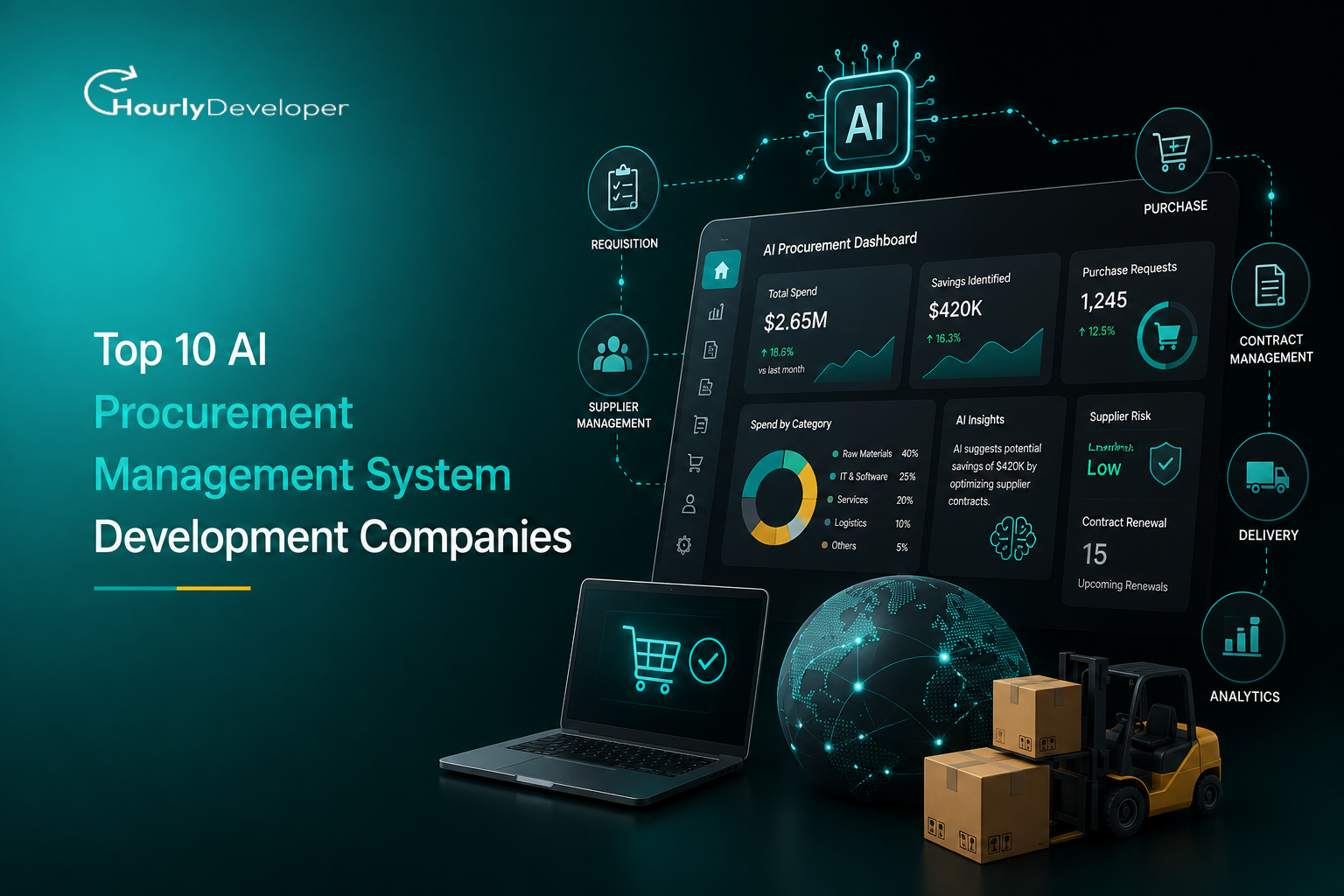
Top 10 AI Procurement Management System Development Companies
Introduction
Top 10 AI Procurement Management System Development Companies
1.Why Businesses Are Building Custom AI Procurement Systems in 2026
Procurement used to be treated as a back office function, but that view has changed fast. Supply chains got more complicated after several years of tariff shifts and vendor consolidation, and finance teams now want real time visibility into every dollar committed before it is spent. An off the shelf tool can handle basic purchase orders, but it rarely adapts to a company’s specific approval hierarchy, custom risk scoring, or the exact ERP and accounting stack already in place. That gap is why so many CEOs are choosing to work with AI procurement management system development companies rather than forcing their teams into a rigid template.
The other driver is cost pressure. When a procurement team is buried in manual invoice matching and vendor onboarding, mistakes creep in, from duplicate payments to missed early payment discounts. A well built AI procurement management system catches those patterns automatically, predicts price changes based on historical vendor data, and gives leadership a single dashboard instead of ten disconnected spreadsheets. For growing companies, that kind of visibility is no longer a nice to have. It is becoming the standard expectation from boards and investors alike.
2.What Goes Into Building a Custom Procurement Platform
Good procurement management software development work rarely starts with writing code. It starts with mapping out how purchase requests actually move through an organization today, who approves what, and where things stall. A development partner worth hiring will spend real time on that discovery phase before touching the AI layer, because the smartest supplier risk model in the world is useless if it sits on top of a broken approval process nobody wants to use.
Once that mapping is done, the actual build usually covers a handful of consistent pieces. There is a purchase request and approval workflow, a supplier database with performance history, an invoice matching engine that checks purchase orders against what actually arrives, and increasingly, a layer of predictive analytics that flags which vendors are likely to raise prices or run late. Some companies also want a supplier facing portal so vendors can respond to requests directly rather than through email, which cuts down on the back and forth that eats up a procurement team’s week.
The companies below approach this build differently depending on their size and specialty, and understanding those differences upfront will save a lot of time during vendor selection.
3.The Top 10 AI Procurement Management System Development Companies
HourlyDeveloper has built a reputation around a simple idea, letting companies hire vetted developers by the hour instead of committing to a rigid project scope upfront. For procurement software, that flexibility matters because requirements almost always shift once a system is in front of real buyers and vendors. The team has delivered several custom procurement and supply chain tools for clients in retail, manufacturing, and logistics, with a strong focus on integrating AI models for spend analysis and vendor risk scoring directly into existing ERP environments.
What sets this team apart is the transparency around engagement. Clients get direct access to the developers working on their AI Procurement Management System rather than communicating through layers of account managers, which shortens feedback cycles considerably. The hourly billing model also appeals to founders who are not ready to commit to a large fixed price contract before validating that the AI features actually improve their sourcing decisions.
Best for companies that want a flexible, hands on engagement model and prefer paying for actual development hours rather than negotiating a large fixed bid before the scope is fully known.
Their onboarding process is also notably quick, with most engagements starting within a week or two of an initial scoping call, which matters for founders who need a working prototype before the next board meeting rather than months into a signed statement of work.
AI product engineering and enterprise digital transformation
Key Services
Generative AI integration, LLM based document processing, cloud native procurement platforms, mobile enterprise apps
Appinventiv has grown into one of the larger AI focused engineering firms serving both fast moving startups and established enterprises like KPMG and IKEA. Their procurement work typically centers on document intelligence, using large language models to read contracts, purchase orders, and vendor invoices, then extracting structured data that feeds directly into approval workflows. That capability is particularly useful for companies drowning in unstructured paperwork from dozens of suppliers.
The firm’s scale means they can staff a full team spanning data engineering, backend development, and UX design on a single procurement project, which shortens delivery timelines for companies that need a production ready system rather than a proof of concept. Their AI consulting arm also helps clients figure out which parts of the procurement cycle actually benefit from automation before writing a single line of code.
Best for mid sized to large enterprises that want a full service partner capable of handling everything from AI model selection to final deployment without bringing in multiple vendors.
Their project teams typically include a dedicated AI product strategist alongside engineers, which helps keep the roadmap grounded in measurable procurement outcomes rather than adding AI features simply because the technology is available.
Backend architecture and API driven procurement infrastructure
Key Services
Scalable backend systems, third party ERP integrations, real time approval engines, vendor database architecture
As the name suggests, this firm’s strength sits squarely in backend architecture, which happens to be the part of procurement software that determines whether the system holds up once transaction volume grows. Their engineers have built approval engines that process thousands of purchase requests without slowing down, along with integration layers that connect procurement tools to accounting systems like SAP, NetSuite, and QuickBooks.
Because so much of an AI procurement platform depends on clean, well structured data flowing between systems, a shaky backend can quietly sabotage even the smartest AI model. This team’s approach to database design and API architecture gives client companies a foundation that can scale from a single warehouse to a multi region operation without a full system rebuild down the line.
Best for companies whose procurement volume is expected to grow quickly and who want infrastructure that will not need to be rearchitected within the first year.
They also tend to document their API architecture thoroughly, which makes it far easier for an internal IT team to take over maintenance later without depending on the original development team for every small change.
Digital product engineering and cloud native application development
Key Services
Co-engineering delivery model, AWS and Azure cloud architecture, enterprise AI pipelines, legacy system modernization
Simform runs on what they call a co-engineering model, embedding their engineers directly alongside a client’s internal team rather than working as a fully separate outsourced unit. For companies that already have some technical staff but need extra hands to build out AI capabilities inside a procurement system, that model tends to work smoothly because knowledge transfer happens naturally throughout the project instead of at a single handoff meeting.
Their cloud expertise across AWS and Azure is particularly relevant for procurement platforms that need to process large volumes of supplier data and run machine learning models for spend forecasting. Simform has also handled a fair amount of legacy modernization work, which matters for companies replacing an aging procurement tool rather than building one from a blank slate.
Best for organizations that already have an internal engineering team and want a partner to extend that capacity rather than replace it entirely.
Clients also point to their structured discovery workshops, which typically run one to two weeks before development starts and help surface hidden requirements that would otherwise surface midway through the build.
Full stack web and enterprise application development
Key Services
End to end procurement platform builds, custom dashboards, supplier portal development, API integrations
This company positions itself around full stack delivery, meaning a single team handles frontend dashboards, backend logic, and database design without splitting work across multiple contractors. For a procurement system where finance teams, warehouse staff, and vendors all need different views into the same data, having one team responsible for the entire experience tends to reduce the miscommunication that often shows up between separate frontend and backend vendors.
Their recent work has leaned into building supplier facing portals where vendors can submit bids, update pricing, and respond to purchase orders directly, reducing the email back and forth that eats up procurement staff time. They also build internal facing dashboards that surface AI generated spend insights for leadership without requiring a separate business intelligence tool.
Best for companies that want a single accountable team managing the full technical stack rather than coordinating between separate frontend and backend vendors.
They typically assign a dedicated project lead who stays with the engagement from kickoff through post launch support, which reduces the knowledge gaps that often appear when different people rotate through a project over time.
Offshore software development and enterprise staff augmentation
Key Services
Flexible engagement models, agile development squads, custom procurement software, IP protection protocols
ValueCoders has been in the offshore development space long enough to have refined how they handle staff augmentation and full project ownership at the same time, letting clients choose whichever model fits their internal capacity. Their engineering pool is large enough that a procurement project can pull in specialists for AI model integration, cloud infrastructure, and quality assurance without a long hiring runway.
One thing worth noting for CEOs evaluating offshore partners is how seriously ValueCoders treats intellectual property protection, with ISO certified processes and strict non disclosure agreements built into every engagement. For a procurement system that will hold sensitive vendor pricing and contract data, that kind of documented governance is not a minor detail.
Best for companies that want the flexibility to scale their development team up or down as the procurement project evolves, without renegotiating a new contract each time.
Their long track record also means they have handled a wide range of ERP integrations before, so a company using a less common accounting system is less likely to hit a connector that has never been built.
Applied AI and machine learning development for enterprise software
Key Services
Predictive spend analytics, supplier risk models, natural language processing for contract review, custom AI model training
HireAIDevelopers, as the name implies, focuses specifically on the machine learning side of enterprise software rather than general purpose development. Their procurement work tends to center on the parts of the system that actually justify calling it an AI platform, such as predictive models that flag which suppliers are likely to raise prices or miss delivery windows based on historical patterns.
They have also built natural language processing tools that scan vendor contracts for unfavorable clauses or missing compliance language, saving legal and procurement teams from reading every document line by line. For a company that already has a procurement workflow in place and wants to layer genuinely useful AI on top of it, this team’s narrow focus tends to produce more polished results than a generalist shop trying to do everything at once.
Best for companies that already have a procurement process defined and specifically need strong machine learning talent to add predictive and analytical capabilities.
They are also comfortable working alongside a client’s existing development vendor rather than replacing them, stepping in purely to build and tune the machine learning layer while another team handles the rest of the platform.
Custom software development and digital transformation consulting
Key Services
Enterprise software modernization, AI and machine learning integration, SAP Ariba optimization, IoT and cloud solutions
Fingent has more than two decades of experience serving clients ranging from mid sized businesses to Fortune 500 names like Sony and Johnson & Johnson, and that longevity shows up in how they approach procurement modernization projects. Rather than starting from scratch, a lot of their work involves upgrading existing systems, including SAP Ariba environments, with newer AI capabilities for spend visibility and supplier risk scoring.
Their consulting first approach means a project usually starts with a discovery phase that maps out exactly where manual bottlenecks exist before any development begins, which helps avoid building AI features nobody on the procurement team actually needed. That discipline tends to appeal to CEOs who have been burned before by vendors who jumped straight into coding without understanding the workflow.
Best for enterprises with an existing procurement system that needs modernization and AI enhancement rather than a completely new build from zero.
Their long standing client relationships, some spanning over a decade, also suggest a team that sticks around for ongoing support rather than moving on the moment the initial contract wraps up.
Web, mobile, and AI enterprise application development
Key Services
Custom procurement dashboards, data analytics integration, mobile approval apps, cross platform development
DataEximIT has built a broad portfolio across web and mobile enterprise applications, and their procurement projects usually reflect that range, combining a desktop facing admin dashboard with a mobile app that lets managers approve purchase requests from a phone while traveling. That mobile piece often gets overlooked by other vendors but ends up being one of the most used features once a system goes live.
Their data analytics practice feeds directly into procurement dashboards, giving finance leaders visual breakdowns of spend by category, vendor, and department without needing to export anything into a separate reporting tool. For companies whose leadership wants quick visual answers rather than raw spreadsheets, that built in analytics layer saves a meaningful amount of back and forth after launch.
Best for companies that want strong mobile access to their procurement system alongside the standard web dashboard, particularly for leadership teams that approve requests on the go.
Their cross platform development approach also means a single mobile codebase typically covers both iOS and Android, which keeps ongoing maintenance costs lower than maintaining two separate native apps.
WebClues Infotech has carved out a niche building custom web platforms for mid market companies that need something more tailored than a generic SaaS tool but do not require the scale of a large enterprise engagement. Their procurement builds often include a vendor management portal alongside the internal approval system, giving both sides of a transaction a proper interface instead of relying on email threads.
They have also experimented with AI chatbots embedded into procurement systems, letting staff ask plain language questions like which vendors are overdue on delivery instead of digging through filters and reports manually. It is a smaller touch compared to predictive analytics, but it lowers the learning curve for staff who are not naturally comfortable with dashboards full of numbers.
Best for mid market companies that want a tailored procurement portal with an easier learning curve for non technical staff, including a vendor facing interface.
Their pricing tends to sit on the more accessible end for this category of work, making them a reasonable starting point for companies testing whether a custom system is worth the investment before scaling further.
4.What to Check Before You Hire an AI Procurement Software Development Company
Once you have a shortlist, the real evaluation starts. Ask every company for a live demo of a similar procurement system they have already built, not just a slide deck of logos. A demo shows you how the approval workflow actually feels to use, whether the AI generated insights are genuinely useful or just decorative charts, and how the system handles edge cases like a rejected purchase order that needs to be resubmitted with changes.
Pricing structures vary widely across this space. Some firms charge a fixed project fee that typically runs from $25,000 to $120,000 depending on scope, while others bill hourly or offer dedicated team retainers starting around $4,000 to $8,000 per developer per month. Whichever model you choose, get clarity upfront on what happens after launch, because AI models used for spend prediction and supplier scoring need retraining as your vendor base and purchasing patterns change over time. A contract that ends the moment the system goes live often leaves companies stuck maintaining machine learning components they never built in house.
Finally, ask directly how the vendor handles data security, especially around vendor pricing and contract terms that competitors would love to get their hands on. Any serious **hire AI procurement software developers** conversation should include a clear answer on encryption standards, access controls, and whether your data is used to train models for other clients. If a company cannot answer that question specifically, treat it as a warning sign rather than an oversight.
It also helps to ask how a team plans to measure success once the system is live. A vendor that only talks about lines of code shipped or features delivered is missing the point. The metrics that matter are things like average approval turnaround time, percentage of invoices matched automatically without manual review, and how much spend visibility improves month over month. Companies that hire AI procurement software developers who can speak fluently about these outcomes, not just the technology stack, tend to end up with systems their teams actually adopt rather than quietly abandon after the first few months.
5.Final Thoughts
There is no universal best choice among the 10 companies covered here. A founder running a lean startup with 15 suppliers has completely different needs from a manufacturing CEO managing hundreds of vendors across three continents, and the right development partner depends heavily on your current systems, your budget, and how much of the AI work needs to happen versus how much backend infrastructure needs building first.
What matters most is treating this as a partnership decision rather than a one time purchase. The best AI procurement software development companies are the ones willing to sit through a real conversation about your existing approval bottlenecks before proposing a single feature. Take the time to talk to at least three teams from this list, ask for references from companies your size, and trust the answers that come with specifics rather than generic reassurances.
It is also worth remembering that the market for best AI procurement software development companies will keep shifting as new AI capabilities mature, so build a relationship with a partner who documents their work clearly and hands over full ownership of your code and models. That way, even if priorities change down the road, your procurement system remains yours to evolve rather than something you are locked into maintaining through a single vendor indefinitely.
Nikhil Patel, our dynamic Director, charts our course with innovative fervor and strategic acumen. With a sharp eye for opportunity, he steers our company's ascent with resolute determination. Nikhil's empathetic leadership unites us, igniting a collective drive for greatness and propelling us toward boundless success.
Frequently Asked Questions
Most custom builds take between 4 and 9 months depending on complexity. A basic approval workflow with simple analytics can launch in around 12 to 16 weeks, while systems with predictive supplier scoring, contract analysis, and deep ERP integration usually need 6 to 9 months including testing and staff training before a full rollout.
Yes, and most companies choose this route. Development teams typically build API connectors that pull vendor, invoice, and inventory data from systems like SAP, Oracle, or NetSuite into the new procurement layer, which avoids a disruptive full migration while still giving staff access to the newer AI driven features across daily workflows.
Beyond hosting fees, expect to budget for periodic AI model retraining as vendor behavior shifts, along with a maintenance retainer that usually runs $2,000 to $6,000 monthly for bug fixes and small feature updates. Companies that skip this often find their predictive features grow noticeably less accurate within a single year.
Reputable firms use encrypted databases, role based access controls, and signed non disclosure agreements before any project begins. Some also offer on premises or private cloud hosting for companies unwilling to store pricing data on shared infrastructure. Always confirm in writing whether your data will ever be used to train models for other clients.
It depends on budget and communication needs. Offshore teams in India often cost 40 to 60 percent less and bring strong technical depth, while local agencies may offer easier time zone alignment for daily standups. Many CEOs land on a hybrid approach, using offshore developers for build work and local consultants for strategy.
Find exceptional developers at Hourlydeveloper. Get the expertise, solutions, and teamwork you need for success. Hire developers easily and boost your projects today!
 Back to Blog