Web Analytics

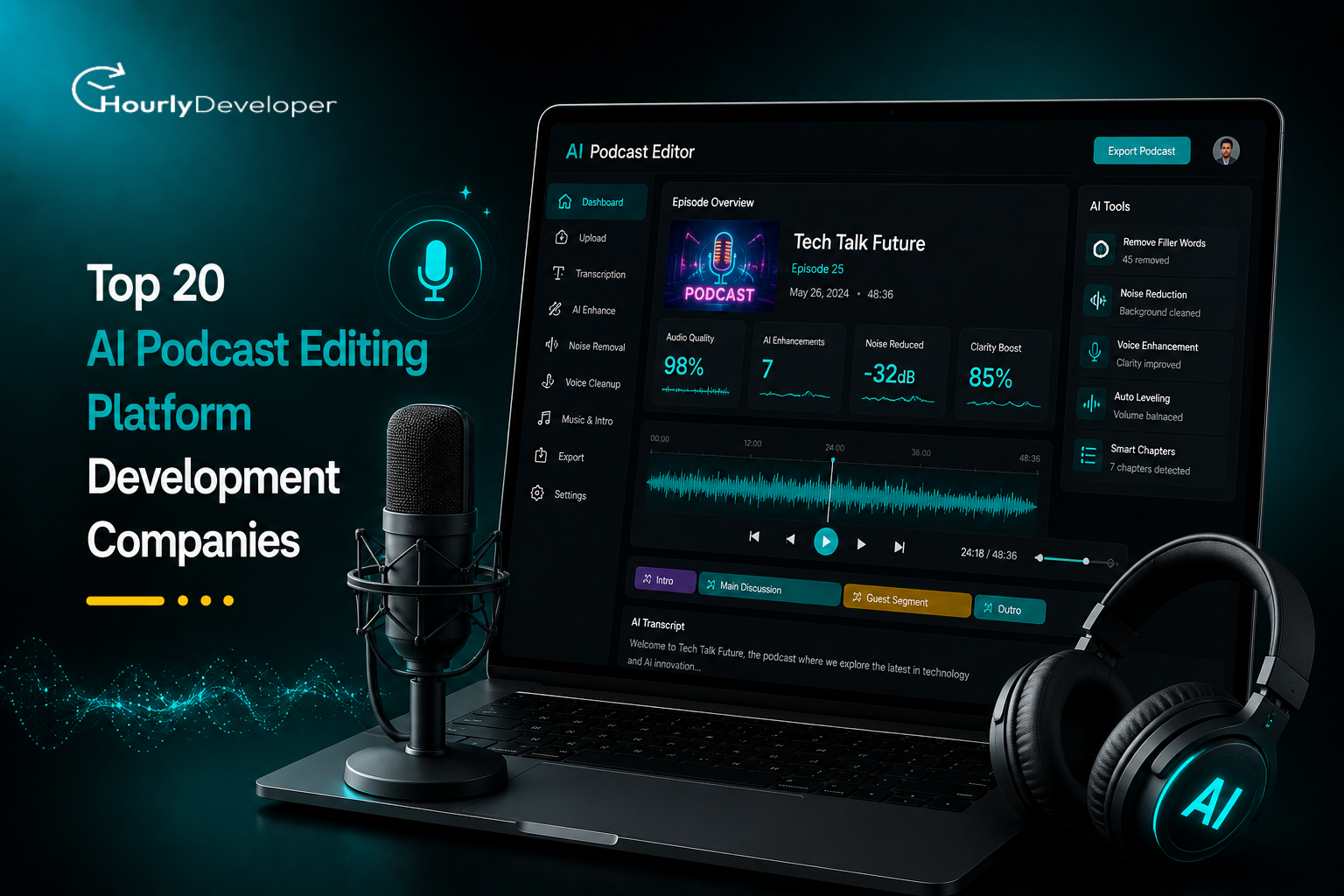
Top 20 AI Podcast Editing Platform Development Companies

Introduction

As AI continues to transform audio production, choosing the right AI Podcast Editing Platform development company is essential for building intelligent, scalable, and feature-rich podcast solutions. This guide highlights 20 trusted firms with expertise in AI-powered audio editing, speech recognition, noise reduction, transcription, show note generation, and media processing, helping businesses compare reliable development partners based on their technical capabilities, industry experience, and project expertise.

1.What Goes Into Building One of These Platforms

A working AI Podcast Editing Platform usually combines several separate technical pieces: automatic speech recognition for transcripts, a filler word and silence detection model, audio enhancement for noise and levels, and a text based editor that lets creators cut audio by editing a transcript instead of a waveform. Bolting these together so they feel like one smooth product is where most of the real engineering effort goes, and it is also where a lot of first time builds fall apart under real usage, especially once users start uploading recordings that were never made in a proper studio.

The companies below were shortlisted because they have shipped audio, speech, or media processing products before, not just marketing sites with AI in the name. Some are broad AI software development company studios with a proven audio practice, others are specialist shops that have built voice or transcription tools for other clients. We have mixed both types in deliberately, since the right fit depends on whether you need a full product build or a narrower feature added to something you already run, and on how much in house technical judgment you already have to manage the build yourself. A few also bring genuine media industry experience beyond software engineering, which shows up in small but meaningful product decisions around how creators actually work day to day.

2.The Top 20 AI Podcast Editing Platform Development Companies

Here is the full list, mixing established full stack studios with specialist AI and audio teams. Founded years and headquarters are listed alongside a short note on what each company is best suited for.


# Company Founded / HQ What They Bring
1 HourlyDeveloper 2015  India / United States Hourly Developers staffs dedicated engineers on flexible hourly or monthly contracts, which makes them a practical pick for founders who want to hire AI podcast app developers without committing to a fixed scope agency contract. Their teams have worked on speech to text integrations, audio cleanup pipelines, and creator tooling for media clients, and clients can scale the team up or down as the build moves from prototype to production. This flexibility also helps when a project’s scope shifts mid build, which is common once early users start testing an editing tool on their own messy recordings.
2 Diffco 2009  Silicon Valley, United States Diffco is a full service AI development agency with more than fifteen years of mobile, web, and AI delivery behind it. Their portfolio includes an audio marketing platform built around intelligent ad insertion, which is close enough to podcast production tooling that their audio processing experience carries over directly to a podcast editing build. Their process emphasizes transparent sprints and vetted senior engineers, which matters when a client cannot easily judge audio model quality on their own.
3 Backend Development Company 2016  India As the name suggests, this firm focuses on the server side and infrastructure layer that any serious AI Podcast Editing Platform depends on, including the audio processing queues, storage, and API layer that keep transcription and enhancement jobs running reliably at scale. Teams building the platform’s backend systems often bring this company in specifically for that infrastructure work rather than the full product build, particularly once usage grows past a few hundred concurrent editing sessions and queue management starts to matter more than the front end polish.
4 Uptech 2013  New York, United States / Ukraine Uptech builds scalable digital products for startups through to enterprises, with technical depth in Kotlin, Swift, React, Node.js, and AWS. Their process leans on transparent agile sprints and close client communication, which matters for a platform that will need several rounds of tuning once real user audio starts coming in. They have also delivered media and entertainment projects before, so briefing them on podcast specific workflows tends to go faster than with a generalist team starting from zero.
5 HireFullStackDeveloperIndia 2014  India This team supplies full stack engineers who can own both the recording and editing interface and the backend audio pipeline behind it, which suits founders who want one contract instead of managing a frontend team and a backend team separately during an AI-powered podcast editing application development project. Their engagement model is flexible enough to start with a small prototype team and expand once the core editing flow is validated with real users.
6 InData Labs 2014  Cyprus, with offices in Lithuania and the United States InData Labs specializes in natural language processing, generative AI, and business intelligence, and has built speech and audio focused NLP models for clients across media and communications. Their NLP background is directly relevant to the transcript cleanup and filler word detection layer that sits at the core of most editing platforms, and their business intelligence practice can also help a client figure out which editing features actually move retention once the product is live.
7 LeewayHertz 2007  United States LeewayHertz runs full cycle AI product development, from model selection through deployment and ongoing MLOps support. They have delivered generative AI and speech processing projects across healthcare, fintech, and media, and their post launch monitoring practice is useful for a product where model drift on new accents or audio conditions is a real ongoing risk. Clients working with larger user bases tend to value their experience running models reliably at scale rather than just building an initial demo.
8 HireAIDevelopers 2017  India HireAIDevelopers puts together dedicated machine learning and NLP engineers for companies that need the intelligence layer built without hiring an entire in house data science department. For an editing platform, that typically means the filler word detection, silence trimming, and voice enhancement models that sit underneath the editor interface, along with the ongoing evaluation work needed to keep those models accurate as new types of recordings come through.
9 Biz4Group 2015  California, United States Biz4Group builds custom AI applications across generative AI, computer vision, and automation, with a delivery process built around measurable business outcomes rather than proof of concept demos. Founders evaluating them for a podcast tool typically want a partner who can also help validate pricing and packaging around the AI features, not just write the code, since their process includes market and competitor research alongside the technical build.
10 DataEximIT 2012  India DataEximIT covers custom software and AI integration work for small and mid sized companies, and is a common choice for founders who want a capable AI software development company without enterprise level rates. Their teams have handled speech to text and audio processing integrations as part of broader product builds, and their smaller engagement minimums make them approachable for a first version before a larger round of funding is in place.
11 CONTUS Tech 2008  India / United States CONTUS Tech builds AI enabled media and communication products, including video and audio streaming infrastructure, which gives them working familiarity with the low latency processing pipelines an editing platform needs when handling long recordings or live sessions. Their streaming background is particularly useful for founders planning to add live recording or real time transcription features down the line, rather than only supporting uploaded files after the fact.
12 WebClues Infotech 2015  India / United States WebClues Infotech delivers custom web and mobile products with an AI and automation practice layered on top, and has shipped SaaS tools with transcription and content generation features for creator focused clients, which maps closely onto podcast editing use cases. Their team can typically cover both the consumer facing editor and the subscription billing and account management layer that a commercial platform needs around it.
13 AIS Technolabs 2010  India / United States AIS Technolabs develops AI powered mobile applications, automation software, and business intelligence tools for startups and small to mid sized businesses. Their smaller team size often means more direct access to the actual engineers building your product rather than a layered account management structure, which some founders prefer when the editing platform is still being shaped through frequent feedback and iteration rather than following a fixed spec.
14 Master of Code Global 2006  Ukraine / United States Master of Code Global has built conversational AI and generative AI products for close to two decades, with deep experience in speech interfaces and NLP. Their long track record with voice interaction projects is a meaningful advantage for the conversational and transcript editing layer of a podcast platform, and their scale means they can staff a larger dedicated team quickly if a project needs to move faster than a smaller shop can support.
15 SoftKraft 2016  Poland SoftKraft focuses on custom software and AI development for startups, with particular strength in scalable backend architecture. Their engineering first culture suits founders who already have a clear product vision for their editing platform and mainly need a technical execution partner rather than product strategy support, and their European base can also be a practical fit for teams needing overlapping working hours with clients in the United Kingdom or continental Europe.
16 Entrans 2016  United States / India Entrans builds tailor made AI applications for web, mobile, and enterprise use, including products that process and generate text, audio, image, and video together. Their MLOps practice, covering model monitoring, drift detection, and retraining, is a genuine differentiator for a platform whose audio models will need retuning as usage grows, since most first time builders underestimate how much ongoing model maintenance an editing tool actually requires after launch.
17 10Pearls 2004  United States 10Pearls is a global, data driven digital product studio that pairs software engineering with applied data science. Their scale and process maturity make them a fit for founders who need a partner capable of supporting a platform through several years of iteration rather than a single build and handoff, which matters for a product category where user expectations around AI editing quality keep rising every year.
18 DataToBiz 2018  India / United States DataToBiz pairs app development with dedicated AI expertise to help clients apply machine learning models and data analytics to real business problems. For a podcast tool, that experience typically shows up in smarter show note generation and audience analytics layered on top of the core editor, giving creators more than just a cleaner audio file at the end of the editing process.
19 Talentica Software 1999  India Talentica Software has partnered with startups for over two decades on cloud and AI product builds, including generative AI, NLP, and image processing work. Their startup focused delivery model tends to suit founders who need to move from prototype to a fundable product quickly, and their long operating history means they have already worked through the common technical pitfalls that newer AI focused shops are still learning.
20 ELEKS 1991  Tallinn, Estonia ELEKS is one of the longer established AI development firms operating in Europe, with a broad engineering bench that spans everything from computer vision to natural language processing. Their scale suits larger media companies that need a platform built with enterprise grade reliability and security requirements from day one, including compliance considerations that come up once a platform starts handling recordings from corporate or regulated clients.

3.How These Companies Were Evaluated

This list of top AI podcast editing platform development companies was checked against a few consistent criteria rather than picked from a generic top ten roundup. The first was demonstrated audio or speech experience, meaning a real shipped project involving transcription, voice processing, or media pipelines, since that background transfers directly to an editing platform in a way that general mobile app experience does not. The second was team structure, since a founder hiring for a multi month build needs to know whether they are getting a stable dedicated team or a rotating set of contractors pulled between projects.

The third criterion was transparency around engagement models and rough pricing ranges, since agencies who dodge cost questions during an initial call tend to keep dodging them once a contract is signed. Company size was deliberately kept varied across the list too, from small specialist shops with a handful of engineers to established firms with hundreds of staff, because the right size of partner depends on the scale of the platform being built and the internal technical oversight a founder already has in house.

4.What These Builds Typically Cost

Pricing for a custom AI Podcast Editing Platform depends heavily on how much of the pipeline you are building from scratch versus wiring together existing speech and audio APIs. A minimum viable version that handles transcription, filler word removal, and basic audio cleanup through third party models can often be built for $25,000 to $60,000, depending on the region and team composition of your chosen partner. A fuller platform with a custom text based editor, voice enhancement, multi speaker handling, and automated show notes tends to run from $80,000 to $200,000 or more, especially once you add mobile apps or a hosting and publishing layer on top.

Most of the firms above work on either a fixed scope model for a clearly defined first version or a dedicated team model billed monthly, which tends to suit products that will keep evolving after launch. Ongoing costs matter just as much as the build itself, since speech models need periodic retraining as usage grows and new accents, languages, or recording conditions show up in your user base. Budgeting a separate ongoing line for model maintenance, rather than treating the launch budget as the whole project cost, tends to save founders from an unpleasant surprise about six months after the platform goes live.

Regional rates also shift the numbers meaningfully. Firms based in India or Eastern Europe often quote hourly rates in the $25 to $60 range for experienced engineers, while agencies based in the United States or Western Europe frequently start closer to $80 to $150 an hour for comparable seniority. Neither region is automatically the better choice, since communication overlap, time zone alignment, and depth of audio specific experience often matter more to the final outcome than the headline hourly rate.

5.Common Features Worth Planning For

Beyond the core editing loop, most successful platforms end up adding a handful of features that were not part of the original pitch deck. Automatic show notes and episode summaries are now close to standard, since creators use them for both publishing and social promotion, and multi speaker diarization has moved from a nice to have into an expected feature once a platform supports interview style shows with more than one guest.

Export flexibility matters more than most first time builders expect too. Creators publish the same episode as an audio file, a video clip for social platforms, and a written transcript for accessibility and SEO, so a platform that only outputs one format tends to get replaced quickly once a competitor supports all three from a single edit.

Collaboration features tend to get underestimated at the planning stage as well. Many shows are produced by a small team rather than a solo host, with a producer handling rough cuts, a host reviewing the transcript for accuracy, and an assistant preparing show notes for publishing, so a platform that only supports a single editor logged in at a time will frustrate teams fairly quickly once they move past a one person operation.

6.Red Flags to Watch For When Hiring

Be cautious of any development partner who cannot explain, in plain language, how their proposed filler word detection or noise reduction approach actually works. A team that has genuinely built audio machine learning systems before can talk through tradeoffs between accuracy and processing speed without falling back on vague phrases like leveraging cutting edge AI models.

It is also worth asking directly how a company plans to test their build against difficult audio, such as recordings with heavy accents, overlapping speakers, or poor microphone quality, before you sign anything. A partner who has a clear testing plan for these edge cases is far more likely to deliver a platform that holds up once real users start uploading whatever audio they actually have, rather than the clean sample files used during the sales pitch.

Watch out too for a proposal that skips over data handling entirely. An editing platform touches recordings that may include unreleased episodes, private business conversations, or interviews under embargo, so a partner who has no clear answer on storage security, retention periods, or who can access uploaded audio during processing is a partner who has not thought through the parts of the job that matter most once you have paying customers.

7.Questions to Ask Before You Sign a Contract

Before committing a budget to any of the companies above, it helps to ask a short, consistent set of questions across every call so the answers are actually comparable afterward. Start with a direct question about past audio or speech projects, and ask to see a working demo rather than a slide deck, since a real demo tends to expose whether a team has actually solved problems like background noise or overlapping speakers or whether they are proposing to solve them for the first time on your project.

It is also worth asking who on the team will actually write the audio processing code, not just who will manage the account, since developer experience varies enormously even within reputable agencies. Finally, ask how the contract handles scope changes, since almost every AI-powered podcast editing application development project ends up adjusting scope once real user feedback starts coming in, and a rigid fixed price contract with no defined change process tends to create friction right when a product needs to move fastest. A short pilot phase, priced separately from the main build, is often a low risk way to confirm a team’s real capability before committing to the full engagement.

8.Final Thoughts

There is no single best answer among the top AI podcast editing platform development companies listed here, because the right partner depends on whether you need a full product built from zero, a narrower feature added to an existing app, or an experienced team to take over an MVP that outgrew its first developer. What matters more than any single company’s logo is whether they can show you real audio or speech projects they have shipped before, not just a slide about their AI capabilities or a generic case study that could describe any software product.

Start conversations with three or four companies from this list, ask each one the same technical questions about accuracy and retraining, and compare their answers side by side rather than their marketing pages. That comparison, more than anything else, is what actually separates a partner who can deliver a working platform from one who is still learning on your budget, and it costs you nothing more than a few hours of scheduled calls before you commit to a contract.

Whichever company you eventually choose, treat the first version as a starting point rather than a finished product. Speech models, listener expectations, and the podcast production workflows people build their shows around all keep shifting, and the partner who stays useful over the following year is usually the one who planned for iteration from the very first conversation rather than the one who simply delivered the fastest launch.

Nidhi Jain

With a pen in hand and creativity in her heart, Nidhi crafts compelling narratives that captivate our audience and leave them wanting more. Her versatile writing style effortlessly adapts to various genres, ensuring our message resonates with readers from all walks of life.

Frequently Asked Questions

A minimum viable version built around existing speech APIs can launch in 3 to 4 months. A fuller platform with a custom editor, voice enhancement, and multi speaker support typically takes 6 to 10 months, depending on team size and how much of the audio pipeline is built from scratch versus assembled from third party models.

Most early versions use existing speech to text APIs from providers like major cloud vendors to save development time. Companies typically move to custom or fine tuned models later, once they have enough real user audio to improve accuracy on accents, industry vocabulary, or noisy recording conditions that generic APIs handle poorly.

Handling multi speaker audio reliably is usually the hardest part. Separating overlapping voices, keeping speaker labels consistent across a long recording, and maintaining accuracy when guests use different microphones or connection quality all require careful engineering that generic transcription tools were not built to handle well, especially once episodes run past an hour.

Most teams start with a web app since it ships faster and avoids app store review delays. A desktop app becomes worth adding once users need offline editing or faster processing of large audio files, which browser based tools can struggle with once recordings run past an hour or two.

Maintenance is usually billed separately from the initial build, often as a monthly retainer covering bug fixes, model monitoring, and small feature updates. Retraining speech or audio models as usage grows is sometimes included and sometimes billed as a separate project, so it is worth clarifying this before signing a contract.

  • Hourly
  • $20

  • Includes
  • Duration: Hourly Basis
  • Communication: Phone, Skype, Slack, Chat, Email
  • Project Trackers: Daily reports, Basecamp, Jira, Redmi
  • Methodology: Agile
  • Monthly
  • $2600

  • Includes
  • Duration: 160 Hours
  • Communication: Phone, Skype, Slack, Chat, Email
  • Project Trackers: Daily reports, Basecamp, Jira, Redmi
  • Methodology: Agile
  • Team
  • $13200

  • Includes
  • Duration: 1 (PM), 1 (QA), 4 (Developers)
  • Communication: Phone, Skype, Slack, Chat, Email
  • Project Trackers: Daily reports, Basecamp, Jira, Redmi
  • Methodology: Agile