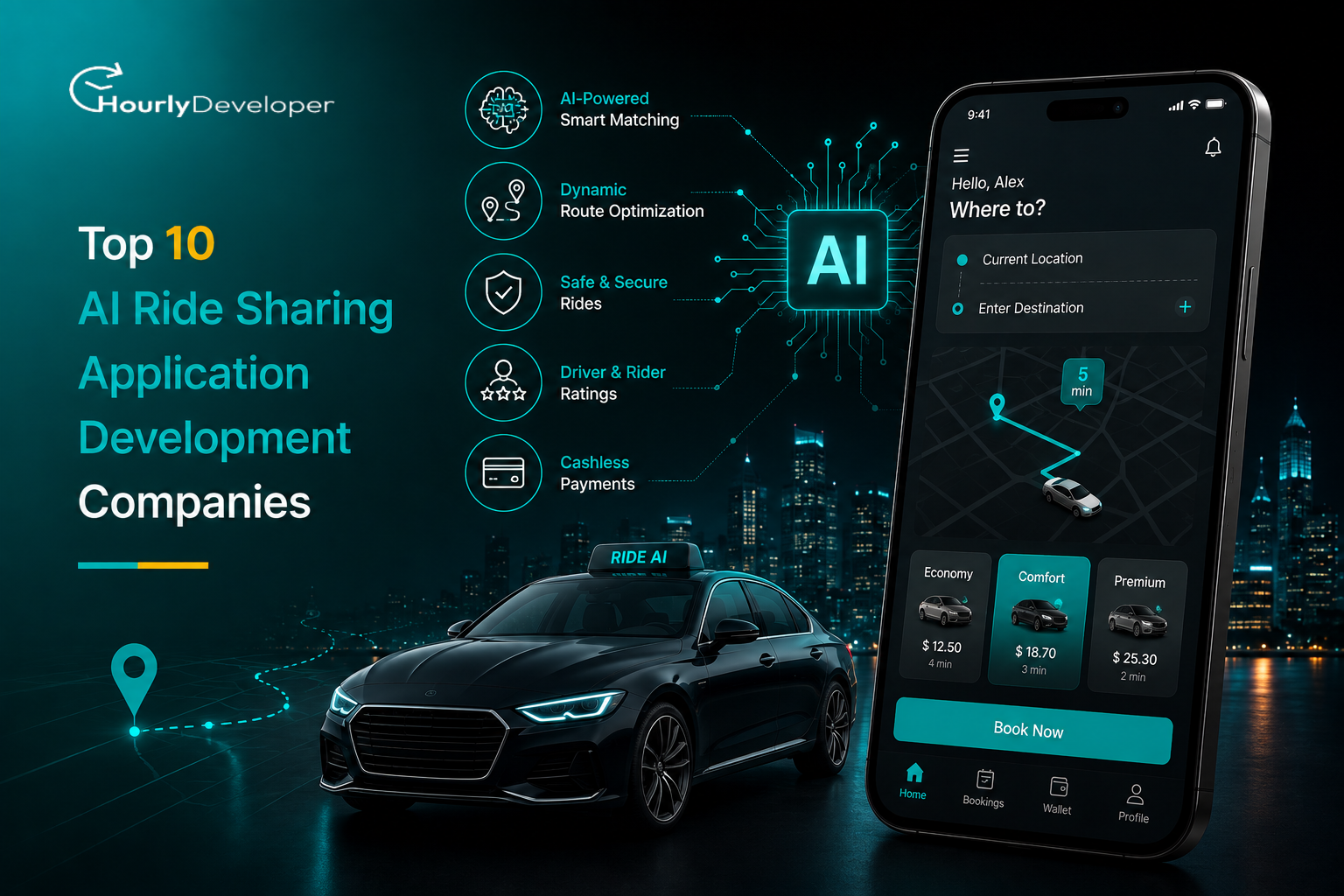
Top 10 AI Ride Sharing Application Development Companies
Introduction
Top 10 AI Ride Sharing Application Development Companies
1.What Actually Makes a Ride Sharing App AI Powered in 2026
Plenty of companies claim they build AI Ride Sharing Application products, but the label gets thrown around loosely. A genuinely intelligent platform does a few specific things well. It predicts demand before it spikes, so drivers are already positioned near stadiums or business districts before a rush starts. It prices rides dynamically based on real conditions, not just a flat surge multiplier. It matches drivers and riders using factors like route efficiency and driver rating, not just proximity. And it flags fraud, fake accounts, and unsafe driving patterns automatically instead of relying on rider complaints days later.
When you are evaluating a partner for AI taxi booking app development, ask them directly how their systems handle these four areas. A team that can answer with specifics, model types, data pipelines, and real numbers from past projects, is a very different conversation from one that just says yes to everything you ask.
2.Why 2026 Is a Different Market Than It Was Two Years Ago
The competitive landscape around ride hailing has shifted in a few concrete ways heading into 2026. Riders now expect electric vehicle options inside the same app they use for a standard ride, which means fleet management logic needs to account for charging schedules alongside driver availability. Regulatory scrutiny has also tightened in several major markets, with cities requiring clearer data on driver background checks, vehicle inspections, and insurance coverage before an operator can launch.
None of this makes building an AI Ride Sharing Application harder in a discouraging way. It just means the bar for what counts as production ready has moved up. A development partner that was solid two years ago on a basic booking flow might not have the compliance or fleet complexity experience your 2026 launch actually needs, which is exactly why the list below focuses on current capability rather than reputation alone.
Flexible, hourly hiring model built for mobility startups
HourlyDeveloper built its entire model around a simple problem. Most founders do not know exactly how many hours a ride sharing build will take until they are already deep into it, and fixed cost contracts punish that uncertainty. Their hourly engagement model lets you scale a development team up during a sprint and scale back down between releases, without renegotiating a contract every time your scope shifts.
For an AI Ride Sharing Application, this flexibility matters more than it sounds. Early stage ride hailing apps change direction constantly based on what pilot cities reveal, and Hourly Developers structures its teams so that pivoting the driver app, the rider app, or the admin panel does not mean starting a new negotiation. Clients get transparent time tracking, weekly reporting, and direct access to the engineers actually writing the code.
Their engagement usually starts with a short paid trial sprint, which lets a founder see how the team communicates and estimates before committing to anything longer. That low pressure entry point is part of why so many early stage mobility founders start their search here before moving on to a full build partner.
Rates typically sit in the mid range for the market, positioned specifically to make it easy for a bootstrapped founder to keep a small team engaged for months without straining runway.
Key Highlights:
● Hourly billing with full time tracking transparency
● Dedicated developers for rider apps, driver apps, and admin dashboards
● Fast onboarding, usually within a week of signing
US based mobility specialist with a decade of ride hailing builds
Apptunix has spent more than ten years focused on on demand mobility platforms, and ride hailing is one of its clearest specialties. The company has shipped Uber style apps, carpooling platforms, corporate transportation systems, and chauffeur booking solutions for clients ranging from early stage startups to established transportation providers.
What sets Apptunix apart for teams researching Best AI ride sharing app development companies is how methodically they approach the discovery phase. Before writing a line of code, they map out fare logic, driver incentive structures, and regional compliance requirements specific to the markets a client wants to launch in. That upfront planning tends to reduce the expensive mid project pivots that derail so many first time mobility apps.
Their engineering teams also lean into post launch support, which matters more than most founders expect once a driver network is live and small operational issues start showing up daily. Clients working with Apptunix typically get a dedicated point of contact rather than rotating through a general support queue.
Pricing generally sits toward the higher end of the market, which reflects the seniority of the engineers assigned to most projects and the amount of pre launch planning included by default.
Key Highlights:
● Over 10 years focused specifically on mobility and on demand apps
● Strong track record with Uber style and carpooling platforms
● Detailed discovery phase covering fare logic and compliance
Infrastructure specialists for high concurrency ride hailing systems
A ride sharing platform lives or dies on its backend. When thousands of riders open the app during a Friday evening rush, the matching engine, the payment layer, and the live tracking system all need to hold up without lag. Backend Development Company focuses entirely on this layer, building the systems that sit underneath the rider facing app most people notice.
Their engineers work extensively with microservices architecture, real time location streaming, and database structures built specifically for high write volumes, which is exactly what a ride matching system generates every second. For founders who already have a design partner but need the underlying engine to actually scale past a single city, this is the kind of specialist worth bringing in early rather than after performance problems show up.
Backend Development Company also spends time stress testing systems before launch, simulating rush hour traffic patterns rather than waiting for real users to expose weak points. That kind of pre launch load testing has saved several of their clients from the kind of app store reviews that mention crashes during peak demand.
They generally work best as a specialist add on to a client’s existing frontend team rather than as a sole vendor, which keeps their scope tight and their delivery timelines predictable.
Key Highlights:
● Deep specialization in microservices and real time data pipelines
● Experience scaling systems from single city to multi city operations
● Strong focus on database architecture for high concurrency writes
Enterprise engineering firm with predictive analytics expertise
Intellectsoft operates at the enterprise end of the market, working with clients who need mobility platforms that integrate into much larger logistics or fleet management operations. Their engineering teams bring strong experience in secure architecture, dynamic pricing engines, and multi fleet management systems that go beyond a single ride hailing app.
Where Intellectsoft tends to add the most value is in predictive analytics. Rather than reacting to demand after it appears, their systems are built to forecast where riders will need cars based on historical patterns, weather, and local events. For operators managing multiple cities or a mixed fleet of standard and electric vehicles, that forecasting layer can meaningfully cut both wait times and idle driver hours.
Because Intellectsoft works so often with larger operators, their proposals tend to include a clear governance and compliance plan alongside the technical build. That can feel heavier than what an early stage startup needs, but for a company already managing regulatory requirements across several regions, it removes a lot of guesswork later.
Project timelines here run longer than most on this list, often six months or more, which reflects the scale and regulatory complexity of the clients they typically serve.
Key Highlights:
● Enterprise grade security and scalable architecture
● Predictive analytics for demand forecasting across cities
● Experience with multi fleet and logistics style operations
Cost efficient full stack teams for end to end app builds
HireFullStackDeveloperIndia gives founders access to complete development teams that can own a project from the first wireframe through to post launch support, without needing to assemble separate frontend, backend, and QA vendors. For a ride sharing build, that single point of accountability tends to reduce the communication overhead that slows down projects with multiple vendors.
Their teams have worked across rider apps, driver apps, and admin panels, and they are comfortable building the full feature set a modern platform needs, from live GPS tracking to in app chat between drivers and riders. Clients researching where to Hire AI ride sharing app developers on a tighter budget often land here because the pricing stays competitive without cutting corners on the actual engineering.
Communication happens through regular video check ins and shared task boards, which keeps overseas time zone gaps from turning into project delays. Most clients report that within the first two weeks they have a working sense of the team’s pace and can plan milestones around it with reasonable confidence.
Their contracts are usually structured around a fixed monthly rate per developer, which makes budgeting simpler for founders who want cost predictability over the life of the build.
Key Highlights:
● Full stack teams covering rider, driver, and admin builds
● Competitive pricing without outsourcing core engineering roles
● Experience with GPS tracking, chat, and payment integrations
Custom software partner for transportation and dispatch systems
Belitsoft builds custom software for transportation businesses, and their ride sharing work leans heavily into the operational side of the platform. Dispatch automation, GPS tracking, predictive analytics, and secure payment gateways are all areas where their teams have delivered production systems rather than proof of concept demos.
Their approach tends to suit businesses that already understand their operational model in detail, whether that is a regional taxi fleet moving to an app based system or a logistics company adding a passenger transport arm. Belitsoft tailors the technology stack to what the business actually needs rather than pushing a single standard template across every client.
Belitsoft also has notable depth in integrating legacy systems, which matters for transportation businesses that already run dispatch software from years ago and cannot afford to rip everything out at once. Their teams generally propose a phased migration path rather than an all at once rebuild.
Engagement usually starts with a dedicated project manager who scopes the migration before any development work begins, which keeps surprises to a minimum for operators used to older, less flexible systems.
Key Highlights:
● Strong focus on dispatch automation and operational workflows
● Secure payment gateway integrations built into core offerings
● Custom technology stacks tailored to specific business models
Specialist AI engineers for matching, pricing, and fraud detection
HireAIDevelopers is built around a narrower promise than most firms on this list. Instead of offering full app development end to end, they supply specialist engineers who focus specifically on the machine learning layers inside a mobility platform, driver rider matching algorithms, dynamic pricing models, and fraud detection systems.
This makes them a strong fit for companies that already have a development partner handling the app itself but need deeper AI expertise layered in. Their engineers have worked on demand prediction models and route optimization logic that plug directly into an existing codebase, which shortens the timeline compared to bringing on a full generalist team just for the AI components.
Because their scope is narrower, HireAIDevelopers tends to move faster than a full stack agency would on the same task, since the team is not context switching between frontend polish and backend infrastructure. Founders usually bring them in for a defined sprint rather than an open ended retainer.
Most engagements are billed against a defined milestone, such as a working matching algorithm or a validated pricing model, rather than an open hourly rate, which keeps expectations clear on both sides.
Key Highlights:
● Narrow focus on ML driven matching, pricing, and fraud detection
● Works well alongside an existing development team
● Experience with demand prediction and route optimization models
Marketplace and mobility platform builder with global reach
FATbit Technologies has built a strong reputation around marketplace style platforms, and their ride sharing and taxi booking work extends naturally from that background. They approach mobility apps the way they approach any marketplace, focused on matching supply and demand efficiently while keeping both sides of the platform, drivers and riders, genuinely satisfied with the experience.
Their portfolio spans startups launching a first taxi booking service through to more established transportation businesses digitizing an existing fleet. Clients evaluating AI taxi booking app development partners often appreciate that FATbit brings pre built modules for common features like fare estimation and driver verification, which can shorten the initial build timeline considerably.
FATbit also maintains a global client base, which means their teams are used to working across different time zones and regional payment norms. That experience shows up in small but important details, like handling multiple currencies or adapting driver onboarding flows to local licensing requirements.
Their pricing tends to be modular, so a client can start with the core booking and payment modules and add fraud detection or predictive pricing later once the platform has real usage data to work from.
Key Highlights:
● Strong marketplace and two sided platform expertise
● Pre built modules for fare estimation and driver verification
● Experience serving both startups and established fleets
Cloud native fleet management and ride sharing builder
Carmatec builds cloud native ride sharing and fleet management platforms with a strong emphasis on real time monitoring. Their systems typically include performance dashboards and route analytics that give operators visibility into what is happening across their entire driver network, not just individual trips.
For businesses that plan to scale quickly across several cities, Carmatec’s cloud first approach tends to pay off, since the infrastructure is designed from the start to handle growth without a costly rebuild later. Their teams also bring experience integrating third party mapping and payment providers, which removes a common bottleneck in early stage mobility projects.
Their dashboards are also built with non technical operators in mind, so a regional manager without an engineering background can still read fleet performance data and spot problems without waiting on a developer to pull custom reports. That accessibility tends to matter more once a platform grows past a handful of cities.
Carmatec typically works on fixed scope contracts for the initial build, then shifts to a retainer model once the platform is live and needs ongoing monitoring and small feature updates.
Key Highlights:
● Cloud native architecture built for multi city scaling
● Real time performance dashboards and route analytics
● Solid track record integrating mapping and payment providers
Backend engineering specialists for high concurrency mobility apps
Devsinc focuses heavily on backend engineering and scalable API systems, which makes them a natural fit for ride sharing platforms expecting significant concurrent traffic. Their work with microservices architecture and cloud deployments is built specifically around the kind of real time data streams a mobility app generates constantly.
Founders who already have a strong product vision and design but need engineering firepower on the infrastructure side often bring Devsinc in as a specialist partner. Their performance optimization work tends to show up most clearly during peak hours, when a poorly built backend would otherwise start to lag or drop requests entirely.
Devsinc also runs a fairly large engineering bench, which means they can flex team size up quickly if a client needs to accelerate a timeline ahead of a launch date. That kind of scaling flexibility is harder to find at smaller specialist shops with only a handful of senior engineers.
Their reporting cadence tends to be lighter on ceremony and heavier on working code shipped each sprint, which suits founders who would rather review a staging build than sit through a lengthy status deck.
Key Highlights:
● Strong expertise in microservices and scalable API design
● Built for high concurrency, multi city traffic patterns
● Performance optimization focus for peak hour reliability
3.How to Choose the Right Partner for Your Project
With ten strong options in front of you, the deciding factor usually comes down to what stage your business is at. A pre launch startup testing a single city usually needs a full stack partner who can move fast and keep costs predictable. An established transportation business digitizing an existing fleet usually needs deeper backend and dispatch expertise instead. And a company that already has an app but wants smarter pricing or matching often just needs to Hire AI ride sharing app developers for that one layer instead of rebuilding the whole platform.
Whichever direction fits your situation, ask every shortlisted company for two things before signing anything. First, a reference client in a similar business stage to yours, and second, a rough technical breakdown of how they would approach demand prediction and fraud detection for your specific market. The answers to those two questions usually reveal more than any portfolio page.
It also helps to compare notes across a few of the Best AI ride sharing app development companies before making a final call, since pricing and communication style can vary widely even among firms with similar technical skill. A short paid discovery sprint with two finalists is often the cheapest insurance you can buy before a multi month engagement.
Pay attention as well to how a company talks about failure modes, not just features. A partner who can walk you through what happens when a driver’s GPS signal drops mid trip, or how the system behaves during a payment gateway outage, is generally thinking about the platform the way an experienced operator would rather than the way a first time vendor pitches a demo.
4.Conclusion
There is no single best company on this list. There is only the best fit for what you are building right now, at the budget and timeline you actually have. A founder testing a regional taxi app in one city has very different needs from an enterprise fleet operator rolling out predictive pricing across ten metro areas, and the right partner for one is rarely the right partner for the other.
What matters most is starting the conversation with a clear picture of your own priorities. Walk into discovery calls knowing whether speed, cost, AI depth, or backend scalability matters most for your launch, and use that to filter the ten companies above rather than trying to fit your project around whichever firm pitches the loudest. The right AI Ride Sharing Application partner will ask you just as many questions as you ask them.
Take the time to run at least two discovery calls before signing anything, even if the first company feels like a strong match. A second conversation almost always sharpens what you actually need, whether that means realizing you need deeper AI expertise than you assumed or discovering that your timeline was more flexible than you originally planned. That extra week of comparison shopping tends to pay for itself many times over once development actually begins.
With a love for connecting with people and a flair for communication, Prachi's expertise in digital marketing is unmatched. Her strategic approach to campaigns ensures our brand's story reaches far and wide, making an impact on the lives of countless individuals.
Frequently Asked Questions
A basic MVP with core booking, tracking, and payment features usually takes 3 to 5 months. Adding AI features like dynamic pricing or demand prediction can extend that to 6 to 9 months. Timelines shift based on how many cities you plan to launch in and how much regulatory compliance work is required upfront.
Costs generally range from $40,000 for a lean MVP to $150,000 or more for a full featured platform with AI matching, fraud detection, and multi city support. Ongoing maintenance, server costs, and third party API fees typically add another 15 to 20 percent annually on top of the initial build cost.
White label solutions launch faster and cost less upfront, which suits businesses testing a single market before committing fully. Custom builds cost more but give full control over pricing logic, driver incentives, and future feature additions. Most companies scaling beyond one city eventually move away from white label platforms for that added flexibility.
Accurate ETA prediction and fair dynamic pricing tend to matter most to riders, while smart trip matching and route optimization matter most to drivers. Fraud detection runs quietly in the background but protects both sides. Demand forecasting helps operators position drivers before a rush starts rather than reacting once it has already begun.
No, most development partners build both apps alongside a shared backend and admin dashboard within a single engagement. Keeping one team responsible for all three components usually reduces integration issues later, since the matching logic and data flow need to stay tightly synchronized between the driver and rider experiences at all times.
Find exceptional developers at Hourlydeveloper. Get the expertise, solutions, and teamwork you need for success. Hire developers easily and boost your projects today!
 Back to Blog