PyTorch vs TensorFlow in 2026: Which Should You Hire For?
Anyone building a machine learning team in 2026 runs into the same argument eventually. Half the hiring panel wants PyTorch experience on the resume. The other half insists nothing matters more than TensorFlow, because that is what the production pipeline already runs on. Both sides have a case, and that is exactly why the PyTorch vs TensorFlow 2026 question keeps showing up in hiring meetings instead of getting settled once and for all.
There is no single correct answer here. A research team building a new vision model has different needs than a bank running fraud detection on a TensorFlow stack it built five years ago. If you are trying to decide which framework to hire for, the honest answer depends on what you are building, who is already on your team, and where the trained model needs to live once it ships.
This guide walks through where PyTorch and TensorFlow actually stand this year, what the adoption numbers say, what companies are paying for each skill set, and how to think about hiring so your team's skills match the infrastructure you actually run.
Key Takeaways
PyTorch now accounts for around 85 percent of deep learning research papers and roughly 55 percent of new production deployments started since late 2025.
TensorFlow still runs a larger share of existing production systems, with more than 25,000 companies reported to be using it worldwide.
Job postings mentioning PyTorch (37.7 percent) have overtaken those mentioning TensorFlow (32.9 percent), though demand for both remains strong.
If your infrastructure already runs on TensorFlow Serving or TFX, rewriting it rarely pays off. Hire for the framework you actually operate, not the one that trends on social media.
What PyTorch Looks Like in 2026
PyTorch built its reputation on dynamic computation graphs. Instead of defining a graph and then running it, you write code that executes line by line, the same way any Python script does. You can drop a print statement into a training loop and see actual tensor values, not placeholders. That single design choice is why PyTorch became the default for research labs, and why it has stayed there.
The framework has matured a lot since those early research days. torch.compile, backed by the TorchInductor compiler, now gives PyTorch models graph level optimizations that used to be TensorFlow's main selling point, without giving up the ability to debug like normal Python. PyTorch 2.x releases have shipped meaningful speed gains almost every few months, and the PyTorch Foundation, now under the Linux Foundation, has kept the release cadence steady and the governance open rather than tied to one company's roadmap.
PyTorch is also the framework underneath most of the generative AI and large language model work happening right now. Hugging Face's model hub lists well over 200,000 models built with PyTorch, dwarfing every other framework combined. If your roadmap includes fine tuning open source language models, building retrieval systems, or working with diffusion models, you are almost certainly going to be working in PyTorch, because that is where the community, the tutorials, and the pretrained checkpoints already live.
What TensorFlow Looks Like in 2026
TensorFlow's reputation as the harder framework to debug is mostly a leftover from TensorFlow 1.x, when you had to build a static graph before you could run anything. TensorFlow 2 switched to eager execution by default years ago, and the gap in day to day usability between the two frameworks has narrowed a lot. What TensorFlow kept, and what still sets it apart, is the depth of its production tooling.
TensorFlow Serving and TensorFlow Extended (TFX) give teams a fairly complete path from a trained model to a monitored production endpoint, with versioning, validation, and rollout controls built in. TensorFlow Lite, rebranded LiteRT, runs on an estimated 2.7 billion devices, covering everything from Android phones to embedded hardware. If your product needs to run inference on a phone, a car, or a piece of factory equipment with no reliable network connection, TensorFlow's mobile and edge tooling is still ahead of what PyTorch offers out of the box.
TensorFlow also keeps a strong hold on Google Cloud, where its XLA compiler and native TPU support give it an edge for teams training at very large scale on Google's own hardware. Companies like Airbnb, PayPal, and Lyft still run substantial parts of their machine learning infrastructure on TensorFlow, not because it is trendy but because rebuilding a working production system for the sake of switching frameworks is a hard sell to any finance team.
Who Actually Uses Each Framework
Concrete examples tend to be more convincing than percentages. Meta built PyTorch internally before open sourcing it, and it still runs most of Meta's own research and a large share of its production ranking systems. Tesla's Autopilot team has spoken publicly about training on PyTorch. OpenAI, Anthropic, and most of the well known language model labs build on PyTorch as well, which is a big part of why it dominates the current wave of generative AI work.
On the other side, Google is the obvious anchor for TensorFlow, alongside JAX for a growing share of its own internal research. Twitter, now X, PayPal, Airbnb, and Lyft have all discussed TensorFlow components in their production stacks, generally for recommendation systems and fraud detection built before PyTorch's production tooling matured. None of this means one company's choice should dictate yours. It just shows that the split in the data reflects real infrastructure decisions, not just survey noise.
PyTorch vs TensorFlow 2026: Head to Head
Here is how the two frameworks compare across the factors that actually affect a hiring decision, rather than the ones that show up in marketing pages.
Factor
PyTorch
TensorFlow
Programming style
Dynamic, runs like normal Python
Eager by default, static graph optional via tf.function
Learning curve
Shorter for people who already know Python
Steeper if coming from outside the Keras API
Debugging
Standard Python debuggers work directly
Improved since TF2, still an extra layer at times
Compiler
torch.compile / TorchInductor
XLA
Production serving
TorchServe, growing but younger
TensorFlow Serving, mature and widely used
Mobile and edge
ExecuTorch, improving quickly
LiteRT, running on billions of devices already
Cloud TPU support
Supported, less native
Deep native integration on Google Cloud
Research adoption
Around 85 percent of papers
Small and shrinking share
Enterprise install base
Growing fast, smaller base
Larger existing base, slower growth
Best fit
Research, LLMs, fast moving product teams
Legacy pipelines, mobile deployment, TPU heavy training
Performance: Speed, Compilation, and Hardware
The old argument that TensorFlow is faster because of its static graph does not really hold up anymore. Both frameworks now ship production grade compilers. PyTorch's TorchInductor and TensorFlow's XLA both take a model and generate optimized, fused kernels for the target hardware, and independent benchmark runs on NVIDIA A100 and RTX 4090 GPUs through 2026 have shown the two trading wins depending on the model architecture, batch size, and precision used.
Where PyTorch has an edge is release speed. Because TorchInductor is tied directly to PyTorch's own release cycle, performance improvements land every few months, and the community around it is large enough that new hardware support tends to show up in PyTorch first. TensorFlow's XLA is older and, for teams training on Google's TPU hardware specifically, still arguably more polished, since Google builds both the chips and the compiler.
For teams that train in one framework and need to serve in another, ONNX has become the practical answer. Both PyTorch and TensorFlow export to the ONNX format, and ONNX Runtime can then serve that model on CPU, GPU, or mobile hardware regardless of which framework produced it. This is a common enough pattern now, train in PyTorch, export to ONNX, deploy through whatever serving stack the company already has, that it is worth asking candidates directly whether they have done it.
Inference cost is a separate question from training speed, and it matters more for most companies once a model is actually shipped, since inference runs far more often than training does. Both frameworks support quantization, where model weights are compressed from 32 bit floats down to 16 bit or 8 bit representations to cut memory use and speed up inference with a small accuracy tradeoff. PyTorch's quantization tooling has improved sharply alongside the rise of large language model serving, where running a 70 billion parameter model affordably depends almost entirely on getting quantization right. TensorFlow's LiteRT has offered mature quantization support for edge devices for years, which is part of why it remains the stronger option when the target hardware is a phone rather than a server rack.
Ecosystem and Tooling You Will Actually Use
The framework itself is only part of the picture. What surrounds it, the libraries, the training helpers, the deployment tools, often matters more for day to day productivity than the core API does.
On the PyTorch side, PyTorch Lightning has become the default way to organize training code without writing boilerplate loops by hand, and Hugging Face's Transformers, Accelerate, and PEFT libraries cover everything from loading a pretrained model to fine tuning it on limited hardware using techniques like LoRA. If a candidate has used any of these, it is a reasonable signal they have done real training work rather than just following a tutorial once.
TensorFlow ships with Keras built in, and Keras 3 now supports PyTorch and JAX as alternate backends, which has blurred the line between the two ecosystems more than most job descriptions acknowledge. On the production side, TensorFlow Extended (TFX) still offers one of the more complete end to end pipeline frameworks available, covering data validation, model analysis, and serving in a single system, something PyTorch's ecosystem has been catching up to piece by piece rather than matching with one unified tool.
Experiment tracking tools like Weights and Biases and MLflow work with both frameworks about equally well at this point, so that particular skill does not really favor one side. What does matter is whether a candidate has actually used a tracking tool on a real project, versus training models with print statements and a spreadsheet, which still happens more often than most hiring managers expect.
Market Share and Adoption: The Numbers Behind the Debate
Numbers on framework adoption vary depending on who is measuring and how, but the general pattern across independent sources is consistent enough to be useful for planning. Here is where things stood through 2026.
Metric
PyTorch
TensorFlow
Overall market share
23 to 26 percent
37 to 38 percent
Companies reported using it
Roughly 17,000
Roughly 25,000
Share of research papers with code
Around 85 percent
Small remainder
Share of new production deployments (since Q3 2025)
Around 55 percent
Around 45 percent
Share of ML job postings
37.7 percent
32.9 percent
Devices running the mobile runtime
Growing, smaller base (ExecuTorch)
Around 2.7 billion (LiteRT)
Read those two rows on market share and production deployments together and the picture makes more sense. TensorFlow still runs on more existing systems because it had roughly a five to six year head start in enterprise adoption. PyTorch is winning new projects at a higher rate, which is why the deployment share for anything started after 2025 tilts toward it. Neither number tells the whole story on its own.
PyTorch vs TensorFlow Which Is Better in 2026, by Use Case
Rather than asking which framework is better in the abstract, it helps to ask which one fits the specific work in front of you. Here is how that tends to shake out.
Research and experimentation: PyTorch is the default choice. It is what most published work uses, so new techniques and pretrained checkpoints show up there first.
Startups shipping a new AI product: Most lean PyTorch, both because of the talent pool and because it plays well with the Hugging Face ecosystem most generative AI products are built on.
Large enterprises with legacy pipelines: TensorFlow usually wins by default, not by choice, because rebuilding a stable production system just to switch frameworks is a hard case to make.
Mobile and edge deployment: TensorFlow's LiteRT is still the more mature option for shipping models onto phones, cars, and embedded devices with no reliable connection.
Fine tuning language models or working with diffusion models: PyTorch, almost without exception, since that is where the open source ecosystem and the pretrained weights live.
Large scale recommender systems on Google Cloud infrastructure: TensorFlow, particularly where TPU training is already part of the pipeline.
Teams with a mixed or undecided roadmap: Consider hiring for strong fundamentals in one framework plus working familiarity with the other, and lean on ONNX for the gap.
The Job Market: What the Data Shows
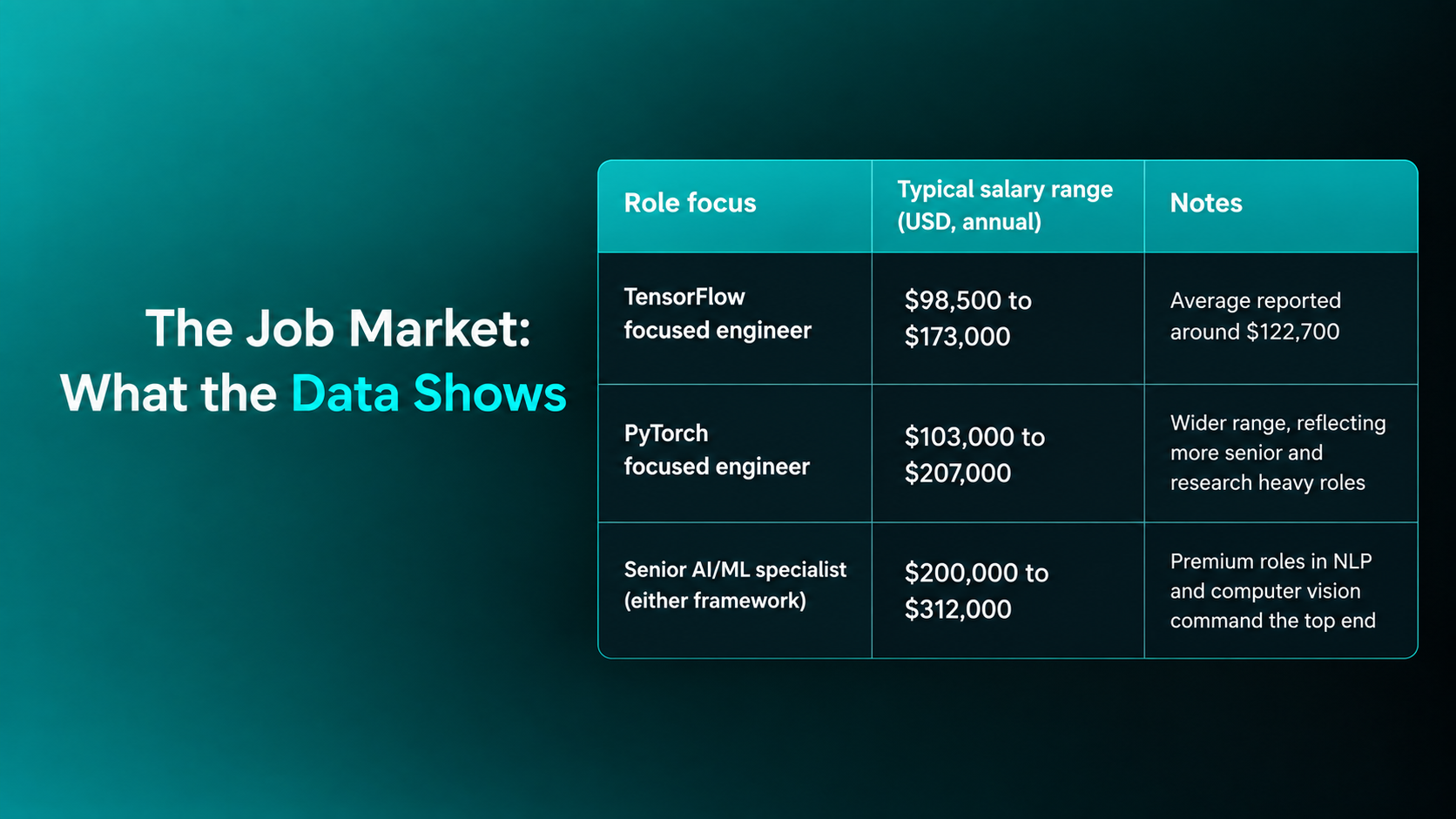
Job postings mentioning PyTorch now sit at around 37.7 percent of machine learning listings, ahead of TensorFlow at 32.9 percent. Python remains the language behind almost all of it, and both frameworks continue to rank among the top skills requested in machine learning roles. The overall machine learning job market grew by roughly 28 percent in the first quarter of 2025 alone, which tells you demand for people who know either framework is not slowing down.
The wider salary band on PyTorch roles is not really about the framework itself. It reflects the fact that PyTorch skills often come bundled with research background, large language model experience, or senior individual contributor status, all of which push pay upward on their own. A junior engineer doing routine data pipeline work in TensorFlow and a senior researcher fine tuning language models in PyTorch are not really in the same labor market, even though both list a deep learning framework on their resume.
For companies that would rather bring in specialists on a project basis than run a lengthy in house search, working with a firm that already has vetted PyTorch and TensorFlow engineers on the bench can shorten the time to hire from months to weeks. This is often the more practical route when you need to hire AI ML developers quickly for a specific deliverable rather than build a permanent team from scratch, particularly for companies without an existing technical interviewer who can evaluate deep learning experience properly.
Should You Hire PyTorch Developers or TensorFlow Developers?
Before writing a job description, it helps to answer a few questions internally, because the framework decision should follow from these, not the other way around.
What does your current production stack already run on? If you have a working TensorFlow Serving setup handling real traffic, hiring PyTorch specialists to rebuild it is usually not worth the risk or the cost.
Is the work closer to research and experimentation, or closer to maintaining a stable pipeline? Research leans PyTorch. Long lived production maintenance leans toward whatever is already running.
Does the product need to run on a phone, a vehicle, or offline hardware? If yes, TensorFlow's mobile tooling still has the edge, and that should weigh heavily in the hiring decision.
Is the roadmap built around language models, fine tuning, or generative AI features? PyTorch is close to a default requirement here, since that is where the open source ecosystem lives.
Do you have budget for one senior hire who can work across both, or several specialists split by framework? Smaller teams often do better with one strong generalist than two narrow specialists who cannot cover for each other.
For most companies starting something new in 2026, PyTorch vs TensorFlow which is better in 2026 resolves in PyTorch's favor by default, simply because most new tooling, research, and pretrained models target it first. The exception is any team whose production environment, deployment target, or existing headcount already leans TensorFlow. In that case, switching frameworks to chase a trend usually costs more than it saves.
Skills to Look for When You Hire AI ML Developers
Framework knowledge alone is not a great filter. Plenty of candidates can list PyTorch or TensorFlow on a resume without having shipped anything that survived contact with real users or real data. When you hire AI ML developers, the framework is only one part of what actually matters.
Solid Python fundamentals, since both frameworks are Python first and weak Python skills show up quickly once code moves past a notebook.
Experience taking a model from a notebook into an actual served endpoint, not just training runs on a local machine.
Familiarity with data pipeline tools like data loaders, sharding, and distributed training, especially for anything beyond small datasets.
Comfort with GPU memory management and mixed precision training, which separates people who have trained small demo models from people who have trained anything at real scale.
Some exposure to model serving and monitoring, whether that is TorchServe, TensorFlow Serving, or a cloud provider's managed endpoint.
Awareness of MLOps basics such as experiment tracking, model versioning, and rollback plans, since a model that cannot be safely rolled back is a liability in production.
Companies that hire AI ML developers purely based on framework keywords in a resume tend to end up with people who can train a model but cannot ship one. The candidates worth prioritizing are the ones who can talk through what happened when a model degraded in production, not just how they built it.
Interview Questions That Separate Real Experience from Buzzwords
A resume listing both frameworks does not tell you much on its own. These questions tend to surface the difference between someone who has actually worked with a framework and someone who has read about it.
Walk me through a time a model performed well in training but poorly once deployed. What changed, and how did you find it?
How would you debug a PyTorch model that trains fine on one GPU but produces different results across multiple GPUs?
What is the tradeoff between eager execution and a compiled graph, and when would you choose one over the other for a specific project?
Have you exported a model to ONNX? What broke, and how did you fix it?
How do you decide whether a slowdown in training is a data pipeline problem or a model architecture problem?
Can You Use Both? Hybrid Teams and ONNX
A growing number of teams are not choosing one framework at all. It is common now to see research and prototyping happen in PyTorch, with the trained model exported to ONNX and served through whatever production stack the company already runs, TensorFlow Serving included. This gives teams the research speed of PyTorch without forcing a rewrite of a working production system.
The tradeoff is that ONNX conversion is not always painless. Custom layers, certain operators, and some quantization schemes do not always convert cleanly, and teams that go this route need at least one engineer who has actually done it before, not just read about it. If your hiring plan includes a hybrid setup, say so directly in the job description. Candidates who have handled a real ONNX export pipeline are noticeably rarer than candidates who know either framework individually.
Common Mistakes Companies Make When Choosing a Framework
Most of the friction around this decision does not come from the frameworks themselves. It comes from how companies approach the hiring and planning around them. A few patterns show up often enough to call out directly.
Picking a framework based on what is trending on social media rather than what the deployment target actually requires.
Hiring a full team of framework specialists before the product direction is settled, then discovering the roadmap needs something else entirely.
Underestimating how expensive it is to rewrite a working production pipeline just to switch frameworks, even when the new one is objectively better suited long term.
Assuming framework experience transfers perfectly between PyTorch and TensorFlow. It transfers reasonably well for someone with strong fundamentals, but not instantly, and not for someone who only knows one framework's high level API.
Writing job descriptions that ask for both frameworks at expert level when the actual day to day work only touches one. This shrinks the candidate pool for no real benefit.
Treating a framework decision as permanent. Most production systems get revisited every few years anyway as hardware, cost, and team composition change, so it rarely needs to be the highest stakes decision a team makes.
Conclusion
The PyTorch vs TensorFlow 2026 decision is not really about which framework is objectively superior, because both are mature enough that the gap has narrowed to specific tradeoffs rather than one clear winner. PyTorch has the research community, the language model ecosystem, and the faster growing share of new production work. TensorFlow has the larger existing install base, stronger mobile tooling, and deep Google Cloud integration that some teams cannot easily walk away from.
The practical move is to look at what you are actually building, what you already run in production, and where the model needs to end up, and hire against that rather than against whichever framework is getting more attention this quarter. If you are still working through the decision or need developers who can work across both frameworks and know when to reach for ONNX instead of picking sides, it is worth talking to a team that hires and vets AI and machine learning engineers for a living rather than guessing from a stack of resumes.
Ayush, the visionary Director leading our team towards new horizons. With a passion for innovation and a keen eye for opportunities, Ayush drives our company's growth with unwavering determination. His strategic thinking and empathetic leadership inspire us all to achieve greatness together.
Frequently Asked Questions
No. PyTorch leads in research and new project starts, but TensorFlow still runs a large share of existing production systems and remains ahead in mobile and edge deployment through LiteRT. Most companies are not abandoning working TensorFlow infrastructure, they are simply starting new projects in PyTorch more often than before.
PyTorch focused roles report a wider salary range, roughly $103,000 to $207,000, compared to $98,500 to $173,000 for TensorFlow roles. This gap reflects role seniority and research exposure more than the framework itself, since PyTorch skills often accompany language model or research experience that already commands higher pay.
Someone with strong Python and deep learning fundamentals can usually pick up the other framework's syntax within a few weeks. The harder part is production tooling, such as TensorFlow Serving or TorchServe, and framework specific debugging habits, which take longer to build real fluency in than the core API does.
Not usually. Many companies run a hybrid setup where models are trained in PyTorch, exported through ONNX, and served on existing TensorFlow infrastructure. This works best with at least one engineer who has handled that conversion process before, rather than assuming it will go smoothly on the first attempt.
Ask what deployment target the model needs to reach, what your current infrastructure already supports, and whether the work leans toward research or long term maintenance. Those answers, not general framework popularity, should drive whether you hire for PyTorch, TensorFlow, or someone comfortable moving between both.
Find exceptional developers at Hourlydeveloper. Get the expertise, solutions, and teamwork you need for success. Hire developers easily and boost your projects today!
 Back to Blog