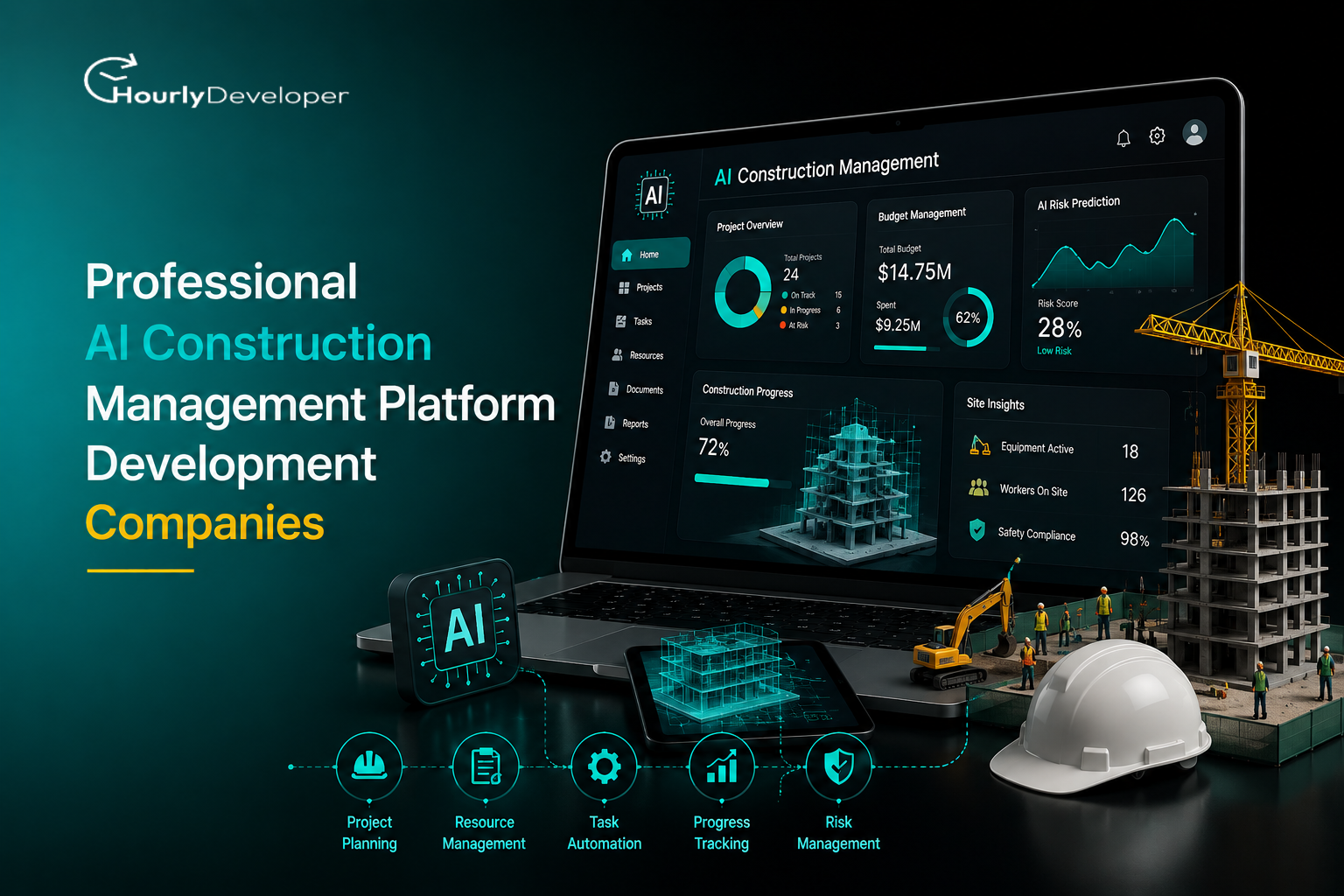
Professional AI Construction Management Platform Development Companies
Introduction
Professional AI Construction Management Platform Development Companies
1.Why Construction Companies Are Investing in AI Right Now
Smart construction application development is becoming one of the fastest growing lines of work inside IT services companies, and there is a reason for that. The construction industry has three problems that will not fix themselves. Skilled labor is harder to find every year, material costs swing without warning, and project delays are almost the default rather than the exception. A well built AI platform attacks all three at once. It can forecast which trades are likely to fall behind schedule, flag a budget line before it goes over, and route safety alerts to the right supervisor in real time instead of after an incident report gets filed. None of this requires a massive internal IT department either, since most of these platforms are built to run on cloud infrastructure that a small operations team can manage without hiring a dedicated engineering staff.
This is exactly why smart construction application development has moved from a nice to have to something boards actively budget for. Firms are no longer asking whether they need this kind of software. They are asking who can build it properly, on time, and within a budget that makes sense for a mid sized contractor rather than only for the largest national builders.
2.What to Check Before You Hire a Development Partner
Not every software vendor that lists construction as an industry actually has people who have worked on a real jobsite problem. Before you hire AI construction software developers, ask to see a past project that solved something specific, like predictive maintenance for heavy equipment or automated compliance checks for OSHA reporting. A generic portfolio full of unrelated apps is a warning sign, not a reassurance.
It also matters whether the team can integrate with what you already use, such as Procore, Autodesk BIM 360, or your existing ERP. A platform that cannot talk to your current systems creates more manual work, not less. The companies below were chosen with this in mind, and each one is described with the kind of detail a decision maker actually needs before reaching out. Company size is another factor worth weighing early. A 15 person studio can offer more direct access to senior engineers, while a 500 person firm can absorb a sudden scope increase without missing a deadline. Neither is automatically the better choice, and the right answer depends entirely on what your project actually needs.
3.What These Projects Actually Cost in 2026
Budget conversations tend to get vague fast, so it helps to set expectations early. A basic platform covering scheduling, reporting, and one core AI feature usually starts in the tens of thousands of dollars, while a full enterprise build with multiple integrations, predictive modeling, and custom hardware connections can run into six figures without much trouble. Team location changes this significantly too, since a company based mainly in India or Eastern Europe often delivers similar quality at a noticeably lower hourly rate than a team based entirely in the United States or Western Europe.
None of this means the lowest bid is the smartest choice. A founder should compare quotes on what is actually included, not just the total number at the bottom of the proposal. Two companies quoting a similar figure can mean very different things once you factor in post launch support, the number of revision rounds included, and whether AI model tuning after launch is billed separately or bundled into the original scope.
HourlyDeveloper works on a transparent, pay as you go model that many founders find easier to budget for than a fixed bid contract. Their teams build custom construction management software, including scheduling tools, budget tracking dashboards, and AI powered reporting features. Clients who want to hire AI developers without committing to a large upfront retainer often start here, since the hourly structure lets a company test the relationship on a smaller project first. Their developers have experience connecting new platforms to existing ERP and accounting systems, which matters for contractors who do not want to rebuild their entire back office. Weekly time logs and sprint reports are shared directly with the client, so there is rarely any guessing about where the budget actually went that month. This also makes it easier for a founder to scale the team up during a busy quarter and scale back down once a module ships, instead of being locked into a fixed headcount for the entire year.
Location: United States, with delivery centers in Europe
ScienceSoft has been in the custom software business for over three decades, and construction technology is one of its established practice areas. The company builds project management platforms, IoT enabled equipment tracking, and predictive analytics tools for cost estimation. Their process leans heavily on documented discovery phases before any code gets written, which suits founders who want a clear scope before committing budget. ScienceSoft also offers dedicated maintenance contracts after launch, so the relationship does not end the day the platform goes live. Their teams have also worked on compliance heavy projects, including systems that generate automated safety documentation for regulatory audits, which can save a construction company real time during inspection season.
Location: India, serving clients across North America and Europe
As the name suggests, this company specializes in the infrastructure layer that most construction platforms depend on, things like real time data pipelines, secure API architecture, and database design that can handle thousands of daily field updates without slowing down. Their engineers frequently partner with frontend teams or in house designers, which makes them a strong fit for founders who already have a product vision and need reliable backend architecture behind it. They have delivered systems that sync data between mobile field apps and office dashboards with minimal lag. Because their focus stays narrow, their teams tend to move quickly on the kind of technical problems that stall other vendors, like handling patchy site connectivity or reconciling data from several different subcontractor systems at once.
Matellio focuses heavily on AI and machine learning integration inside custom software, and construction is a repeat vertical for them. Recent projects include predictive scheduling tools that flag likely delays before they happen and computer vision systems that scan jobsite photos for safety violations. Their team tends to start engagements with a short discovery sprint to map out feasibility, which helps founders avoid overbuilding a feature that the AI model cannot realistically support yet. They also spend time explaining the limits of a given model in plain language, which is genuinely useful for a non technical founder trying to figure out what a first version should and should not include.
This company builds complete, end to end construction management platforms rather than isolated modules. A single team typically covers the mobile app for field staff, the admin dashboard for office managers, and the AI layer that handles forecasting and reporting. Founders who want to avoid coordinating between three different vendors for frontend, backend, and AI often choose this route instead. Their pricing tends to be competitive relative to teams based in the United States or Western Europe, without a noticeable drop in communication quality. Daily standups and weekly demos are standard practice, which keeps a client involved in decisions rather than waiting weeks for a single big reveal at the end of a sprint cycle.
Appinventiv has built a name in AI, IoT, and blockchain based enterprise software, and their construction portfolio includes fleet tracking systems and automated compliance platforms. They tend to work with mid size to large contractors who need a platform that scales across multiple regional offices. Their teams also handle data security certifications, which matters for clients who work with government contracts or public infrastructure projects and need to meet stricter compliance standards. Their delivery model usually includes a dedicated technical architect on the account, someone a founder can go to directly with tough questions instead of routing everything through a general account manager.
Location: United States, with engineering teams in India
Simform is known for strong DevOps and cloud engineering practices, which is a less glamorous but genuinely important part of any AI platform. A construction management tool is only useful if it stays online during a storm, a power outage at a regional office, or a sudden spike in field app usage. Simform builds with this kind of reliability in mind from day one, and their cloud architecture choices tend to reduce long term hosting costs for clients running the platform across several job sites. They also run load testing before launch that simulates hundreds of field workers hitting the app at once, which catches performance issues long before they show up on a live site during peak construction season. They also document their infrastructure decisions clearly enough that a client’s internal IT team can take over maintenance later on, if that ever becomes the goal down the line.
This team is built specifically around AI and machine learning work, which makes them a natural fit for construction firms that already have a working platform but want to add predictive features, like cost overrun alerts or automated resource allocation. Founders who already tried to hire AI developers through general staffing agencies and got generalists instead of specialists often end up here, since the entire company is structured around model training, data pipeline work, and AI feature deployment rather than general app development. They also spend real time cleaning and organizing historical project data before training any model, which is unglamorous work but usually the difference between a prediction tool that is actually accurate and one that just looks impressive in a sales demo. They are also comfortable working alongside an existing development team rather than replacing it, which suits a founder who already has an in house team but lacks in house AI expertise.
OpenXcell has a long track record in mobile app development, and their construction industry work leans toward field facing apps for site supervisors and subcontractors. Their platforms typically include offline mode, since jobsite internet connectivity is unreliable at best, and data syncs automatically once a device reconnects. This is a detail smaller vendors sometimes overlook, and it becomes a real problem once a platform is actually being used on an active site rather than in a demo. Their teams have also built simple photo based progress tracking tools, where a supervisor snaps a picture and the software logs it against the correct project milestone automatically, cutting out a step that used to eat up a good chunk of a foreman’s afternoon.
Location: United States, United Kingdom, and Ukraine
Intellectsoft has worked with several large construction and real estate clients on enterprise grade platforms, including tools that combine IoT sensor data with AI based predictive maintenance for heavy machinery. Their engagements tend to be larger in scope and budget, which suits founders running multi state or multi country operations rather than a single regional contractor. They also publish detailed case studies, which gives a shortlisting team something concrete to evaluate rather than only marketing language. Their teams have experience running pilot programs on a single job site before a company wide rollout, which lowers the risk for a founder who wants proof that a platform works before it touches every project the company has running at once. Their account teams are also used to coordinating across time zones for clients with international operations, which is a genuine consideration for any company running projects outside its home country.
Location: Ukraine, serving clients in the United States and Europe
Binariks brings a strong background in data heavy platforms, originally built around healthcare and fintech work, which translates well into construction analytics dashboards that need to process large volumes of financial and scheduling data reliably. Their teams are known for thorough QA processes before a release goes out, which matters for platforms handling payroll or subcontractor payments where an error is expensive rather than just annoying. That background in regulated industries also means their engineers are comfortable working within strict data privacy requirements, which comes up more often than expected once a platform starts storing worker identification and payment details.
Trigent has decades of experience in software product engineering across several industries, and their construction technology work includes custom ERP modules and reporting tools built around client specific workflows rather than a one size fits all template. Firms with unusual internal processes, built up over years of doing things a certain way, often prefer a partner like Trigent that will actually adapt the software to match existing habits instead of asking the client to change how they work. Their discovery process usually includes actual site visits or detailed workflow interviews with field staff, not just conversations with office management, which tends to surface requirements that get missed when only executives are consulted. This kind of groundwork usually pays off later, once the platform is actually in use and needs far fewer revisions than one designed purely from an office whiteboard.
Location: India, with offices in the United States and United Kingdom
Hidden Brains has built a reputation around mobile and web application development for mid size businesses, and their construction sector clients typically want a practical, no frills platform rather than an experimental one. Their pricing structure tends to work well for founders who need a solid, working product within a defined budget rather than an open ended research and development engagement. They also offer fixed price packages for common modules like scheduling or invoicing, which gives a founder a clearer starting point for budgeting than an hourly estimate that could shift as the project unfolds.
Konstant Infosolutions focuses on mobile and web platforms with a straightforward, deadline driven delivery style. Their construction industry projects have included inventory tracking apps and basic project dashboards for smaller contractors who are just starting to move away from spreadsheets. This makes them a reasonable option for founders who want to hire AI construction software developers for a first version of a platform before scaling up to more advanced predictive features later. Their smaller team sizes also mean a founder is more likely to work directly with the same two or three developers throughout the project, rather than being handed off between rotating staff on a larger account.
Space-O Technologies has built a wide range of mobile applications across industries, and their construction sector work includes field reporting apps and basic scheduling tools. They tend to be a good fit for founders who want a functional, well tested mobile app quickly, with the option to expand into more advanced AI features once the core platform is already in daily use on active job sites. Their teams also handle app store submission and ongoing updates as part of standard packages, which removes one more task from a founder’s plate after the initial build is complete.
5.How to Actually Decide Between These Companies
A shortlist of 15 names is only useful once it gets narrowed down. Serious AI construction software development work shows up in specifics, like a named client, a described problem, and a measurable outcome, rather than vague claims about innovation. Start by ruling out anyone whose past work does not include a real construction client, not just a generic enterprise software portfolio. Then look at team structure. A company that assigns a dedicated project manager and a stable core team tends to deliver more consistent results than one that rotates developers in and out mid project.
It also helps to ask how a company handles disagreement. Every software project hits a point where the client wants a feature the original timeline did not account for, and how a vendor responds to that moment tells you a lot about what the next 12 months of the relationship will look like. A team that pushes back with a clear explanation, rather than either refusing outright or agreeing to everything without discussing the tradeoffs, is usually the more experienced one.
Budget matters, but the cheapest bid is rarely the safest choice for an AI Construction Management Platform, since predictive features and machine learning models need ongoing tuning after launch, not just a one time build. Ask every company on your shortlist what post launch support actually includes, and get it in writing before signing anything. A platform that works well in a demo but has no support plan after month two is not a platform at all. It is a liability waiting to surface during your busiest season.
Finally, talk to at least one past client if the company can arrange it. A short reference call, even 15 minutes, tends to surface things a case study never will, like how the team handled a missed deadline or whether the same developers stayed on the project from start to finish. Founders who skip this step are more likely to find out about a team’s actual working style only after signing a contract, which is the most expensive time to learn it.
6.Final Thoughts
None of these 15 companies are the right choice for every contractor, and that is actually the point. A national builder running projects across six states needs a different partner than a regional contractor with 40 employees and one office. What matters is matching the size and style of the development team to the size and complexity of your actual operation, not chasing whichever company has the flashiest case study.
It is also worth remembering that this decision does not have to happen all at once. Plenty of founders start with a single module, like an AI powered scheduling tool or an automated safety reporting feature, before committing to a full platform build. That approach lowers the financial risk and gives a company a real chance to prove itself on a smaller piece of work before it touches every project you have running.
If there is one thing worth repeating before you make a call, it is this. The best AI Construction Management Platform is not the one with the longest feature list. It is the one your site managers and subcontractors will actually open every single day, because it saves them time instead of adding to their workload. Start conversations with two or three names from this list, ask hard questions about post launch support, and let the answers guide the decision rather than the sales pitch. The right development partner in 2026 is out there for almost every budget and every size of operation. It just takes asking the right questions before the contract gets signed instead of after.
Digital Marketing Manager: With a passion for data-driven strategies and an instinct for spotting trends, Radhika navigates the virtual realm with finesse. Her commitment to staying ahead of the curve ensures our brand's message reaches the right audience at the right time.
Frequently Asked Questions
Most mid sized platforms take between 4 and 8 months from discovery to launch, depending on how many modules are included. A basic scheduling and reporting tool moves faster, while adding predictive analytics or computer vision for safety monitoring can add several additional months to the timeline and testing phase before a stable release ships.
Pricing varies widely based on scope, but a functional platform with core scheduling, reporting, and one AI feature usually falls between $40,000 and $150,000. Larger enterprise builds with multiple integrations and advanced predictive modeling can run well past $250,000 depending on team location, complexity, and how many field devices need support.
Most established firms on this list offer maintenance contracts covering bug fixes, security patches, and periodic model retraining for AI features. The terms vary significantly, so it is worth requesting a written support agreement with defined response times and monthly costs before signing the initial development contract with any vendor.
Yes, many of the companies listed offer AI integration services for existing platforms rather than requiring a full rebuild. This usually costs less and takes less time, though it depends heavily on whether your current system has clean, accessible historical data for the AI models to actually learn from and improve over time.
Smaller contractors often get faster attention from mid size development firms that are eager for repeat business, compared to being a small account at a large enterprise vendor. Starting with a smaller pilot module rather than a full platform build is also a practical way to test the partnership before committing a larger budget.
Find exceptional developers at Hourlydeveloper. Get the expertise, solutions, and teamwork you need for success. Hire developers easily and boost your projects today!
 Back to Blog