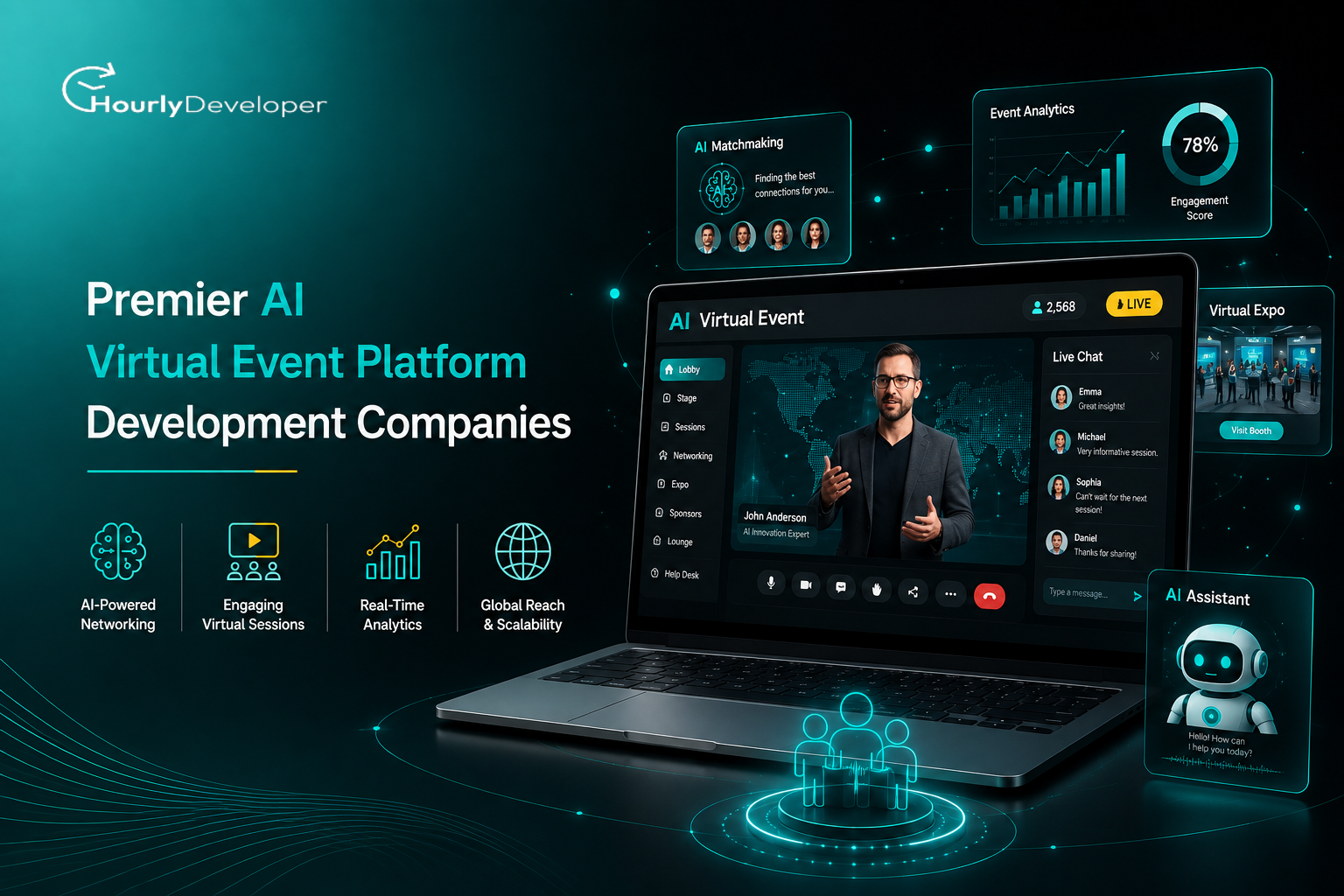
Premier AI Virtual Event Platform Development Companies
Introduction
Premier AI Virtual Event Platform Development Companies
1.What Is an AI Virtual Event Platform?
Before comparing vendors, it helps to get clear on what we are actually talking about. An AI Virtual Event Platform is event software that uses artificial intelligence, not just video streaming and registration forms, to run the entire attendee journey. That includes matching attendees with the right sessions and people, answering questions instantly through a chatbot, translating content in real time, and generating reports on what worked and what did not once the event wraps up.
Traditional virtual event tools were mostly about logistics. You could stream a keynote, collect registrations, and maybe run a poll. An AI powered platform goes further. It studies attendee behavior as the event happens and adjusts the experience on the fly. If someone spends ten minutes browsing sessions related to fintech, the platform can quietly recommend three more fintech sessions and introduce them to two attendees working in that space. That is the difference between hosting an event and running an intelligent one.
There is also a practical side to this that founders often underestimate. Building a platform like this is not a single feature, it is a stack of interconnected systems, video infrastructure, a recommendation engine, a chatbot layer trained on your event content, and an analytics pipeline that ties everything together after the event ends. Each of those pieces needs a different kind of engineering depth, which is exactly why the choice of development partner matters so much more here than it would for a simple marketing website.
Some organizers only need one or two of these AI layers to start, like smart matchmaking for a networking heavy summit, while others need the full stack for a large multi-track conference. Knowing which pieces matter most for your specific event helps you scope the conversation with any development partner before you even get on a call.
2.Why Businesses Are Investing in AI Virtual Event Platforms
Most companies do not wake up one day and decide they want an AI Virtual Event Platform. They arrive at that decision because something about their current event process is broken. A few problems come up again and again in conversations with event organizers and founders planning their 2026 calendar.
Low attendee engagement is usually the first complaint. Attendees log in, watch a session passively, and log off without interacting with anyone. Without AI driven prompts, polls, or matchmaking, virtual audiences tend to disengage within the first twenty minutes, and once that happens, they rarely come back for the second or third session of the day, no matter how good the content is.
Manual event management eats up entire teams. Someone has to manually approve registrations, assign session tracks, answer repetitive attendee questions, and stitch together feedback from five different tools once the event ends. This is exhausting work that AI can automate almost entirely, freeing up staff who would otherwise spend an entire week just on post-event admin instead of planning the next one.
Difficulty matching attendees is a quieter but costly problem. Sponsors pay good money expecting quality introductions, but without smart matchmaking, most attendees never find the right person to talk to. This directly hurts renewal rates for paid sponsorships, and it is often the single biggest reason a sponsor quietly declines to come back the following year.
Limited networking opportunities follow from the same root cause. Chat rooms and generic breakout sessions rarely lead to meaningful conversations. People need a system that actively suggests who they should meet, based on shared goals or industry, rather than leaving them to guess who among five hundred strangers might actually be worth a five minute conversation.
Managing large-scale virtual events becomes genuinely difficult once attendee counts cross a few thousand. Manual moderation, support tickets, and content scheduling collapse under that volume without automation handling the repetitive layers, and event staff end up firefighting instead of focusing on the parts of the event that actually need a human touch.
Personalizing attendee experiences at scale is nearly impossible without AI. A live event manager cannot personally track five thousand attendee preferences, but an algorithm can, and it can act on that data instantly, adjusting agendas, recommendations, and even follow up emails on the fly for every single person logged in.
Finally, measuring event ROI is where a lot of organizers get stuck. Sponsors and stakeholders want real numbers on engagement, lead quality, and networking outcomes, not just a headcount of who logged in. This same scrutiny now extends to nearly every category of specialized software a company evaluates, from event platforms to something entirely different like an AI Crypto Portfolio Tracker built for a finance team, because budget holders want to see hard outcomes before renewing any contract.
3.Benefits of AI-Powered Virtual Event Platforms
Once these problems are solved, the upside is significant, and it shows up in ways that are easy to measure rather than vague promises about a better attendee experience.
Higher attendee engagement comes naturally when the platform nudges people toward content and conversations that actually interest them, instead of leaving them to figure it out alone. Organizers typically see session completion rates climb once recommendations start doing the work that a printed agenda never could.
Better networking opportunities follow because AI matchmaking introduces attendees based on real signals like job title, interests, and past interactions, rather than random chance. This is often the single feature attendees mention most in post-event surveys, ahead of even the keynote content itself.
Increased event attendance happens when personalized reminders, smart scheduling, and relevant session previews keep people coming back for more sessions instead of dropping off after the opening keynote. Attendees stay because the platform keeps surfacing something worth their time.
Improved sponsor ROI is one of the most business critical benefits. When sponsors can see exactly who engaged with their booth and how many qualified leads came through, they are far more likely to renew and increase their spend next year, which directly protects your event’s revenue model.
Reduced operational workload frees up event teams from repetitive manual tasks like registration approvals and FAQ handling, so they can spend their time on strategy instead of admin work, which matters enormously for lean teams running events without a large operations department.
Personalized attendee journeys mean every single person gets an agenda that reflects what they actually care about, not a generic one size fits all schedule that ignores their role, industry, or reason for attending in the first place.
Actionable event analytics give organizers a clear picture of what worked, down to which sessions had the highest drop off rates and which speakers drove the most engagement, so the next event can be planned around evidence instead of guesswork.
Scalable event management means a team of five can run an event for fifty thousand attendees almost as smoothly as one for five hundred, because the AI is handling the repetitive layers automatically. This is exactly why so many founders now choose to hire AI virtual event developers rather than trying to retrofit AI features onto an old, static platform.
The demand for this kind of software is only growing. Corporate training, product launches, investor days, and even government town halls are shifting toward virtual and hybrid formats permanently, not just as a pandemic era workaround. That is pushing more founders to look for the Best AI virtual event software development companies who can build something tailored to their industry rather than a generic, one size fits all product. This mirrors a broader shift happening across enterprise software right now, where founders increasingly want a purpose-built tool for a specific job, whether that is an event platform for a global summit or something completely different like an AI Crypto Portfolio Tracker built for a fintech client, instead of a bloated, all-purpose system that does everything adequately and nothing particularly well. Whether you already have a shortlist of AI virtual event platform development companies or are starting from scratch, the profiles below should give you a clearer sense of who specializes in what.
4.12 AI Virtual Event Platform Development Companies Worth Shortlisting
Hourly Developers is a go-to name for companies that want to hire AI virtual event developers without committing to a large, rigid team structure. The company has built a reputation over more than two decades for flexible hiring models, letting clients bring on engineers hourly, part-time, or full-time depending on project scope. Their engineering pool includes over 220 developers experienced in real-time video infrastructure, AI matchmaking algorithms, and scalable backend systems, which matters a lot when you are trying to support thousands of concurrent attendees without the platform slowing down. Clients often start with a small proof of concept, like an AI powered networking feature or a smart agenda builder, before scaling up to a full platform build. This makes Hourly Developers a strong pick for founders who want to test an idea before committing to a bigger contract, and it also suits teams who already have some engineering in-house but need to plug specific gaps quickly rather than replacing their whole stack.
2. Matellio Inc.
Headquarters
San Jose, California, USA
Founded / Experience
2014
Team Size
250+ professionals
Known For
Custom AI and ML engineering for enterprise clients
Matellio is a US based software engineering studio, headquartered in San Jose, California, with additional engineering teams across India and the United Kingdom. Founded in 2014, the company has grown to over 250 professionals and has completed more than a thousand custom software projects across healthcare, finance, and enterprise sectors. For virtual event platforms specifically, Matellio brings strong experience in machine learning based content recommendation, IoT integrations for hybrid event setups, and cloud native architecture that can handle large simultaneous audiences. Their hybrid onshore and offshore delivery model tends to appeal to founders who want the accountability of a US based studio combined with the cost efficiency of an offshore engineering team, and their enterprise client history means they are comfortable navigating procurement and compliance conversations that smaller agencies sometimes struggle with.
As the name suggests, Backend Development Company has built its entire identity around one thing, server side engineering. For an AI Virtual Event Platform, the backend is where most of the heavy lifting actually happens, from real time video routing to processing attendee data for AI matchmaking, and this team specializes exclusively in that layer. They work with API architecture, database optimization, and cloud native infrastructure, serving startups, SaaS companies, and enterprise clients across the United States. Their narrow focus means they are not distracted by design or marketing services, so if you already have a front end team and need someone to build a backend that will not buckle under thousands of concurrent connections, this is worth a serious look, particularly for event platforms expecting a sudden traffic spike right at keynote time.
4. Bacancy Technology
Headquarters
Ahmedabad, India, with offices in Miami and New York, USA
Founded / Experience
2011
Team Size
1,000+ employees
Known For
Large-scale AI, ML, and enterprise engineering teams
Bacancy Technology is one of the larger names on this list, founded in 2011 and headquartered in Ahmedabad, India, with additional offices in the United States including Miami and New York. The company has grown to over a thousand employees and has delivered work for recognizable global brands. Bacancy’s AI development practice covers machine learning, natural language processing, and computer vision, all of which show up directly in modern virtual event features like smart chatbots, automated captioning, and behavior based session recommendations. Their scale means they can staff a large dedicated team quickly, which is useful if your event platform needs to launch on a tight timeline, and their agile delivery process gives founders regular visibility into progress instead of waiting for a single big reveal at the end.
OpenXcell has been in the IT consulting and custom software space since 2009, with its main development center in Ahmedabad, India, and a team of over 500 professionals. The company has built a strong track record in machine learning, cloud computing, and AI strategy work, and its portfolio includes AI powered platforms across several industries. For event platform builds specifically, OpenXcell brings experience integrating custom large language models into products, which is increasingly relevant for features like AI event assistants that can answer attendee questions in natural language instead of relying on rigid FAQ bots. Their CMMI Level 3 certification is also worth noting for founders who need documented process discipline for enterprise procurement reviews.
Combined front-end and backend delivery under one team
HireFullStackDeveloperIndia is built for founders who need one team that can own both the front end and backend of an event platform, rather than coordinating between separate specialists. Based in Ahmedabad, India, the company offers flexible hourly, part-time, and dedicated hiring models, and its developers work across the MERN, MEAN, and Python stacks along with cloud database management. This full stack approach can shorten development timelines meaningfully, since the same team designing the attendee interface also understands exactly how the backend and AI features need to communicate with it, reducing the back and forth that usually happens when two separate vendors are involved, and simplifying the maintenance conversation once the platform actually goes live.
7. Space-O Technologies
Headquarters
Ahmedabad, India, with offices in Canada and the USA
Founded / Experience
2010
Team Size
250+ employees
Known For
Cross-platform mobile companion apps for events
Space-O Technologies has been building mobile, web, and software products since 2010, and is headquartered in Ahmedabad, India, with additional offices in Canada and the United States. The company has delivered thousands of applications for global clients and has a dedicated AI and machine learning practice alongside its core mobile development work. For an AI powered event platform, this matters because attendees increasingly expect a companion mobile app alongside the desktop experience, complete with push notifications, offline agenda access, and in-app networking features. Space-O’s cross platform expertise makes them a solid option if a mobile app is just as important to your event strategy as the web platform, and their portfolio of consumer facing apps suggests they understand attendee experience beyond just enterprise dashboards.
8. Konstant Infosolutions
Headquarters
Jaipur, Rajasthan, India, with an office in New York, USA
Founded / Experience
2003
Team Size
150-200 professionals
Known For
Two decades of mobile and web application delivery
Konstant Infosolutions is a veteran in this space, founded back in 2003 and based in Jaipur, Rajasthan, with an additional office in New York. With a team in the range of 150 to 200 professionals, the company has built its reputation on mobile and web application development, and has expanded into AI and machine learning services in recent years. Their long operating history means they have weathered several technology cycles, which can be reassuring if you are looking for a partner who will still be around to support your platform years after launch, not just at delivery, and their smaller team size often translates into more direct access to senior developers rather than layers of account management.
United States, with delivery teams serving global clients
Founded / Experience
AI-focused development practice
Team Size
180+ professionals
Known For
120+ delivered AI projects and high client retention
HireAIDevelopers is exactly what its name promises, a team built specifically around artificial intelligence projects rather than general software development. The company has delivered more than 120 AI projects with a team of over 180 professionals, and reports an unusually high client retention rate. For virtual event platforms, their specialization shows up in features like intelligent attendee matchmaking, predictive analytics for event ROI, and natural language chatbots that can genuinely understand attendee questions rather than matching keywords. Founders who already have a development team in place but specifically need to hire AI developers for the intelligence layer of their platform tend to gravitate toward this kind of specialist, treating them almost like an AI consultancy bolted onto an existing engineering roadmap.
10. Peerbits
Headquarters
Ahmedabad, India, with offices in the UAE, Saudi Arabia, and Colombia
Founded / Experience
2011
Team Size
180+ professionals
Known For
Enterprise mobility across global time zones
Peerbits has been operating since 2011 out of Ahmedabad, India, with a global footprint that includes offices in the UAE, Saudi Arabia, and Colombia. The company has a team of around 180 professionals and has delivered custom mobility and software solutions for healthcare, logistics, and education clients. Peerbits’ enterprise mobility background is a genuine advantage for event platforms that need to support attendees across different devices, time zones, and connectivity conditions, especially for events that draw a genuinely global audience rather than one concentrated in a single region, where bandwidth and device assumptions simply cannot be one size fits all.
11. Zealous System
Headquarters
Ahmedabad, India
Founded / Experience
2008
Team Size
150-170 employees
Known For
Long-term product partnership over one-off delivery
Zealous System, founded in 2008 and headquartered in Ahmedabad, India, is a mid-sized software development company with roughly 150 to 170 employees. The team works across modern frameworks including React, Node.js, and Flutter, and has expanded into AI and IoT development over the past several years. What stands out about Zealous System is their emphasis on long-term partnership rather than one-off delivery, working closely with clients to understand how an event platform needs to evolve after the initial launch, not just during the build phase, which matters for a product that needs new features added after every event cycle.
Noida, India, with a development center in Amsterdam, Netherlands
Founded / Experience
2018
Team Size
250+ professionals
Known For
Modern AI tooling built without legacy technical debt
Appventurez was founded in 2018 in Noida, India, and has grown quickly to a team of around 250 professionals, with international development centers including one in Amsterdam. The company works across mobile app development, AI, machine learning, and blockchain, and has served more than 500 clients since its founding. Being one of the newer names on this list, Appventurez tends to bring a more current approach to AI tooling, since their engineering practices were built around modern frameworks from day one rather than retrofitted onto legacy systems, which can translate into faster iteration once your platform is live and collecting real attendee data.
So here is the real question worth sitting with. Is your current event process actually built for the attendees you have in 2026, or is it still running on the assumptions that made sense five years ago, back when a simple livestream and a chat box felt like enough.
Attendee expectations have moved fast, and there is a real cost to falling behind them, whether that shows up as declining attendance, sponsors who quietly stop renewing, or a networking experience that never quite delivers the connections people came for. The good news is that closing that gap does not require starting from scratch, and it rarely means throwing out everything you already have working.
Whether you decide to hire AI virtual event developers for a full custom build or bring in a specialist team to hire AI developers for just the intelligence layer, the companies on this list represent a genuine cross section of what is available right now, from large scale engineering studios to focused AI specialists, and from teams that have been doing this for over two decades to newer players building with the most current frameworks available.
Take the time to actually talk to two or three of them before deciding. Ask each one to walk you through a past project that resembles yours, not just a generic capabilities deck. The right partner should be asking you just as many questions about your attendees as you are asking them about their portfolio, because a platform this personal to your audience cannot be built well by a team that never bothered to understand who that audience actually is.
With a pen in hand and creativity in her heart, Nidhi crafts compelling narratives that captivate our audience and leave them wanting more. Her versatile writing style effortlessly adapts to various genres, ensuring our message resonates with readers from all walks of life.
Frequently Asked Questions
Most custom builds take between 10 and 18 weeks depending on scope. A basic MVP with registration, streaming, and simple AI matchmaking can launch faster, while a full platform with predictive analytics, multilingual support, and a companion mobile app typically needs the longer end of that range to test properly before a live event.
Costs vary widely based on team location and feature depth, generally ranging from $25,000 for a focused MVP to well over $150,000 for an enterprise-grade build with advanced AI features. Hourly hiring models often work out cheaper for phased builds, while fixed-scope contracts suit teams with a clearly defined feature list from day one.
Indian companies generally offer stronger cost efficiency and large available teams, useful for scaling quickly, while US based studios often provide easier time zone overlap and in-person meetings. Many founders now choose a hybrid approach, pairing offshore engineering with local project oversight to balance cost, speed, and communication ease across the entire project timeline.
Yes, most experienced vendors on this list build with open APIs specifically so event data, including registrations, session attendance, and lead scores, can sync automatically with existing CRM and marketing tools. Always confirm integration scope during scoping, since deep two-way syncing typically costs more than a basic one-way data export.
Look for SOC 2 Type II compliance and GDPR readiness at minimum, especially if attendees will be based in Europe. For events handling payment data or health information, ask specifically about PCI DSS or HIPAA experience, since not every general software vendor has handled those specific compliance requirements before starting a project.
Find exceptional developers at Hourlydeveloper. Get the expertise, solutions, and teamwork you need for success. Hire developers easily and boost your projects today!
 Back to Blog