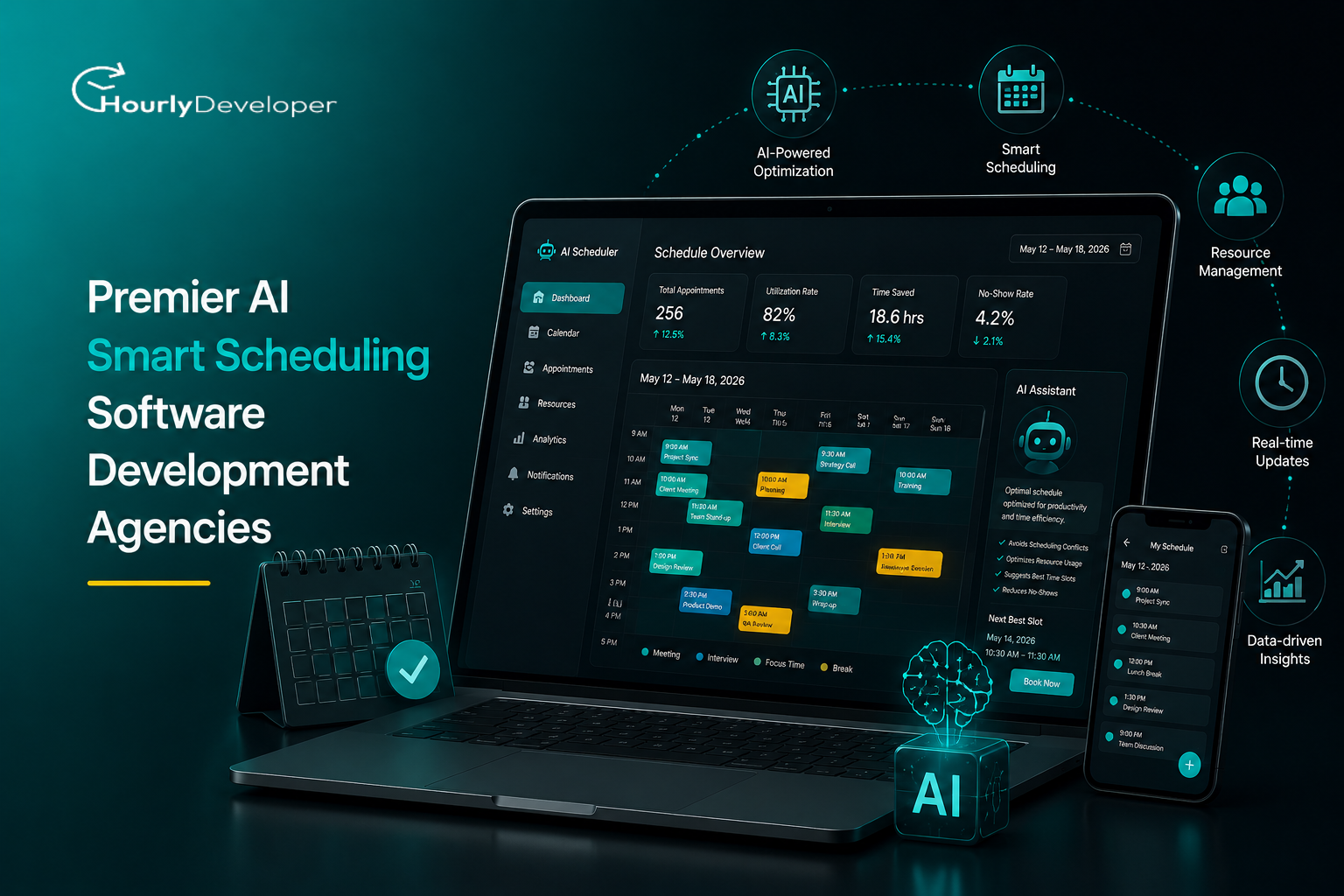
Premier AI Smart Scheduling Software Development Agencies
Introduction
Premier AI Smart Scheduling Software Development Agencies
1.What Makes AI Smart Scheduling Software Different in 2026
Basic scheduling tools sort events on a calendar. AI Smart Scheduling Software goes further because it treats a calendar as a living system with constraints that change by the hour. A field service company might need to balance technician skill sets, travel time, parts availability, and customer preference all at once. A clinic might need to predict no shows before they happen and fill that slot automatically instead of leaving it empty. A hiring platform might need to route interview slots across time zones without a recruiter touching a spreadsheet.
What separates the best AI scheduling software development companies from the rest is how they solve these problems under the hood. The strongest platforms combine constraint based optimization engines with machine learning models trained on historical booking data, so the system gets better at predicting demand and preventing conflicts the longer it runs. Real time sync with existing calendars, CRMs, and ERPs matters just as much as the intelligence layer itself, because a scheduling engine that lives in isolation from the rest of a business quickly becomes another tool nobody trusts.
Cost is also shifting. Where scheduling software used to be a fixed line item, in 2026 many vendors price based on usage volume or the number of active resources being scheduled, which means the underlying architecture has to be built for scale from day one rather than retrofitted later. This is part of why choosing the right development partner matters more now than it did five years ago.
Adoption has also broadened beyond the industries most people expect. Property management firms now use AI Smart Scheduling Software to coordinate maintenance visits across hundreds of units without double booking a single technician. Universities use it to place thousands of exam slots around room capacity and invigilator availability in a fraction of the time a manual process would take. Even small professional practices, such as law firms and accounting offices, are adopting lightweight versions of this technology simply to stop losing billable hours to scheduling back and forth over email.
2.What to Check Before You Hire AI Scheduling Software Developers
Not every software partner that lists AI on their homepage can actually deliver a scheduling engine that holds up under real traffic. Before you hire AI scheduling software developers, it helps to look past the pitch deck and ask a few direct questions.
First, ask how the team handles conflict resolution logic specifically, since this is usually the hardest part of any scheduling system and the part most likely to break in production. Second, ask for examples of integrations they have built with calendar systems, payment gateways, or industry specific tools such as electronic health record platforms or field service management software, because integration work often takes longer than the AI model itself. Third, ask about their approach to data privacy, particularly if the platform will handle healthcare appointments, financial consultations, or any booking data covered by regulations such as HIPAA or GDPR.
Pricing structure is worth clarifying early too. Some agencies quote a fixed project fee, others work on a dedicated team model billed monthly, and a few offer hourly engagement for smaller feature additions. None of these models is inherently better, but mismatched expectations around pricing are one of the most common reasons scheduling projects stall midway. The companies listed below each bring a different strength to the table, so read through their profiles with your specific use case in mind rather than picking whichever name appears first.
It is also worth asking who will actually own the code once the project ships. Some agencies hand over full source code and documentation as standard practice, while others keep certain proprietary scheduling algorithms under license, which can matter later if you ever want to switch maintenance providers. Getting this in writing before a contract is signed avoids an awkward conversation down the line, especially if the scheduling platform becomes central to daily operations.
Team location and time zone overlap deserve a mention too, even though they rarely make it onto a formal evaluation checklist. A team that shares four or five working hours with yours each day can move through requirements clarifications far faster than one relying entirely on overnight handoffs, particularly during the first few weeks when the scheduling rules are still being defined. This does not rule out fully offshore teams, since several on this list operate that way successfully, but it is a factor worth weighing against cost savings rather than assuming it will not matter.
3.The Premier AI Smart Scheduling Software Development Agencies to Know in 2026
HourlyDeveloper works with startups and growing companies that want a scheduling platform built without a rigid fixed price contract. The company is built around flexible staffing, letting clients scale a development team up or down as a project moves from prototype toward production, and its developers regularly rotate onto scheduling projects across industries such as home services, tutoring platforms, and small clinics.
Key Services
Custom AI Smart Scheduling Software engines, calendar and CRM integrations, API development, cloud hosting setup, and ongoing maintenance billed by the hour.
Why It Stands Out
The hourly billing model removes much of the budget guesswork for teams that are not yet sure how large their scheduling feature will eventually need to be, and clients keep clear visibility into what they are paying for each week through detailed time logs rather than a lump sum invoice at project end.
Best Fit For
Founders who want to launch a working scheduling MVP quickly and adjust scope as user feedback comes in, without renegotiating a contract every time priorities shift.
Engagement Model
Hourly billing with weekly reporting, no long term minimum contract required, and the option to pause and resume work as budget allows.
Worth Knowing
Because pricing scales with hours worked rather than a fixed scope, clients should keep a close eye on weekly time logs and set clear feature priorities early, otherwise a flexible arrangement can drift without anyone noticing until the invoice arrives.
Simform is a product engineering company known for pairing cloud native architecture with applied AI, and it has built booking and resource management features for clients across healthcare, retail, and logistics. The company generally works with mid market and enterprise clients rather than very early stage startups.
Key Services
AI and machine learning integration, cloud infrastructure on AWS and Azure, custom scheduling modules, data engineering for demand forecasting, and long term product engineering support.
Why It Stands Out
Simform tends to bring a strong DevOps and cloud cost optimization discipline into projects, which matters once a scheduling platform starts handling thousands of daily bookings and infrastructure costs start to compound if the architecture was not planned carefully from the start.
Best Fit For
Mid sized companies that already have a live product and need to add or rebuild a scheduling layer without disrupting existing infrastructure or user experience.
Engagement Model
Dedicated team and staff augmentation models, typically structured as ongoing monthly retainers with quarterly scope reviews.
Worth Knowing
Minimum engagement sizes tend to be larger here than at smaller boutique agencies, so very early stage startups with a limited budget may find better value starting elsewhere and returning once the product has real traction.
Backend Development Company focuses specifically on the server side architecture that scheduling platforms depend on, including databases, queueing systems, and the APIs that keep booking data accurate under concurrent load. This narrow focus is unusual in a market where most agencies advertise full stack capability regardless of where their real strength lies.
Key Services
Scalable backend architecture, real time conflict detection logic, database design, message queue setup for high traffic booking events, and API development for scheduling and dispatch systems.
Why It Stands Out
Because the team specializes narrowly in backend work rather than spreading across design, mobile, and marketing services, clients often get deeper engineering attention on the parts of a scheduling system that are hardest to get right, particularly around race conditions when two users try to book the same slot at once.
Best Fit For
Companies that already have a frontend or mobile app in place and need a dependable, high concurrency scheduling engine behind it.
Engagement Model
Project based pricing for defined builds, with monthly support retainers available after launch and optional performance audits.
Worth Knowing
Since the company concentrates on backend work, clients typically need a separate frontend or mobile partner unless they already have design assets ready, so factor that additional coordination into the overall project timeline.
LeewayHertz is an AI development firm with a strong background in generative AI and applied machine learning, and it has extended that expertise into predictive scheduling and resource allocation tools for enterprise clients across finance, healthcare, and logistics.
Key Services
Custom AI model development, predictive analytics for demand forecasting, generative AI copilots for scheduling admins, model retraining pipelines, and enterprise system integration.
Why It Stands Out
The company’s depth in model development means its scheduling tools tend to lean heavily on prediction, such as forecasting busy periods before they happen rather than only reacting to bookings as they come in, which reduces the amount of manual reshuffling operations staff need to do each week.
Best Fit For
Enterprises that want scheduling software with genuine predictive intelligence built on their own historical data rather than generic industry benchmarks.
Engagement Model
Custom scoped enterprise contracts, usually following an initial discovery and proof of concept phase before full development begins.
Worth Knowing
Predictive models only get better with volume, so companies with limited historical booking data may need to run a data collection period first before the more advanced forecasting features start delivering meaningfully accurate results.
HireFullStackDeveloperIndia connects businesses with full stack engineering teams based in India, offering a cost effective route to building complete scheduling platforms from the database layer through to the user interface. Clients typically work with a project manager who coordinates the full team rather than managing individual developers directly.
Key Services
End to end full stack development, mobile and web scheduling apps, third party calendar and payment gateway integrations, UI and UX design, and quality assurance testing.
Why It Stands Out
The full stack focus means one team can own the entire build, which reduces the coordination overhead that often comes from splitting frontend, backend, and mobile work across separate vendors, and it usually shortens the overall timeline from first design draft to launch.
Best Fit For
Businesses that want a single accountable team handling design, development, and testing for their scheduling product from start to finish.
Engagement Model
Fixed price for defined scopes, or a dedicated team model for longer running product work, with time zone overlap available for daily standups.
Worth Knowing
Clients working across a large time zone gap should confirm overlap hours upfront, since even strong asynchronous processes can slow down the back and forth needed during the early design and requirements phase of a project.
Intuz is a digital engineering company that builds AI driven web, mobile, and IoT solutions, and it has delivered scheduling and dispatch features for field service and logistics clients looking for fast, working prototypes rather than lengthy planning cycles.
Key Services
AI and machine learning consulting, mobile app development, IoT integration for asset and vehicle tracking, chatbot development for booking assistants, and rapid MVP delivery.
Why It Stands Out
Intuz is often chosen for its speed in getting a working proof of concept in front of stakeholders, which suits teams that need to validate a scheduling idea before committing to a larger build and larger budget.
Best Fit For
Startups and internal innovation teams that need a functioning scheduling prototype within a short timeframe to secure buy in from leadership.
Engagement Model
Sprint based engagements, often starting with a scoped proof of concept before a full build contract is signed.
Worth Knowing
A fast prototype is useful for internal buy in, but teams should budget for a separate hardening phase afterward, since production ready security and scalability work is rarely fully covered inside an initial proof of concept sprint.
ScienceSoft is an established enterprise software provider with decades of experience in healthcare IT, and it has built appointment and resource scheduling systems that meet strict compliance requirements across hospitals, insurance providers, and diagnostic networks.
Key Services
HIPAA compliant scheduling systems, electronic health record integration, custom enterprise software development, security auditing, and long term system maintenance.
Why It Stands Out
The company’s healthcare compliance background is a genuine differentiator for any scheduling project that touches patient data, insurance workflows, or regulated appointment records, since a compliance failure in this space carries real legal and financial consequences.
Best Fit For
Healthcare organizations and other regulated industries that need scheduling software built with compliance as a first class requirement rather than an afterthought.
Engagement Model
Enterprise contracts with formal compliance documentation, structured project governance, and dedicated account management.
Worth Knowing
The formal governance process that makes ScienceSoft strong for regulated work also tends to extend project timelines compared to smaller, less structured agencies, which is a reasonable tradeoff for compliance heavy projects but worth planning around.
HireAIDevelopers connects companies directly with vetted AI engineers, making it a practical option for businesses that already have a product roadmap and need specialized talent to build the scheduling intelligence layer rather than an entire application from scratch.
Key Services
AI and machine learning engineering, natural language processing for booking assistants, model training on historical scheduling data, algorithm tuning for conflict resolution, and API level AI integration.
Why It Stands Out
Rather than positioning itself as a full agency, the platform focuses on matching clients with individual AI specialists, which can lower costs for teams that already have in house product and design capability and only need the machine learning piece filled in.
Best Fit For
Product teams that need to hire AI scheduling software developers for a specific feature rather than outsourcing an entire build.
Engagement Model
Talent matching with flexible hourly or monthly contracts based on the specialist and scope involved, with replacement guarantees if a match is not a good fit.
Worth Knowing
This model works best when a company already has product management and design covered internally, since the matched AI specialist is typically focused narrowly on the machine learning component rather than owning the full project.
Belitsoft is an outsourced software development company with a long track record in fintech and healthcare, and it has applied that experience to building compliant, high availability scheduling systems for regulated clients that cannot tolerate downtime.
Key Services
Custom software outsourcing, healthcare and fintech compliant development, legacy system modernization, database migration, and dedicated development teams.
Why It Stands Out
Belitsoft’s experience modernizing older enterprise systems is useful for companies that need to bolt a modern AI scheduling layer onto software that was not originally designed for it, without a disruptive full rebuild that risks losing years of historical booking data.
Best Fit For
Established businesses replacing or upgrading an aging scheduling system without a full platform rebuild.
Engagement Model
Dedicated team outsourcing, typically billed monthly with a defined minimum engagement period and clear escalation paths.
Worth Knowing
Modernization projects often uncover unexpected complexity buried in old systems once work begins, so it is worth building some schedule and budget flexibility into the plan rather than treating the initial estimate as fixed.
Iflexion is a custom software development company that has worked across manufacturing, retail, and professional services, building resource planning and appointment systems tailored to each industry’s specific booking rules and shift patterns.
Key Services
Custom scheduling and resource planning software, systems integration, cloud migration, workforce management modules, and post launch technical support.
Why It Stands Out
The company’s cross industry experience means it arrives with a library of booking rule patterns already solved, rather than treating every constraint as a brand new engineering problem, which tends to shorten the discovery phase of a project considerably.
Best Fit For
Mid market companies with industry specific scheduling rules that off the shelf software cannot handle.
Engagement Model
Fixed price or time and materials contracts, scoped after an initial requirements workshop and detailed technical specification.
Worth Knowing
Because much of the value here comes from reused booking rule patterns, companies with a genuinely unusual scheduling model should confirm during discovery that the team has handled something similar before committing to a fixed price scope.
4.How to Choose the Right Partner From This List
With ten strong options on the table, the decision usually comes down to three things: how closely a company’s existing experience matches your industry, how their pricing model fits your budget cycle, and how much ownership you want to keep in house after launch. A regulated healthcare business has very different priorities than a field service startup testing its first booking feature, even though both are technically shopping for the same category of software.
It also helps to separate the best AI scheduling software development companies for your specific situation from the biggest names in the broader software development market. A firm with enterprise scale and a long client list is not automatically the right fit for a five person startup that needs to move fast on a tight budget, and a lean, hourly billed team is not automatically the right fit for a hospital network with strict compliance obligations. Match the company to the constraint that matters most for your project, whether that is speed, compliance, cost, or predictive accuracy, rather than defaulting to whichever name is most recognizable.
Finally, ask every shortlisted company for a short technical call before signing anything. A thirty minute conversation about how they would handle your specific scheduling edge cases, such as overlapping resources or last minute cancellations, will tell you more than any portfolio page.
It also pays to look one step past the initial launch. Ask each company how they handle model retraining once the platform is live, since booking patterns shift with seasons, promotions, and staffing changes, and a scheduling system that never updates its assumptions will slowly lose accuracy no matter how well it was built at the start. A partner who raises this on their own, without being prompted, is usually a good sign that they think about scheduling software as a living system rather than a one time deliverable.
5.Final Thoughts
Choosing a development partner for a scheduling platform is really a decision about how much friction you are willing to tolerate later, once real customers and real staff are depending on it every day. The list above covers a genuine range, from hourly billed teams built for fast iteration to enterprise firms built for compliance heavy environments, and every option can reasonably be called one of the premier AI smart scheduling software development agencies operating in 2026.
What matters most is being honest about your own constraints before you start reaching out. Know your budget model, know your compliance requirements if any apply, and know whether you need a full build or a specialist to hire AI scheduling software developers for one specific feature. Get that clarity first, and the right partner from this list becomes a much easier call to make.
One last thing worth remembering is that a scheduling platform is rarely finished on launch day. The companies that tend to earn repeat business are the ones willing to keep tuning the system after real users start interacting with it, since no amount of pre launch testing fully replicates the unpredictability of actual bookings. Treat the vendor selection process less like a one time purchase and more like the start of an ongoing working relationship, and the outcome tends to hold up far better a year down the line.
Nikhil Patel, our dynamic Director, charts our course with innovative fervor and strategic acumen. With a sharp eye for opportunity, he steers our company's ascent with resolute determination. Nikhil's empathetic leadership unites us, igniting a collective drive for greatness and propelling us toward boundless success.
Frequently Asked Questions
A working MVP usually takes 8 to 12 weeks, covering booking logic, calendar sync, and basic conflict detection. Adding predictive features such as no show forecasting or demand based pricing typically extends the timeline by another 2 to 3 months, since those models need real booking data to train against before they perform reliably.
Most of the firms listed offer both. Full stack focused teams and digital engineering companies generally build native or cross platform mobile apps alongside the web dashboard, while narrower backend specialists usually hand off the mobile layer to a separate frontend team working from the same API, so confirm this split before signing a contract.
Yes, and it is one of the more common requests these companies receive. The work usually involves building a scheduling microservice that connects to the existing system through an API rather than replacing the whole platform, which keeps disruption to current users to a minimum during rollout and shortens the overall project timeline.
Beyond hosting and infrastructure, expect a maintenance retainer for bug fixes and model retraining, since prediction accuracy tends to drift as booking patterns shift over a year. Many vendors also charge based on usage volume, so costs typically grow in step with how many bookings the platform handles each month.
Smaller teams increasingly get access through hourly billed development or talent matching platforms rather than full enterprise contracts, which lowers the entry cost significantly. Starting with a narrower feature set, such as automated conflict detection alone, is a common and practical way small businesses phase in the investment over several quarters.
Find exceptional developers at Hourlydeveloper. Get the expertise, solutions, and teamwork you need for success. Hire developers easily and boost your projects today!
 Back to Blog