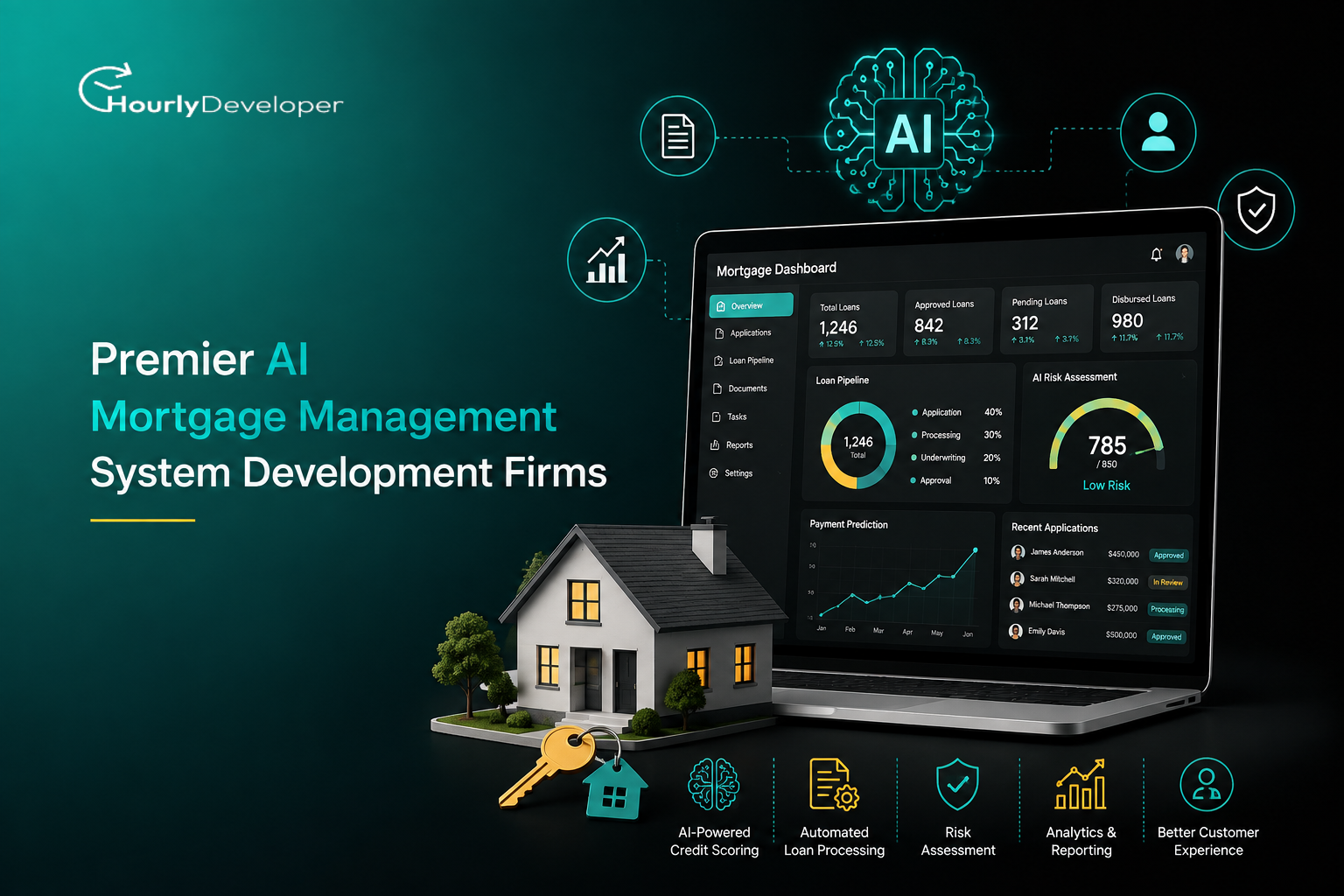
Premier AI Mortgage Management System Development Firms
Introduction
Premier AI Mortgage Management System Development Firms
1.Why 2026 Is Different for Mortgage Technology
A few years ago, most lenders treated software as a back office cost to keep as low as possible. That thinking has flipped. Rate volatility, tighter margins, and borrowers who expect a same day answer have made technology the actual differentiator between a lender who wins a deal and one who loses it to a faster competitor. An AI Mortgage Management System is no longer a nice to have add on. It is closer to the core infrastructure that decides how many loans a team can process without adding headcount.
This is also why the vendor landscape has gotten more crowded and, honestly, more confusing. Plenty of firms now claim AI capability after adding a chatbot to an old dashboard, which is very different from a team that understands underwriting logic, servicing workflows, and the compliance weight behind every automated decision. Knowing the difference before you sign a contract will save you a rebuild eighteen months down the line.
2.What Actually Matters When You Hire AI Mortgage Software Developers
Before you dive into the list, it helps to know what you are actually screening for. Mortgage software is not like a typical business app. A single bug in an underwriting rule can cause compliance violations across thousands of loans, so experience matters more here than almost anywhere else in software development.
Look for firms that can show real project history with loan origination systems, servicing platforms, or credit risk models, not just a portfolio of generic web apps. Ask how they handle regulatory frameworks like TRID, RESPA, HMDA, ECOA, and GDPR if you operate internationally. Ask about their approach to explainability too, because a black box AI model that denies a loan without a clear reason is a legal and reputational risk you do not want.
Team structure matters as well. Some firms assign a dedicated squad with a domain expert, a compliance reviewer, and engineers who have shipped fintech products before. Others rotate generalist developers across projects, which usually shows up later as slower delivery and more revision cycles. When you decide to hire AI mortgage software developers, ask directly who will actually be on your project, not just who closed the deal. It is also worth asking how a firm tests its models against biased outcomes, since a scoring engine that quietly favors one borrower profile over another can turn into a legal problem long before it turns into a good headline.
With that in mind, here are 15 companies worth your shortlist, starting with a team known for consistent delivery and clear communication.
HourlyDeveloper built its reputation on a model that lending companies actually want, flexible, hour based engagement instead of rigid fixed bid contracts. That structure works especially well for AI Mortgage Management System projects, where requirements often shift as compliance rules or underwriting logic get refined mid build. Their team has delivered loan servicing dashboards, automated document verification modules, and AI powered credit risk scoring tools for lenders across the US and UK. Clients frequently mention their transparent reporting and the fact that you can scale the team up or down depending on project phase, which keeps budgets predictable for founders who are still validating product market fit. Founders who need to move a launch date without renegotiating an entire contract tend to find that flexibility valuable in practice, not just on paper.
HourlyDeveloper
Founded
2016
Headquarters
India, with global delivery
Team Size
50 to 100 developers
Core Expertise
AI mortgage automation, loan servicing platforms, fintech app development
Best Suited For
Startups and mid sized lenders needing flexible, scalable engagement
ScienceSoft has been building software for regulated industries for more than three decades, and its fintech portfolio includes a loan management system for a US based consumer lender that won recognition at a global fintech innovation award. The company runs pre launch compliance assessments against frameworks like ECOA, HMDA, FCRA, and TRID before a single line of production code ships, which is rare among vendors this size. Their custom mortgage software development process typically includes dedicated compliance experts alongside engineers, so lenders get systems built with audit readiness in mind rather than bolted on afterward. ISO 9001 and ISO 27001 certifications back their quality and security claims. That combination of certifications, compliance discipline, and decades of enterprise delivery makes them a safer bet for larger institutions that cannot afford a public misstep.
ScienceSoft
Founded
1989
Headquarters
USA, with global delivery centers
Team Size
700 plus
Core Expertise
Regulated fintech systems, loan management, AI agents for lending
Best Suited For
Enterprise lenders needing compliance heavy custom builds
DashDevs has spent over a decade inside the fintech space, building everything from core lending software to full mortgage automation platforms. What stands out about their approach is the integration work. Rather than building every module from scratch, they connect essential lending providers, credit bureaus, and identity verification services so clients launch faster without reinventing infrastructure that already exists. Their engineers have supported peer to peer lending systems and loan management tools for clients across Europe and North America, giving them a practical view of how AI loan management software development needs to flex across different regulatory environments. For a lender expanding into a new country, that integration heavy playbook can shave months off a launch timeline compared to building every connection in house.
DashDevs
Founded
2013
Headquarters
United Kingdom
Team Size
200 plus
Core Expertise
Fintech integrations, lending platforms, digital banking
HireAIDevelopers focuses squarely on one thing, building and deploying artificial intelligence systems for financial workflows, and mortgage lending is one of their core niches. Their engineers specialize in fraud detection models, automated underwriting engines, and natural language tools that can read and summarize loan documents in seconds. Because the entire team works exclusively on AI heavy projects, founders looking to hire AI mortgage software developers get engineers who already understand model training, bias testing, and explainability requirements instead of learning them on the client’s budget. They also offer ongoing model monitoring after launch, which matters because lending models drift as market conditions change. That narrow focus can be a real advantage for lenders whose main pain point is the underwriting decision itself rather than the surrounding software.
Django Stars brings over 16 years of fintech experience and has delivered several mortgage products across markets including the US and UK. Their engineering approach leans heavily on microservices architecture, which gives lenders the flexibility to update one part of a loan platform, say the underwriting module, without redeploying the entire system. They combine market research and competitor analysis early in the process, so clients get a product built around a genuine gap in the market rather than a copy of what already exists. Digital mortgage platforms that simplify brokerage from application to closing are a particular strength of theirs. Their long tenure in fintech also means fewer surprises around timelines, since the team has already seen most of the technical roadblocks a mortgage build tends to hit.
Appinventiv works across the full lending lifecycle, from mortgage CRM software that manages leads and client communication to collateral management tools that track and value assets in real time. Their loan origination builds typically include automated workflows, document management, and credit scoring baked in from day one, so lenders are not left stitching together separate systems after launch. They have also built alternative lending software for peer to peer and microfinance models, which shows range beyond traditional mortgage products. With hundreds of engineers and a client list spanning large enterprises and fast growing startups, they can scale a team to match project complexity. That breadth means a lender can start with one module, such as origination, and expand into servicing or collections later without switching vendors.
Backend Development Company earns its spot on this list for a simple reason, mortgage platforms live or die on their backend architecture. Loan calculations, document storage, third party credit bureau integrations, and real time payment processing all depend on backend systems that can handle heavy transaction volume without slowing down. Their engineers specialize in building the infrastructure layer behind an AI Mortgage Management System, including secure APIs, database architecture, and server side logic that keeps a lending platform stable as user numbers grow. They work well as a technical partner alongside an in house product team that needs deep backend expertise without hiring a full internal engineering department. Lenders who already have a design team or a product manager in house often pair well with a specialist like this rather than hiring a full stack agency for the whole build.
Backend Development Company
Founded
2017
Headquarters
India, with global remote delivery
Team Size
60 to 100 engineers
Core Expertise
Backend architecture, API development, database design for fintech
Best Suited For
Product teams that need dedicated backend specialists
Tuvoc has more than a decade of experience specifically in mortgage software, and its case studies show a clear focus on compliance automation. One project involved building a compliance integrated origination platform with built in modules for TRID, RESPA, HMDA, and ECOA, along with audit trails and real time validation that flagged non compliant entries before they became a problem. That kind of proactive compliance work saves lenders from the far more expensive alternative, which is fixing violations after an audit has already flagged them. Tuvoc also supports CRM and digital lending app integrations, so new systems can plug into what a lender already uses. For lenders operating across multiple states with different disclosure requirements, that kind of built in rule checking reduces the manual review burden considerably.
Tuvoc
Founded
2013
Headquarters
USA
Team Size
100 plus
Core Expertise
Compliance automation, loan origination, digital mortgage apps
Best Suited For
Lenders in heavily regulated states needing built in compliance tooling
Jappware has built a name around custom mortgage apps and management software tailored to whatever workflow a client already runs internally, rather than forcing lenders into a rigid template. Their track record includes work with a notable number of established tech companies, and client feedback consistently points to responsiveness and meeting deadlines as core strengths. For lenders, credit unions, and mortgage brokers exploring custom mortgage software development for the first time, Jappware’s process usually starts with mapping the existing approval chain before writing any code, which helps avoid the common mistake of building software that does not match how the loan team actually works. That mapping first approach tends to shorten the discovery phase and gives stakeholders a clearer picture of cost before any contract is signed.
Jappware
Founded
2015
Headquarters
USA
Team Size
50 to 100
Core Expertise
Custom mortgage apps, loan servicing software, fintech development
Best Suited For
Banks and credit unions wanting workflow specific builds
Wildnet Edge, part of Wildnet Technologies, positions itself as an enterprise level partner for mortgage technology and has moved well past basic loan origination tools into more complex real estate automation software. Their engineering work covers automated underwriting, AI driven risk assessment, and secure document management, evaluated against how well systems scale to process large volumes of applications at once. They also run marketing and IT outsourcing services under the same roof, which can be useful for lenders who want a single partner handling both the technology build and the digital growth side of the business. Their broader marketing arm can also help newer lending brands build visibility while the technical team focuses on the platform itself.
Wildnet Edge
Founded
2012
Headquarters
USA
Team Size
100 plus
Core Expertise
Enterprise mortgage platforms, real estate automation, risk assessment AI
Best Suited For
Enterprise lenders needing scalable, high volume systems
HireFullStackDeveloperIndia brings a straightforward advantage to mortgage projects, engineers who can move across the entire stack without handing work between separate frontend and backend teams. That matters for lending platforms where a change to a loan calculation on the backend often needs a matching update on the borrower facing dashboard the same week. Their developers have experience with loan management dashboards, document upload and verification flows, and integrations with third party credit and identity verification APIs. Because pricing is structured around India based delivery rates, lenders and mortgage startups get senior level full stack talent without the cost structure of a US based agency. That combination of speed and cost efficiency makes them a common first hire for founders testing a mortgage product before committing to a larger build.
HireFullStackDeveloperIndia
Founded
2019
Headquarters
India
Team Size
80 to 120 developers
Core Expertise
Full stack fintech development, loan dashboards, API integrations
Best Suited For
Startups needing cost efficient, senior full stack talent
Intellectyx has built a specific niche around AI agents for mortgage servicing, the operationally heavy part of the loan lifecycle that includes payment processing, escrow management, compliance monitoring, and borrower communication. Rather than a single chatbot bolted onto an existing platform, their agents are built to operate across the full servicing workflow, handling repetitive tasks independently while flagging anything that needs human review. Banking and financial services clients make up the bulk of their work, and their delivery model combines a US based team with global engineering support, which keeps costs manageable while maintaining oversight on sensitive financial data. Lenders drowning in manual servicing tickets tend to see the fastest return here, since agentic automation targets exactly the repetitive tasks that eat up staff time.
Intellectyx
Founded
2013
Headquarters
USA, with global delivery
Team Size
150 plus
Core Expertise
AI agents for loan servicing, compliance automation, banking AI
Best Suited For
Lenders wanting to automate servicing operations specifically
Suffescom Solutions builds fintech software across several financial niches, and mortgage and loan processing is one of their core focus areas alongside accounting and healthcare finance tools. Their approach to loan platforms includes investment and budget forecasting features alongside standard property management functions, giving lenders a broader financial picture rather than a narrow loan tracking tool. They also build fraud detection and real time transaction monitoring into their fintech products by default, which is a useful baseline for any lender handling sensitive borrower financial data at scale. That broader financial lens can be useful for lenders who eventually plan to expand beyond mortgages into adjacent lending products.
Suffescom Solutions
Founded
2012
Headquarters
India, with a US presence
Team Size
100 plus
Core Expertise
Fintech app development, fraud detection, mortgage and loan processing tools
Best Suited For
Lenders wanting broader financial software beyond just mortgages
Konstant Infosolutions has more than two decades of experience across mobile, web, and AI development, and that longevity shows up in how many client relationships they have sustained over multiple project phases. Their fintech work spans loan management dashboards, mobile banking apps, and AI powered scoring tools, built for a client base that includes startups as well as established enterprises. For founders comparing the best AI mortgage software development companies, Konstant’s long track record and broad client base offer a lower risk option, since the company has already weathered several technology cycles without disappearing or pivoting away from client work. Their diversified client base across industries also means they bring outside perspective on user experience patterns that a mortgage only shop might not consider.
Konstant Infosolutions
Founded
2003
Headquarters
India
Team Size
200 plus
Core Expertise
AI development, mobile and web platforms, fintech products
Best Suited For
Lenders who value long term stability and proven longevity
Binmile Technologies rounds out this list with a strong focus on enterprise software across banking, finance, and insurance, alongside retail and healthcare. Their fintech engineering covers custom software development, mobile and web applications, AI development, and software testing, giving lending clients a single vendor for both building and validating a mortgage platform before launch. Testing discipline matters more in lending software than most other categories, since a single miscalculated interest figure or a missed compliance check can cost a company far more than the testing cycle would have. Binmile’s dedicated QA processes are built specifically to catch those issues before they reach production. That combined build and test approach can shorten the path to a stable production launch, especially for teams without a dedicated in house QA function.
Binmile Technologies
Founded
2017
Headquarters
India
Team Size
100 plus
Core Expertise
Enterprise fintech software, QA and testing, AI development
Best Suited For
Lenders who want development and rigorous QA under one roof
3.How to Choose the Right Fit for Your Mortgage Business
Fifteen strong options is a good problem to have, but it can also make the decision harder if you do not narrow things down first. Start by matching company size to your project scope. A lean startup validating an early mortgage product usually gets more value from a flexible, hour based partner than from a 700 person enterprise vendor built for large scale rollouts, and the reverse is true for an established lender processing thousands of applications a month.
Next, ask every shortlisted firm for a compliance walkthrough specific to your jurisdiction, not a generic answer about following industry standards. The difference between a vendor who has actually built TRID or HMDA compliant workflows and one who is learning on your project will show up fast once your system goes live.
Finally, pay attention to how each firm talks about AI. An AI Mortgage Management System that cannot explain why it flagged or approved a loan is a liability, not an asset, especially once regulators start asking questions. The firms on this list that mention explainability, model monitoring, or bias testing without being asked are usually the ones who have already dealt with a real compliance review, not just a sales pitch.
Budget conversations are also worth having early rather than at the contract stage. Ask each firm to break down cost by phase, discovery, core build, compliance testing, and post launch support, instead of accepting a single lump sum number. A vendor who can explain where the money actually goes is usually more organized internally, and that organization tends to show up later as fewer missed deadlines during your project.
4.Final Thoughts
There is no universal winner on this list, and that is exactly the point. The right partner for a three person mortgage startup looks nothing like the right partner for a regional bank rolling out a new servicing platform to fifty thousand existing customers. What matters is matching your specific project, your compliance exposure, and your budget to a firm that has actually solved that problem before, not one that is promising to figure it out along the way.
If there is one thing worth taking from this guide, it is that the strongest premier AI mortgage management system development firms are the ones who treat compliance and explainability as part of the build, not an afterthought bolted on before launch. That single difference tends to separate a project that sails through its first regulatory review from one that spends months in rework.
Take your time going through the profiles above, get on a call with two or three that fit your scope, and ask pointed questions about past mortgage specific work rather than general capability. By 2026 standards, that is the difference between hiring a vendor and hiring a genuine technology partner for your lending business.
One last piece of practical advice. Ask every firm on your shortlist for a reference client in a business roughly your size, not just their biggest logo. A team that has solved your exact scale of problem before will almost always outperform one that is impressive on paper but has never actually worked at your level of volume or regulatory complexity.
Nainesh Pandya, our astute Director, navigates our team toward unprecedented success. With a fervent dedication to innovation and a sharp business acumen, Nainesh propels our company forward with resolute determination. His strategic foresight and compassionate guidance motivate us to scale new heights collaboratively.
Frequently Asked Questions
Most custom builds take between 4 and 9 months depending on scope. A basic loan tracking and document automation module can launch in around 10 to 14 weeks, while a full platform with underwriting AI, compliance modules, and servicing tools usually needs 6 to 9 months, plus extra time for regulatory testing before a public launch.
Costs vary widely based on features and compliance scope. A basic MVP with loan tracking and document upload can start around $25,000 to $40,000, while a full AI powered platform with underwriting automation, fraud detection, and servicing tools often ranges from $80,000 to $250,000 or more depending on integrations and team location.
Neither option is automatically better. Indian firms often offer stronger cost efficiency and large talent pools, while US based firms may have deeper direct experience with specific state level compliance rules. Many lenders now choose a hybrid team, using an Indian development partner for engineering and a domestic compliance consultant for regulatory review.
Yes, and it is often the smarter route. Most development firms can add AI modules such as automated underwriting, fraud scoring, or chatbots on top of an existing loan origination system through APIs, avoiding a costly full rebuild while still modernizing the borrower and loan officer experience within a few months.
Beyond bug fixes, expect model monitoring since lending AI can drift as market conditions shift, along with periodic compliance updates when regulations change. Reliable firms also offer performance monitoring for peak application periods and typically bundle a support retainer covering a set number of hours each month after launch, plus a clear escalation path for urgent issues.
Find exceptional developers at Hourlydeveloper. Get the expertise, solutions, and teamwork you need for success. Hire developers easily and boost your projects today!
 Back to Blog