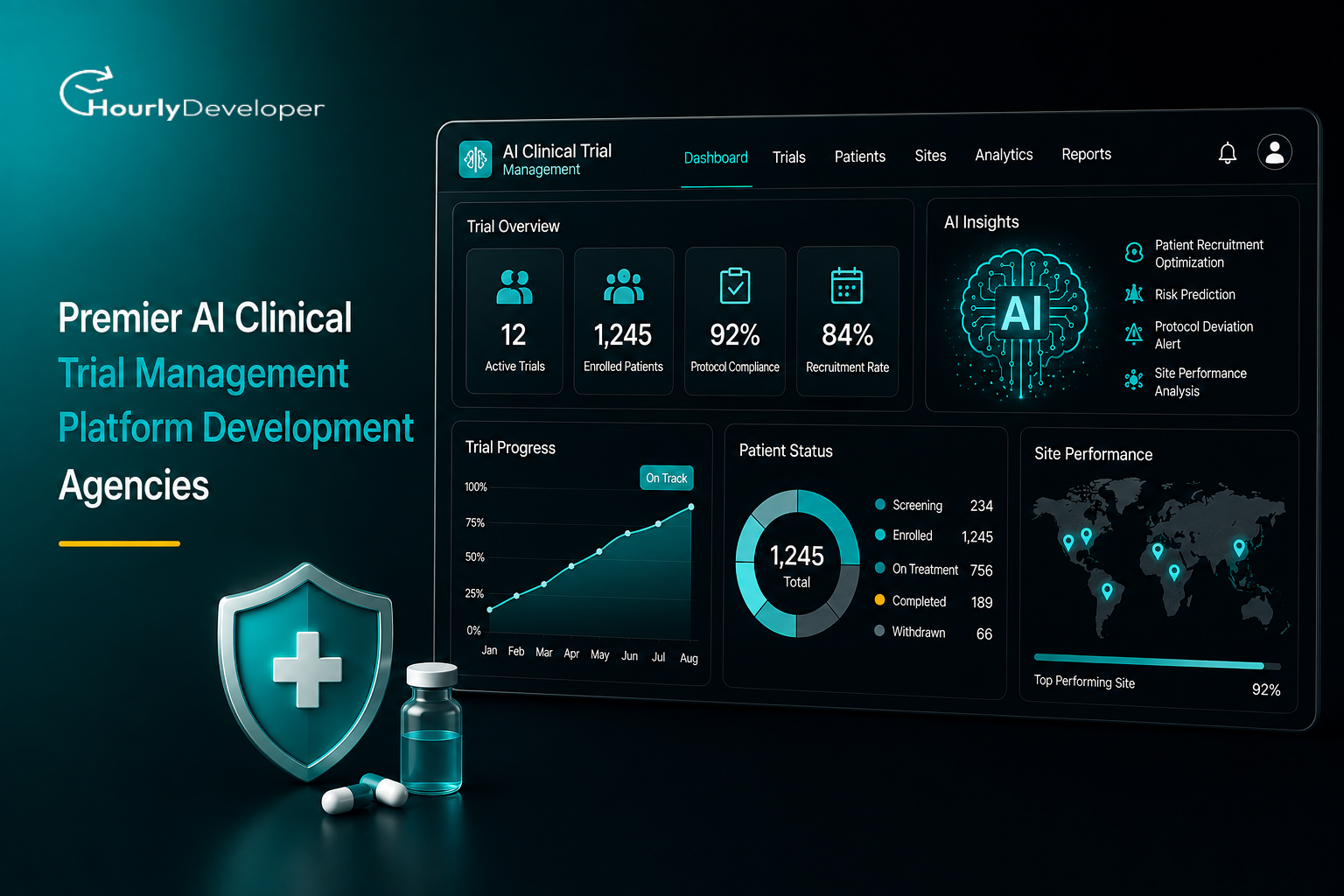
Premier AI Clinical Trial Management Platform Development Agencies
Introduction
Premier AI Clinical Trial Management Platform Development Agencies
1.Why AI Is Rewriting the Rules for Clinical Trial Software
Traditional CTMS platforms were built to store information. Today’s expectation is different. Sponsors want a system that reasons about the information, flags risk before a monitor has to fly out to a site, and shortens the distance between a data point being entered and a decision being made.
That shift explains why the AI Clinical Trial Management Platform category has grown so quickly since 2024. Predictive site selection models can now compare a candidate site’s enrollment history, patient demographics, and past protocol deviation rates against a new study’s design, and flag which sites are actually likely to hit their targets. Natural language processing tools read through adverse event narratives and highlight the ones that need a closer look, instead of leaving that job entirely to an already stretched safety team. Automated query generation catches inconsistent data at the point of entry rather than three months later during a monitoring visit.
None of this works if the underlying software is bolted together from disconnected modules. That is why sponsors increasingly want to hire AI healthcare software developers who can build a unified data layer first, then add intelligence on top of it. A platform that pulls EDC, RTSM, eTMF, and safety data into one architecture gives the AI models something coherent to learn from. A platform that treats AI as an afterthought usually ends up with recommendations nobody trusts, because the underlying data was never clean enough to support them.
For CROs juggling several sponsor studies at once, and for biotech founders running their first trial without a large operations team, this matters even more. The gap between a platform that merely displays data and one that actually helps you make faster, safer decisions is where these development agencies earn their fee. Sponsors budgeting for 2026 are moving away from off the shelf licenses toward custom builds they actually own.
The rise of decentralized and hybrid trials has pushed this trend further. When participants complete assessments from home instead of a research site, the volume of incoming data grows and the margin for manual review shrinks. AI powered compliance monitoring can flag a participant who has stopped submitting patient reported outcomes on schedule long before a coordinator would normally notice, and voice or chat based data capture tools can turn a routine check in into structured, analyzable information without extra staff time. None of these features are experimental anymore. They are becoming the baseline expectation for any platform built or upgraded this year, which is exactly why the vendor selection process deserves real scrutiny rather than a quick comparison of feature checklists.
2.What Separates the Best Development Partners From the Rest
Not every software vendor that lists healthcare on its homepage can actually build this kind of platform. Before you shortlist anyone, it is worth checking a few things that separate the best AI clinical trial management software development companies from teams that are simply comfortable with general web development.
Look for direct experience with HL7 and FHIR interoperability, because a platform that cannot talk to EHR systems and lab feeds will always need manual workarounds. Ask how the team handles HIPAA, GDPR, and 21 CFR Part 11 requirements at the architecture level, not as a checklist added at the end. A team that treats compliance as a foundation designs audit trails, e signatures, and access controls from day one, rather than retrofitting them under deadline pressure.
Ask about their AI track record specifically. Plenty of agencies can integrate a large language model API. Fewer have actually built predictive models on real clinical data, validated them, and shipped them into a production trial environment. The difference shows up in whether their AI features are genuinely useful or simply decorative.
Finally, pay attention to how a company communicates during the sales process itself. If a vendor cannot clearly explain their approach to data security and trial workflows in a discovery call, they are unlikely to explain it clearly to your regulatory team either. The premier AI clinical trial management platform development agencies below were chosen because they combine healthcare domain knowledge with genuine AI engineering, not because they simply claim to.
It is also worth asking for references from sponsors running studies similar in scale and therapeutic area to yours, rather than accepting a generic case study on a landing page. A vendor that has built decentralized trial software for a small biotech running one Phase II study may not be the right fit for a CRO coordinating a global Phase III program across a dozen countries, and the reverse is just as true. Matching the agency’s proven scale to your actual study, rather than to its marketing, will save you a difficult conversation midway through the build.
3.18 Premier AI Clinical Trial Management Platform Development Agencies to Shortlist in 2026
Here are eighteen agencies worth evaluating, starting with flexible engagement specialists and moving through established healthcare software companies across the US, Europe, and Asia.
HourlyDeveloper works with sponsors and CROs who want to hire a dedicated team without committing to a full time hire. Clients pay for verified hours on clinical trial modules, from eConsent workflows to AI powered risk dashboards, and can scale the team up or down as a study moves through different phases. The hourly model suits founders who need to hire AI healthcare software developers for a defined sprint rather than an open ended contract, and want transparent time tracking on every deliverable. Weekly reporting and screen recorded work logs give sponsors visibility into progress without requiring a full time project manager on their own side, which matters for smaller teams juggling a trial alongside everything else on their plate.
Founded in 1989 and headquartered in McKinney, Texas, ScienceSoft brings over three decades of enterprise software experience to clinical trial platforms. Its healthcare practice builds custom EDC, CTMS, and eTMF systems with AI layered in for risk based monitoring and predictive site performance scoring. With more than 750 in house engineers and ISO 9001 and ISO 27001 certified processes, ScienceSoft is a common shortlist name among the best AI clinical trial management software development companies serving mid size and enterprise sponsors. Its long standing project management office and dedicated architecture center of excellence give it an unusually structured delivery process for a firm of its size, which large pharma clients tend to value on multi year engagements.
HireFullStackDeveloperIndia connects sponsors with full stack engineering teams based in India who handle both the clinical data layer and the AI models sitting on top of it. The company positions itself around cost efficient, senior level talent for founders who want an AI Clinical Trial Management Platform built end to end by one accountable team, rather than juggling a front end vendor, a back end vendor, and a separate data science contractor. Engagements typically start with a short discovery sprint to map the required integrations before a dedicated team is assigned, which helps smaller sponsors avoid overpaying for capacity they do not yet need.
Folio3 Digital Health, founded in 2005 and based in California with delivery teams in Pakistan, builds HIPAA compliant clinical platforms that unify EDC, CTMS, eConsent, and remote monitoring into one modular stack. Its HL7 and FHIR based integrations connect directly with EHR systems such as Epic, and its AI layer focuses on query resolution, source data verification prioritization, and early risk signal detection for faster site oversight. The team also supports bring your own tech models, meaning sponsors can plug existing devices and data lakes into the platform without ripping out systems that already work.
TechMagic, a Lviv, Ukraine based company founded in 2014 with more than 400 engineers, has been recognized by Clutch as a Top Developer in HealthTech. Alongside clinical trial modules, its teams bring strong Node.js, AWS, and data engineering expertise, which matters for sponsors who need a platform that can process large volumes of patient reported outcome data without slowing down during peak enrollment periods. TechMagic also operates satellite offices in Poland and the UK, giving sponsors closer time zone overlap for daily standups than a fully offshore team would offer.
Backend Development Company focuses specifically on the infrastructure layer that most clinical trial platforms take for granted until something breaks. Its engineers specialize in building the databases, APIs, and audit trail systems that keep randomization, safety reporting, and AI risk models running reliably under real world data volumes, making it a practical partner for agencies or sponsors who already have a front end team and need serious backend depth. This narrow focus also makes the team a useful subcontractor for agencies that want to strengthen the reliability of a platform already in active use without a full rebuild.
OSP Labs, headquartered in Silver Spring, Maryland, is an ISO 9001:2015 certified custom software provider with a dedicated clinical trial management practice. The company builds end to end CTMS platforms covering patient recruitment, financial tracking, and protocol compliance, and has expanded into AI powered eligibility screening and reporting dashboards for sponsors who want a fully bespoke system rather than a configured off the shelf product. Its broader healthcare portfolio, spanning EMR systems and remote patient monitoring, gives it useful context when a trial platform needs to integrate with a sponsor’s existing care delivery systems.
Innowise was founded in 2007 and now employs more than 3,500 IT professionals from its Warsaw, Poland headquarters. Its pharma and biotech practice covers clinical trial management, clinical data management, and AI pipelines for drug discovery, and the company has even built its own internal healthcare startup, giving its teams first hand experience with the regulatory and data challenges sponsors actually face. The company has also appeared on the Inc. 5000 list of fastest growing private companies, which points to a delivery model that scales well beyond a single flagship client.
HireAIDevelopers is built around a single premise: sponsors evaluating clinical trial software rarely need more web developers, they need engineers who genuinely understand machine learning applied to healthcare data. The company staffs teams for predictive enrollment modeling, adverse event detection, and automated query generation, which makes it a direct answer for founders who search for ways to hire AI healthcare software developers who specialize in exactly that. Its engagement process typically includes an initial data readiness review, since a predictive model is only as useful as the historical trial data it is trained on.
SPsoft, founded in 2016 and based in San Francisco, describes itself plainly as a developer of custom healthcare software and AI solutions. Its clinical trial work spans participant tracking, eCRF design, and AI powered data collection and reporting, and the company also augments existing sponsor teams that already have AI ambitions but lack the in house machine learning talent to execute on them. This augmentation model appeals to sponsors that already own a platform and simply need specialist AI talent for a defined project rather than a full outsourced build.
Belitsoft, founded in 2004 and headquartered in Warsaw, Poland, runs a healthcare practice built around custom patient recruitment software, automated eligibility screening, and secure patient databases with controlled access. With more than 400 developers across Poland, Latvia, and Georgia, the company is a reasonable fit for sponsors who want a European delivery team experienced in both compliance heavy healthcare projects and applied AI work. Its recruitment automation tools, which trigger scheduling and follow up messages based on predefined criteria, are a particularly strong fit for sponsors struggling with slow patient enrollment.
PureLogics, founded in 2006 and based in New York with delivery centers overseas, has completed more than 800 projects for clients including Fortune 1000 companies. Its healthcare and life sciences practice builds clinical trial software that tracks integrations across EDC, EHR, IWRS, and central lab systems, alongside financial reporting tools for sponsors who need visibility into per patient trial costs. Its broader enterprise client base also means the team is comfortable working within the procurement and security review processes that larger sponsor organizations tend to require.
N-iX traces its roots to Lviv, Ukraine in 2002 and now operates globally from its Malta headquarters with more than 2,000 employees. Its pharma and medtech clients rely on the company for clinical trial software, patient data capture tools, and machine learning models for medical image analysis, giving it unusually deep bench strength for sponsors running trials with an imaging or diagnostics component. The company’s scale also supports parallel workstreams, so a sponsor can have data engineering, AI model development, and interoperability work progressing at the same time rather than sequentially.
Cleveroad, founded in 2011 with headquarters in Tallinn, Estonia and a US office in Delaware, holds ISO 9001 and ISO 27001 certifications and ranks among Clutch’s top global custom software developers. Its healthcare portfolio includes predictive analytics and computer vision projects alongside HIPAA and GDPR compliant systems, and its engineers regularly work on AI features added to existing clinical platforms rather than only greenfield builds. Recent recognition placed the company among the top five global firms for custom software development, a signal of consistent delivery quality across client reviews.
Appinventiv, founded in 2014 and headquartered in Noida, India, is an ISO 27001 and ISO 9001 certified company with more than 1,600 healthcare software developers and partnerships with AWS, Azure, and Google Cloud. Its clinical software work leans heavily on AI for patient risk stratification and operational automation, backed by a large enough bench to staff sizable, multi year sponsor engagements. Having delivered more than 3,000 projects overall, the company also brings pattern recognition from adjacent regulated industries such as finance into how it structures compliance heavy healthcare builds.
16. Itransition
Itransition has been building software since 1998 and now operates from Decatur, Georgia with more than 1,600 experts across five continents. Its AI practice, active for over half a decade, has moved from strategic consulting into hands on implementation for healthcare clients, and its clinical trial work benefits from the kind of process discipline that comes with more than 25 years in enterprise software delivery. The firm typically pairs a dedicated AI consultant with the engineering team on healthcare projects, which helps keep model design grounded in what a clinical operations team can realistically act on.
17. Ditstek Innovations
Ditstek Innovations positions itself as a strategic partner rather than a pure staffing vendor, with a healthcare practice covering drug development, trial management, and regulatory compliance software. The India based company builds AI driven custom medical software aligned with HIPAA, HITECH, and PIPEDA requirements, and offers rapid prototyping timelines for sponsors who want to validate a concept before committing to a full build. Its stated 14 day prototype process gives early stage biotech founders a low commitment way to test whether an idea holds up before a larger engineering budget is approved.
18. EngineerBabu
EngineerBabu, based in Indore, India, was selected for Google’s AI Accelerator program, which validated its production AI capabilities beyond typical outsourcing claims. The company serves more than 400 healthcare clients across the US, UAE, Australia, and the UK, applying machine learning techniques originally built for financial risk scoring to clinical risk stratification, no show prediction, and diagnostic support within trial workflows. Its familiarity with multiple regulatory frameworks at once, spanning HIPAA, Dubai Health Authority rules, and Australia’s Privacy Act, suits sponsors running trials across more than one region simultaneously.
4.Conclusion
Picking a development partner for a clinical trial platform is not really a technology decision. It is a risk decision. The vendor you choose will touch patient safety data, feed the summaries your monitors act on, and shape how quickly your team can respond when a site starts drifting off protocol. That is worth more scrutiny than most software purchases get.
The eighteen companies above are not interchangeable. Some are broad healthcare IT specialists who happen to do excellent clinical trial work. Others, like HourlyDeveloper, HireFullStackDeveloperIndia, and HireAIDevelopers, are built specifically around flexible engagement models for sponsors who do not want to negotiate a year long enterprise contract before writing a single line of code. What they share is a track record of building an AI Clinical Trial Management Platform that sponsors can actually trust in production, not just in a demo.
Before you sign with anyone, ask to see how their AI features perform on messy, real world trial data rather than a curated sample set. Ask how they would handle a mid study protocol amendment, because that is where a lot of custom platforms quietly fall apart. And if a company cannot walk you through their HIPAA and GDPR approach without reaching for a slide deck, treat that as useful information in itself.
2026 is shaping up to be the year sponsors stop treating AI in trial software as an experiment and start treating it as table stakes. Whether you end up working with a decade old healthcare specialist or a smaller team that only recently began building for life sciences, the goal stays the same: a platform your data managers, monitors, and regulators can all rely on without a second thought.
Start the conversation with two or three names from this list rather than one. A short comparison, even a handful of discovery calls, will tell you more about how a team actually works than any portfolio page can. Pay attention to how quickly they grasp your specific protocol, how honestly they answer questions about timeline and cost, and whether their proposed architecture actually fits the scale of your study rather than a one size fits all template. The right partner will make that difference obvious fairly quickly, and the investment of a few extra weeks upfront is small compared to the cost of rebuilding a platform that was rushed the first time around.
Ravi Patel, the dynamic Director at the helm of our team's journey towards excellence. Fueled by boundless creativity and a knack for seizing opportunities, Ravi propels our company forward with resolute determination. His strategic acumen and compassionate guidance empower us to reach unprecedented heights as a cohesive unit.
Frequently Asked Questions
Most custom builds take between 4 and 9 months depending on scope. A single module, such as an AI powered risk dashboard added to an existing CTMS, can launch in 6 to 10 weeks, while a full eClinical suite covering EDC, eTMF, and RTSM typically needs 6 to 9 months including validation.
Costs vary widely by region and scope. Eastern European and South Asian teams often charge $30 to $70 per hour, while US based specialists can charge $100 to $200 per hour. A mid sized custom CTMS with AI features commonly falls between $80,000 and $300,000 depending on integrations and compliance work required.
Yes, any system supporting FDA regulated trials generally needs to meet 21 CFR Part 11 requirements for electronic records and signatures. Development agencies experienced in this space build validation documentation, audit trails, and access controls into the platform from the start rather than adding them after the software is already in use.
In many cases, yes. Several agencies on this list specialize in adding AI modules such as predictive site scoring or automated query detection onto an existing platform through APIs, which is often faster and less disruptive than a full replacement, especially for sponsors already mid way through an active study and unwilling to migrate historical trial data.
Licensing gives you a ready made product with vendor imposed limits on customization. Hiring a development agency means you own the resulting platform outright and can adapt it as your trial protocols evolve, though it usually requires a longer initial build timeline and more upfront involvement from your team throughout the discovery and design phases.
Find exceptional developers at Hourlydeveloper. Get the expertise, solutions, and teamwork you need for success. Hire developers easily and boost your projects today!
 Back to Blog