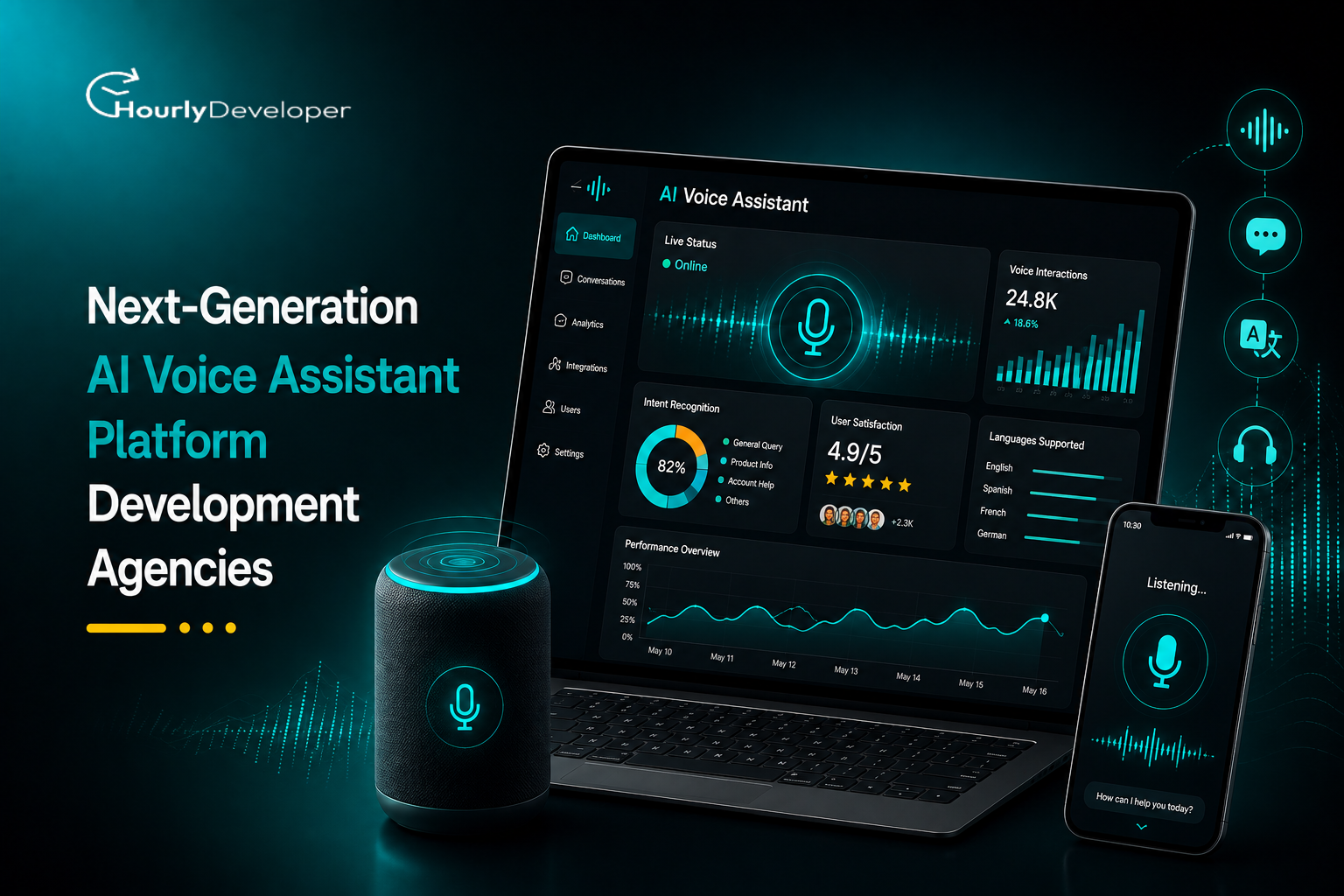
As voice AI becomes a key part of modern digital experiences, choosing the right AI Voice Assistant Platform development company is essential for building intelligent, scalable, and reliable voice solutions. This guide features 15 trusted agencies with expertise in AI voice assistants, speech recognition, natural language processing (NLP), conversational AI, and enterprise voice applications, helping businesses compare development partners based on their technical capabilities, industry experience, and project expertise.
1.Why Voice AI Became a 2026 Boardroom Priority
Three years ago, voice AI projects were run by innovation teams as pilots. In 2026, they are budgeted line items reviewed by the CFO, because the economics finally work. Speech to text latency has dropped enough that a caller does not notice they are talking to a machine for the first ten seconds. Text to speech has gotten expressive enough that customers stop asking to speak to a real person out of frustration with how the bot sounds. And the language models behind the reasoning layer got cheap enough, and fast enough, that a mid sized business can run thousands of calls a day without the bill looking like a mistake.
The technical bar also moved. Barge in handling, where a caller can interrupt the assistant mid sentence and have it respond naturally, used to be a rare, expensive feature. In 2026 it is close to table stakes for any serious platform. Multilingual support has improved enough that a single assistant can handle a call in English, Spanish, or Hindi without routing to entirely separate systems. And on the deployment side, more agencies now offer usage based pricing tied to call volume instead of flat monthly platform fees, which has made voice AI financially accessible to mid sized businesses that could not have justified the cost three years ago.
That shift changed who gets hired to build these systems. A generalist app development shop that dabbled in a voice project two years ago is no longer competitive against a dedicated AI voice assistant development company that has spent that time solving problems specific to voice, like handling interruptions, managing silence and background noise, and building compliance recording for regulated industries. If your business handles healthcare data, financial transactions, or high call volumes, the agency you choose needs experience with those constraints, not just a portfolio of consumer chatbot demos.
There is also a competitive angle founders are watching closely. Customers increasingly expect to resolve issues by voice without waiting on hold, and the businesses that get this right are seeing measurable drops in cost per contact and measurable gains in customer satisfaction scores. That is why the decision about who builds your platform now sits with the same people who approve the year’s biggest technology spend.
2.What to Check Before You Hire AI Voice Assistant Developers
Not every agency that lists voice AI on its website has actually shipped a production voice assistant handling real call volume. Before you commit a budget, it is worth running through a short checklist.
- Ask to see a live demo, not a recorded one. A live call, even a short one, tells you more about latency, interruption handling, and voice quality than any case study. If a team hesitates to do this, treat it as a signal.
- Ask which speech recognition and text to speech providers they use, and whether they can switch providers if one underperforms for your accent or language mix. Agencies locked into a single vendor stack have less flexibility to fix problems later.
- Ask how they handle fallback to a human agent. A platform that cannot gracefully hand off a frustrated caller will generate complaints faster than it saves costs.
- Ask how they handle call recording, data storage, and consent, especially if you operate in a regulated industry or a region with strict privacy law. A platform that stores raw voice recordings indefinitely without a clear retention policy is a liability waiting to surface during your next compliance audit.
- Ask for an integration test plan before the contract is signed. The agencies worth hiring will tell you exactly how they plan to test the assistant against real call scenarios, including background noise, strong accents, and callers who go off script, before it ever reaches a live customer.
- Ask about ongoing costs, not just the build price. Voice AI systems carry real per minute costs for transcription, language model inference, and telephony, and those numbers should be part of your proposal from day one, not a surprise on your first invoice.
Finally, when you Hire AI voice assistant developers, ask for references from clients in your industry specifically. A team that built a great voice assistant for an ecommerce brand may not automatically translate that success to healthcare intake, where compliance and accuracy requirements are much stricter.
It also helps to ask how the agency measures success after launch, not just before it. A team that only talks about build quality and never mentions containment rate, average handle time, or customer satisfaction scores has probably not run a voice assistant through a real production quarter. The agencies worth hiring will already have a point of view on which metrics matter for your specific use case, and they will usually have a dashboard or reporting process ready to show you, rather than promising to figure it out after the contract is signed.
With those questions in mind, here are 15 of the Best AI voice assistant platform development companies worth evaluating for your voice AI project in 2026, spanning specialists in customer support automation, industry specific compliance, and startups building experimental voice interfaces from scratch.
| S.No. |
Company |
Headquarters |
Core Expertise |
Best Suited For |
| 1 |
HourlyDeveloper |
Ahmedabad, India |
Custom voice AI development on flexible hourly and dedicated team models, with strong conversational AI, speech pipeline, and NLP integration skills across multiple industries. |
Startups and mid sized businesses that want to scale a development team up or down without committing to a long term fixed price contract. |
| 2 |
Master of Code Global |
Canada and Ukraine |
Conversational AI strategy, chatbot and voice bot design, and NLP consulting that takes a project from discovery workshops through to a launched product. |
Enterprises that want a design led approach to conversational UX worked out carefully before any development begins. |
| 3 |
Backend Development Company |
India |
API architecture, cloud infrastructure, and the backend systems that keep a voice assistant platform reliable once call volume starts to climb. |
Founders who already have a voice AI concept and need the infrastructure layer engineered to handle real scale. |
| 4 |
Yellow.ai |
India and United States |
Enterprise conversational AI platform with prebuilt voice and chat automation modules that can be configured rather than built from scratch. |
Large enterprises that want a proven, out of the box platform rather than a fully custom build. |
| 5 |
Konverge AI |
United States |
Applied AI consulting, including voice and speech technology integration built with the compliance requirements of regulated industries in mind. |
Healthcare and financial services companies that need compliance aware voice solutions from day one. |
| 6 |
HireFullStackDeveloperIndia |
India |
Full stack engineering teams that own an entire voice assistant platform build, from the speech pipeline through to the front end monitoring dashboard. |
Businesses that want a single team to own the entire technical stack rather than coordinating multiple vendors. |
| 7 |
Ideas2IT |
United States and India |
Product engineering with a dedicated machine learning and NLP practice, used to embed voice features inside a larger existing product. |
Companies building a voice product as part of a broader AI driven product roadmap. |
| 8 |
Softweb Solutions |
United States |
AI and IoT integration work, including voice interfaces designed specifically for connected devices and embedded hardware. |
Hardware and IoT companies looking to add voice control to physical products already in the market. |
| 9 |
HireAIDevelopers |
India |
Dedicated AI specialists you can bring on when you want to Hire AI voice assistant developers for a clearly defined, scoped project. |
Companies that want to add specialized voice AI talent to an existing in house engineering team. |
| 10 |
ValueCoders |
India |
Outsourced software development including custom voice bot and chatbot builds delivered through structured, managed engagement models. |
Businesses looking for cost effective offshore development without sacrificing communication quality or project visibility. |
| 11 |
DataEximIT |
India |
Custom software and AI development with a growing focus on conversational and voice AI solutions for small business budgets. |
Small and mid sized businesses looking for an affordable, practical entry point into voice AI. |
| 12 |
Netguru |
Poland |
Digital product design and engineering, including AI and voice feature integration layered into existing, already live applications. |
Companies that need voice added to a digital product that already has real users. |
| 13 |
Grid Dynamics |
United States |
Enterprise AI engineering at scale, including large language model integration for voice systems handling significant call volume. |
Enterprises with complex, high volume voice AI requirements and existing cloud infrastructure investments. |
| 14 |
WebClues Infotech |
India |
Custom app and AI development, with a growing portfolio of voice bot and virtual assistant projects delivered alongside mobile builds. |
Businesses that want a single vendor handling both the mobile app and its voice assistant integration. |
| 15 |
Fingent |
United States and India |
Custom software consulting with dedicated AI and machine learning teams built for long horizon technology partnerships. |
Companies that want a long term technology partner beyond just the initial voice AI build. |
3.The Voice AI Reality Check: What Most Agencies Still Get Wrong
A polished demo is the easiest thing for an agency to produce. A voice assistant that survives a Tuesday afternoon with three hundred real callers, half of them irritated and talking over each other, is a completely different achievement. This is the gap most buyers do not see until after they have signed a contract.
- Why Demos Sound Impressive but Fail in Production
Sales demos are almost always run in a quiet room, with a friendly caller reading from a script, on a fast internet connection, using a clear accent the model was trained on. None of that resembles a real customer calling from a parking lot with traffic noise in the background, switching topics mid-sentence, or mumbling an account number twice before getting it right. A demo tells you the assistant can hold a conversation. It tells you almost nothing about whether it can hold that same conversation once call volume, background noise, and genuinely confused customers get involved.
- Common Deployment Mistakes
The same handful of mistakes show up again and again once a voice assistant goes live. Teams train the assistant on a narrow set of expected questions and never test what happens when a caller asks something completely outside that scope. They skip load testing, so the system that handled ten test calls smoothly falls apart at two hundred calls an hour. They forget to build a clean handoff to a human agent, so a caller who needs help gets stuck in a loop instead of reaching someone who can actually resolve the issue. And they launch without a plan for reviewing real call transcripts afterward, which means problems get discovered by angry customers instead of by the team that built the system.
- Hallucinations, Latency, and Interruption Handling
Three technical problems separate a usable voice assistant from an unusable one, and they rarely show up in a sales pitch. Hallucination is when the assistant confidently states something false, like quoting a return policy that does not exist or promising a refund it has no authority to issue, which is a serious liability in regulated industries. Latency is the delay between when a caller finishes speaking and when the assistant responds, and anything much past a second starts to feel unnatural and prompts callers to talk over the system. Interruption handling, sometimes called barge in, is whether the assistant can stop talking the instant a caller starts speaking again, rather than plowing through its own sentence while the caller repeats themselves in frustration. Any agency worth hiring should be able to explain, specifically, how they test for and reduce all three before a system ever reaches a live customer.
4.What "Next-Generation" Actually Means in 2026
The word next generation gets used loosely in this industry, so it is worth being specific about what actually separates a 2026 grade voice assistant from the scripted bots of a few years ago.
- Real-Time Speech-to-Speech Models
Older voice systems converted speech to text, ran that text through a language model, then converted the response back to speech, a three step process that added noticeable delay at every stage. Newer speech to speech models process the caller’s voice directly and generate a spoken response without that extra translation step in between, cutting latency significantly and making the back and forth of a conversation feel far closer to talking with a person.
The best 2026 platforms can pick up on tone, not just words, noticing when a caller sounds frustrated, confused, or urgent and adjusting the conversation accordingly. A frustrated caller might get routed to a human faster. A confused caller might get a slower, more detailed explanation instead of the standard script. This is a meaningful shift from systems that treated every caller exactly the same regardless of how they actually sounded.
Voice is increasingly just one channel in a single ongoing conversation. A customer might start on a phone call, get sent a link by text message mid conversation to upload a photo or complete a form, and then continue the same interaction back over voice, all without repeating themselves or starting over. Building this well requires the voice layer to share context with chat, SMS, and app based channels in real time, not as a separate, disconnected system.
- Memory and Personalization
A next generation assistant remembers. It can recall that a customer called last week about a delayed shipment, or that they always prefer email confirmations over text messages, and use that context without the caller having to repeat their history on every single call. This requires the platform to securely store and retrieve customer context across sessions, which is a meaningfully harder engineering problem than a stateless bot that forgets everything the moment a call ends.
The most advanced platforms in 2026 do more than answer questions. They can actually take action, checking an order status directly in the backend system, rescheduling an appointment, issuing a refund within a preset limit, or updating a customer’s account, all during the call itself rather than promising to follow up later. This agentic capability is what turns a voice assistant from a glorified FAQ page into something that genuinely reduces the workload on human staff, and it is the clearest dividing line between a basic voice bot and a true next generation platform.
5.What a Voice Assistant Platform Engagement Actually Costs and Takes in 2026
A. Cost by project scope
- Narrow, single workflow assistant (for example, appointment scheduling for a single clinic): $15,000 to $40,000, built in 6 to 10 weeks
- Full contact center platform with custom NLU training, telephony integration, live agent handoff, and compliance recording: $80,000 to $250,000, with a 4 to 8 month timeline from kickoff to production launch
- Final pricing depends heavily on how much custom engineering the speech pipeline requires and how many systems the assistant needs to connect with
B. Recurring costs most buyers underestimate
- Speech to text and text to speech providers typically charge per minute of audio processed
- Language model inference for the reasoning layer adds a separate per token or per call cost
- Telephony providers charge separately again for phone lines and call routing
- None of these show up in a one time build quote, so any proposal should include projected monthly operating costs at your expected call volume, not just the development price
C. What affects timeline
- An assistant that only answers questions from a knowledge base can launch faster than one needing live integration with a legacy CRM, scheduling system, or payment processor
- Agencies with strong backend engineering benches, like Backend Development Company, tend to move faster through this integration phase because they are used to connecting new AI layers to older systems without breaking them
- Regulated industries such as healthcare and financial services generally add time for compliance review and testing
D. Post launch tuning
- Even a well built voice assistant needs 2 to 3 months of real call data before intent recognition and conversation flows are fully dialed in
- Agencies that build this tuning period into their proposal upfront, rather than treating launch as the finish line, tend to deliver assistants that perform noticeably better by month 3
- When comparing proposals from different next-generation AI voice assistant platform development agencies, check specifically whether this post launch phase is included or billed as a surprise add on later
E. Regional pricing differences
- Agencies based in India, including several covered in this list, typically quote lower hourly rates than agencies based in the United States or Western Europe
- Lower rates do not mean lower quality. Many of these teams work daily with clients across the United States, United Kingdom, and Australia and have adjusted their communication style and working hours to support that
- Geography is a useful lever if budget is tight, as long as the team has genuine experience in your specific industry rather than being chosen on price alone
Pricing for these projects varies more than most first time buyers expect, and the range depends heavily on scope. A narrow voice assistant handling one specific workflow, say appointment scheduling for a single clinic, can be built by a focused AI voice assistant development company for $15,000 to $40,000, with a timeline of 6 to 10 weeks. A broader platform meant to handle multiple call types across a full contact center, with custom NLU training, telephony integration, live agent handoff, and compliance recording, typically runs $80,000 to $250,000 depending on how much custom engineering the speech pipeline requires, and takes 4 to 8 months from kickoff to production launch.
There are also recurring costs that many first time buyers underestimate. Speech to text and text to speech providers usually charge per minute of audio processed. Language model inference for the reasoning layer adds a separate per token or per call cost. Telephony providers charge separately again for the actual phone lines and call routing. None of these show up in a one time build quote, so ask any agency you are evaluating to walk you through expected monthly operating costs at your projected call volume, not just the development price.
Timeline also depends heavily on how much of your existing infrastructure the new assistant needs to talk to. A voice assistant that only needs to answer questions from a knowledge base can launch faster than one that needs live integration with a legacy CRM, a scheduling system, and a payment processor. Agencies with strong backend engineering benches, the kind of teams a company like Backend Development Company specializes in providing, tend to move faster through this integration phase because they are used to connecting new AI layers to messy, older systems without breaking them.
One more thing worth budgeting for is post launch tuning. Even a well built voice assistant needs two to three months of real call data before its intent recognition and conversation flows are fully dialed in. Agencies that build this tuning period into their proposal upfront, rather than treating launch as the finish line, tend to deliver assistants that perform noticeably better by month three. When you compare proposals from different Next-generation AI voice assistant platform development agencies, look specifically for whether this post launch phase is included or billed as a surprise add on later.
Where an agency is based also affects the number on the proposal, though not always in the direction people expect. Teams based in India, including several on this list, typically quote lower hourly rates than agencies based in the United States or Western Europe, which is why so many of the cost effective options above are headquartered there. That does not mean quality is lower. Many of these teams work with clients across the United States, the United Kingdom, and Australia on a daily basis and have adjusted their communication style, working hours overlap, and project management process specifically to support that. What it does mean is that geography is a useful lever if the budget is tight, as long as you confirm the team has genuine experience with your specific industry rather than choosing on price alone.
6.Building the Right Voice Assistant Starts With the Right Partner
There is no universal best choice on this list. The right Next-generation AI voice assistant platform development agencies for a hospital network triaging after hours calls looks nothing like the right agency for a direct to consumer retail brand handling order status questions. What both businesses need is the same discipline in how they choose: a clear demo, a clear understanding of ongoing costs, and a partner whose past work actually resembles the problem in front of them.
2026 has made voice AI cheap enough and reliable enough that the technology risk is smaller than it was two years ago. The bigger risk now is picking a partner who oversold their experience or underestimated the complexity of your specific use case. That is exactly why this list leans toward agencies with visible, checkable track records rather than the flashiest marketing pages.
If you are still narrowing things down, start with two or three names from this list whose specialization lines up with your industry, ask them the questions from the checklist above, and compare not just their price but how they answer questions about fallback handling, ongoing costs, and past client references. A strong AI voice assistant development company will answer those questions specifically and quickly. A weaker one will talk in generalities.
Voice is becoming the interface customers expect, not a nice to have feature reserved for the biggest brands. Getting the build right the first time, with an AI Voice Assistant Platform team that has actually done this before, is what separates the businesses that launch on schedule from the ones still debugging their assistant six months after the original deadline.
Keep this list handy as a starting point rather than a final answer. Reach out to three or four agencies whose specialization matches your use case, ask the same set of questions across each conversation, and pay close attention to how specifically they answer, not just how confidently. The right partner will talk through failure modes, edge cases, and pricing details without being asked twice. That kind of directness, more than any portfolio slide, is usually the clearest sign that you have found a team ready to build something that will actually hold up once real customers start talking to it.
 Back to Blog