Web Analytics

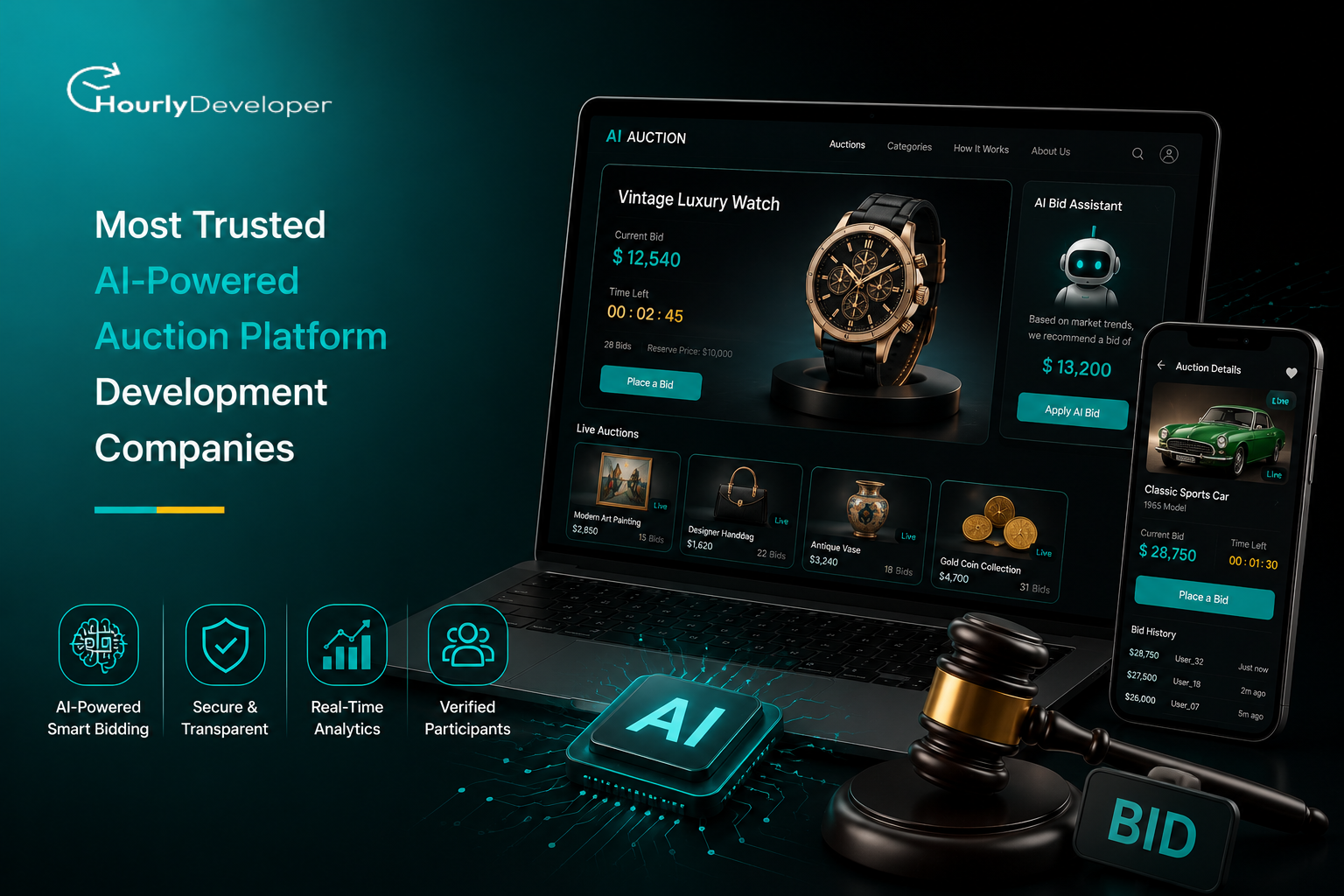
Most Trusted AI-Powered Auction Platform Development Companies

Introduction

As AI continues to reshape online marketplaces, choosing the right AI-Powered Auction Platform development company is essential for building secure, scalable, and intelligent bidding solutions. This guide highlights the most trusted AI-powered auction platform development companies with expertise in real-time bidding systems, AI-driven pricing, fraud detection, recommendation engines, marketplace development, payment integration, and predictive analytics, helping startups and enterprises compare reliable development partners based on their technical expertise, industry experience, and proven project delivery.

1.What Actually Makes an Auction Platform AI Powered

A lot of platforms bolt on a chatbot and call themselves AI driven. A genuine custom AI-powered auction platform development project goes further than that. It usually includes dynamic pricing models that adjust minimum bids based on demand, fraud scoring that watches for bid manipulation or shill bidding in real time, and recommendation systems that show buyers items similar to what they already bid on.

There is also the operational side that founders often overlook. Good AI marketplace application development work includes automated image tagging for listings, chat support that can answer basic buyer questions instantly, and analytics dashboards that tell a seller when demand for their category usually peaks. None of this needs to be complicated for the end user. It just needs to work quietly in the background while people focus on winning their auction.

It is also worth understanding that custom AI-powered auction platform development does not always mean building every component from scratch. Many strong platforms combine off the shelf payment and identity verification tools with genuinely custom bidding logic and pricing models, since the custom part should be wherever your platform actually needs to behave differently from a generic ecommerce store.

2.How We Put This List Together

We looked at public case studies, the technology each company talks about on their own site, and the kind of clients they mention working with. We were not interested in agencies that only do generic web development and mention AI as an afterthought. If you plan to hire AI auction platform developers, you want a team that can speak specifically about bidding logic, escrow handling, and fraud prevention, not just app development in general.

We also paid attention to how each company talks about maintenance after launch, since an auction platform is never really finished. New fraud patterns show up, payment regulations change in different regions, and pricing models need retraining as buyer behavior shifts over time.

3.The Most Trusted AI-Powered Auction Platform Development Companies

1. HourlyDeveloper
HourlyDeveloper works on a flexible hourly and dedicated team model, which makes them a practical pick for founders who are not ready to commit to a large fixed price project before they know exactly how big the build will get. Their teams have built bidding engines, real time notification systems, and payment integrations for marketplace clients across different regions, and they are comfortable joining a project midway if you already have a partial codebase.
What stands out is the transparency around hours and progress. Clients get regular reports showing exactly what was built each week, which matters a lot when you are trying to control cost on an AI-Powered Auction Platform build that might expand in scope as testing reveals new requirements.
This makes them a sensible starting point for founders who want to test a vendor relationship on a smaller feature first, such as a fraud alert module, before committing to the full platform build across every part of the marketplace.


2. ScienceSoft
ScienceSoft has been around long enough to have handled marketplace projects across retail, real estate, and industrial auction niches, and their case studies show a consistent focus on the unglamorous parts of a project that tend to matter most later, like data migration and reporting.
Their strength is in data engineering, which matters a great deal for pricing models that need clean historical bid data to work well. A pricing algorithm is only as good as the data feeding it, and this is where many smaller shops fall short.
They tend to suit mid to large scale projects where compliance and data governance are as important as the bidding features themselves, particularly for platforms operating in regulated industries such as agricultural or industrial equipment auctions. Their reporting tools also help operations teams track which categories are performing best over time.


3. Intellectsoft
Intellectsoft leans heavily into enterprise style engagements, with experience integrating AI recommendation engines into existing marketplace software rather than always starting from scratch. This is useful if you already have an auction site and want to layer in smarter pricing and fraud detection without a full rebuild that would disrupt existing sellers.
Their delivery process includes discovery workshops before any code is written, which helps founders avoid paying for features they do not actually need. This upfront planning stage often surfaces requirements that a founder had not considered, such as how refunds are handled after a disputed win.
Clients who value structured documentation and predictable timelines over the fastest possible delivery tend to get along well with this team, since their process leaves a clear paper trail that later helps with audits or investor due diligence.


4. Backend Development Company
As the name suggests, this team specializes in the backend architecture that keeps an auction platform stable during traffic spikes, which happens constantly during live bidding events. They focus on database design, API performance, and the kind of caching strategy that stops a site from crashing when two hundred people bid on the same item in the last thirty seconds of a listing.
They have also worked on queueing systems that process bids in the correct order even under heavy load, which prevents the frustrating situation where a buyer’s bid appears accepted on their screen but was actually beaten by someone else a moment earlier.
For founders whose biggest fear is downtime during a big sale, this is a sensible team to talk to first, especially if your platform expects seasonal spikes tied to holidays or limited time releases where thousands of buyers might log in within the same few minutes.


5. Simform
Simform has a reputation for structured engineering practices, including automated testing pipelines that catch bugs before they reach a live auction environment. Their marketplace work spans logistics, retail, and B2B trading platforms, giving them a broad view of how bidding logic changes across different industries.
They are a good fit for founders who care about long term maintainability and want documentation that a future in house team could pick up without confusion, which matters if you plan to bring development in house after the initial launch phase.
Their engagement model also supports gradual team scaling, so you can start small during MVP development and add specialists as the platform grows, without renegotiating the entire contract structure each time headcount changes.


6. DevTeam.Space
DevTeam.Space runs on a curated network of vetted engineers rather than a single fixed office team, which gives them flexibility to assemble specialists in machine learning, mobile development, and payment security depending on what a project needs at each stage.
This model suits founders who want senior level expertise in specific areas without hiring a full permanent department, particularly useful for the machine learning components of an auction platform where you might only need that skill set intensively for a few months.
Their project managers typically coordinate closely with the client, which helps reduce the communication friction that can come with a distributed engineering network spread across multiple time zones and specialties.


7. Appinventiv
Appinventiv has delivered marketplace and bidding apps with strong mobile experiences, which is worth noting since a large share of auction bidding today happens on phones during the final minutes of a listing. Their design team pays close attention to how bid confirmations and countdown timers feel on a small screen, since a confusing interface at that moment can cost a seller real money.
They also bring experience in blockchain based auction models for clients exploring transparent bid verification, where every bid is recorded in a way that cannot be altered after the fact.
Founders building a consumer facing auction app with an expected mobile heavy audience often shortlist this team specifically for their design sensibility, especially when the bidding experience needs to feel exciting rather than purely functional.


8. HireFullStackDeveloperIndia
This team offers full stack engineers who can handle both the bidding logic on the backend and the buyer facing interface, which keeps communication simpler for founders who do not want to manage separate frontend and backend vendors on the same project.
Their pricing tends to be competitive for founders working with a tighter budget, without giving up code quality or testing discipline, and they are used to working across time zones with clients based in North America and Europe.
This makes them a practical option for early stage founders who need a full working platform without the overhead of a larger enterprise agency, and their team is generally comfortable adjusting scope as an MVP evolves based on early user feedback.


9. Idea Usher
Idea Usher has worked on niche marketplace apps, including collectible and resale auction platforms, and understands the specific features that category needs, such as authenticity verification and condition grading tools built into the listing flow.
They tend to move quickly on MVP builds, which suits founders trying to validate demand before investing in a fully featured platform with every AI capability included from day one.
Their smaller scale means founders often deal directly with the same engineers throughout the project rather than being passed between account managers, which tends to speed up decision making when small design questions come up mid sprint.


10. Konstant Infosolutions
Konstant Infosolutions has a long history in ecommerce and marketplace development, with auction specific work that includes proxy bidding, where the system automatically raises a buyer’s bid up to a limit they set in advance without requiring them to keep refreshing the page.
Their teams also handle multi vendor auction setups, useful for platforms hosting many independent sellers rather than a single marketplace owner, including commission tracking and seller specific dashboards.
They are a reasonable fit for founders planning a broad category marketplace rather than a single niche auction site, since their tools are built to handle many product types under one roof without becoming cluttered.


11. Chetu
Chetu operates at a large scale and has built custom software across finance, healthcare, and retail, which gives them useful cross industry perspective when a client wants payment escrow or compliance features borrowed from more regulated sectors.
They are typically chosen by founders who want one vendor capable of handling a wide range of technical requirements under one contract, including integrations with accounting systems and third party logistics providers for platforms that also handle shipping.
Their scale can be an advantage for complex builds, though smaller founders sometimes prefer a more boutique team for closer day to day involvement and faster turnaround on small requests.


12. HireAIDevelopers
HireAIDevelopers focuses specifically on machine learning talent, including engineers who specialize in fraud scoring models, demand forecasting, and personalized recommendation systems for marketplace and bidding platforms.
If the AI layer is the part you are most worried about getting right, this is a sensible team to bring in, either as your main partner or alongside another agency handling general app development. Their engineers are used to explaining model behavior in plain language so non technical founders can still make informed decisions.
They also help clients think through what data they will need to collect from day one, since good models depend on data that is often overlooked during early planning, such as how long a buyer hesitates before placing a bid or how often they return to a listing before committing.


13. ValueCoders
ValueCoders offers dedicated development teams and has case studies covering auction and classifieds platforms, with particular strength in integrating third party payment gateways and identity verification services that reduce fraudulent bidding before it becomes a real problem.
Their contracts tend to be flexible, allowing founders to scale the team size up during a launch phase and back down afterward once the platform stabilizes.
They also provide detailed weekly reporting, which helps founders who are managing the project part time alongside other responsibilities, and their onboarding process is quick enough that new engineers rarely slow down an active sprint.


14. Sphinx Solutions
Sphinx Solutions has built marketplace apps with a focus on user experience research before development begins, which helps avoid the common mistake of designing a bidding interface that looks good but confuses first time users during a live auction.
Their smaller team size means founders often get more direct access to senior developers throughout the project, rather than working mainly with junior staff and account managers.
This tends to appeal to founders who value close collaboration over sheer size of the vendor, particularly during the early design phase when small usability decisions can shape the entire bidding experience.


15. Zealous System
Zealous System has handled real time applications where speed matters, which translates well to auction platforms since a delay of even a few seconds in showing the current highest bid can frustrate users and cost a seller money on a time sensitive listing.
They also offer post launch support packages, useful for founders who want ongoing bug fixes and small feature additions after the initial build without negotiating a new contract every time.
Their pricing is generally transparent, with clear scope documents that reduce the chance of surprise costs mid project, which many first time founders appreciate after hearing horror stories from other vendors.


16. Mobisoft Infotech
Mobisoft Infotech brings strong data science capability, having worked on predictive models across several industries before applying similar techniques to demand forecasting and dynamic pricing for marketplace clients.
They are a reasonable choice for founders who want the pricing algorithm itself to be a real point of differentiation rather than a basic rule based system that just applies a flat percentage markup.
Their engineers can also advise on which data points are worth collecting early so the pricing model has enough history to work with once the platform scales, which saves a lot of rework down the line.


17. Space-O Technologies
Space-O Technologies has delivered a wide range of on demand and marketplace apps, with experience building bid notification systems that alert buyers instantly when they are outbid, a small feature that has a big effect on user engagement and repeat participation.
Their process includes a clear milestone based payment structure, which many founders find easier to plan around financially compared to a single large upfront cost.
They also support both iOS and Android natively, which some founders prefer over cross platform frameworks for performance heavy bidding screens where every frame of animation and every second of load time genuinely matters to the user.


18. Hidden Brains
Hidden Brains has over a decade of software delivery experience and has worked across web and mobile marketplace projects, including platforms handling live and timed auction formats for different regional markets with varying payment preferences.
They offer both project based and dedicated team engagement models, giving founders flexibility depending on how defined their requirements already are at the start of the conversation.
Their broader industry exposure outside of auctions specifically can bring useful ideas from adjacent marketplace models, such as ticketing platforms or property listing sites that face similar demand spikes.


19. Nine Hertz
Nine Hertz has experience building blockchain integrated marketplace platforms, which appeals to founders exploring NFT auctions or platforms that want transparent, tamper resistant bid records that buyers can independently verify.
Their team also covers traditional auction formats, so blockchain is offered as an option rather than a forced requirement for every client, which keeps costs reasonable for founders who do not need that layer.
They tend to work well with founders who are still deciding between a conventional and a blockchain based approach and want honest guidance rather than a sales pitch for the more expensive option, since not every auction category actually benefits from that added complexity.


20. Suffescom Solutions
Suffescom Solutions rounds out this list with strong experience in marketplace and auction app development across both web and mobile, including support for multiple currencies and regional payment methods for platforms operating across borders.
They also provide ongoing maintenance contracts, which matters since an auction platform needs regular monitoring rather than a one time launch and walk away approach, particularly around payment gateway updates and security patches.
Founders planning an international launch from the outset often find their multi currency experience particularly useful during early planning conversations, since currency conversion and regional tax handling are easy to underestimate until they cause a real problem after launch.

4.Questions Worth Asking Before You Sign a Contract

Before you commit, ask any shortlisted vendor to walk you through a real fraud detection scenario they have built before, not just a slide describing the concept. Ask how their pricing model handles a sudden spike in bidding activity, and whether their infrastructure has actually been tested under that kind of load rather than assumed to work.

It also helps to ask directly whether you should hire AI auction platform developers as a dedicated add on team working alongside your main development partner, especially if the agency you like most is stronger in general app development than in machine learning specifically. Many founders end up mixing two vendors for exactly this reason, and there is nothing wrong with that approach if it gets you a better result.

Finally, ask what happens after launch. Solid AI marketplace application development does not stop the day your platform goes live. Bidding patterns change, fraud attempts evolve, and your pricing model will need retraining as more real data comes in. A vendor who talks about this openly, instead of treating launch day as the finish line, is usually the safer long term choice.

5.Final Thoughts

There is no single correct answer to who the best partner is, because it depends heavily on your budget, your timeline, and how much of the AI layer you want built from scratch versus adapted from existing tools. What does matter is picking a team that can talk specifics about auction mechanics rather than general marketing language.

Use this list of most trusted AI-powered auction platform development companies as a starting point, request a short technical call with two or three of them, and pay attention to how clearly they explain their past work on a real AI-Powered Auction Platform. That single conversation usually tells you more than any portfolio page ever could.

2026 is a good time to build, since the underlying AI tools have matured enough that they no longer require a research team to implement well. What still separates a strong platform from a mediocre one is the development partner behind it, so take your time on this decision even if it means a few extra calls before you sign anything.

Nikhil Patel

Nikhil Patel, our dynamic Director, charts our course with innovative fervor and strategic acumen. With a sharp eye for opportunity, he steers our company's ascent with resolute determination. Nikhil's empathetic leadership unites us, igniting a collective drive for greatness and propelling us toward boundless success.

Frequently Asked Questions

A basic version with core bidding features and simple fraud checks can take 10 to 14 weeks. Adding advanced recommendation engines, dynamic pricing, or blockchain based bid verification typically extends the timeline to 5 to 7 months, depending on how much custom testing the AI models require and how many payment regions you plan to support at launch.

Yes, in most cases. Fraud scoring, recommendation engines, and dynamic pricing can often be added as separate services connected through APIs. This avoids rebuilding the whole platform and lets you test AI features on a smaller scale, such as a single product category, before rolling them out to every listing on the site.

Most of the companies listed here handle both web and mobile builds, either natively for iOS and Android or through a single cross platform codebase. It is worth asking directly which approach a vendor prefers, since it affects both cost and how fast future updates can be pushed to bidders on both platforms.

Look for PCI DSS compliant payment handling, encrypted storage of buyer and seller data, and two factor authentication for account access. Ask vendors how they isolate payment processing from the rest of the application, since that separation limits damage if any other part of the system is ever compromised or breached.

It happens more often than people expect. Some founders hire one team for general app development and a separate specialist for machine learning components like fraud detection or pricing models. This works well as long as both teams agree early on how their systems will communicate and who owns which part of the codebase.

  • Hourly
  • $20

  • Includes
  • Duration: Hourly Basis
  • Communication: Phone, Skype, Slack, Chat, Email
  • Project Trackers: Daily reports, Basecamp, Jira, Redmi
  • Methodology: Agile
  • Monthly
  • $2600

  • Includes
  • Duration: 160 Hours
  • Communication: Phone, Skype, Slack, Chat, Email
  • Project Trackers: Daily reports, Basecamp, Jira, Redmi
  • Methodology: Agile
  • Team
  • $13200

  • Includes
  • Duration: 1 (PM), 1 (QA), 4 (Developers)
  • Communication: Phone, Skype, Slack, Chat, Email
  • Project Trackers: Daily reports, Basecamp, Jira, Redmi
  • Methodology: Agile