Web Analytics
Nikhil Patel

Director

August 17, 2026

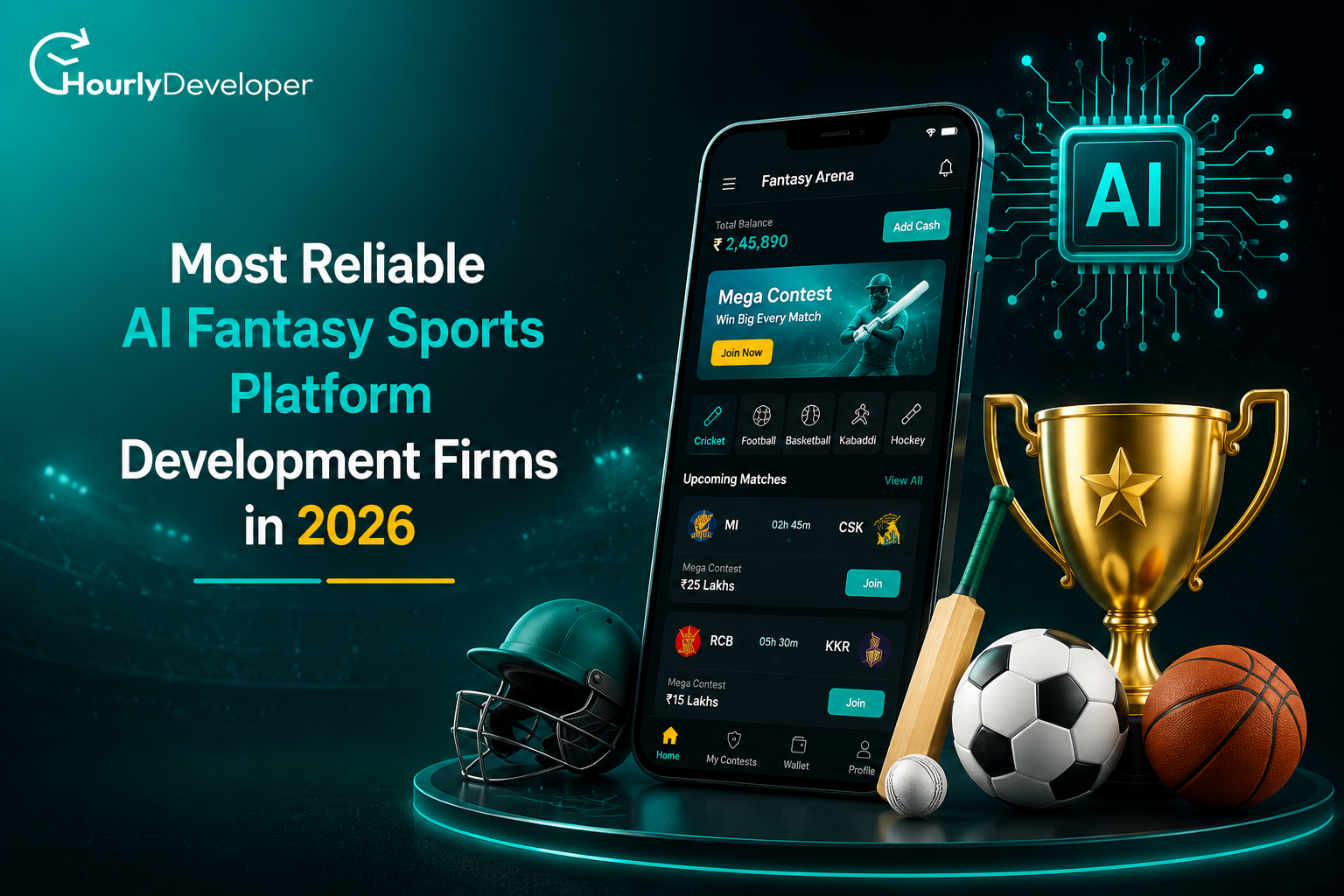
Most Reliable AI Fantasy Sports Platform Development Firms in 2026

Introduction

Fantasy sports is rapidly growing, with users expecting real-time stats, personalized recommendations, secure payments, and engaging experiences. An AI Fantasy Sports Platform uses AI to analyze player performance, predict outcomes, detect fraud, and personalize user interactions. Choosing the right development partner is crucial for building a reliable and scalable platform. This guide highlights 15 of the most reliable AI fantasy sports platform development firms, selected based on their expertise, experience, team strength, and proven project work.

1.What Makes a Development Firm Worth Hiring

Not every app development company that lists fantasy sports on its website actually understands the space. Before you decide to hire AI fantasy sports developers or sign a contract with a full agency, it helps to check a few basics. Has the team built live scoring engines that update within seconds during a real match? Do they understand contest formats, prize pool logic, and the regulatory quirks of daily fantasy versus season long leagues? Have they actually shipped AI features such as player performance prediction, personalized lineup suggestions, or fraud detection, rather than adding a chatbot and calling it AI?

Team size and location matter too, but not in the way most people assume. A large offshore team can be excellent for cost-effective scaling, while a smaller boutique studio might offer more hands-on attention during the early stages of your build. What matters most is whether the company can show real fantasy sports work, real client feedback, and a technical stack that can survive a traffic spike on a big match day. Keep these questions in mind as you go through the list below, because the right fit depends on your specific sport, region, and budget as much as it does on a company’s reputation.

2.Why AI Is Reshaping Fantasy Sports Platforms in 2026

Fantasy sports used to be about spreadsheets and gut feeling. That is no longer true. Every serious AI Fantasy Sports Platform launched this year uses machine learning to study player form, weather conditions, injury history, and head to head matchups to suggest smarter lineups to users in real-time. Fraud detection models catch suspicious account behavior before it becomes a payout problem, and personalization engines decide which contests, leagues, or sports a specific user is most likely to enjoy, which keeps engagement numbers healthy long after the initial signup.

None of this happens by accident. It requires a development team that understands both the sports data pipeline and the machine learning models sitting on top of it, and that combination is rarer than most founders expect. A company that has only built generic mobile apps will usually struggle with the real-time data demands of a live match, while a pure AI consultancy might not understand contest logic or prize pool settlement at all. The firms on this list were chosen because they sit somewhere in that overlap, whether through direct fantasy sports experience or through proven AI development work that can be adapted to the sport specific rules your platform needs.

3.15 Most reliable AI fantasy sports platform development firms in 2026

1. Hourly Developers
Founded: 2004  |  Headquarters: Ahmedabad, India  |  Team size: 150+ engineers
Hourly Developers built its reputation on flexible hiring rather than rigid project contracts, and that flexibility works well for fantasy sports founders who are not sure how big a team they need yet. Businesses can bring on backend engineers, full stack developers, or AI specialists on an hourly, part time, or full time basis, then scale that team up as the platform grows from a pilot to a full public launch. With over two decades of combined delivery experience across mobile, web, and cloud projects, the team is comfortable working inside an existing codebase or building a fantasy sports engine from scratch. For founders who want to control costs while still keeping senior talent close to the project, this model removes a lot of the friction that usually comes with hiring offshore teams. The company also supports post launch maintenance, which matters once your fantasy contests are live and every bug report needs a fast response during an active match window.


2. MindInventory
Founded: 2011  |  Headquarters: Ahmedabad, India  |  Team size: 250 to 300 engineers
MindInventory has spent over a decade combining mobile app development with AI and machine learning, which makes it a strong fit for fantasy sports products that lean heavily on personalization. The company holds ISO 9001 and ISO 27001 certifications, both of which matter when your platform will be handling real money transactions and sensitive user data. Its engineering teams have delivered thousands of projects for clients ranging from early stage startups to established enterprises, with particular strength in building recommendation engines and data driven features that keep users coming back. For a fantasy sports founder who wants AI baked into the product from day one rather than bolted on later, MindInventory brings the technical depth to make that happen. The company also maintains offices beyond India, which helps when a fantasy sports operator needs support across different time zones during peak season.


3. Backend Development Company
Headquarters: Ahmedabad, India  |  Focus: Backend engineering and API architecture
As the name suggests, Backend Development Company focuses entirely on the engine room of a digital product rather than trying to be everything to everyone. For a fantasy sports platform, that engine room is where the real complexity lives. Live scoring updates, contest settlement logic, wallet management, and the ability to handle thousands of concurrent users during a big match all depend on backend architecture that does not buckle under pressure. This firm specializes in building and modernizing exactly that kind of system, working with scalable database design, cloud infrastructure, and API development so that the rest of your team, whether in-house or outsourced, can build a smooth frontend on top of a foundation that actually holds. This kind of narrow focus is useful when an existing fantasy sports app is struggling under load and needs a rebuild rather than a patch.


4. Fansportiz
Founded: 2021  |  Headquarters: Ahmedabad, India  |  Team size: 150 to 250 professionals
Fansportiz was built specifically for fantasy sports and gaming, which shows in how quickly the team can turn around a working platform. Its offerings cover cricket, football, kabaddi, basketball, baseball, hockey, and esports, with support for live scoring data, toss updates, and social sharing features built directly into the product. The company has also leaned into AI-powered analytics and support for multiple sports from a single admin backend, letting operators run several fantasy formats without managing separate systems. Flexible pricing models, including setup and monthly options, make Fansportiz approachable for smaller operators who still want a genuinely dedicated AI Fantasy Sports Platform rather than a generic app with a fantasy sports skin. Its focus on fair play mechanics and monetization models also gives newer operators a template for pricing contests without guessing.


5. Vinfotech
Founded: 1999  |  Headquarters: Indore, India  |  Team size: 100+ fantasy sports specialists
Few companies on this list can match Vinfotech’s history in fantasy sports specifically. The company built its own frameworks, including vFantasy, years before most agencies even had a fantasy sports offering, and it remains an active member of the Fantasy Sports Trade Association and the Indian Federation of Sports Gaming. Its client list spans iGaming operators, sports leagues, and media brands across more than 20 countries, with platforms supporting 15 or more languages and integrations with outside sports data providers such as Opta and Sportradar. Vinfotech has also expanded into prediction market software, worth knowing if your fantasy sports roadmap eventually includes prediction style or event trading formats alongside traditional fantasy leagues. Over 600,000 users have already engaged with platforms it has built, which gives a good sense of scale before you even ask for a demo.


6. HireFullStackDeveloperIndia
Founded: 2013  |  Headquarters: Ahmedabad, India  |  Team size: 180+ developers
HireFullStackDeveloperIndia positions itself as a single vendor option for founders who do not want to coordinate separate frontend, backend, and AI teams. Its developers cover both client side frameworks such as React and Angular and server side stacks such as Node.js and Python, along with dedicated AI development services for businesses that want predictive features or intelligent automation built into their product. The company offers hourly, part time, and full time contract models, which gives fantasy sports founders room to start small during the MVP stage and expand the team once the platform proves demand. For CEOs juggling a tight budget and an even tighter timeline, having one accountable team across the whole stack tends to reduce the usual back and forth between vendors. The company also works with clients in the United Kingdom and beyond, so language and time zone overlap with Western markets tend not to be a major hurdle.


7. Excellent Webworld
Founded: 2011  |  Headquarters: Ahmedabad, India  |  Team size: 250 to 300 engineers
Excellent Webworld has built a reputation over more than a decade for combining enterprise grade software with AI-powered features, and its portfolio includes work spanning fantasy leagues, fitness tracking, and live streaming style products. The company has delivered more than 900 projects for clients across 18 or more industries, with a technology stack that covers everything from mobile app development to cloud infrastructure and AI and machine learning integration. That range matters for fantasy sports founders who want a single partner capable of handling the mobile app, the admin dashboard, and the AI layer that powers personalized recommendations, all without managing three separate vendors. Its client base spans North America, Europe, and the Middle East, which is worth noting if your fantasy sports platform is targeting more than one region at launch.


8. Cogniteq
Founded: 2005  |  Headquarters: Vilnius, Lithuania  |  Team size: 50 to 85 engineers
Cogniteq brings a distinctly European perspective to the list, with two decades of experience delivering custom software for clients such as DHL, Bosch, and Audi. The company holds ISO IEC 27001 certification, which speaks to a strong focus on data security, an important consideration for any fantasy sports platform handling payment information and personal user data. While Cogniteq is not a fantasy sports specialist in the way some other firms on this list are, its full cycle development process, covering everything from UI UX design to QA and IT consulting, makes it a solid option for operators targeting European markets or needing to meet stricter data compliance standards from the start. Its smaller team size also tends to mean shorter internal chains of communication once your project is underway.


9. HireAIDevelopers
Headquarters: Ahmedabad, India, with global clients  |  Team size: 180+ AI specialists
HireAIDevelopers sits at a slightly different point in the fantasy sports development world compared to full platform builders. Rather than building the entire app, this firm focuses specifically on the artificial intelligence layer, including predictive scoring models, recommendation engines, computer vision for player tracking, and natural language processing for chat based support. With more than 120 completed AI projects and a reported client retention rate above 95 percent, the team has clearly moved past basic chatbot integrations and into more sophisticated territory. Founders who already have a development partner for the core app but want a specialist to hire AI fantasy sports developers for the intelligence layer often find this kind of focused partnership works better than asking a generalist team to learn AI on the job. The team also reports a client retention rate near 98 percent, a signal worth weighing alongside its technical portfolio.


10. RipenApps
Founded: 2017  |  Headquarters: Noida, India  |  Team size: 150 to 250 professionals
RipenApps has built a reputation as a fast moving mobile app development agency with a presence in 18 or more countries, including offices in the United States, UAE, and several parts of Europe and Asia. The company has delivered more than 500 apps to date, with particular strength in helping early stage startups get an MVP into the market quickly and helping established businesses refresh aging products. Its ISO certification and structured QA process add a layer of reliability that startups sometimes overlook when chasing speed. For a fantasy sports founder who needs to launch fast ahead of a specific sports season, RipenApps’ experience with tight MVP timelines can be a genuine advantage. The company’s global footprint also means it can support launches aimed at cricket heavy markets and Western sports markets from the same playbook.


11. Code Brew Labs
Founded: 2013  |  Headquarters: Dubai, UAE  |  Team size: 350 to 450+ employees
Code Brew Labs has grown from a smaller Indian studio into a global technology partner that has served more than 10,000 businesses across 150 or more countries. The company leans heavily into AI-powered app development, using machine learning and data analytics to build smarter, more personalized user experiences, which lines up well with what modern fantasy sports users expect. Its size also means Code Brew Labs can handle larger, more complex builds, including platforms that need to support several sports, regions, and currencies at once. Fortune 500 companies and fast growing startups alike make up its client base, giving it the kind of range that suits both first time founders and established operators looking to modernize an existing platform. Its design first process also tends to reduce costly rework later in the build, since usability issues get caught before development begins.


12. ArcTouch
Founded: 2008  |  Headquarters: San Francisco, United States  |  Team size: 270 to 350 professionals
ArcTouch built its name designing what it calls lovable apps, and that design first philosophy shows in the polish of its work. As part of the AKQA and WPP network since 2016, the company combines boutique agency attention with the resources of a much larger organization, which is a rare combination in this space. Its services span product strategy, UX UI design, backend engineering, and increasingly, AI and emerging technology integration. For fantasy sports founders targeting a premium user base in the United States or Europe, where design quality often makes or breaks user retention, ArcTouch’s focus on interface craft and user experience is worth serious consideration. Backing from a global network also means the studio can draw on specialists it might not keep on staff full time, such as accessibility experts or motion designers.


13. Uinno
Founded: 2019  |  Headquarters: Remote first, global team  |  Team size: Boutique, founder led
Uinno stands out on this list because the people who started it were building fantasy sports and fan engagement products years before the company existed. One of its founders spent years at a major sports data and fan engagement firm, where the team shipped more than 50 fantasy and fan engagement products for organizations including the NFL, Major League Baseball, MLS, MotoGP, Euroleague, and Cricket Australia. That kind of sports native leadership is genuinely rare among development agencies, most of which treat fantasy sports as just another vertical. Uinno also brings AI and machine learning capabilities to the table, covering predictive analytics and fraud detection, which pairs naturally with its deep domain knowledge of how fantasy sports products need to work under real match day conditions. Its founder led structure also tends to mean direct access to senior decision makers rather than layers of account management.


14. Chetu
Founded: 2000  |  Headquarters: Sunrise, Florida, United States  |  Team size: 3,000+ developers
Chetu is one of the largest and most established names on this list, with more than two decades in business and a global delivery model spanning offices across the United States, Europe, and Asia. The company serves everyone from early stage startups to Fortune 5000 organizations, and its scale means it can absorb large, complex fantasy sports builds that require compliance work across multiple jurisdictions, something that matters a great deal for operators running real money contests. Chetu’s software security and quality assurance practices are well documented, and its size gives fantasy sports operators access to specialists across nearly every technology stack without needing to manage several smaller vendors. That breadth can be especially useful for operators planning to expand from one sport into several over time.


15. Dogtown Media
Founded: 2011  |  Headquarters: Venice, California, United States  |  Team size: Boutique studio
Dogtown Media is a smaller, more boutique studio compared to some of the larger names on this list, and that size comes with its own advantages. The team has worked with recognizable brands such as Google, Lexus, and Red Bull, building mobile apps that integrate AI, machine learning, and IoT features. For a fantasy sports founder who wants close, hands-on collaboration with a senior team rather than being one account among hundreds, Dogtown Media’s smaller footprint can mean faster communication and more direct access to the people actually writing the code. Its focus on AI-powered solutions and a design centered approach makes it a reasonable option for startups building a first version of a fantasy sports product on the United States West Coast. The studio also maintains offices in San Francisco, New York, and London, giving it reach beyond its home base when a project calls for it.

4.Picking the Right Partner for Your Fantasy Sports Platform

There is no single right answer here, and that is worth saying plainly. A founder building a niche cricket fantasy app for one country has very different needs than an operator trying to launch a platform covering multiple sports and prediction markets across a dozen regions. What matters is matching the scale and specialization of the development firm to the scale and specialization of your product. A team that excels at rapid MVP builds is not automatically the right fit for a platform expecting millions of concurrent users on a World Cup weekend, and the reverse is just as true.

If you are early stage and cost conscious, a flexible hiring model through a firm such as Hourly Developers or HireFullStackDeveloperIndia might make more sense than committing to a large agency retainer. If fantasy sports specific experience matters most to you, companies such as Vinfotech, Fansportiz, or Uinno bring domain knowledge that generalist agencies simply cannot match. And if AI is the piece you are missing, whether that is predictive scoring, personalization, or fraud detection, working with a focused partner like HireAIDevelopers can fill that gap without forcing you to rebuild your existing platform from scratch.

Whichever direction you choose, treat this list as a starting point rather than a final answer. Reach out to two or three companies, ask to see live products they have shipped, and pay close attention to how they talk about contest logic, live data handling, and AI features specifically, not just general app development language. That conversation will tell you more about whether you have found one of the best AI fantasy sports software development companies for your project than any portfolio page ever could. The fantasy sports market is not slowing down in 2026, and the most reliable AI fantasy sports platform development firms are the ones already building for what next season’s users will expect, not just what worked last season.

Nikhil Patel

Nikhil Patel, our dynamic Director, charts our course with innovative fervor and strategic acumen. With a sharp eye for opportunity, he steers our company's ascent with resolute determination. Nikhil's empathetic leadership unites us, igniting a collective drive for greatness and propelling us toward boundless success.

Frequently Asked Questions

Costs vary widely depending on features, but most custom builds fall between $40,000 and $250,000, while white label solutions can start around $5,000 per sport with faster launch timelines. Real-time data integration, live scoring engines, and AI personalization features tend to push costs toward the higher end of that range.

A basic MVP with core fantasy sports features can launch in 6 to 10 weeks, while a full featured platform with AI-powered analytics, wallet integration, and support for multiple sports typically takes 4 to 7 months. White label providers can sometimes launch a working product in as few as 14 days.

Requirements depend heavily on your target country and whether contests involve real money. Many regions require daily fantasy sports operators to register separately from traditional sports betting platforms. A development partner with prior fantasy sports experience can usually flag these requirements early, though legal review from a local expert remains essential.

Most platforms rely on outside sports data providers such as Opta, Sportradar, or Stats Perform for live scores, player statistics, and match events. The choice of data provider affects both platform cost and the accuracy of AI driven features like performance prediction, so it is worth discussing this early with your development team.

Yes. Many operators launch with a simpler rules based scoring system and add AI-powered personalization, fraud detection, or predictive analytics in a later phase once they have real user data to train models on. This phased approach is common and often more cost-effective than building every AI feature from day one.

  • Hourly
  • $20

  • Includes
  • Duration: Hourly Basis
  • Communication: Phone, Skype, Slack, Chat, Email
  • Project Trackers: Daily reports, Basecamp, Jira, Redmi
  • Methodology: Agile
  • Monthly
  • $2600

  • Includes
  • Duration: 160 Hours
  • Communication: Phone, Skype, Slack, Chat, Email
  • Project Trackers: Daily reports, Basecamp, Jira, Redmi
  • Methodology: Agile
  • Team
  • $13200

  • Includes
  • Duration: 1 (PM), 1 (QA), 4 (Developers)
  • Communication: Phone, Skype, Slack, Chat, Email
  • Project Trackers: Daily reports, Basecamp, Jira, Redmi
  • Methodology: Agile