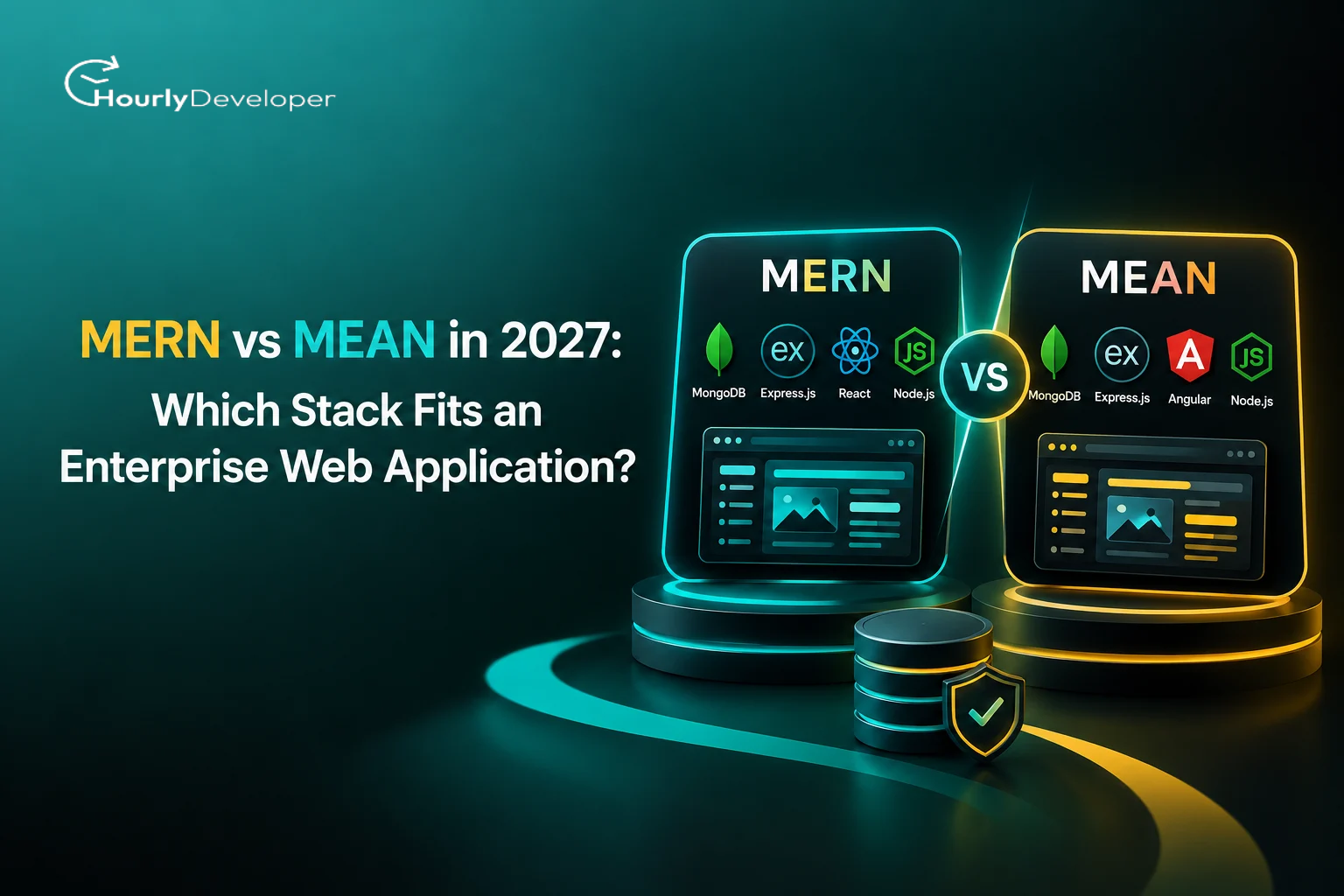
MERN vs MEAN in 2027: Which Stack Fits an Enterprise Web Application?
Introduction: Why the MERN vs MEAN Decision Still Matters in 2027
In the 2025 Stack Overflow Developer Survey, 44.7% of respondents said they had worked with React in the past year. Only 18.2% said the same about Angular. If popularity settled technical decisions, this article could end right here.
It doesn't, because enterprise software is different. A company portal in 2027 might pull data from an old ERP, run an AI assistant, and serve 5,000 employees who all log in at 9 a.m. on Monday. The stack behind it shapes how fast the app responds, how well it grows, how safe it is, how quickly your team ships, how easy it is to fix, who you can hire, and what it costs over five years.
MERN and MEAN are close cousins. Both are JavaScript-based, and they share three of their four parts. The real debate in MERN vs MEAN in 2027 comes down to React versus Angular, yet that one swap spreads into team structure, code reviews, hiring and long-term upkeep.
This guide answers one practical question: which stack suits the specific requirements of your enterprise application? Both can run large systems, but they follow different philosophies, and those matter more as teams grow.
What Is a Technology Stack?
What Does "Technology Stack" Mean?
A technology stack is the set of tools that run an application together. Think of a restaurant: the dining room is the frontend users see, the kitchen is the backend, the pantry is the database, and the power supply is the server runtime. APIs are the waiters carrying requests between rooms, and supporting tools handle testing, monitoring and deployment.
Why Does the Technology Stack Matter for an Enterprise Application?
Your stack shapes user experience, development workflow, scalability, security, integrations, infrastructure and developer availability. Together these add up to total cost of ownership: what the app costs to build, run and maintain over its life. Companies that set out to Hire Web Developers for a niche stack often discover a very small hiring pool.
What Makes an Enterprise Web Application Different?
A brochure website shows information. An enterprise app runs part of a business: ERP systems, CRM platforms, banking apps, healthcare platforms, logistics systems, SaaS products, internal tools, e-commerce stores and data-heavy dashboards. They come with many user roles, strict permissions, audit trails and uptime promises written into contracts.
What Is the MERN Stack?
What Does MERN Stand For?
MERN is MongoDB, Express.js, React and Node.js. Because every layer speaks JavaScript, one developer can follow a feature from the button a user clicks to the database record. That single-language advantage is the main reason MERN stack development became popular with startups and product teams.
MongoDB
MongoDB is a NoSQL database. Instead of spreadsheet-style rows and columns, it stores "documents" in JSON-like format, so one customer record can hold a name, addresses and preferences together. Schemas are flexible, meaning documents in one collection can have different fields, and sharding spreads data across servers. It suits product catalogs, user profiles, content and event logs. The flip side is a data gap risk: older documents may lack fields that newer code expects.
Express.js
Express is a small backend framework on Node.js. It defines routes (which URL does what), runs middleware (code that checks each request, such as login checks), and holds business logic and APIs. Express 5, the default on npm since 2025, now passes errors from async code to your error handler instead of failing quietly.
React
React is a frontend library for building interfaces from reusable components. A "date picker" is built once and used everywhere, which suits dynamic screens and dashboards. React Compiler 1.0, released in October 2025, handles many speed optimizations automatically, and React now sits under the independent React Foundation at the Linux Foundation.
Node.js
Node.js runs JavaScript on a server. It is event-driven: one event loop juggles thousands of waiting requests, which suits APIs that mostly wait on databases.
How MERN Components Work Together
User → React → Express/Node.js → MongoDB → Express/Node.js → React → User
A user clicks "View orders." React calls an Express route, Express checks the login token and asks MongoDB for the orders, and React redraws only the parts of the screen that changed.
What Is the MEAN Stack?
What Does MEAN Stand For?
MEAN is MongoDB, Express.js, Angular and Node.js. Three of the four parts match MERN exactly. The single difference: MERN uses React, while MEAN uses Angular.
MongoDB, Express.js and Node.js in MEAN
These play the same roles as in MERN: MongoDB stores documents, Express handles APIs and business rules, and Node.js runs the server. The backend in MEAN stack development is identical to its sibling's.
Angular
Angular is a full framework maintained by Google. React gives you an engine and lets you pick the rest; Angular arrives with most of the car assembled. It uses TypeScript and includes components, dependency injection (a system that hands each part of the app the services it needs), routing, forms, an HTTP client and a code generator. A new major version ships every six months, each supported for 18 months. Version 22, released in mid-2026, made Signal Forms stable and switched the default change detection to OnPush for faster screens.
How MEAN Components Work Together
User → Angular → Express/Node.js → MongoDB → Express/Node.js → Angular → User
An Angular component asks a shared "OrderService" for data, the service calls the Express API, and the response flows back to update the screen.
MERN vs MEAN: What Is Actually Different?
The major difference is React versus Angular. Many people searching MERN vs MEAN which is better for enterprise applications expect a long list of differences, but the backend and database can be identical.
Factor
MERN
MEAN
Frontend
React
Angular
Type
Library
Full framework
Language
JavaScript or TypeScript
TypeScript
Learning curve
Moderate
Steeper
Flexibility
High
More opinionated
Architecture
You design it
Largely set by the framework
Built-in features
Fewer (add libraries)
Routing, forms, HTTP, DI included
Enterprise standardization
Needs extra team decisions
Strong out of the box
UI development
Highly flexible
Structured
Ecosystem
Very large
Large
Best suited for
Flexible, fast-changing products
Structured enterprise systems
Why does one swap matter? Much enterprise code lives in the frontend. With React, each team picks its own routing, form and state libraries unless someone sets rules; with Angular, those choices are made. Across eight teams and 300 screens, that shows up in every code review.
MERN vs MEAN Architecture: How Do They Handle Enterprise Applications?
MERN Architecture
React calls REST APIs on a Node/Express backend that talks to MongoDB. Login uses tokens or sessions, state management comes from tools like Redux or TanStack Query, and payments, email or AI plug in through the backend.
MEAN Architecture
Same shape, but Angular organizes code into components and injectable services. Data fetching and permission checks live in shared services that every screen uses the same way.
Monolithic vs Modular Enterprise Architecture
Neither stack decides whether your app is a monolith (one big deployable unit), modular, microservices-based or event-driven. Those are separate design choices, and non-technical buyers often miss this.
Can MERN and MEAN Support Microservices?
Yes. Both can run small Node services behind an API gateway (a single front door that routes requests), in containers, talking through message queues such as Kafka. These decisions matter as much as the stack.
MERN vs MEAN Performance in 2027
No honest look at MERN vs MEAN in 2027 can crown one stack as faster everywhere. Performance lives in layers.
Frontend Performance
React's compiler and Angular's signals both cut unnecessary screen updates. Both support lazy loading and code splitting, so users download a screen's code only when they open it, and bundle size depends more on added libraries than on the framework.
Backend Performance
Both run the same Node.js and Express, so there is no difference.
Database Performance
MongoDB speed comes from indexes (like a book's index), sensible data modeling, efficient aggregation and caching in Redis. One missing index can turn a millisecond query into a multi-second one.
Performance at Enterprise Scale
Under pressure, weak points are predictable. Node's event loop stalls if one request builds a huge PDF report, and every other user waits; the fix is worker threads or a background job queue. The MongoDB Node.js driver also defaults to 100 pooled connections per client, so a traffic spike can leave requests queuing while the database sits idle.
Which Is Faster: MERN or MEAN?
Neither is automatically faster. Architecture, code quality, database design, infrastructure and caching matter far more than the letter in the middle of the acronym.
MERN vs MEAN Scalability
What Does Scalability Mean?
Scalability is handling more users or data without falling over. Vertical scaling means a bigger server; horizontal scaling means more servers sharing the load.
MERN Scalability
React apps compile to static files served from a CDN (servers worldwide that deliver files from near each user). Node services sit behind a load balancer, Redis caches frequent reads, and MongoDB scales through replica sets and sharding.
MEAN Scalability
The server side scales identically. Angular's service and module structure helps with a different kind of scale: more features and more developers rather than more traffic.
Which Stack Is More Scalable?
Both handle enterprise workloads when properly designed. MERN tends to have the edge for scaling a product quickly; MEAN for scaling a large developer organization. One trap hits both: a poor shard key (for example, one based on today's date) sends every new write to the same server, creating a "hot shard" that defeats the point of sharding.
MERN vs MEAN Security
Security is an architecture concern, not a stack feature. Anyone weighing MERN vs MEAN which stack should enterprises choose in 2027 on security grounds should know both share the same backend and database, and therefore the same core risks.
Authentication
Options include session cookies, JWTs (signed tokens the server verifies), OAuth 2.0 and SSO through providers like Okta.
Authorization
Role-based access control decides what each role can do. Multi-tenant apps, where many client companies share one system, must filter every query by tenant, or one customer may see another's data.
API Security
Rate limiting, input validation, API authentication and secure headers (via the Helmet package) apply equally to both.
Data Security
Encrypt data in transit and at rest, keep passwords in a secrets manager, restrict network access, and test backups by restoring them.
Common Web Vulnerabilities
Both frontends escape text by default, blocking most cross-site scripting (XSS), and Angular's HTTP client includes CSRF token support. NoSQL injection, where attackers send {"$gt": ""} instead of a password, hits both through Express. Patch speed matters: in December 2025, the React2Shell flaw (CVE-2025-55182, CVSS 10.0) let attackers run code on servers using React Server Components, and CISA listed it as actively exploited within days. Weeks later, "MongoBleed" (CVE-2025-14847) leaked memory from MongoDB servers with zlib compression enabled, no login required.
Which Is More Secure: MERN or MEAN?
Neither. Angular switches on a few more protections by default, but implementation quality and patch speed decide your real risk.
MERN vs MEAN for Enterprise Development
MERN gives teams freedom to choose libraries and patterns. MEAN gives them conventions: a standard folder layout and standard ways to fetch data and build forms. Freedom speeds up small teams; conventions protect large ones.
Maintainability follows. Angular's TypeScript-first design and dependency injection make it harder for a project to drift into ten coding styles. A React project can stay as clean if someone enforces the rules, which is why React-heavy companies often create a platform team to own shared components.
Large teams feel the gap most. With 200 developers on one Angular app, someone moving from billing to HR usually finds the same structure. In an unmanaged React codebase, each module can feel like a different company built it. This is why MEAN stack development tends to appeal to organizations building large internal portals.
For long-term maintenance, Angular's CLI includes automated migrations (ng update) that rewrite code for new versions. React upgrades are usually smaller, but a React app with 40 added libraries has 40 release calendars to track.
Governance (coding standards, architecture rules, security policies) is easier to enforce when the framework already agrees with you. If you plan to Hire MEAN Stack Developers for a regulated environment, look for people who have worked under that kind of governance.
MERN vs MEAN and TypeScript in 2027
What Is TypeScript?
TypeScript is JavaScript with labels. Declare that "amount" is a number, and your editor warns you if someone stores text in it, catching bugs before users see them.
TypeScript in MERN
React supports TypeScript fully, and many enterprise React projects use it, but it remains optional.
TypeScript in MEAN
Angular is TypeScript by default, which removes a decision and a source of inconsistency.
Type safety, refactoring, error detection and collaboration all improve with TypeScript, and the benefit grows with size. In a 500,000-line app, renaming a field across hundreds of files without types is guesswork. One gap remains in both stacks: TypeScript checks code at build time, not data at runtime. If an API returns null where a number was promised, types won't catch it, so teams add runtime validation (Zod is popular) wherever data enters.
MERN vs MEAN for AI-Powered Enterprise Applications in 2027
Enterprise apps now include AI assistants, recommendations, predictive analytics, document processing, AI search and RAG systems (retrieval-augmented generation, where the AI checks your company's documents before answering).
MERN for AI Applications
React has the widest choice of ready-made libraries for AI chat interfaces, streaming answers and model-driven dashboards. Teams doing MERN stack development for AI products also use MongoDB Atlas Vector Search, which stores and searches embeddings (numeric representations of meaning) next to regular data.
MEAN for AI Applications
Angular fits large internal systems where AI is one feature among many, such as a claims portal with an AI summary panel. Typed services keep AI integrations consistent across dozens of screens.
Important Clarification
Neither MERN nor MEAN is an AI stack. Models run elsewhere: provider APIs, Python microservices, cloud ML platforms or dedicated AI services. Your web stack displays and orchestrates AI; it does not decide how smart it is. AI calls are slow and sometimes fail, so the interface needs timeouts, retries and a fallback message, and when a model's answer conflicts with your own database, the app should show sources and let users flag errors.
MERN vs MEAN for Real-Time Applications
Chat, live dashboards, notifications, vehicle tracking and support desks depend on real-time updates. They use WebSockets, a connection that stays open so the server can push updates instantly. Node.js handles many open connections efficiently, and Socket.IO is common on both stacks.
Both frontends handle streaming data well. The harder problems sit on the server. With several Node servers behind a load balancer, a message sent to server A will not reach a user on server B unless you add a shared channel such as the Socket.IO Redis adapter. After a network drop, messages can arrive twice or out of order, so each event needs an ID and timestamp. And when two dispatchers update the same shipment within a second, version numbers should reject the stale update rather than letting the last write silently win.
MERN vs MEAN for Different Enterprise Use Cases
Choose MERN for
Why
SaaS platforms
Features change weekly, and React's flexibility keeps experiments cheap.
Consumer-facing apps
Polished interfaces benefit from React's huge component ecosystem.
Interactive dashboards
Mature charting and data-grid libraries exist for React.
Content-heavy and e-commerce sites
Frameworks like Next.js add server rendering for search visibility.
Social platforms
Feeds, comments and reactions suit small reusable components.
AI-powered interfaces
React has the widest choice of AI chat UI libraries.
Rapidly evolving products
Fewer framework rules mean quicker pivots.
Choose MEAN for
Why
Large enterprise portals
Hundreds of screens stay consistent under shared conventions.
Internal business systems
Built-in forms and validation suit data-entry-heavy work.
ERP-style applications
Complex modules and roles map well to Angular services.
Complex admin platforms
Strict typing reduces errors in rule-heavy screens.
Projects needing strong conventions
The framework enforces structure as staff change.
Large, distributed teams
New developers find the same patterns in every module.
Several industries can go either way. People asking MERN vs MEAN which is better for enterprise applications in these sectors usually find the deciding factor is the team, not the industry:
▪ FinTech and healthcare: customer and patient apps lean MERN; back-office systems with long validated forms lean MEAN.
▪ Logistics: tracking works in both, since the hard parts live in Node and the database.
▪ E-commerce and education: storefronts and learning apps favor MERN; admin back offices can go either way.
▪ CRM, SaaS and portals: decide on team size and how often the product changes.
MERN vs MEAN Development Cost in 2027
Neither stack has a fixed price. Cost comes from developer rates, UI/UX, backend and database work, testing, DevOps, hosting, security, integrations, AI features and maintenance. For reference, the U.S. Bureau of Labor Statistics put the median web developer wage at $90,930 in May 2024; rates vary widely by country.
Factors Affecting MERN Cost
MERN stack development often starts cheaper because React talent is plentiful and setup is light. Costs can rise later if the team must design its own architecture and standards, and if many third-party libraries need ongoing upgrades.
Factors Affecting MEAN Cost
Setup and onboarding take longer, and experienced enterprise Angular developers are fewer. Over five years, built-in structure can lower the cost of adding features and replacing staff.
Does MERN Cost Less Than MEAN?
Sometimes at the start, not always over the full life. Complexity, team size, expertise, features, timeline and architecture outweigh the frontend choice.
MERN vs MEAN Developer Availability and Hiring in 2027
React's larger user base means more candidates, and the BLS projects web developer and digital designer jobs to grow 7% from 2024 to 2034. Angular candidates are fewer, but enterprise Angular and TypeScript experience usually brings large-codebase discipline. Big systems also need frontend and backend specialists alongside full-stack developers.
Teams that Hire MERN Stack Developers because a résumé lists the acronym sometimes get someone whose biggest project was a tutorial. Companies that Hire MEAN Stack Developers by keyword face the same problem. Evaluate instead:
▪ Architecture experience and API design
▪ Database modeling and indexing
▪ Cloud, CI/CD and testing habits
▪ Security knowledge
▪ Previous enterprise-scale projects
▪ AI integration experience
MERN vs MEAN: Testing and Quality Assurance
Testing means code that checks your code. Unit tests check single functions, integration tests check parts working together, API tests check each endpoint, and end-to-end tests drive a real browser through user journeys. Performance and security tests apply load and probe for weaknesses.
Angular includes a testing setup, with Vitest as the default runner since Angular 21. React teams usually pick Vitest or Jest with React Testing Library. Playwright handles end-to-end tests on both, and backend tests are identical.
Manual QA cannot recheck 300 screens whenever a shared component changes, so enterprise apps need automation covering unhappy paths too: expired logins, network drops mid-payment, and old records missing fields.
The pipeline is identical for both. Docker containers make code run the same everywhere, CI/CD runs tests on every change and deploys when they pass, and containers run on AWS, Azure or Google Cloud, with Kubernetes when there are many services. Load balancers spread traffic, while logging and performance monitoring show what breaks.
One 2026 change affects both stacks equally. Node.js is moving from two major releases a year to one: Node.js 26 shipped in April 2026 under the old model, and from Node.js 27 onward every release becomes LTS (long-term support). Node.js 20 reached end of life on April 30, 2026, so apps still running it get no more security patches.
MERN vs MEAN Maintenance and Long-Term Support
Maintenance means dependency updates, upgrades, security patches, refactoring, documentation, onboarding and paying down technical debt (old shortcuts that now slow you down). Angular's fixed cadence makes planning predictable; React's core changes less often, but its libraries move on their own timelines.
What Happens if Your Development Team Changes?
Staff leave and vendors change. Five things reduce dependence on any individual: documentation, enforced coding standards, clear architecture, TypeScript throughout, and automated tests that warn newcomers when they break something. MEAN stack development provides some of this by default; with MERN, write it into the contract.
MERN vs MEAN: Advantages and Disadvantages
Advantages
Disadvantages
MERN
Flexible frontend; very large ecosystem; reusable components; strong UI work; suits fast-changing products
More architecture decisions; relies on extra libraries; consistency harder across large teams
MEAN
Structured architecture; TypeScript built in; routing, forms and HTTP included; consistent across teams; suits large apps
Steeper learning curve; more opinionated; can feel heavy for small projects
MERN vs MEAN Comparison Table for Enterprise Applications
Factor
MERN
MEAN
Frontend
React
Angular
Backend
Node + Express
Node + Express
Database
MongoDB
MongoDB
Language
JS/TS
TypeScript
Architecture
Flexible
Structured
Learning curve
Moderate
Higher
Scalability
Excellent
Excellent
Performance
Excellent
Excellent
Security
Depends on implementation
Depends on implementation
Enterprise suitability
High
Very high
Large teams
Good with enforced standards
Excellent
Flexibility
Very high
High
Development speed
Fast
Fast after setup
AI integration
Excellent
Excellent
Real-time apps
Excellent
Excellent
Maintenance
Depends on architecture
Strong conventions
Best fit
Flexible enterprise products
Structured enterprise systems
Read this table as tendencies, not scores. The rows that differ (architecture, learning curve, large teams, maintenance) are where anyone asking MERN vs MEAN which is better for enterprise applications should spend their discussion time.
Decision Matrix: Should You Choose MERN or MEAN?
Choose MERN if:
▪ Your product needs a highly interactive UI.
▪ Requirements will change often.
▪ You value frontend flexibility.
▪ Your team already knows React.
▪ You are building a customer-facing SaaS product.
▪ You need fast experimentation.
Choose MEAN if:
▪ You have a large development team.
▪ The project needs strict architecture.
▪ You want conventions enforced by the framework.
▪ You are building a complex enterprise portal.
▪ TypeScript is central to your strategy.
▪ Long-term consistency is a top priority.
If your list splits evenly, team skills break the tie, since retraining 30 React developers costs months. Before you Hire MERN Stack Developers or switch stacks, audit what your current team runs well. The answer to MERN vs MEAN which stack should enterprises choose in 2027 is often "the one your people already run well in production."
When Should You NOT Choose MERN or MEAN?
Look elsewhere when the backend does highly specialized processing, when machine learning workloads dominate, when company infrastructure favors another ecosystem, when your team's expertise lies elsewhere, or when regulators or legacy systems dictate the architecture.
Alternatives include .NET, Java with Spring, Python backends (Django or FastAPI), PHP with Laravel, or a React or Angular frontend on a Java backend. The goal is an evidence-based decision. Plenty of businesses that Hire Web Developers for a MERN or MEAN build learn during discovery that a 15-year-old Java system will dictate the backend anyway.
How to Choose Between MERN and MEAN for Your Enterprise Project
Step 1. Define the business requirements: who uses the app, and what must it do on day one?
Step 2. Identify application complexity: count roles, modules, integrations and data sources.
Step 4. Evaluate team expertise: what does your team already run in production?
Step 5. Consider scalability: expected users, data volume and growth over three years.
Step 6. Evaluate security and compliance: GDPR, HIPAA, SOC 2, PCI DSS or local rules.
Step 7. Estimate development and maintenance costs over five years, not just the build.
Step 8. Consider AI and future integrations, including every system the app must talk to.
Step 9. Plan for long-term maintenance: who upgrades it, and how often?
Step 10. Build a proof of concept: two to four weeks on one real feature, with real data.
Teams stuck on MERN vs MEAN which stack should enterprises choose in 2027 often get their answer within days of building one real screen, because a proof of concept exposes data problems, integration gaps and skill gaps that no slide deck reveals.
MERN vs MEAN in 2027: Final Verdict
MERN is generally a strong choice when flexibility, rich user experiences, rapid product evolution and existing React skills are priorities.
MEAN is particularly compelling for large, structured applications where consistency, TypeScript and built-in conventions matter, especially when many developers share one codebase for years.
The honest summary of MERN vs MEAN in 2027 is this: the best stack is the one that matches your application's requirements, your team's expertise, your architecture, your budget and your long-term roadmap.
Conclusion
MERN and MEAN share MongoDB, Express.js and Node.js, so the real distinction is React versus Angular. Both support enterprise-scale applications, and neither guarantees better performance, security or scalability; architecture, testing and patching decide that. MERN leans toward flexibility, MEAN toward structure. Choose on business requirements, not trends.
For an enterprise web application, the right people matter as much as the right acronym. When you Hire MERN Stack Developers for a fast-moving product, look for people who have maintained systems after launch, not just built them. When you Hire MEAN Stack Developers for a large internal platform, look for a team that has handled big-codebase upgrades and will start with a proof of concept.
Nikhil Patel, our dynamic Director, charts our course with innovative fervor and strategic acumen. With a sharp eye for opportunity, he steers our company's ascent with resolute determination. Nikhil's empathetic leadership unites us, igniting a collective drive for greatness and propelling us toward boundless success.
Frequently Asked Questions
MERN is usually easier to start because React has a smaller core. MEAN requires TypeScript, dependency injection and Angular's conventions up front, which pays off on large projects.
MEAN generally fits large teams better because Angular enforces a shared structure, so developers move between modules easily. MERN works for big teams too, but only with your own enforced standards and shared component library.
Yes. Both scale horizontally with load balancers, caching, replica sets and sharding. At that scale, indexes, shard keys and monitoring matter far more than React or Angular.
MERN is often cheaper to start because React developers are easier to find, while MEAN can cost less to maintain on large systems. If you plan to Hire Web Developers on a tight budget, ask for quotes that include five years of maintenance, not just the build.
Most startups lean toward MERN because requirements change quickly and React talent is plentiful. A startup building complex enterprise software with an Angular-skilled team can reasonably pick MEAN.
Find exceptional developers at Hourlydeveloper. Get the expertise, solutions, and teamwork you need for success. Hire developers easily and boost your projects today!
 Back to Blog