LlamaIndex vs LangChain: Which Is Better for RAG in 2026?
Every team that has tried to connect a large language model to its own documents runs into the same two names within the first hour of research: LangChain and LlamaIndex. Both are open source Python and TypeScript frameworks. Both started as small side projects around 2022 and 2023. Both are now backed by funded companies with enterprise offerings, dedicated observability tools, and thousands of production deployments. And both get recommended, sometimes in the same sentence, for building retrieval augmented generation (RAG) systems.
That overlap is exactly why the question LlamaIndex vs LangChain for RAG keeps coming up in engineering Slack channels and hiring interviews in 2026. The two frameworks solve overlapping problems from different starting philosophies, and picking the wrong one for a specific project can cost a team weeks of rework. This guide walks through what each framework actually does well, where they genuinely differ, how they perform under load, and how to decide between them for an enterprise RAG build without relying on marketing copy from either vendor.
What Is RAG, and Why the Framework Choice Matters
Retrieval augmented generation pairs a language model with a search step. Instead of asking a model to answer purely from what it learned during training, a RAG system first retrieves relevant passages from your own documents, then feeds those passages to the model as context before it writes an answer. This keeps answers grounded in material you actually control, and it lets you update the knowledge base without retraining anything.
The pattern sounds simple, but building a dependable RAG pipeline involves a long list of smaller decisions: how to split documents into chunks, which embedding model to use, which vector store to query, how to rerank results, how to combine keyword and semantic search, how to handle multi document questions, and how to keep the whole system fast enough for real users. A framework's job is to give you defaults and abstractions for these decisions so you are not writing every piece from scratch.
This is where LangChain and LlamaIndex diverge. They were built by different teams solving different first problems, and that history still shows up in how each framework is structured today.
Market data backs up why this decision now carries real weight. The global RAG market was valued at close to $1.94 billion in 2025, and multiple market research firms project it to grow past $9 billion by 2030, at a compound annual growth rate above 38 percent. Financial services, healthcare, and legal are consistently named among the fastest growing adopters, largely because these industries need answers that can be traced back to a specific source document. A framework choice made in 2026 is not a small technical detail. It is the foundation a company's AI search, support, and compliance tools will run on for years.
What Is LangChain?
LangChain launched in late 2022 as a general framework for building applications on top of language models. Its scope was broad from day one: prompt templates, chains of calls, memory, agents, and integrations with dozens of model providers and tools. That breadth is still LangChain's defining trait. As of 2026, LangChain has more than 119,000 stars on GitHub and over 500 third party integrations, making it one of the most widely adopted frameworks in the AI application space.
In production, LangChain today mostly means LangGraph, its graph based orchestration layer built for stateful, multi step agents. Plain LangChain Expression Language (LCEL) chains still exist for simpler pipelines, but any team building something with memory, tool calls, retries, or human approval steps is almost certainly reaching for LangGraph. LangGraph models an application as a graph of nodes and edges, with checkpointing built in, so an agent can pause mid task and resume later without losing its place.
LangChain's retrieval support has also matured over time. It ships document loaders, text splitters, and vector store integrations, and it can absolutely build a working RAG pipeline. What sets it apart is not retrieval depth, it is what happens once retrieval hands off to the reasoning layer: routing between tools, calling external APIs, maintaining conversation state across sessions, and coordinating multiple agents that each handle a piece of a larger task.
LangChain at a Glance
Best for: multi step agents, tool calling, stateful workflows, applications that combine RAG with other actions
Core production layer: LangGraph
Observability: LangSmith, generally considered the more mature tracing and evaluation platform of the two
Deployment: LangServe for wrapping chains as REST APIs, LangGraph Cloud for hosting stateful agents
License: MIT, no vendor lock in on the open source core
What Is LlamaIndex?
LlamaIndex started under a different name, GPT Index, and its original, still central purpose is connecting language models to external data. Where LangChain began broad, LlamaIndex began narrow and has slowly widened. As of 2026 it has around 44,000 GitHub stars and over 300 data connectors, a smaller footprint than LangChain but one concentrated almost entirely on ingestion, indexing, and querying.
LlamaIndex's retrieval primitives are its strongest asset. It offers hierarchical chunking that preserves document structure, auto merging retrieval that combines small chunks back into larger context when needed, sub question decomposition that breaks a complex query into smaller pieces before running them against the index, and query routing that sends different question types to different indexes. These are not add ons bolted onto a general framework, they are the reason the framework exists.
LlamaIndex has also expanded into agent territory with Workflows 1.0, an event driven system for building agentic applications that keep retrieval at the center. It is no longer only an indexing library, but retrieval quality remains the area where it consistently outperforms a general purpose framework with less tuning required.
LlamaIndex at a Glance
• Best for: document heavy retrieval, search quality, fast RAG pipeline iteration
• Core strength: chunking, indexing, and query engines built specifically for retrieval accuracy
• Observability: built in RAG evaluation metrics such as faithfulness and relevancy, plus LlamaCloud for managed retrieval infrastructure
• Deployment: LlamaCloud, focused on managed RAG rather than general purpose API hosting
• License: MIT, the same open licensing model as LangChain
Learning Curve and Developer Experience
LlamaIndex is generally considered easier to start with, especially for RAG specifically. Its documentation is narrower and more focused, and a developer can get a basic query engine running against a handful of documents in an afternoon. LangChain's documentation is more comprehensive, covering agents, memory, tools, and dozens of integrations, but that breadth can overwhelm a developer who only needs to answer questions from a document set. Once a team learns LCEL and LangGraph, however, LangChain's composability becomes a real advantage: the same building blocks that felt like extra weight during onboarding start paying off once the application grows past a single retrieval step.
Community size follows a similar pattern. LangChain has the larger community, more GitHub stars, and a longer trail of blog posts, tutorials, and forum answers built up since 2022. LlamaIndex's community is smaller but growing quickly, particularly among engineers focused specifically on retrieval quality, and its narrower scope means fewer conflicting opinions on how to solve a given problem.
For a team handing a project to a junior engineer or a machine learning engineer without deep prior LangChain experience, LlamaIndex's smaller surface area often means faster ramp up time. For a team building a genuinely complex agent product, the investment in learning LangGraph tends to pay for itself once the application outgrows simple retrieval.
Documentation quality also matters once something breaks in production, not just during the first afternoon of setup. LlamaIndex's narrower scope means its troubleshooting guides tend to map closely to the actual error a developer sees, since there are fewer paths through the code to begin with. LangChain's documentation covers more ground, which is useful once a team knows what it is looking for, but can slow down debugging for a developer who is still learning which layer, LCEL, LangGraph, or a specific integration, is responsible for a given failure. Neither gap is permanent. Both communities have invested heavily in examples and cookbooks through 2025 and 2026, and the practical difference has narrowed compared to a few years ago.
LlamaIndex vs LangChain for RAG: The Core Technical Differences
This is the question most engineers are actually asking when they search LlamaIndex vs LangChain for RAG, so it deserves a direct answer before anything else: for a project where retrieval accuracy over your own documents is the hardest problem, LlamaIndex tends to be the faster path to a working system, and it usually needs less code to get there. For a project where the RAG step is one part of a larger multi step application, LangChain's orchestration model tends to hold up better as complexity grows.
A few technical differences explain why.
Chunking and indexing. LlamaIndex ships several index types out of the box, including list indexes, tree indexes, and vector indexes, each suited to a different retrieval pattern. Its hierarchical chunking keeps parent child relationships between document sections, so a retriever can pull a small precise chunk while still having access to the surrounding context if the model needs it. LangChain's text splitters are flexible but more manual. You are choosing and configuring pieces yourself rather than picking from purpose built index types.
Query handling. LlamaIndex's sub question decomposition engine can take a broad question, split it into narrower sub questions, run each against the index, and combine the results into one answer. For questions that touch five or more source documents, this consistently produces better answers than a single pass retrieval step, by a margin research teams commonly report in the 10 to 15 percent range on internal benchmarks.
Code volume. Teams building comparable RAG pipelines in both frameworks generally report needing 30 to 40 percent more code in LangChain to reach the same functionality, simply because LlamaIndex provides more retrieval logic as a default rather than something you assemble by hand.
Runtime overhead. At the framework level, LlamaIndex's lighter footprint shows up in benchmarks as roughly 6 milliseconds of overhead per request compared to LangGraph's roughly 14 milliseconds, along with a smaller token overhead per call. Neither number matters much for a demo with ten users, but at 100 or more concurrent users the gap compounds into real infrastructure cost.
None of this means LangChain produces worse retrieval. It means LlamaIndex was purpose built for this exact problem, so its defaults require less adjustment to reach strong results.
LlamaIndex vs LangChain for Enterprise AI: What Changes at Scale
A proof of concept and a production system behave differently, and the question LlamaIndex vs LangChain for enterprise AI usually comes from a team that has already built the demo and is now planning the rollout. A few factors matter more here than raw retrieval quality.
State and memory. LangGraph has meaningfully more mature state and memory management. Multi session persistence, checkpointing, and several memory strategies are built into the framework. LlamaIndex's memory support is simpler, adequate for straightforward chat but less suited to complex, long running agent sessions that need to remember and resume work across many steps.
Observability. LangSmith is generally the more complete observability platform of the two, with tracing, evaluation, and dataset management combined in one tool that has been tested in production longer. LlamaIndex has solid, purpose built RAG evaluation metrics such as faithfulness and relevancy checks, which are genuinely useful for measuring retrieval quality specifically, though they cover a narrower slice of the application than LangSmith does.
Deployment tooling. LangChain has more mature deployment options. LangServe wraps a chain as a REST API in a single command, and LangGraph Cloud hosts stateful agents directly. LlamaCloud focuses on managed retrieval infrastructure rather than general API deployment, a good fit if retrieval is the entire application but a narrower fit if you need to host a full agent workflow.
Stability and upgrade path. LlamaIndex's narrower surface area has historically meant fewer breaking changes between versions, which matters to teams that have been through a painful framework migration before. LangChain's broader scope has, at times, meant more churn across major releases, though this has settled somewhat now that LangGraph is the standard production layer.
Security and compliance. Neither framework handles data residency, access control, or audit logging on its own. Both depend on the vector store, model provider, and surrounding infrastructure a team chooses. For regulated industries such as finance, healthcare, and legal, this means the framework decision is only one piece of a larger compliance picture that includes where embeddings are stored and which model provider processes the data.
Full Comparison Table
The table below lines up both frameworks side by side across the factors that actually influence a build decision.
LlamaCloud plus built in faithfulness and relevancy metrics
Deployment
LangServe, LangGraph Cloud
LlamaCloud (managed retrieval infrastructure)
Learning curve
Steeper, broader API surface
Narrower, focused on RAG
Multi document reasoning
Good, depends on manual chain design
Strong, sub question decomposition built in
Best fit
RAG plus agents, tools, and multi step logic
Retrieval heavy apps: document Q&A, search, knowledge bases
License
MIT
MIT
Performance Benchmarks: What the Numbers Actually Show
For simple question answering over a corpus of around 1,000 documents, both frameworks produce comparable quality, with the difference commonly measured at only 1 to 3 percent on standard benchmarks. The frameworks pull apart on harder tasks.
Complex, multi document reasoning (synthesizing an answer from five or more sources): LlamaIndex's tree index and response synthesizers tend to produce answers rated 10 to 15 percent better in internal evaluations.
Hierarchical document retrieval (legal filings with numbered sections, code repositories with file and function structure): LlamaIndex's structure aware indexing handles this more accurately with less custom configuration.
Latency and cost at scale. LlamaIndex's lighter runtime overhead, about 6 ms versus LangGraph's 14 ms, and roughly 1,600 tokens of overhead versus roughly 2,400, becomes noticeable once a system is serving 100 or more concurrent users, translating into lower per request cost over time.
Development speed. With 30 to 40 percent less code required for an equivalent RAG pipeline, teams under deadline pressure often reach a usable LlamaIndex prototype in days rather than weeks.
When LlamaIndex Is the Better Choice
The core problem is search: finding the right passage inside thousands of internal documents, contracts, tickets, or manuals
The team wants a working RAG pipeline this sprint, not next quarter
Retrieval accuracy and answer quality are the metrics leadership actually cares about
Documents have real structure worth preserving: sections, headings, code files, legal clauses
The application does not need extensive multi step agent behavior or long running stateful sessions
When LangChain (LangGraph) Is the Better Choice
• The application needs to call multiple tools, APIs, or other agents, not just answer questions
• Conversations need to persist across sessions with proper checkpointing
• Human in the loop approval steps are part of the workflow
• The team is already invested in the LangChain and LangSmith ecosystem
• RAG is one feature inside a larger product, not the entire product
Using Both Together: The Pattern Most Production Teams Actually Choose
By 2026, the framing has shifted. This is not a case where teams pick a side once and never revisit it. Most of the LangChain versus LlamaIndex posts published since 2023 still frame the decision as a clean either or split. In practice, the most common architecture at companies running serious production RAG systems combines both frameworks rather than choosing one, and that pattern has only become more common as both frameworks have matured.
LlamaIndex handles ingestion, chunking, indexing, and the retrieval query engine
LangGraph orchestrates the surrounding agent logic: which tools to call, when to ask the retriever for more information, how to handle multi turn conversations, and when to hand off to a human
LangSmith or a similar tool handles tracing and evaluation across the combined pipeline
This pattern lets each framework do the part it was actually built for. LlamaIndex's retrieval layer gets called once, or several times, inside a LangGraph flow depending on how complex the user's question is. Teams that try to force one framework to do both jobs alone often end up rebuilding the piece the framework was weaker at, which costs more time than combining both from the start.
Common Mistakes Teams Make When Choosing a RAG Framework
Picking a framework based on GitHub stars alone rather than the actual shape of the problem
Skipping chunking strategy entirely and assuming the framework's defaults will handle messy, inconsistent documents
Underestimating how much retrieval quality depends on the embedding model and vector store choice, not just the framework
Building a full agent system in LangGraph when the actual product only needed document search
Never load testing retrieval latency until the system already has real users
Treating the framework decision as permanent when a hybrid approach is available
Market Trends Behind the LlamaIndex vs LangChain Debate in 2026
The global RAG market is projected to grow from roughly $1.94 billion in 2025 to $9.86 billion by 2030, a compound annual growth rate above 38 percent
Financial services remains the largest RAG market segment by end user, followed closely by healthcare and legal, industries where answers need to be traceable to a specific source
Enterprise interest in hybrid retrieval, combining keyword and semantic search, roughly tripled in early 2026 as pure vector search architectures hit accuracy limits at scale
Open source frameworks including LangChain and LlamaIndex continue to sit alongside managed enterprise RAG platforms rather than being replaced by them, because they remain the lowest cost way to keep full control of the data pipeline
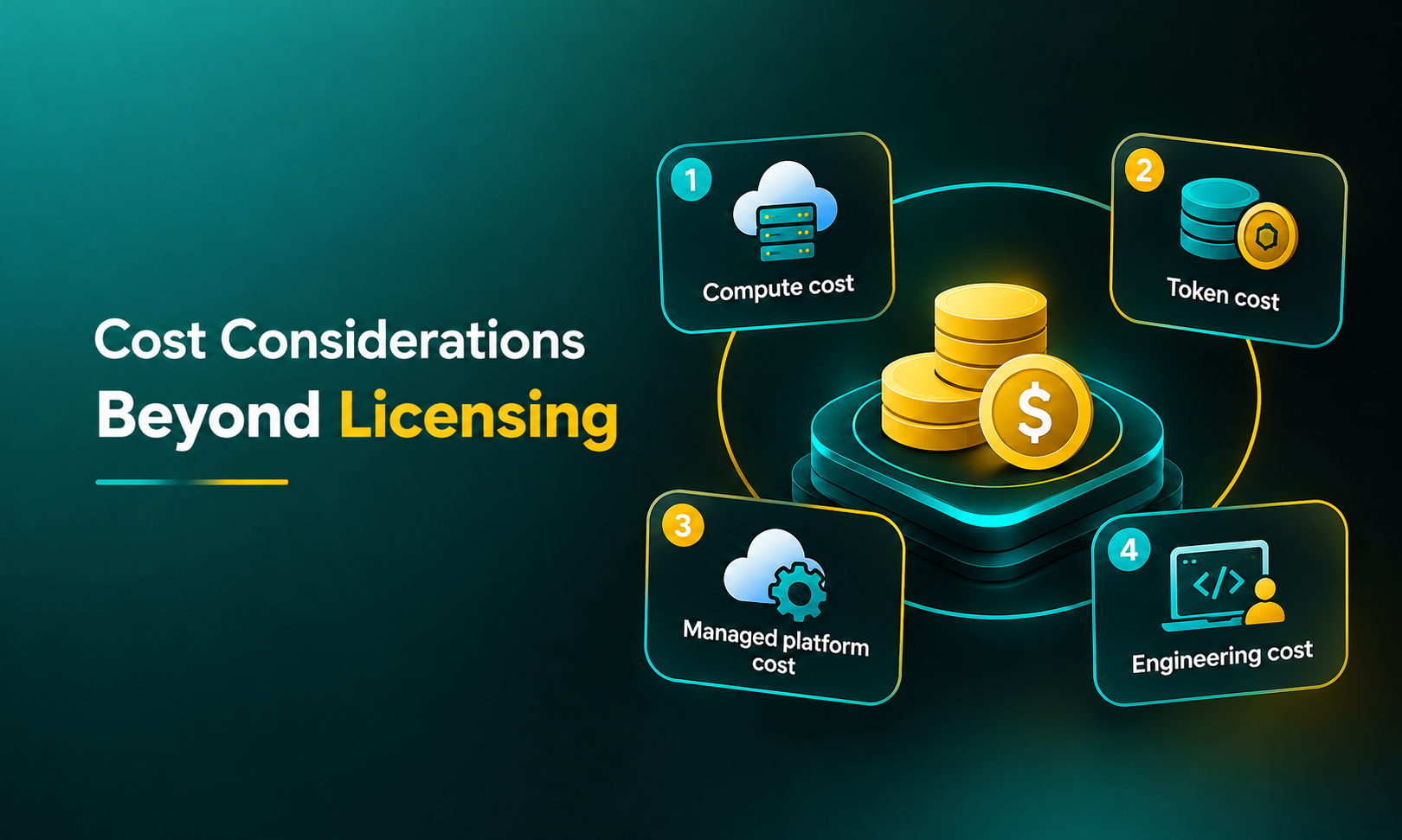
Cost Considerations Beyond Licensing
Both frameworks are open source under the MIT license, so neither carries a licensing fee for the core framework. Real cost differences show up elsewhere.
Compute cost. LlamaIndex's lower runtime overhead translates into a measurable reduction in per request cost at scale, since less framework overhead means less compute spent per query
Token cost. Lower token overhead per call, roughly 1,600 tokens versus roughly 2,400 for a comparable LangGraph pipeline, adds up quickly across millions of queries a month
Managed platform cost. LangSmith and LlamaCloud both offer paid tiers for teams that want managed observability or retrieval infrastructure rather than self hosting everything
Engineering cost. The framework a team already knows well will almost always cost less in engineering time than the framework that technically benchmarks better on paper
Best Framework for RAG Applications: A Practical Decision Framework
There is no single best framework for RAG applications that fits every team, and any article claiming otherwise is skipping the part where your documents, your team's skill set, and your product's shape all affect the answer. A more useful way to decide is to answer four questions honestly.
1. What is actually hard about your project? If it is finding the right information inside a large, messy document set, start with LlamaIndex. If it is coordinating multiple steps, tools, or long conversations, start with LangGraph.
2. How much time do you have? LlamaIndex generally gets a working RAG pipeline into a demo faster, which matters if you are proving a concept to leadership on a deadline.
3. What does the application look like in twelve months? A simple document Q&A tool today can grow into a multi tool assistant next year. If that growth is likely, building on LangGraph from the start avoids a rebuild later, even if LlamaIndex handles the retrieval piece underneath it.
4. What does your team already know? A team with existing LangChain and LangSmith experience will move faster staying inside that ecosystem, even for a retrieval heavy project, and the same is true in reverse for a team already fluent in LlamaIndex.
For most companies building their first serious RAG system in 2026, the honest starting point is LlamaIndex for the retrieval layer, with LangGraph added once the application needs to do more than answer questions.
Where Hiring Fits Into the Decision
Choosing between LlamaIndex and LangChain is only half the work. Both frameworks assume a team that understands embeddings, vector search, chunking strategy, and evaluation, and that expertise is not something most product teams have in house by default. This is where many companies choose to hire machine learning engineers rather than have a general software team learn RAG architecture through trial and error on a production system.
An experienced machine learning engineer typically shortens the path from framework choice to a working system by handling the parts that do not show up in a comparison table: cleaning and structuring source documents, choosing an embedding model suited to the domain, tuning chunk size and overlap, setting up evaluation so answer quality can be measured objectively rather than guessed at, and deciding when a hybrid LlamaIndex plus LangGraph architecture is worth the added complexity. For companies that need to move quickly without building an internal AI team from scratch, working with a partner to hire machine learning engineers on a project or ongoing basis is often the faster, lower risk route to a production RAG system that actually holds up under real usage.
Conclusion
There is no universal winner in the LlamaIndex vs LangChain for RAG debate, and by 2026 the two frameworks have converged enough that the old shorthand, LangChain for orchestration and LlamaIndex for data, no longer tells the whole story. What has stayed consistent is which problem each framework was built to solve first. LlamaIndex remains the stronger starting point when retrieval over your own documents is the hardest part of the job. LangChain, through LangGraph, remains the stronger choice when your application needs to reason across multiple steps, tools, and sessions. Many of the most dependable RAG systems running in production today use both, and the right move for most teams is to match the framework to the actual bottleneck in front of them rather than pick a side based on which one trended on social media that month. Get the retrieval layer right, get the right engineers on the project, and the framework choice becomes a detail rather than a gamble.
Digital Marketing Manager: With a passion for data-driven strategies and an instinct for spotting trends, Radhika navigates the virtual realm with finesse. Her commitment to staying ahead of the curve ensures our brand's message reaches the right audience at the right time.
Frequently Asked Questions
Yes, and this is actually the most common enterprise pattern in 2026. LlamaIndex handles document ingestion, chunking, and retrieval, while LangGraph manages the surrounding conversation flow, tool calls, and agent state. Teams typically wrap LlamaIndex's query engine as a callable tool inside a LangGraph node, letting each framework do the job it was built for.
Yes, LangChain can build a fully working RAG pipeline using its document loaders, text splitters, and vector store integrations. The difference is depth, not capability. LlamaIndex ships more retrieval specific logic, like sub question decomposition and hierarchical chunking, as defaults. LangChain gives you the pieces and expects you to assemble the retrieval strategy, which takes more code for comparable results.
LlamaIndex tends to cost less per request at scale because of lower framework overhead, close to 6 milliseconds versus LangGraph's 14 milliseconds, plus lower token overhead per call. At low volume the gap is negligible. Past 100 or more concurrent users, the difference in compute and token spend shows up clearly on a monthly bill.
Both frameworks are primarily Python first, though LangChain also maintains a JavaScript and TypeScript version with close feature parity. LlamaIndex's TypeScript support exists but trails the Python version in features. For teams building a Node.js backend, LangChain.js is currently the more complete option of the two frameworks for production use outside Python.
No. Longer context windows reduce the need for retrieval in some narrow cases, but enterprise document sets are usually too large to fit in any context window, and stuffing everything into a single prompt raises cost and latency sharply. Survey data from 2026 shows enterprise interest in long context as a RAG replacement actually fell after early testing, not rose.
Find exceptional developers at Hourlydeveloper. Get the expertise, solutions, and teamwork you need for success. Hire developers easily and boost your projects today!
 Back to Blog