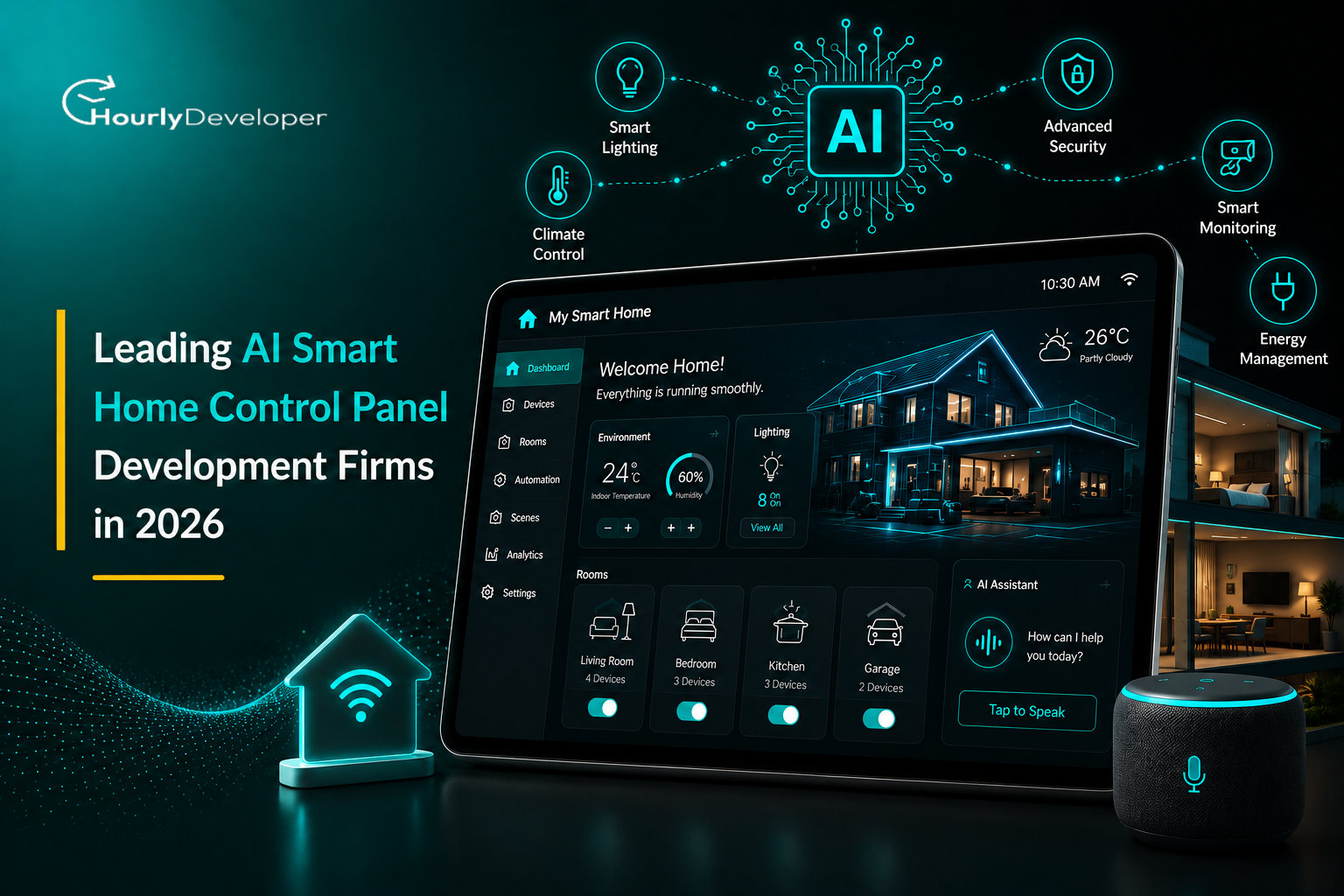
Leading AI Smart Home Control Panel Development Firms in 2026
Introduction
Leading AI Smart Home Control Panel Development Firms in 2026
1.What to Look For Before You Hire
Before jumping into the list, it helps to know what actually separates a strong partner from an average one. AI smart home software development is not just about writing code that connects a thermostat to an app. It involves handling real time data streams from dozens of sensors, building machine learning models that adapt to a household’s routine, and doing all of this while keeping the system secure enough that a stranger cannot unlock someone’s front door from across the street.
The firms worth shortlisting usually show proof of three things. First, they have shipped a working product, not just a prototype in a pitch deck. Second, they understand IoT protocols like Zigbee, Z Wave, Matter, and Thread well enough to make devices from different brands cooperate. Third, they can explain their AI approach in plain language, without hiding behind buzzwords, because if a team cannot explain how their prediction model works, they probably cannot debug it either when something breaks at 2am for a client.
2.Why 2026 Changed the Bar for Smart Home Software
Two years ago, most control panels were essentially remote controls with a nicer interface. They toggled devices on and off and maybe logged a bit of usage history. That is no longer good enough for buyers, and it shows in what clients are asking development firms to build. AI smart home software development in 2026 increasingly means systems that notice patterns on their own, like a household that always lowers the thermostat at 10pm, and start suggesting or automating that behavior without being explicitly programmed to.
The rise of the Matter standard has also changed things. Devices from different manufacturers can now talk to each other more easily than before, which means the software layer, not the hardware, has become the real differentiator. A firm that understands how to build a smart, adaptive control layer on top of that shared standard has a genuine advantage over one that only knows how to wire up individual devices.
HourlyDeveloper works on a flexible, hour based engagement model that makes them a practical starting point for founders who are not ready to commit to a large fixed price contract. Their teams have built control panel dashboards, voice assistant integrations, and energy monitoring features for smart home startups across the US and Europe.
What stands out is how transparent their process is. Clients get weekly time logs, sprint demos, and direct access to the engineers writing the code, not just an account manager relaying updates. For anyone comparing options to hire AI smart home developers without locking into a rigid scope, this setup removes a lot of the usual friction.
They also tend to be a good fit for projects that evolve mid build, since the hourly structure makes it easy to shift priorities without renegotiating a whole contract every time the roadmap changes.
Appinventiv is a mid to large sized development company with a dedicated IoT and AI practice that has worked on connected home products for clients in North America and the Middle East. Their portfolio includes energy management apps, smart security dashboards, and predictive maintenance tools for appliance manufacturers.
They tend to attract enterprise clients because of their formal project governance and compliance experience, which matters for companies building products that will eventually need to pass regional data protection audits.
Their AI team has also worked on voice command systems that respond in natural language rather than rigid preset phrases, which is becoming a common expectation for control panels aimed at a mainstream, non technical audience.
As the name suggests, this firm’s strength is server side architecture, which turns out to be the unsung hero of any good smart home platform. Control panels look simple on the surface, but the backend has to process sensor data from hundreds of devices in real time without lag, and that is exactly what this team focuses on.
They have built the data pipelines and API layers behind several smart home dashboards, working as a backend partner to front end and hardware teams rather than owning the whole project themselves, which suits founders who already have a design partner and just need the engineering muscle underneath.
Simform runs dedicated engineering pods that plug into a client’s existing product team, which makes them a common choice for smart home startups that already have a CTO but need more hands. Their IoT work spans device connectivity, cloud infrastructure, and machine learning models for occupancy detection.
Clients generally point to their documentation and code quality as reasons they stick around past the first project.
Their pod model also makes it easier to scale the team up or down as a project moves from prototype to full launch, which suits founders who are not yet sure how big their engineering needs will get.
Intellectsoft has been building connected device software for over a decade, and their smart home division has shipped control systems for hospitality and residential real estate clients, including hotel chains that wanted room automation tied into a central dashboard.
Their experience with large scale IoT deployments, not just single households, gives them an edge for anyone planning a product that needs to scale across hundreds of properties.
They also maintain an in house lab where they test new device integrations before rolling them out to client projects, which cuts down on the trial and error that usually slows this kind of work down.
This firm offers full stack teams out of India at a price point that appeals to early stage founders trying to stretch a limited budget. Their engineers have worked on mobile apps, web dashboards, and backend systems for smart home products, covering the entire stack rather than just one layer.
For a startup that needs one team to own frontend, backend, and basic device integration without hiring three separate vendors, this kind of full stack coverage keeps communication simple and avoids the usual finger pointing between separate teams.
Their pricing structure also tends to be flexible enough to accommodate a phased build, so founders can launch a stripped down version first and add features as the budget allows.
Softermii built its reputation on real time communication features, video calling, live data sync, and that expertise translates well into smart home dashboards where instant device status updates matter. They have delivered custom control panels for security camera platforms and video doorbell products.
Their real time engineering background is a genuine differentiator when a control panel needs to show camera feeds or motion alerts without any noticeable delay.
They also have a track record of building cross platform apps, so a control panel they build usually works just as smoothly on a wall mounted tablet as it does on a phone.
Binariks focuses heavily on healthcare and IoT crossover projects, which has given them unusual depth in remote monitoring systems, a skill set that transfers directly to smart home platforms built for elderly care or accessibility. Their control panels have included fall detection alerts and medication reminders alongside standard automation features.
Founders building smart home products for the senior care market specifically should have this team on their shortlist.
They also tend to build data privacy front and center, since much of their client base already operates under strict healthcare data regulations, which carries over naturally into how they handle smart home data too.
This firm is entirely focused on artificial intelligence work, which means their smart home projects lean heavily on the prediction and personalization side rather than basic device connectivity. They have built recommendation engines that learn a household’s habits and adjust lighting, temperature, and security settings automatically.
For a product where the AI layer is the actual selling point rather than an add on feature, working with a team that lives and breathes machine learning day to day tends to produce a noticeably smarter end result.
They are also upfront about the limits of what current models can do, which is refreshing in a field where overpromising on AI capabilities has become common.
Iflexion has decades of enterprise software experience and applies that same rigor to smart home projects, particularly around system integration. They are often brought in when a client needs an existing legacy system, like an older building management platform, connected to a modern smart home control panel.
Their strength is less about flashy features and more about making complicated systems talk to each other reliably.
That reliability focus makes them a sensible choice for property developers or facility managers who need a control panel that will not break every time a new device is added years down the line.
Existek is a smaller, more boutique firm that takes on a limited number of projects at a time, which clients often describe as giving them more direct access to senior engineers instead of being passed down to a junior team. Their smart home work has included custom dashboards for boutique real estate developers.
This limited capacity model works well for founders who want closer collaboration and are willing to trade a bit of speed for that attention.
Diceus specializes in custom software built around specific business logic rather than off the shelf templates, and their smart home clients have included energy utility companies building consumer facing apps to help households track and reduce power usage.
Their background in energy sector software gives them a practical edge for any control panel project where energy monitoring is a core feature rather than an afterthought.
They have also built billing and reporting tools that plug directly into a smart home dashboard, which is useful for products aimed at utility companies rather than individual consumers.
ScienceSoft is one of the more established names in this space, with a smart home portfolio that includes both consumer products and commercial building automation systems. Their teams handle everything from device firmware questions to cloud architecture, which suits larger projects with many moving parts.
Clients tend to choose them when the project scope is broad and they want one vendor who can realistically own most of it.
Their consulting background also means they are comfortable pushing back on a client’s initial spec if they see a simpler or more reliable way to build the same feature.
Netguru pairs strong design capability with solid engineering, and it shows in their smart home control panel work, several of which have won attention for genuinely pleasant, easy to navigate interfaces rather than the cluttered dashboards common in this space.
For founders who know their product needs to feel simple even though the technology underneath is complex, Netguru’s design first approach is worth a serious look.
Their research process usually includes real user testing before final designs are locked in, which catches usability problems early instead of after the product has already shipped.
Space-O Technologies has built a steady track record in mobile app development for IoT products, including companion apps for smart home hubs that sync with wall mounted control panels. Their work often bridges the gap between a physical device and its mobile counterpart.
They are a solid pick for founders whose product lives across both a control panel and a smartphone app that needs to stay perfectly in sync.
They have also built offline modes into some of their apps, so basic controls still work even when a home’s internet connection briefly goes down, a detail that matters more than it sounds until it actually happens to a customer.
TechAhead has a long history in mobile and connected device software, and their smart home clients span both consumer startups and larger appliance brands looking to add app based control to existing hardware lines.
Their experience working with hardware manufacturers directly makes them a comfortable fit for projects where the software has to be built around devices that already exist rather than designed from a blank slate.
They have also handled firmware updates delivered over the air, a detail that matters once a product is out in the world and needs bug fixes without a physical recall.
Konstant Infosolutions is a full service development company with a growing IoT portfolio, including smart home dashboards for regional real estate and property management clients who wanted centralized control across multiple units.
Their multi property automation experience is useful for anyone building a product aimed at landlords or property managers rather than individual homeowners.
They also offer maintenance packages after launch, which smaller firms sometimes skip, so clients are not left scrambling to find a new team the first time something needs fixing post launch.
Mobcoder works across mobile, web, and IoT, and their smart home projects have generally centered on budget conscious startups that need a capable team without enterprise level pricing. They have delivered control panel apps for independent smart lock and sensor brands.
They are a reasonable fit for early stage founders who need working software fast and are watching their runway closely.
Zfort Group has been building custom software since the early 2000s and brings that longevity into their IoT division, where they have handled everything from sensor data collection to dashboard visualization for smart home clients in Europe and North America.
Their long operating history tends to appeal to founders who want a vendor that will realistically still be around to support the product several years from now.
They also run a dedicated QA team separate from development, which catches integration bugs before they ever reach a client’s staging environment.
Chetu takes on highly specialized, custom built software projects across many industries, and their IoT team has worked on smart home systems that required deep customization beyond what typical off the shelf platforms allow, including proprietary device protocols.
When a project genuinely cannot be built with standard tools and needs something written from scratch, Chetu’s custom first approach fits that need well.
They also work across a wide range of industries beyond smart homes, which means they bring integration lessons learned from other sectors, like retail and logistics, into how they approach IoT problems.
3.How to Actually Choose Between These Firms
Reading through 20 companies can start to blur together, so it helps to narrow the decision down to a few practical questions. How big is the team you actually need, a full product build or a specific piece like the backend or the AI layer? What is your timeline, are you trying to launch a working version in three months or building something meant to scale over three years? And how much do you want to stay involved day to day versus handing off ownership entirely?
Smart home dashboard development in particular tends to separate strong firms from average ones quickly, because a dashboard is where all the technical complexity underneath either shows up as something clean and usable or as something confusing and cluttered. Ask any firm you are considering to walk you through a past dashboard project, screen by screen, and pay attention to how they talk about the tradeoffs they made along the way. That conversation usually tells you more than any portfolio page.
It is also worth asking directly about their AI approach. Some firms build genuinely adaptive systems that learn from usage patterns over time, while others rely on simpler rule based automation dressed up with AI language. Neither approach is wrong for every project, but you should know which one you are getting before you sign a contract, especially if predictive behavior is something your product depends on.
Budget conversations tend to go smoother once you have narrowed the list down to three or four names. At that point, request a rough estimate for the same feature set from each firm, so you are comparing like for like instead of guessing at what is included in one quote versus another. Founders who skip this step often end up comparing a bare bones proposal against a fully loaded one and drawing the wrong conclusion about who is actually more expensive. Whether you decide to hire AI smart home developers from a boutique specialist or a larger full service firm, getting matching quotes first will save you from an unpleasant surprise later.
4.Where This Leaves You
There is no single best firm on this list, only the best fit for what you are trying to build. A founder launching a lean MVP with a tight budget is going to have a very different experience with these companies than a product team scaling a control panel across thousands of installed units. That is exactly why we kept descriptions specific instead of giving every firm the same generic praise.
If you take one thing from this list, let it be this. The strongest AI smart home control panel development firms are the ones that can talk about tradeoffs honestly, not just capabilities. Ask about a time something did not work the first time and how they fixed it. That answer will usually tell you more than any case study on their website ever could.
The firms covered in this rundown of leading AI smart home control panel development firms in 2026 each bring something a little different to the table, from real time engineering to healthcare grade privacy practices to straightforward hourly flexibility. Whichever direction you go, the work of smart home dashboard development is only going to get more central to how people experience their homes from here, and picking the right partner now will save you from a costly rebuild later.
Nainesh Pandya, our astute Director, navigates our team toward unprecedented success. With a fervent dedication to innovation and a sharp business acumen, Nainesh propels our company forward with resolute determination. His strategic foresight and compassionate guidance motivate us to scale new heights collaboratively.
Frequently Asked Questions
Costs generally range from $25,000 to $40,000 for a basic MVP dashboard with core automation features, and can climb to $150,000 or more for a full platform with predictive AI, multi device support, and custom hardware integration. Ongoing cloud hosting and model retraining add recurring monthly costs most founders underestimate at first.
A functional MVP usually takes 10 to 16 weeks depending on how many device integrations are involved. Adding machine learning features like usage prediction or anomaly detection extends this further, since models need real data to train on before they perform reliably, which often pushes full launch timelines past the initial coding phase.
It depends on where your product's value lies. If predictive behavior and personalization are central to your pitch, a specialized AI team will likely produce better results. If your priority is broad device compatibility and a polished interface, a general firm with strong IoT experience may serve you just as well for less.
Look for direct experience with Matter, the newer cross platform standard backed by major device manufacturers, along with Zigbee, Z Wave, and Thread. A firm unfamiliar with Matter in 2026 is behind the curve, since it has become the default expectation for new devices aiming for broad compatibility across ecosystems.
Most firms on this list offer post launch support contracts, though terms vary widely. Some include bug fixes and minor updates only, while others offer full managed services covering server monitoring, security patches, and model retraining. Always clarify what counts as a paid change request versus included support before signing.
Find exceptional developers at Hourlydeveloper. Get the expertise, solutions, and teamwork you need for success. Hire developers easily and boost your projects today!
 Back to Blog