4.The 15 Best AI Burnout Detection Software Development Companies to Shortlist in 2026
Here is the full list, mixed on purpose so you are comparing capability and fit rather than just scrolling past familiar names.
1. HourlyDeveloper
Established remote-first model | Global delivery, India-anchored teams | 500+ vetted developers
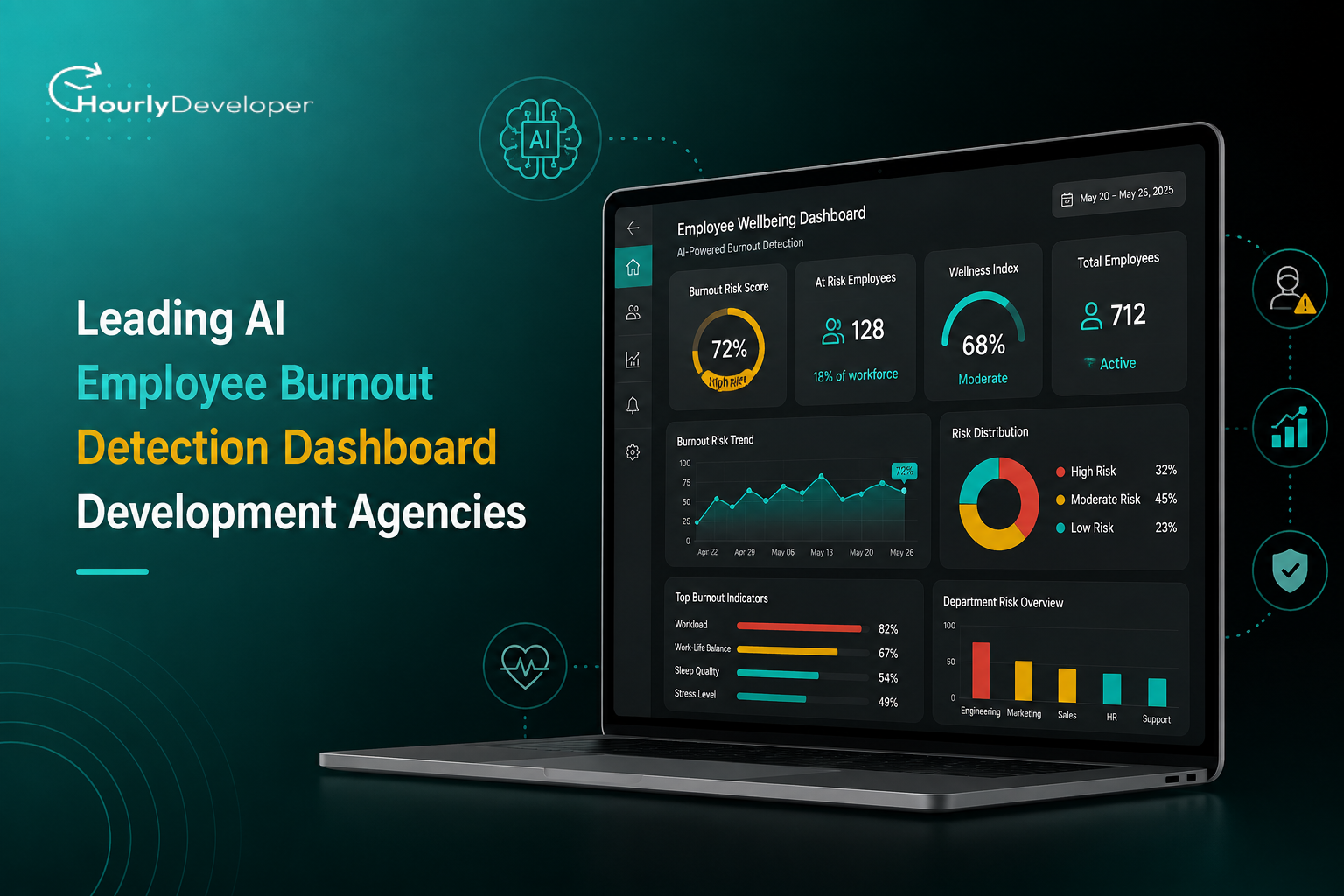
HourlyDeveloper tops this list for a simple reason: if your company wants to test a burnout detection concept without committing to a fixed-scope contract, its hourly hiring model removes the biggest barrier most CEOs face at the pilot stage.
The company connects you directly with pre-vetted data engineers, backend developers, and AI specialists who can be added to your project within days rather than weeks. For a burnout dashboard, that usually means starting with one or two engineers to build the data pipeline from Slack and your HRIS, then scaling the team once the pilot shows results.
What sets Hourly Developers apart from typical staffing platforms is transparency. You see exactly who is working on your project, track hours against deliverables, and can scale the team up or down without renegotiating a contract. For founders who are not yet sure how big this project will get, that flexibility alone justifies a shortlist spot.
2. Appinventiv
Founded 2015 | Noida, India, with offices in the US, UK, and UAE | 1,000+ technology experts
Appinventiv has grown from a small mobile app studio into a full digital transformation partner working with Fortune 500 companies, and its AI and data science practice is now one of its strongest verticals.
For a burnout detection dashboard, Appinventiv’s strength is scale. The company regularly builds systems that need to process behavioral data across thousands of employees and integrate with enterprise HR stacks, which is exactly the kind of complexity a mid-size or large company will run into once a pilot dashboard proves itself and needs to expand company wide.
The tradeoff is that Appinventiv is better suited to companies with a defined budget for a serious build rather than a shoestring proof of concept. Its project teams typically include dedicated AI engineers, UX designers, and a delivery manager, which adds structure but also cost compared to a leaner freelance-style team.
3. Backend Development Company
Specialist backend engineering practice | Distributed team with India delivery centers | 150+ backend and data engineers
As the name suggests, Backend Development Company focuses on exactly the part of a burnout detection dashboard that most agencies underestimate: the infrastructure that ingests, cleans, and processes behavioral data before any dashboard ever displays a number.
A predictive burnout model is only as good as the data pipeline feeding it, and this is where many otherwise capable agencies struggle, especially when a client’s data lives across Slack, a legacy HRIS, calendar exports, and manual spreadsheets. Backend Development Company specializes in exactly this kind of messy, multi-source integration work, along with the secure API architecture needed to keep employee data compliant with privacy regulations.
Companies that already have a front end design partner or an internal product team, but need serious backend and data engineering muscle, will find this a strong fit. It is less suited to a company that wants a single agency to own the entire project end to end.
4. Netguru
Founded 2008 | Poznan, Poland | 450 to 900 employees
Netguru is a certified B Corporation that has built its reputation on pairing strong product design with software engineering, working with brands like IKEA and Volkswagen on digital transformation projects.
For an employee wellness product specifically, that design-first approach matters more than it might seem. A burnout dashboard that HR managers find confusing or intimidating simply will not get used, and Netguru’s UX teams are experienced at translating complex behavioral data into interfaces a non-technical manager can act on in under a minute.
Netguru also brings genuine machine learning expertise to the table, having built AI powered personalization and analytics systems for enterprise clients across Europe and North America. Expect a collaborative, workshop-heavy discovery process before development starts, which suits companies that want to shape the product carefully rather than hand over a spec and wait.
5. Intellectsoft
Founded 2007 | Palo Alto, California, with global offices | 200+ engineers and architects
Intellectsoft has spent nearly two decades building enterprise software for clients including Jaguar Land Rover and Harley-Davidson, and its recent focus has shifted heavily toward AI-powered applications and cloud engineering.
The company’s experience with regulated industries, healthcare and finance in particular, is a real advantage for a burnout detection dashboard, since employee wellness data carries similar privacy sensitivities to patient or financial data. Intellectsoft’s teams are accustomed to building with GDPR and similar frameworks in mind from day one, rather than retrofitting compliance after launch.
This is a solid choice for a company that wants an experienced, process-driven partner and does not mind a more formal engagement structure, with detailed documentation and staged sign offs, in exchange for that maturity.
6. HireFullStackDeveloperIndia
Dedicated full-stack staffing model | India-based teams, global clients | 300+ full-stack engineers
HireFullStackDeveloperIndia is built around a single promise: give clients a full-stack engineer, or a small pod of them, who can own a project from database schema to front end dashboard without needing five different specialists in the room.
For a burnout detection dashboard specifically, that end to end ownership is valuable during the MVP phase, when speed and cost control matter more than deep specialization in any single layer. A full-stack team here can typically get a working pilot, connected to one or two data sources with a basic risk-scoring model, live within six to eight weeks.
Where this option is less ideal is once the project needs genuinely advanced machine learning work, like natural language sentiment analysis across written communication. At that stage, most clients either bring in a dedicated AI specialist alongside the full-stack team or transition to an agency with deeper AI bench strength.
7. Space-O Technologies
Founded 2010 | Ahmedabad, India, with offices in the US and Canada | 200+ developers and designers
Space-O Technologies has quietly built genuine credibility in the HR technology space, having already developed an AI powered recruitment platform for clients looking to speed up hiring decisions, so the underlying architecture for behavioral data scoring is not new territory for its engineers.
That prior HR tech experience translates well into burnout detection work, since both product categories require similar things: pulling structured and unstructured data from multiple systems, applying a scoring model, and presenting results in a way HR staff without a data background can trust and act on.
Space-O also markets a fairly aggressive delivery timeline, often promising working prototypes within a matter of weeks, which appeals to founders who want to see something tangible before committing to a larger engagement. Ask for references from a completed HR-adjacent project before signing, since the company also handles a broad range of unrelated app development work.
8. ThoughtWorks
Founded 1993 | Chicago, Illinois, with offices worldwide | 12,000+ employees globally
ThoughtWorks is one of the most established names in enterprise software consulting, closely associated with the agile software movement, and now positions much of its work around AI-first delivery for large organizations.
For a company already running at real scale, thousands of employees across multiple countries and HR systems, ThoughtWorks brings a level of process discipline and change management expertise that smaller agencies simply cannot match. Its consultants are experienced at rolling out sensitive internal tools, like a burnout dashboard, in a way that builds trust with both leadership and the workforce being monitored.
This maturity comes at enterprise pricing, and the engagement model tends to favor longer, consulting-style relationships over a quick fixed-scope pilot. It is the right call for a company that has already validated the need and is now ready to build something built to last, not for a first-time proof of concept.
9. HireAIDevelopers
AI-specialist staffing and delivery model | Distributed AI engineering teams | 250+ machine learning and AI engineers
HireAIDevelopers exists specifically to solve the problem most general software agencies run into with a burnout detection dashboard: building a model that is actually predictive, not just a dashboard of pre-existing metrics dressed up with an AI label.
Its engineers specialize in the machine learning core of the problem, things like anomaly detection across workload patterns, natural language sentiment scoring from written communication, and building models that improve as more employee data accumulates over time. This is the layer of the project where a lot of value gets created or lost, and it is exactly what this team focuses on.
Companies that already have a front end and product team in place, but need serious data science depth to make the risk scores genuinely reliable, will get the most value here. It is a narrower specialization than a full-service agency, which is precisely the point.
10. Innowise Group
Founded 2007 | Warsaw, Poland | 3,000+ IT professionals
Innowise Group has grown into one of the larger full-cycle software development companies in Central and Eastern Europe, serving Fortune 500 clients across finance, healthcare, and manufacturing with a workforce that now numbers in the thousands.
Its scale is the main draw for burnout dashboard projects that expect to grow quickly, since Innowise can allocate additional engineers, data scientists, or QA specialists to a project without the ramp-up delays smaller boutique agencies sometimes face. The company also has established experience with healthcare-grade data privacy work, useful given how sensitive employee wellness data can be.
Rates tend to be competitive relative to Western European or US-based agencies of similar scale, making Innowise a reasonable option for companies that want enterprise capacity without enterprise pricing, though expect a more standardized delivery process than a boutique studio would offer.
11. MobiDev
Founded 2009 | Incorporated in the US, R&D centers in Ukraine and Poland | 400+ engineers
MobiDev has built its identity specifically around AI and machine learning product development since 2018, and was recognized by Clutch as a top machine learning development company, a specialization that translates directly into burnout detection dashboard work.
The company’s typical engagement starts with a tech strategy and data audit phase before any code is written, which for a burnout dashboard means MobiDev’s team will map out exactly which data sources are usable, which need cleaning, and what a realistic accuracy target looks like before setting client expectations. That upfront rigor tends to prevent the common failure mode of shipping a dashboard whose risk scores nobody actually trusts.
MobiDev’s average client relationship reportedly spans around five years, suggesting the company is built for long-term product evolution rather than a one-off build, which fits well for a burnout dashboard that will need retraining and refinement as your organization changes.
12. Debut Infotech
Founded 2011 | India-origin with delivery centers in the US, UK, and Canada | 150+ technologists
Debut Infotech built its early reputation in blockchain development before expanding into AI and generative AI work, and that security-first background is a genuine asset for a product handling sensitive employee data.
The company has direct experience building AI voice agents, NLP models, and automation dashboards for clients in healthcare and legal services, industries where data confidentiality is non-negotiable, and that discipline carries over well into burnout detection work where anonymization and access control need to be built in from the start rather than added later.
Debut Infotech tends to work well with mid-size companies that want a senior-vetted team without the overhead of a large enterprise consultancy. Ask specifically about their experience with HR or workforce analytics projects, since much of their public portfolio leans toward fintech and healthcare rather than HR tech.
13. Hyperlink InfoSystem
Founded 2011 | Ahmedabad, India, with offices in the US, UK, and UAE | 1,200+ employees
Hyperlink InfoSystem has delivered thousands of mobile and web applications since 2011, and now lists AI, IoT, and business intelligence among its core service lines alongside its original mobile app development strength.
The company’s scale means it can staff a burnout detection dashboard project relatively quickly, and its experience spanning both consumer apps and business intelligence dashboards gives it a reasonable foundation for the two halves of this kind of project, data visualization and underlying model logic.
Hyperlink is best suited to companies that value speed and broad technical coverage over deep specialization in workplace analytics specifically. Because the company works across so many industries and project types, it is worth asking for a portfolio sample closer to HR or people analytics work before finalizing a contract.
14. Softermii
Founded 2014 | Los Angeles, California, with an R&D center in Kyiv | 120+ specialists
Softermii has built a strong niche around AI agents, generative AI, and real-time communication platforms, holding a 4.9 out of 5 rating on Clutch across more than 30 reviews, a signal of consistently satisfied clients in a fairly technical niche.
That real-time communication expertise is directly relevant to burnout detection, since a meaningful share of the signal in these dashboards comes from analyzing communication patterns and sentiment as they happen, rather than in a delayed weekly batch report. Softermii’s proprietary AI development platform is built to shorten the time between prototype and production, which can be valuable for a company that wants to move from concept to working pilot quickly.
As a mid-sized team of around 120 engineers, Softermii suits companies looking for a focused, product-development-style engagement rather than a sprawling enterprise consultancy relationship.
15. Rishabh Software
Founded 1999 | Vadodara, India | 800 to 1,200 employees
Rishabh Software is one of the more established names on this list, having operated for over two decades and worked with enterprise clients including Siemens, Bupa, and Bayer across custom software, analytics, and system integration projects.
Its longevity matters for a project like a burnout detection dashboard, which typically needs ongoing refinement rather than a single delivery and handoff. Rishabh’s analytics practice, built over years of enterprise data integration work, gives it solid footing for the data pipeline and reporting layers of a dashboard, even though workplace wellness specifically is a newer application area for the company.
This is a dependable option for a company that values stability and a long operating track record over a flashy AI-first pitch, particularly if the project will need years of support and iteration rather than a one-time build.
 Back to Blog