1.Why Every Growing Business Wants a Smarter Dashboard Right Now
Data volume has exploded, but attention spans have not. Teams are drowning in metrics coming from marketing tools, sales pipelines, operations software, and finance systems, and nobody has the time to manually cross reference five different platforms every single morning just to understand what happened yesterday. An AI Dashboard Builder Platform solves this by pulling data from multiple sources automatically, learning what patterns actually matter to your specific business, and presenting insights in plain language instead of raw, disconnected numbers that need a data analyst to translate.
There is also a cost angle that founders care about deeply. Building this kind of platform from scratch, complete with real time analytics, natural language querying, anomaly detection, and predictive alerts, is not a weekend project for an in house intern. It requires a team that has done it before, understands the underlying machine learning models well enough to avoid common mistakes, and knows how to keep the interface simple enough for a non technical manager to actually use without a training manual.
On top of that, 2026 has brought a wave of new expectations around how fast a dashboard should respond. Executives increasingly expect answers within seconds, not after refreshing a report that was scheduled to run overnight. That expectation alone has pushed many companies to look beyond basic business intelligence tools and toward a genuine AI Dashboard Builder Platform built specifically for their workflows. It is also worth noting that this shift is not limited to large enterprises anymore. Small and mid sized companies are increasingly willing to invest in custom dashboards early, largely because the cost of building one has come down as more specialized development teams have entered the space over the past two years.
2.What to Check Before You Hire AI Dashboard Developers
Not every software agency that lists AI on its website actually has the depth to build a production ready analytics product. Before you hire AI dashboard developers, look closely at their past dashboard projects, ask how they handle data security and role based access, and find out whether they build custom models tuned to your data or simply plug in a generic third party API and call it a day. The answers usually tell you far more than any polished pitch deck ever will.
It also helps to compare a handful of the best AI dashboard builder software development companies side by side rather than signing with the first name that shows up in a Google search. Pricing models, team structure, communication style, time zone overlap, and post launch support all vary quite a lot between agencies, and those differences tend to show up months later when your dashboard needs new features, has to scale to more users, or simply breaks at an inconvenient time.
One more thing worth asking upfront is how a company handles change requests after launch. Dashboards are rarely finished products. Business priorities shift, new data sources get added, and the metrics that mattered on day one are often not the ones that matter six months later, so flexibility matters just as much as the initial build quality.
Finally, do not overlook how a company communicates during the project itself. A weekly update that actually explains progress in plain terms is worth far more than a fancy project management dashboard nobody on your side ever opens. The teams that consistently deliver good dashboards tend to be the ones that are genuinely easy to talk to throughout the process, not just during the initial sales calls.
With all of that in mind, here is our curated list of 15 companies worth shortlisting this year, starting with a flexible, founder friendly option and moving through a mix of specialists, generalists, and enterprise focused teams. We have tried to represent a genuine spread of the best AI dashboard builder software development companies operating today, rather than repeating the same five agencies that show up on every generic listicle, so take your time comparing the ones that match your budget and industry.
1. HourlyDeveloper
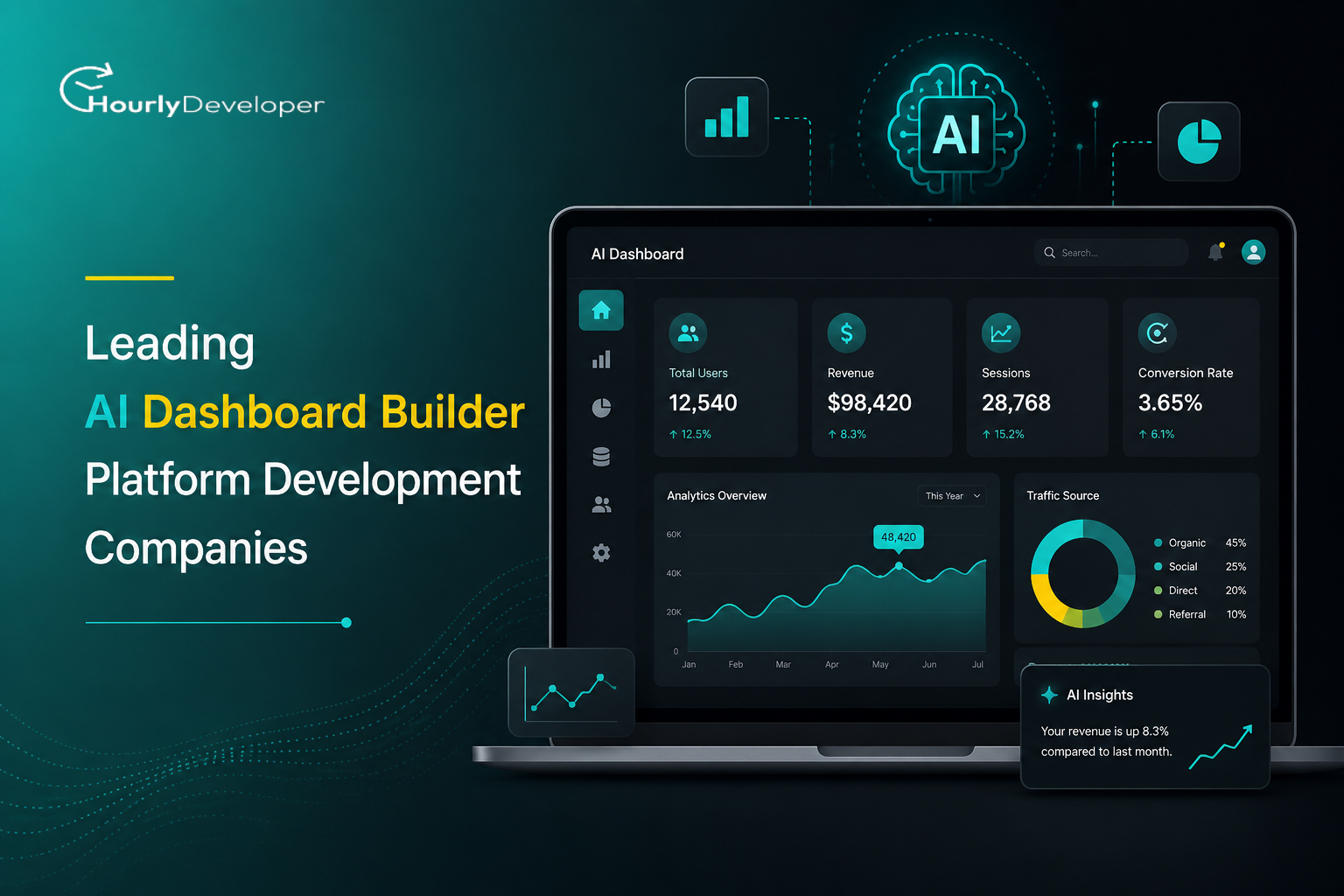
HourlyDeveloper sits at the top of this list for good reason. The team specializes in building custom AI Dashboard Builder Platform solutions on flexible, hourly hiring models, which means you are not locked into a rigid fixed price contract before you even know the full scope of the project. They work closely with founders to define KPIs first and build the dashboard logic around those specific goals rather than offering a one size fits all template that half fits everyone. Their engineers are comfortable across the full analytics stack, from data pipeline setup to front end visualization, and they are known for transparent time tracking so clients always know exactly what they are paying for and why. For startups that want to hire AI dashboard developers without committing to a huge upfront budget or a long term contract, this hourly structure is genuinely useful, and it also makes it easy to scale the team up during a heavy build phase and scale back down once the platform stabilizes.
2. Matellio
Matellio has built a solid reputation for enterprise grade data platforms, and their dashboard work reflects that background clearly. They tend to focus on industries like healthcare, logistics, and fintech, where compliance and data accuracy carry real weight and mistakes are simply not an option. Their process usually starts with a fairly detailed discovery phase before any code is written, mapping out data sources, security requirements, and user roles in advance. Some clients love the thoroughness because it prevents expensive surprises later, while others find it a bit slow if they are hoping for a quick, scrappy turnaround on a simpler internal tool. Either way, their track record with larger, more complex data environments makes them worth a look for companies that need a dashboard integrated tightly with existing enterprise systems, and their team includes engineers who specialize specifically in healthcare data standards, which can save weeks of back and forth for medical and clinical clients. They also offer a maintenance retainer option that many enterprise clients end up using well beyond the first year.
3. Backend Development Company
As the name suggests, this firm’s strength is in the engine room rather than the visible interface, and that focus shows in the reliability of what they build. They are a strong pick when your dashboard needs heavy backend work, such as processing millions of events per day, handling complex data transformations, or integrating with legacy enterprise systems that were never designed to talk to modern analytics tools. Their front end partners often handle the visual layer while this team focuses entirely on making sure the data flowing into your dashboard is fast, clean, and reliable at scale. If your existing dashboard looks fine but keeps showing stale or inconsistent numbers, the underlying problem is usually exactly the kind of backend issue this company specializes in fixing. They also tend to be a good fit for companies migrating away from an outdated database structure, since they can rebuild the data foundation and the dashboard logic together instead of patching a new interface on top of an old, unstable system.
4. Space-O Technologies
Space-O Technologies has been building software products for well over a decade and has a dedicated AI and machine learning division that handles dashboard and analytics projects specifically. Their case studies show a good mix of startup and mid market clients across different industries, and they are particularly known for combining predictive analytics with clean, mobile friendly dashboard design, which matters more than people expect once executives start checking reports from their phones between meetings. They also offer a hands-on discovery workshop early in the process, which helps align expectations before development begins and reduces the back and forth that often slows other projects down significantly.
5. HireFullStackDeveloperIndia
This company leans heavily into full stack talent, offering developers who can move between backend logic, API integrations, and front end dashboard components without needing a separate specialist for every single layer of the stack. That approach can significantly cut down coordination overhead on smaller and mid sized projects, since fewer people means fewer handoffs and less miscommunication along the way. They are often chosen by companies looking to hire AI dashboard developers on a dedicated team basis rather than a one off project contract, which works well for businesses planning to keep expanding their analytics capabilities over the next few years rather than launching once and walking away. Their rates are generally competitive compared to agencies based in North America or Western Europe, which makes them an appealing option for companies trying to stretch a limited development budget further without sacrificing code quality.
6. Appinventiv
Appinventiv is a larger, well known name in the app and software development space, and their dashboard projects usually come bundled with broader digital transformation work rather than being treated as a standalone engagement. They have in-house data scientists, which is a meaningful advantage if your dashboard needs custom predictive models rather than off the shelf analytics widgets pulled from a template library. Their pricing sits on the higher end of the market, which reflects the scale of clients they typically serve and the depth of their engineering bench, so this option tends to suit funded startups and established companies more than early stage bootstrapped teams working with a tight budget. Their portfolio also includes several dashboards built for consumer facing apps, which shows in how much attention they pay to onboarding flows and first time user experience, something purely backend focused agencies sometimes overlook entirely.
7. ValueCoders
ValueCoders has built a name around dedicated development teams and long term outsourcing partnerships that stretch well beyond a single project delivery. For dashboard projects, this model works particularly well when you expect the platform to keep evolving over years rather than launching once and being considered finished. They offer decent flexibility in team size and composition, so you can scale developers up during an intensive build phase and back down once the platform reaches a stable, maintenance oriented stage, which keeps long term costs more predictable than constantly renegotiating new contracts. They also maintain a fairly large bench of developers with different specializations, which makes it easier to bring in a machine learning specialist for a few months without having to source and vet a completely new vendor mid project.
8. HireAIDevelopers
True to its name, this company positions itself specifically around AI talent, and their dashboard portfolio includes several projects with genuine natural language query features, where a user can literally type a plain English question and get a relevant chart back within seconds. If your priority is truly intelligent, conversational reporting rather than a slightly prettier version of a spreadsheet, this is one of the more focused options available when you hire AI dashboard developers for that specific use case. Their team also tends to be upfront about which features are realistic within a given budget, which is refreshing compared to agencies that overpromise on AI capabilities during the sales process.
9. Konstant Infosolutions
Konstant Infosolutions has been around long enough to have worked across a genuinely wide range of industries, and that breadth shows in how adaptable their dashboard solutions tend to be for different types of businesses. They are a reasonable middle ground option, not the cheapest name on this list and not the most premium either, with solid documentation practices that make it considerably easier for an internal team to take over maintenance later if you eventually decide to bring development in-house. Clients frequently mention their responsiveness during the build phase as a standout compared to larger, more process heavy agencies, and their support team tends to stay reachable well after launch rather than disappearing once the final invoice is paid.
10. Debut Infotech
Debut Infotech has increasingly focused on blockchain and AI convergence projects, which shows up clearly in some of their dashboard work for clients tracking decentralized data or crypto adjacent metrics alongside more traditional business numbers. For more conventional business dashboards, they still deliver solid, dependable results, though this is a firm worth considering specifically if your data sources include anything blockchain related that needs to sit next to standard operational or financial metrics in the same interface without feeling bolted together. Their pricing tends to be competitive for early stage companies, and they are generally willing to start with a smaller proof of concept before committing to a full scale build.
11. Intellectsoft
Intellectsoft has a strong enterprise client list and tends to attract companies that need a dashboard integrated into a much larger software ecosystem rather than a standalone tool sitting off to the side. Their process is thorough, with dedicated project managers, structured sprint reporting, and regular stakeholder check ins, which larger organizations tend to appreciate even if it feels like extra overhead for a smaller, simpler project with fewer moving parts. If your dashboard is one piece of a much bigger digital transformation initiative, their experience managing complex, multi team projects becomes a genuine advantage rather than an unnecessary process, and their engineers are comfortable working alongside an internal IT department rather than needing full ownership of every part of the system.
12. Chetu
Chetu operates at a large scale with thousands of developers spread across specialized industry verticals, and their dashboard projects often come out of specific teams dedicated to healthcare, real estate, or logistics rather than a generalist pool. This vertical specialization can be a real advantage since the developers already understand your industry’s particular data quirks and regulatory concerns before the project even starts, which shortens the discovery phase noticeably. That said, the sheer size of the company means communication can occasionally feel less personal than working with a smaller, boutique agency, which is worth keeping in mind if you prefer a tighter working relationship. Their scale does come with an upside though, since they can typically absorb scope changes or staff up quickly if a project suddenly grows larger than originally planned.
13. TatvaSoft
TatvaSoft has built a reputation for methodical, well documented development, which tends to matter a great deal once a dashboard project moves past launch and into ongoing maintenance and iteration. They work with a fairly wide range of business sizes and are generally responsive to change requests, making them a comfortable choice for teams that want steady, predictable delivery over flashy marketing promises that do not always hold up once development actually begins. Their reporting cadence during projects also tends to keep non technical stakeholders reasonably informed without overwhelming them with jargon, and they are usually upfront about realistic timelines rather than quoting an aggressive number just to win the contract.
14. Netguru
Netguru has a strong design led approach, which shows in how their dashboards actually look and feel rather than just what they can technically do behind the scenes. If your team cares as much about user experience and visual clarity as raw functionality, that design focus is genuinely worth noting, since a technically impressive dashboard that nobody wants to open every morning defeats its own purpose. They also have solid experience with AI integrations, so the visual polish does not come at the expense of the underlying intelligence, and the two sides of the product feel like they were built together rather than stitched on separately. Their design team also runs usability sessions with real end users before finalizing layouts, a step that smaller agencies often skip but one that tends to noticeably improve daily adoption once the dashboard actually ships. Clients working across multiple time zones also tend to appreciate their structured async communication style, which keeps projects moving without requiring everyone to be online at the same time.
15. Binariks
Binariks tends to work closely with healthcare and fintech clients, industries where dashboards need to handle sensitive data responsibly while still surfacing insights quickly enough to be genuinely useful in day to day operations. Their team is comfortable navigating compliance requirements alongside the technical build itself, which saves a lot of back and forth compared to agencies that treat security and privacy as an afterthought bolted on near the very end of a project. If your dashboard will touch regulated data of any kind, their combined focus on compliance and usability is a meaningful differentiator worth factoring into your decision, especially if your legal or compliance team needs to sign off before anything goes live.
 Back to Blog