1.The Real Reason Businesses Still Choose Java Spring Boot
There is a version of this conversation where someone suggests switching to Node.js or Go. Fair enough. Both are fast and popular. But here is the thing: when a fintech company needs to process 50,000 transactions per second, when a healthcare platform needs to stay compliant with HIPAA and process millions of records, or when an e-commerce giant needs zero-downtime deployments on Black Friday, Java Spring Boot is consistently the choice that does not crack under pressure.
Here are some numbers that explain why businesses keep choosing this stack over flashier alternatives:
- 17,728+ companies globally are actively using Spring Boot as of the latest market data, with the United States leading adoption at nearly 50%.
- Over 90% of Fortune 500 companies still use Java in their production systems, many of them running Spring Boot for microservices.
- Java remains one of the top three most required languages in global job postings, particularly in banking, telecom, healthcare, and large-scale e-commerce.
- Spring Boot 3.x with GraalVM now compiles Java applications into native binaries that start up in under 100 milliseconds, closing the gap with Go and Rust on startup performance.
When you look for Java Spring Boot developers for hire, you are not paying for nostalgia. You are paying for a stack that has been battle-tested across the most demanding production environments on the planet.
2.What a Good Java Backend Developer Actually Looks Like in Practice
Job descriptions tend to list every technology under the sun. The result is that resumes start looking the same. Everyone knows Spring Boot, everyone has “worked with microservices”, everyone is “passionate about clean code.” But what does that actually mean when it comes to building your product?
Here is what separates a developer who can genuinely deliver from one who has just absorbed enough terminology to get past a recruiter:
- They Can Own an API End to End
A solid Java backend developer does not just write a controller and call it done. They think about how the API will be consumed, what happens when inputs are invalid, how errors get communicated back to the client, and what the API will look like six months later when requirements change. Ask them to show you an API they have built. Look at the response structure, error codes, and documentation.
- They Understand the Database Layer, Not Just the ORM
Spring Data JPA is convenient but it can also generate absolutely terrible SQL if used without thought. Good Java developers know when to use JPA, when to drop down to native queries, and how to design a schema that does not become a nightmare at scale. Ask them about N+1 query problems. Their answers will tell you a lot.
- They Have Actually Dealt With Production Problems
Any developer can write code that works on their local machine. The ones worth hiring can tell you about a time something went wrong in production and what they did about it. Experience with thread dumps, heap analysis, slow query logs, and incident postmortems is worth far more than a clean resume.
- They Know Where Spring Boot Ends and Architecture Begins
Spring Boot makes a lot of decisions for you. A junior developer leans on those defaults and moves on. A senior developer knows exactly why those defaults exist, when to override them, and how to structure a project so it can grow without becoming a mess of circular dependencies and God classes.
3.Technical Skills Checklist (The Non-Obvious Version)
Java 17 or 21: Virtual threads from Project Loom are built into Java 21 and directly affect how Spring Boot handles concurrent requests. A developer who is still writing code as if it is Java 11 is already behind.
- Spring Boot 3.x: Major changes in security configuration, Jakarta EE migration from javax to jakarta, and native compilation support. This is not optional knowledge for anyone building new systems.
- Observability tools: Micrometer, Prometheus, OpenTelemetry. In 2026, you should not ship a service that you cannot observe. Distributed tracing is no longer a nice-to-have.
- Event-driven systems: Apache Kafka integration with Spring Kafka is in massive demand right now. Real-time pipelines are showing up in roles across every industry.
- Spring AI: The newest addition to the Spring ecosystem. Companies are integrating LLM-based features directly into their Spring Boot backends. Developers familiar with this have a real edge.
- Docker and Kubernetes: Not just knowing the commands, but understanding how containerization affects the way you configure and operate a Spring Boot service.
4.Hiring Models: The One Nobody Talks About Honestly
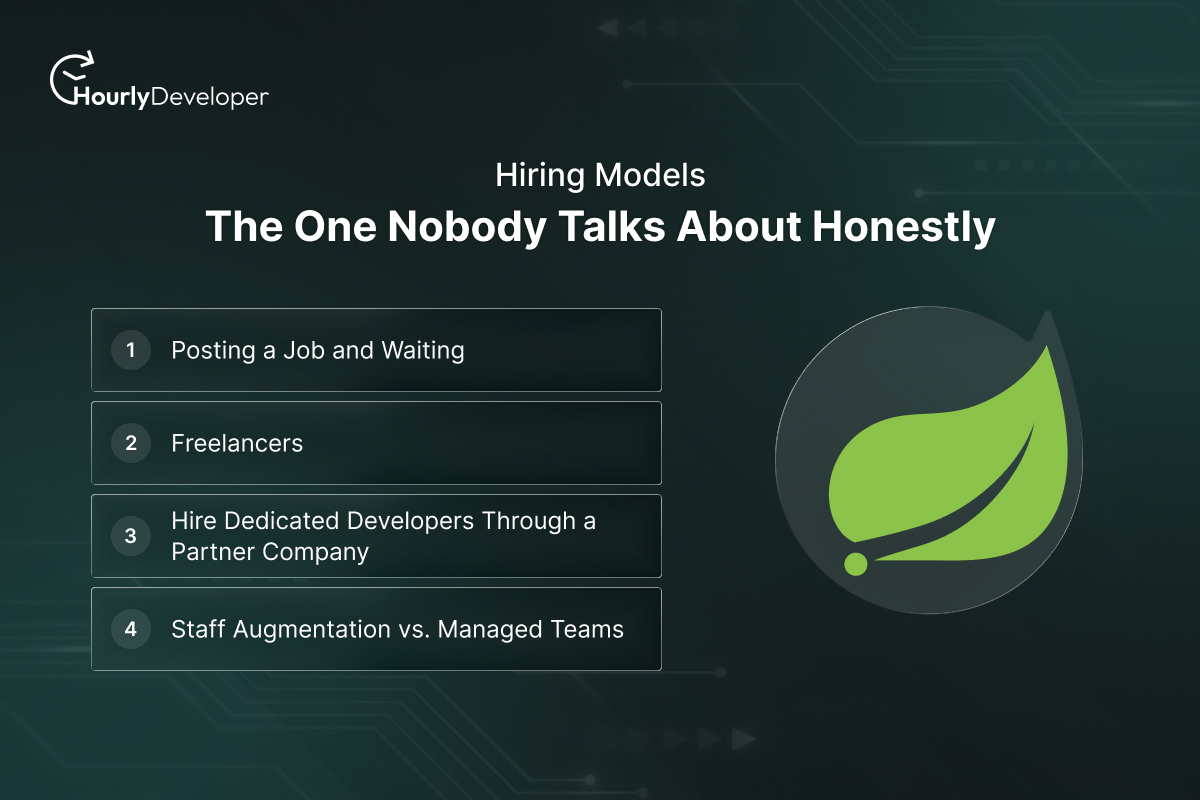
Most hiring guides give you a list of options. This one is going to tell you what actually happens when you pick each one.
- Posting a Job and Waiting
This is the default approach and it is the slowest. For a senior Java developer role, you are realistically looking at three to five months from posting to a productive hire when you factor in screening, interviews, offers, notice periods, and onboarding. If your project starts in six weeks, this is not your path.
Freelancers work well for isolated pieces of work with a clear deliverable. They do not work well when you need someone deep in your codebase who understands the full context of what you are building. The best freelance Java developers are also the busiest. Getting consistent availability from them is genuinely hard, and the moment they get a better offer mid-sprint, your timeline suffers.
- Hire Dedicated Developers Through a Partner Company
This model has become the most popular option for companies building serious products. When you hire Java Backend developers through a backend development company or Java development company, you get a developer who is assigned exclusively to your project, follows your processes, shows up to your standups, and stays for the duration of your engagement.
The most underrated benefit of this model is speed. A good partner company has already done the screening, verified the skills, and employed the developer. You interview, you choose, you start in two to three weeks, not four months. The cost is typically 30 to 50% lower than hiring in-house in North America or Western Europe, and you skip the overhead of HR, payroll, benefits, and equipment.
- Staff Augmentation vs. Managed Teams
Staff augmentation means you bring in individual developers who plug into your existing team. You manage them directly. A managed team arrangement means the partner company provides a project manager or tech lead alongside the developers. If you have strong internal technical leadership, augmentation gives you more control. If you need the partner to help with architecture and delivery ownership, managed teams are the better fit.
5.Cost to Hire Java Backend Developers in 2026: Real Numbers by Region
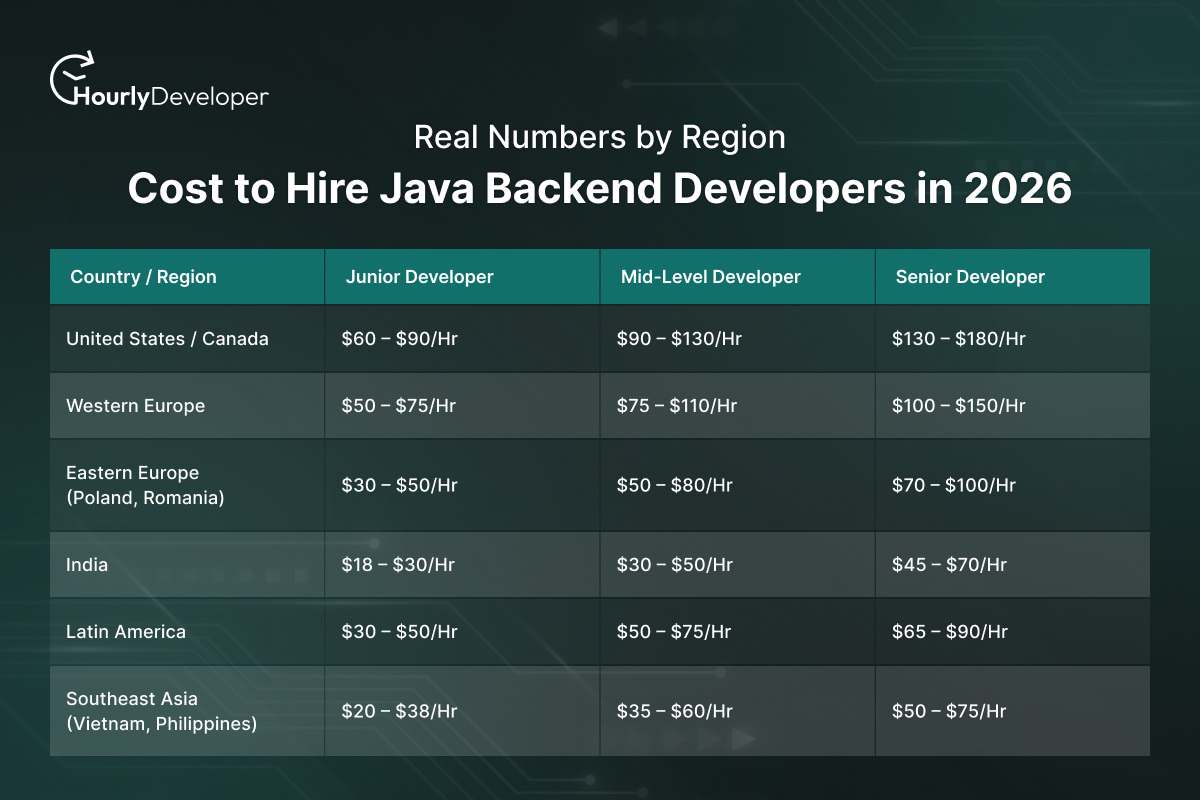
The cost to hire Java backend developers in 2026 has shifted compared to previous years. Salaries for AI-adjacent skills have pushed senior rates up across the board, while mid-level talent in South Asia and Eastern Europe has remained relatively stable. Here is what the market actually looks like:
| Region |
Junior (per hour) |
Mid-Level (per hour) |
Senior (per hour) |
| United States / Canada |
$60 – $90 |
$90 – $130 |
$130 – $180+ |
| Western Europe |
$50 – $75 |
$75 – $110 |
$100 – $150 |
| Eastern Europe (Poland, Romania) |
$30 – $50 |
$50 – $80 |
$70 – $100 |
| India |
$18 – $30 |
$30 – $50 |
$45 – $70 |
| Latin America |
$30 – $50 |
$50 – $75 |
$65 – $90 |
| Southeast Asia (Vietnam, Philippines) |
$20 – $38 |
$35 – $60 |
$50 – $75 |
A few things worth noting here:
- Developers with hands-on Kafka, GraalVM native image, or Spring AI experience are consistently commanding a 15 to 25% premium over these base rates.
- The offshore software development market is projected to reach $151.9 billion globally, which means demand for vetted offshore talent is driving prices up slightly even in historically low-cost regions.
- Eastern Europe and Latin America rates are approximately 46% lower than US equivalents, while South Asian rates can be 60 to 70% lower. That gap is significant for budget planning.
- Hiring through a Java development company typically involves a flat monthly fee per developer that bundles salary, overhead, and management. For senior profiles, this often runs $5,000 to $9,000 per month depending on region, which is still well below the fully-loaded cost of a US-based hire.
6.The Interview Process That Actually Works
Most technical interviews are designed by developers who found their own job through a referral and have never actually had to hire someone systematically. The result is interviews full of algorithm puzzles that have no relationship to the actual work. Here is a process that actually tells you what you need to know:
Round 1: The Conversation Before the Code
Spend 30 minutes talking about their last two or three projects. Not what technologies they used, but what decisions they made. Why did they structure the service this way? What would they do differently today? How did they handle a specific production incident? Listen for specificity. Vague answers about “microservices” and “clean architecture” without concrete detail is a sign they have been around these concepts without truly owning them.
Round 2: Practical Assessment (Not LeetCode)
Give them a task that mirrors real work. A good example: build a REST API with Spring Boot that accepts order requests, validates them, persists to a database, and publishes an event to a message queue. Give them a few hours and access to whatever documentation they normally use. Evaluate:
- Did they handle validation and error responses properly, not just the happy path?
- Is the code structure sensible? Could your team maintain this in six months?
- Did they write any tests, even basic ones?
- Did they ask clarifying questions before diving in?
Round 3: Architecture and Judgment
Give them a real scenario from your domain. Something like: “We need to build a notification service that sends emails, SMS, and push notifications triggered by events from five different services. It needs to handle 500,000 messages per day.” Ask them to walk through how they would design this. You are not looking for a perfect answer. You are looking for how they think about tradeoffs, failure modes, scalability constraints, and operational complexity.
Round 4: Team Fit (More Important Than Most Think)
Have your tech lead or a senior teammate join a casual conversation. No questions about fizzbuzz or system design. Just a conversation about how they prefer to work, how they give and receive feedback, what kind of technical disagreements they have had and how those are resolved. A developer who cannot communicate their thinking clearly, or who becomes defensive about their code during a review, is a much bigger problem than one who is slightly weaker on Kafka.
7.Where to Actually Find Strong Java Backend Developers
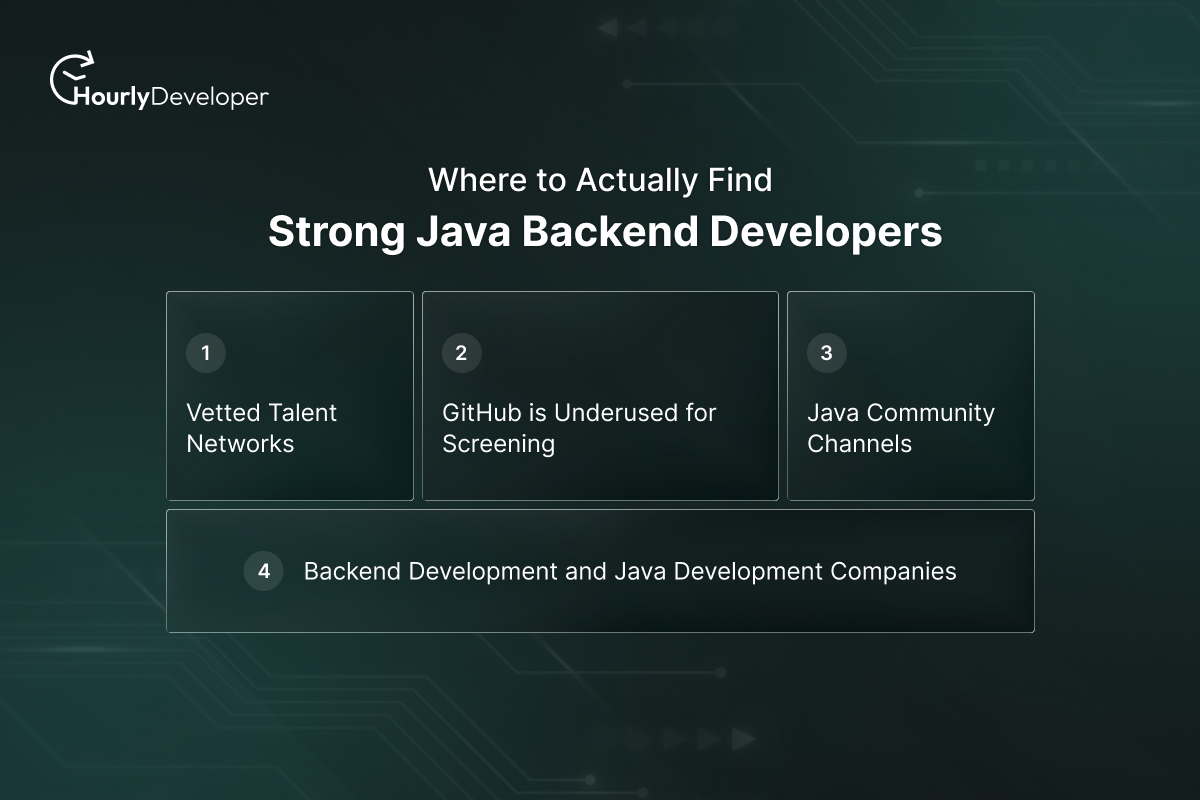
Here is an honest map of where the good talent actually sits and what each channel costs you in time and effort:
Platforms like Toptal, Arc.dev, and Gun.io pre-screen developers before listing them. The quality bar is genuinely high, the time-to-hire is fast (one to two weeks), and the rates reflect that. Expect to pay near or above market rates, but you skip weeks of screening.
- Backend Development and Java Development Companies
A specialized backend development company or Java development company gives you something no talent marketplace does: accountability beyond the individual developer. There is a delivery structure, a process, and someone to call when something goes sideways. The best ones let you interview developers before engagement, give you direct Slack access, and operate in your timezone. This is the channel most growing companies should be using for Spring Boot backend work.
- GitHub is Underused for Screening
Before any interview, look up the candidate on GitHub. A developer who has built and published real Spring Boot projects, contributed to open source Spring ecosystem libraries, or maintained a project with actual documentation and tests is showing you evidence, not claims. Compare this to a resume that lists “Spring Boot” among twenty other technologies.
The Spring community forum, Java subreddits, and Discord servers like the Spring Boot official server are where developers who actually care about the craft spend time. Posting a thoughtful, well-scoped job description in these spaces tends to attract engineers who are passionate about the stack, not just keyword-matching their CV.
8.Six Signs a Developer Is Going to Cost You More Than Their Salary
A bad hire in a senior backend role does not just waste salary. It introduces architectural debt, blocks other developers, ships bugs to production, and creates cleanup work that lasts long after they are gone. Here are the warning signs to watch for during the hiring process:
- They cannot explain a tradeoff: Every architectural decision involves tradeoffs. If they say “we used microservices because that’s best practice” without explaining why it made sense for that specific system, they are following trends, not making decisions.
- Their test coverage story is thin: “We did not have time for tests” is not a legitimate answer for production backend systems. This signals either an environment that tolerated technical debt or a developer who does not see testing as part of their job.
- They have not touched Spring Boot 3.x: The migration from 2.x to 3.x is significant, especially around security configuration and Jakarta EE changes. Someone building greenfield systems in 2025 who is still on 2.x has some catching up to do.
- They talk about technology, not problems: “I used Kafka” tells you nothing. “We used Kafka because we needed to decouple the payment processing service from the notification service and handle upstream failures gracefully” tells you everything.
- They are unfamiliar with observability: Any developer building production services in 2026 should know what distributed tracing is, have used something like Zipkin or Jaeger, and understand why logs alone are not enough.
- Their communication is unclear in writing: For remote Java developers especially, written communication is the primary channel for most decisions. If their emails and messages are unclear or ambiguous, that friction multiplies across every technical discussion.
9.What Nobody Tells You About Working With an Offshore Java Development Company
The decision to hire backend developers offshore through a Java development company is sound for most businesses. But there are practical realities that most guides skip over entirely. Here is what you should actually know:
- Time Zone Matters More for Blockers Than for Standups
People obsess over morning standups and overlapping hours. The real issue is how long it takes to unblock a developer who is stuck. If your architect is 11 hours behind and a developer hits a critical design question at 10am their time, that question either waits 11 hours or gets resolved without the right input. Structure your team so that developers in different timezones have enough context and decision-making authority to keep moving.
- Onboarding Offshore Developers Takes the Same Effort as Onboarding Anyone Else
The biggest mistake companies make is treating offshore developers as plug-and-play. They still need codebase context, architecture documentation, access to the right people, and a clear sense of what success looks like in week one. Companies with a structured onboarding process see offshore developers become productive in two to three weeks. Companies without one take two to three months to reach the same point.
- Code Ownership Should Be Explicit in the Contract
Any contract with a backend development company or Java development company should clearly state that all code developed under the engagement is your intellectual property. It should also cover NDAs, data protection obligations, and what happens to code and credentials if the engagement ends. Do not assume this is standard. Read and negotiate the contract.
Employer of Record arrangements, where you hire a developer directly in their country through an EOR service, are becoming more popular as companies want the dedication and loyalty of a direct hire without the complexity of setting up a legal entity in another country. This sits between full-time employment and outsourcing, and often produces better retention and commitment than pure outsourcing engagements.
10.Choosing a Java Development Company: The Questions That Actually Matter
There are thousands of companies that will tell you they specialize in Java Spring Boot development. Most of them specialize in everything, which means they specialize in nothing. Here is how to find the ones worth working with:
- Ask them to walk you through a past Spring Boot architecture: Not a case study on their website. A live conversation where their developer or tech lead explains a real system they built, the decisions they made, and the problems they solved.
- Find out if you get direct developer access: A good Java development company gives you Slack or Teams access directly to the developers. If all communication routes through an account manager who then relays to the developers, your feedback loop is going to be slow and information will get lost.
- Ask about their own internal code standards: Do they have a style guide? Do they do internal code reviews? How do they handle technical debt across engagements? A company that invests in the quality of its own team will invest in the quality of your project.
- Check their knowledge of Spring Boot 3.x and Java 21: If you are starting a new project, you should not be building on old versions. Ask specifically about their experience with GraalVM native builds, virtual threads, and the Jakarta EE migration.
- Reference checks actually matter: Ask for two or three former clients you can call. Not email. Call. Ask them specifically about how the company handled a difficult moment in the project, because every project has one.
11.Spring Boot in Production Right Now: What the Stack Actually Looks Like
When you hire Java Spring Boot developers for hire, there is a specific set of technologies showing up together in production environments across industries right now. Understanding this helps you evaluate candidates and plan your architecture conversations:
| Layer |
Common Technology |
Why It Matters |
| Runtime |
Java 21 (LTS) + GraalVM |
Native compilation, virtual threads, sub-second startup |
| Framework |
Spring Boot 3.3 / 3.4 |
Jakarta EE, auto-config, native image support |
| API |
REST + Spring WebFlux (reactive) |
Reactive needed for high-concurrency streaming use cases |
| Security |
Spring Security 6 + OAuth2 + JWT |
Identity provider integration, fine-grained access control |
| Messaging |
Apache Kafka + Spring Kafka |
Event-driven architecture, service decoupling |
| Data |
PostgreSQL + Redis + MongoDB |
Relational + cache + document pattern is now standard |
| AI Integration |
Spring AI + vector databases |
LLM API calls and retrieval-augmented generation (RAG) |
| Observability |
Micrometer + OpenTelemetry + Grafana |
Distributed tracing, metrics dashboards, alerting |
| Deployment |
Docker + Kubernetes + Helm |
Cloud-native packaging and orchestration |
The Spring AI entry in that table is worth highlighting. The Spring team released Spring AI as a stable module in late 2024 and adoption has been rapid. Companies are now building AI-assisted workflows, semantic search features, and LLM-powered automation directly into their Spring Boot backends. This is not a future trend. It is happening in production systems right now.
12.A Simple Framework for Making the Hiring Decision
Before you post a job, reach out to a Java development company, or open any interview loop, answer these four questions. They will save you a lot of time and prevent misaligned expectations:
- What does “done” look like? Define the scope clearly. Is this a greenfield backend from scratch? A migration from a monolith to microservices? Adding features to an existing Spring Boot codebase? The hiring process looks completely different depending on the answer.
- Who is managing this developer day to day? If you have strong internal technical leadership who can review code, unblock architectural questions, and run sprints, you can hire Java developers and integrate them directly. If you do not, you need a partner company that provides some of that structure.
- What is your real timeline? If you need someone in two weeks, your only real options are a staffing partner with a ready bench or a dedicated developer platform. Traditional hiring cannot move that fast.
- What does success look like in month three? A developer who has shipped a clean API layer, written meaningful tests, documented their architecture decisions, and integrated without drama into your team is a success. Write this down before the first interview and use it as your evaluation standard.
13.Final Thought
Hiring for a Java Spring Boot backend is not just a technical decision. It is an organizational one. The developer you choose will shape how your product scales, how your team communicates around code, and how quickly you can move when requirements change.
The companies getting this right in the current market are not necessarily the ones with the biggest hiring budgets. They are the ones who are specific about what they need, honest about their constraints, deliberate in their evaluation process, and willing to look beyond geography when the right skill set is not available locally.
Whether you choose to hire Java backend developers directly, work with a backend development company, or hire Backend developers through a staffing partner, the principles in this guide should help you make that decision with confidence and avoid the most expensive mistakes.
 Back to Blog