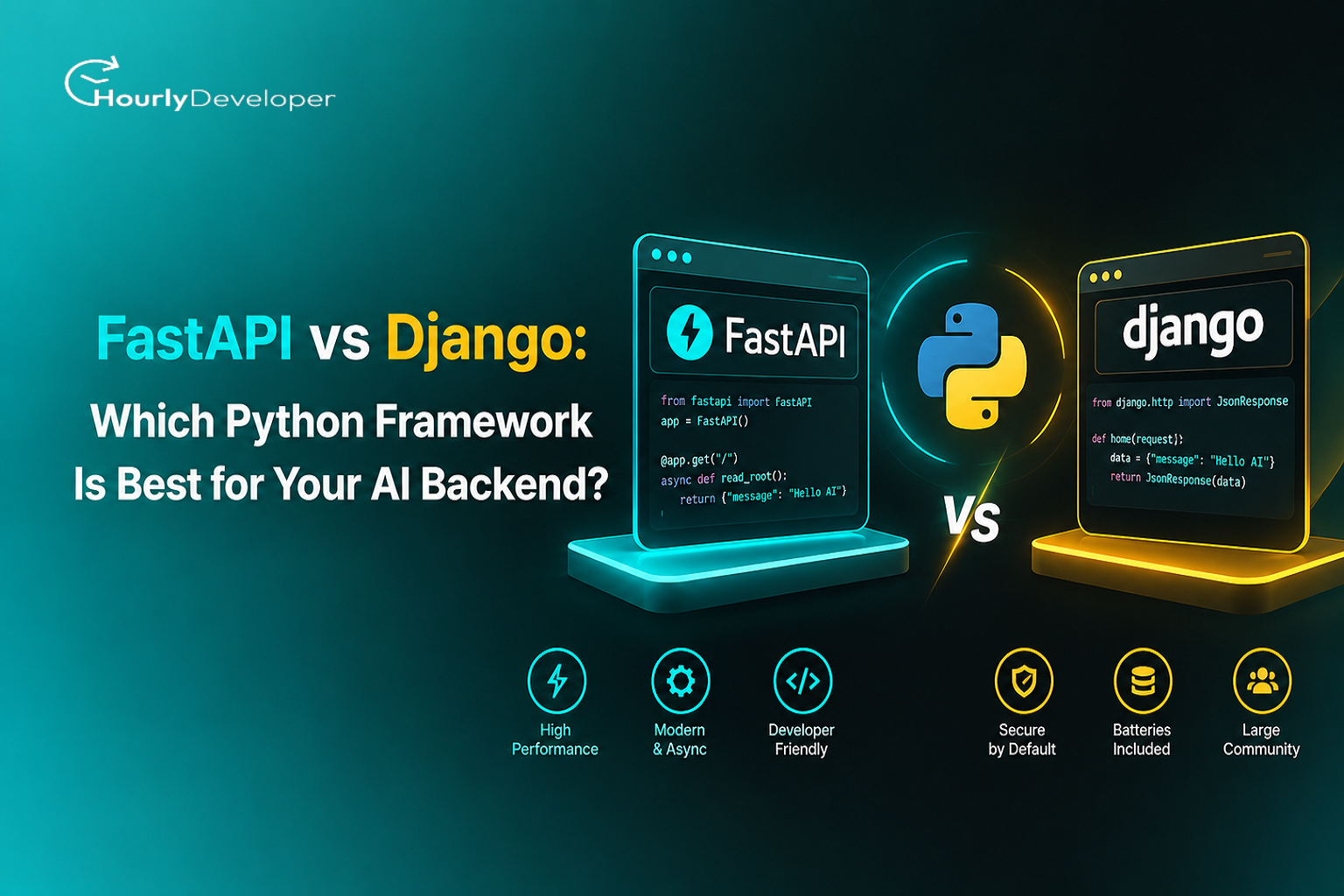
FastAPI vs Django: Which Python Framework Is Best for Your AI Backend?
If you're building an AI product right now, chances are you've already picked Python for the machine learning side and you're now stuck on a much more boring-sounding question: what do I use to actually serve this thing? Do I wrap my model in FastAPI, or do I build the whole thing in Django and call it a day?
This isn't a trivial choice, and it isn't really a "which one is better" question either. Both frameworks are excellent at what they were built for. The real question, especially for teams comparing FastAPI vs Django for machine learning applications, is which one fits the way your AI system needs to behave — how fast it needs to respond, how much it needs to handle at once, how messy the incoming data is, and how much your team already knows.
This article walks through FastAPI vs Django for AI backend development from the ground up: what each framework actually is, what it's good at, where it struggles, and how that plays out once you're dealing with real machine learning workloads — model inference, streaming responses, flaky data, and all the small failures that never show up in a demo. By the end you should be able to make this call for your own project without needing to ask five different Reddit threads.
What is FastAPI and what is it actually good for?
FastAPI showed up in 2018, which makes it fairly young compared to Django, but it caught on fast because it solved a specific, very common problem: Python didn't have a lightweight framework that was also fast, also asynchronous by default, and also generated API documentation for you without extra work.
Here's the short version of how it works. FastAPI is built on top of two other libraries — Starlette handles the actual web server plumbing (routing, requests, responses, WebSockets), and Pydantic handles data validation using Python type hints. You write a function, you tell it what kind of data it expects using normal Python types, and FastAPI does the rest: validates incoming requests, converts data types, returns clear errors when something doesn't match, and builds an interactive Swagger UI for testing your API in the browser.
Core features of FastAPI:
● Native async support (built on ASGI, not the older WSGI standard), so it can handle many requests at once without blocking
● Automatic data validation and serialization through Pydantic models
● Auto-generated OpenAPI/Swagger documentation — you get interactive API docs for free
● Dependency injection system that makes it easy to share logic like authentication or database sessions across endpoints
● Very fast — benchmarks consistently put it near the top of Python frameworks, close to Node.js and Go in raw request handling
● Minimal boilerplate; a working API can be five or six lines of code
● Built-in support for WebSockets and background tasks, both of which matter a lot for AI applications
What FastAPI is genuinely good for:
● Serving machine learning models as an API (image classifiers, recommendation engines, fraud scoring, you name it)
● Wrapping large language models and streaming their output back to a client token by token
● Microservices that need to talk to each other quickly
● Any backend where a lot of requests are hitting the server at the same time and you can't afford to have them queue up behind each other
● Teams that want strict input validation, since bad input is one of the biggest silent killers of ML pipelines
FastAPI doesn't come with an ORM, an admin panel, or a built-in authentication system. That's not a flaw, it's a design choice. It expects you to bring in the pieces you actually need — SQLAlchemy or Tortoise ORM for the database, your own auth logic or a library like FastAPI-Users. That gives you flexibility, but it also means more decisions up front, and a less experienced team can end up gluing together mismatched pieces.
What is Django and what is it actually good for?
Django has been around since 2005, and it was built with a completely different philosophy: give developers everything they need out of the box so they can build a full web application without shopping around for ten different libraries. People call this the "batteries included" approach, and it's genuinely the reason so many companies have shipped production software on Django for close to two decades.
When you start a Django project, you get an ORM, a templating engine, a user authentication system, a permissions framework, an admin dashboard that's generated automatically from your database models, form handling, and a project structure that scales reasonably well as your codebase grows. None of this is glamorous, but all of it is stuff you would otherwise have to build or wire up yourself.
Core features of Django:
● Built-in ORM that maps Python classes to database tables, with migrations handled for you
● Admin panel generated automatically — genuinely one of Django's best features, since it gives non-technical team members a way to view and edit data without writing SQL
● Authentication and permissions system already built in
● A mature, huge ecosystem of third-party packages (Django REST Framework being the big one for building APIs)
● Strong security defaults — protection against SQL injection, cross-site scripting, and CSRF attacks is baked in
● A templating engine if you're rendering HTML server-side rather than building a pure API
● Async support has been added over the last few releases, but it's newer and doesn't run as deep through the framework as it does in FastAPI
What Django is genuinely good for:
● Content-heavy platforms — marketplaces, dashboards, internal tools, admin-facing systems
● Products where you need user accounts, roles, and permissions from day one
● Applications that will grow a lot of unrelated features over time (billing, notifications, reporting) and benefit from one consistent structure
● Teams that want fewer decisions to make and a well-worn path to follow
● Data-heavy admin tools for reviewing, labeling, or correcting training data — this comes up more in AI projects than people expect
Django's ORM and admin panel are also why a lot of "AI product" companies — not the model-serving layer, but the actual product wrapped around the model — are built on Django. Someone still needs a place to manage users, subscriptions, uploaded files, and logs, and Django does that extremely well.
FastAPI vs Django for AI backend development: where they actually diverge
Now for the part that matters more once you're building something real. Both frameworks can technically serve an API. The differences show up in how they behave once you add machine learning into the mix.
Speed and concurrency
This is the one everyone brings up first, and it's not hype. FastAPI is asynchronous by design, which means a single instance can handle a large number of requests that spend time waiting — waiting for a database, waiting for a model to finish inference, waiting for an external API. While one request is waiting, FastAPI can work on others instead of sitting idle.
Django has caught up with async views, but the ecosystem around it — the ORM, most third-party packages, a lot of existing code in production Django apps — is still largely synchronous underneath. You can write an async view in Django, but the moment it calls into the regular ORM, you're back to blocking behavior unless you're careful.
For FastAPI vs Django for machine learning applications, this matters more than it sounds. Model inference, especially with larger models, can take anywhere from a few milliseconds to a few seconds. If your API is handling dozens or hundreds of these requests concurrently, an async-first framework keeps your server responsive instead of forming a backlog.
Data validation
Machine learning systems are only as good as the data going into them, and a huge share of "the model is behaving weirdly" bugs actually turn out to be bad or malformed input that should never have reached the model in the first place.
FastAPI's use of Pydantic means your input schema is defined right there in the code, with types, defaults, and constraints. If someone sends a string where a number was expected, or leaves out a required field, FastAPI rejects the request before your code — or your model — ever sees it, and it tells the client exactly what was wrong.
Django doesn't have this built in at the same level. If you're using Django REST Framework, you get serializers that do a similar job, but it's an added layer rather than something baked into the core framework, and it tends to feel more verbose.
Learning curve and team ramp-up
Django has more concepts to learn up front — the ORM, the settings system, migrations, the admin, the URL routing conventions — but once you know it, the framework makes a lot of decisions for you, so different engineers on a team tend to write code that looks similar.
FastAPI is easier to pick up initially because you can build something working in minutes, but the flip side is that your team has to make more architectural decisions themselves: which ORM, how to structure larger projects, how to handle background jobs, how to manage auth. That freedom is great for experienced teams and can turn into inconsistency on less experienced ones.
Ecosystem maturity
Django has almost twenty years of packages, tutorials, Stack Overflow answers, and battle-tested patterns behind it. If you hit a weird edge case, someone has almost certainly hit it before you and written about it.
FastAPI's ecosystem is younger but has grown quickly, especially around the AI and ML tooling that's popped up in the last few years — it's become something of a default choice for wrapping models, and most ML-serving tutorials, cookbooks, and open-source projects you'll find today lean toward it.
Background jobs and real-time features
AI backends often need to do things outside the normal request-response cycle: retrain a model on a schedule, send a notification once a long job finishes, stream partial results back to a user while a language model is still generating text.
FastAPI handles this natively with background tasks and has first-class WebSocket support, which is exactly what you want for streaming an LLM's response token by token instead of making the user wait for the whole thing.
Django can do all of this too, usually paired with Celery for background jobs and Django Channels for WebSockets, but that's additional infrastructure to set up and maintain rather than something that comes for free.
FastAPI vs Django for machine learning applications: the table version
Added in later versions, partial support across ORM and ecosystem
Performance under load
Very high, close to Node.js/Go in benchmarks
Good, but generally slower under high concurrency
Data validation
Built-in via Pydantic, strict and automatic
Needs Django REST Framework serializers
ORM
None built-in, pairs with SQLAlchemy/Tortoise
Built-in, mature, tightly integrated
Admin panel
None built-in
Yes, auto-generated from models
Authentication
Not built-in, add your own or a library
Built-in
API documentation
Auto-generated Swagger/OpenAPI docs
Manual, or via DRF add-ons
WebSocket support
Native
Needs Django Channels
Background jobs
Native background tasks
Typically via Celery
Learning curve
Lower to start, more decisions later
Higher to start, more guardrails later
Best suited for
Model serving, microservices, real-time APIs
Full applications, admin-heavy products, content platforms
Ecosystem age
Younger, growing fast in AI tooling
Very mature, huge package library
Ideal team size
Small to mid, comfortable making architecture calls
Any size, especially useful when you want fewer decisions
Where things get messy: real-time decisions, missing data, and conflicting signals
This is the part most comparisons skip, and it's the part that actually decides whether your AI backend holds up in production. A demo where you send one clean request and get one clean prediction back tells you almost nothing about how a framework behaves once real users, real data, and real failures show up.
Missing or incomplete input. In a live system, you will constantly get requests with a field left blank, a value that's technically valid but meaningless (age: 0, a null where a category was expected), or a payload from an older version of your mobile app that doesn't match your current schema. This is where FastAPI's validation layer earns its keep — you can mark fields as optional with sensible defaults, write custom validators that catch nonsense values before they reach your model, and return a precise error telling the client which field was the problem. Django can do the same through DRF serializers, but you're writing more of that logic by hand, and it's easier for something to slip through unchecked, especially as the schema grows.
Conflicting signals from your model layer. Once you're running more than one model — say, an older version in production and a newer one you're testing — you'll eventually hit situations where they disagree on the same input. A recommendation engine might rank two products differently depending on which model version handled the request; a fraud check might flag something as risky one moment and safe the next as features update in near real time. Neither framework solves this problem for you; that's a modeling and system-design problem. But how you route around it does depend on the framework. FastAPI's dependency injection makes it straightforward to route a request to a specific model version, log both outputs, and let a lightweight rule decide which one wins, all without slowing the request down much. Django's structure is a better fit if you want a human to review the disagreement — its admin panel is genuinely useful for building a quick internal tool where someone looks at flagged, conflicting predictions and makes the final call.
Real-time decisions under time pressure. Some AI features can't wait — a chatbot has to respond in a second or two or the user assumes it's broken, a live pricing engine has to return a number before a checkout page times out. This is where async handling stops being a nice-to-have. FastAPI lets you set request timeouts, run model inference in a background thread or process pool so it doesn't block the event loop, and fall back to a cached or simplified response if the full model takes too long. Django can be configured to do similar things, but you're fighting the synchronous default more than working with it.
Exceptions that aren't really errors. A model returning a low-confidence prediction isn't a bug, but your API still has to decide what to do with it — return it anyway with a confidence score, hold it back and return a fallback, or queue it for human review. FastAPI's exception handlers make it easy to define custom behavior for these "soft failures" separately from genuine server errors (bad database connection, model file missing, out-of-memory). Django's exception handling works similarly through middleware, but because Django wasn't built with model-serving in mind, you'll often end up writing more custom code to distinguish a data-quality issue from an actual system fault.
System behavior under load. When traffic spikes — a marketing push, a viral moment, a batch job hitting your API all at once — the two frameworks behave differently. FastAPI, running under Uvicorn or Gunicorn with multiple async workers, tends to degrade gracefully: response times climb, but the server keeps accepting and processing requests instead of falling over. Django under heavy synchronous load is more likely to hit a wall where requests start queuing behind slow database calls, unless you've already put caching, connection pooling, and load balancing in place. Neither problem is unsolvable, but FastAPI gives you more headroom before you have to solve it.
None of this means FastAPI wins every scenario. A lot of AI products need exactly the kind of structure, review tooling, and permission control that Django gives you for free. The point is that the messy, unglamorous parts of running an AI system in production — bad input, disagreeing models, slow inference, spikes in traffic — are exactly where the framework choice starts to matter more than it does in a tutorial.
Where the numbers point
Python's dominance in AI and machine learning isn't really in dispute at this point — it's consistently ranked as the top language for data science and ML work in developer surveys, mostly because of libraries like PyTorch, TensorFlow, and scikit-learn, none of which care which web framework you eventually plug them into.
What's changed more recently is which framework people reach for once the model is ready to serve. FastAPI's adoption has grown quickly since its release, driven largely by teams building ML APIs and LLM-based products, and it's become the default choice in a lot of open-source ML tooling and starter templates you'll find today. Django, meanwhile, remains one of the most widely used web frameworks overall, with a long track record in production at companies of every size, and it still shows up constantly in job listings, particularly for full-stack and backend roles that go beyond just serving a model.
Key takeaway: Python isn't the decision you're making anymore — that part's settled. The decision is which framework sits on top of it, and that's really the whole question behind "what's the best Python framework for AI backend work" — it comes down to what your system needs to do once a request comes in, not which name shows up more in headlines.
So, what's the best Python framework for AI backend work?
There isn't one answer that fits every team, and anyone who gives you a flat one-word answer probably hasn't shipped both. The honest version of "which is the best Python framework for AI backend development" is: it depends on what that backend has to do all day, every day, once it's live.
When each framework actually makes sense
It helps to think about this in terms of what you're actually building, not which framework sounds more modern.
Reach for FastAPI when:
● You're serving a machine learning model as a standalone API
● You're building a chatbot, recommendation service, or anything that streams a response
● You need to handle a high volume of concurrent requests
● You're building microservices that talk to other services more than they talk to a database
● Your team is comfortable making some architecture decisions themselves
Reach for Django when:
● You're building a full product, not just an API — user accounts, billing, dashboards, the whole thing
● You need an admin interface quickly, especially for managing training data, reviewing flagged predictions, or handling support requests
● Your team wants fewer decisions and a consistent, well-documented structure
● You're building something that will grow a lot of unrelated features over the next few years
Consider using both together. This is more common than people expect, and it's often the practical answer to best Python framework for AI backend questions. A lot of production systems run Django as the main application — handling users, permissions, billing, and the admin — while a separate FastAPI service handles model inference and anything that needs to be fast and async. The two talk to each other over an internal API. You get Django's structure where you need it and FastAPI's speed where you need that instead, without forcing one framework to do a job it wasn't built for.
Cost, team size, and hiring — the part budgets actually care about
Framework choice isn't purely technical, and pretending otherwise doesn't help anyone shipping on a deadline. It affects how fast you can hire python developers, how much you'll pay, and how long it takes a new engineer to become useful.
Django developers are easier to find in general, partly because the framework has been around longer and partly because Django skills overlap with general full-stack Python web development. FastAPI developers are a slightly smaller pool, but it's grown a lot as more companies build AI products, and the overlap with machine learning engineering means a good FastAPI developer often already understands the ML side of what they're building, not just the API layer.
If you're trying to hire python developers for an AI-heavy project, it's worth being specific in the job description about which framework the role actually needs, since the two skill sets aren't identical — a strong Django developer might have never touched async programming, and a FastAPI-focused engineer might not know Django's ORM or admin system at all. Being vague here slows down hiring more than people realize.
This is also where working with an established AI development company tends to pay off if you don't have this expertise in-house already — a company that builds AI backends regularly will already know which framework fits which situation instead of learning that on your project. A team that's shipped both types of backends before can tell you fairly quickly which one fits your actual use case, rather than defaulting to whatever they personally like working with. It's worth asking directly in an initial conversation which framework they'd recommend and why — a good answer will sound like "it depends on X and Y," not a one-line preference.
Pro tips before you commit
Don't choose based on benchmarks alone. FastAPI will almost always win a raw speed test, but your bottleneck is more often your database, your model's inference time, or a slow third-party API call, not the web framework itself.
If you're serving a model that takes more than a second or two to respond, plan for streaming or background processing from day one rather than bolting it on later.
Write your input validation as if a bad request is guaranteed to arrive eventually, because it is. Loose validation is one of the most common causes of quiet failures in ML systems.
If you go with Django for the main app, don't force it to serve your model directly. A small FastAPI service in front of the model, even a simple one, keeps that part of your system easier to scale and swap out later.
Test your API under concurrent load before launch, not after. A framework that feels fast with one request at a time can behave very differently with fifty at once.
Keep a clear separation between "the model was wrong" and "the system broke." Confusing the two makes debugging painful and makes your error logs nearly useless.
Key takeaways
FastAPI is async-first, fast, and built for APIs — a strong fit for serving models, chatbots, and any high-concurrency workload.
Django is complete out of the box — ORM, admin, auth — and fits full products where an API is only one part of what you're building.
For FastAPI vs Django for AI backend development, the real deciding factor is what happens once a request lands: how much validation it needs, how fast it has to come back, and what happens when something about the input or the model's output isn't clean.
Plenty of production systems use both — Django for the main application, FastAPI for the model-serving layer.
Hiring the right developer matters as much as picking the right framework — whether you hire python developers directly or bring in an AI development company, be specific about which skill set your project actually needs.
Digital Marketing Manager: With a passion for data-driven strategies and an instinct for spotting trends, Radhika navigates the virtual realm with finesse. Her commitment to staying ahead of the curve ensures our brand's message reaches the right audience at the right time.
Frequently Asked Questions
In raw benchmarks, yes, FastAPI generally outperforms Django, especially under concurrent load, because of its async foundation. In practice, the difference matters most when your API is handling many simultaneous requests or waiting on slow operations like model inference. If your traffic is modest and most of the work happens inside a single database query, the gap matters a lot less.
Yes. Django can absolutely serve a model — plenty of production systems do it, especially when the AI feature is just one part of a larger product. It's less naturally suited to high-concurrency, low-latency serving than FastAPI, but for moderate traffic or batch-style predictions, it works fine, and you get its admin and ORM as a bonus.
It depends on what the product actually is. If the core of the product is the AI feature itself and it needs to feel instant, FastAPI is usually the better starting point. If the AI feature is one part of a broader application with user accounts, billing, and an admin panel, Django (possibly paired with a small FastAPI service for the model) tends to save time overall.
Not necessarily, but it helps. Many teams run a Django-based main application alongside a FastAPI microservice that handles inference. Knowing both gives you the option to use each one where it's actually strongest, instead of stretching a single framework to cover jobs it wasn't designed for.
Get specific about the role before you post it. If most of the work involves building and scaling the API layer around a model, look for FastAPI experience and comfort with async programming. If the role is closer to full-stack product development with an AI feature inside it, Django experience matters more. When you're not sure, a conversation with an experienced AI development company can help map the actual requirements to the right skill set before you commit to hiring.
Find exceptional developers at Hourlydeveloper. Get the expertise, solutions, and teamwork you need for success. Hire developers easily and boost your projects today!
 Back to Blog