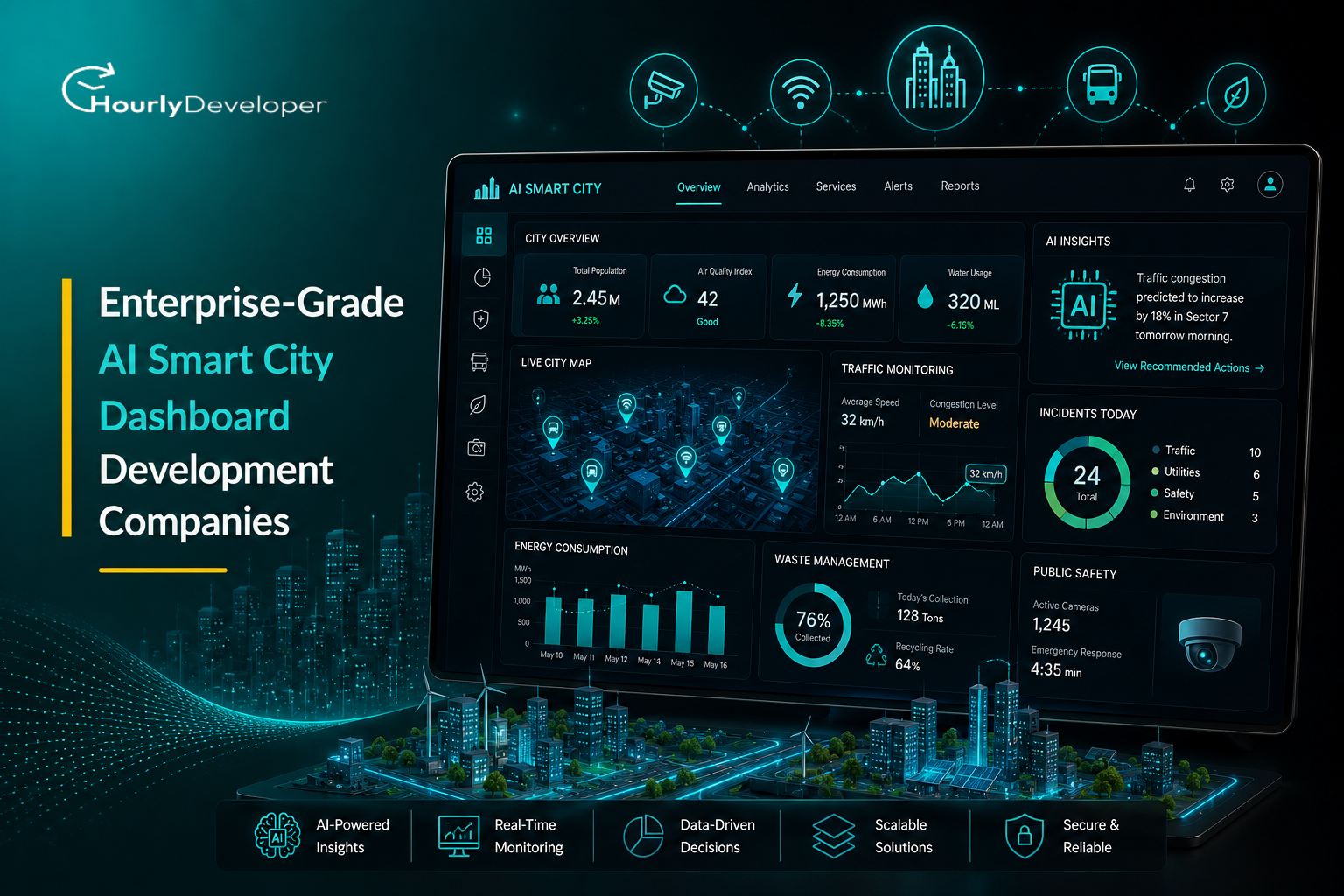
Enterprise-Grade AI Smart City Dashboard Development Companies
Introduction
Enterprise-Grade AI Smart City Dashboard Development Companies
1.What to Actually Check Before You Hire
Most vendor lists rank companies by team size or years in business, which tells you almost nothing about whether they can build a dashboard your city staff will trust. When you are evaluating AI smart city dashboard development companies, four things matter more than a polished case study page.
First, ask how they handle data that arrives late, broken, or in the wrong format, because municipal sensor networks rarely behave the way a demo environment does. A vendor who has only ever worked with clean corporate datasets will underestimate how much of the actual build goes into handling missing readings, duplicate events, and sensors that silently stop reporting for three days before anyone notices.
Second, check whether their AI models explain their own predictions in plain language, since a traffic forecast nobody can question is a forecast nobody will act on. Operations staff need to know why the model flagged a corridor as high risk, not just that it did, especially when that flag is going to justify reallocating limited resources.
Third, look at whether they have worked with legacy government systems before, because a beautiful new interface is worthless if it cannot talk to a 15 year old SCADA system or a permitting database that was never designed to expose an API. This is where timelines usually blow up, and a vendor who has been through it before will budget for that friction honestly instead of promising an unrealistic launch date.
Fourth, confirm they understand procurement cycles, data residency rules, and public sector compliance, because those constraints shape the build far more than the tech stack does. A team that treats compliance as a checkbox at the end of the project, rather than a design constraint from day one, will cost you months in rework once legal review finally happens. Keep these four checks in mind and you will filter out a surprising number of vendors who look identical on paper but would not actually make a list of the best AI smart city software development companies once you dig past the marketing copy.
One more filter worth applying early. Ask for a sample of their pricing structure before you get deep into negotiations, not after. Vendors who are vague about cost drivers at the proposal stage tend to be the same ones who surprise you with change orders once the contract is signed and switching partners mid project becomes expensive and disruptive.
2.How This List Is Put Together
The 20 companies below were chosen for a mix of reasons: proven delivery on urban analytics or civic dashboards, transparent process, realistic pricing conversations, and the ability to work with real time data at city scale. Some are large integrators with government contract experience. Others are focused development partners who specialize in building the exact kind of dashboard this list is about.
You will notice the list mixes global enterprises with smaller specialist teams on purpose. A massive integrator with hundreds of engineers is not automatically the right choice for a mid sized city piloting its first analytics dashboard, and a lean boutique studio is not automatically the right choice for a national infrastructure program with strict federal compliance requirements. Match the size of the vendor to the size and complexity of your actual project, not the other way around. Whichever direction fits, this is meant to save you the week you would otherwise spend on discovery calls and mismatched proposals.
It also helps to know where the market is heading before you lock in a partner. Demand for AI smart city dashboard development companies has shifted noticeably toward predictive capability rather than static reporting, since city administrators increasingly want to know what is likely to happen next week, not just what happened yesterday. Vendors who can show real forecasting work, not just historical dashboards with a fresh coat of paint, tend to be the ones building for where this space is going rather than where it has already been.
3.Top AI Smart City Dashboard Development Companies
HourlyDeveloper sits at the top of this list because of how well its engagement model fits the uncertainty most smart city projects start with. The rest are ordered to mix sizes and specialties rather than ranked strictly first to last, so scan for the profile that matches your project. If you are ready to hire AI smart city developers today rather than keep researching, jump straight to the profiles that mention your specific use case, whether that is traffic, water, or predictive maintenance.
India, with distributed delivery teams serving US, UK, and Gulf clients
Overview
HourlyDeveloper builds custom AI and data dashboards on flexible, hourly engagement models rather than locking clients into rigid fixed-bid contracts. For a smart city project, that structure matters because requirements shift constantly once real sensor data starts flowing in and stakeholders realize what they actually need only after seeing a first working version.
Best For
City departments and civic tech startups that want to start small, prove value on one dashboard module such as traffic or waste, and scale the engagement once the model earns trust internally.
Notable
Transparent hourly billing, dedicated developer pods, and a track record of picking up half finished dashboard projects from other vendors and getting them to production without a full rebuild.
A large scale IT partner with deep bench strength across AI, IoT, and blockchain, Suffescom has delivered over 300 projects for clients that needed dashboards combining live sensor feeds with predictive modeling across multiple city functions at once.
Best For
Larger municipal programs that need one vendor to cover hardware integration, backend, and dashboard UI together without coordinating three separate contractors.
Notable
1200 plus clients served and strong experience connecting IoT hardware to analytics layers, which shortens integration timelines considerably.
As the name suggests, Backend Development Company specializes in the infrastructure layer that most dashboard vendors treat as an afterthought. They build the data pipelines, APIs, and event processing systems that keep a smart city dashboard accurate under real traffic loads instead of buckling once sensor volume actually scales up.
Best For
Teams that already have a frontend or design partner but need someone who can architect a backend that survives thousands of concurrent sensor updates without lag or dropped events.
Notable
Strong focus on scalable microservices architecture and real time data pipelines built specifically for high frequency civic data streams.
RisingMax has over a decade of experience across IoT app development, blockchain, and big data, with a specific track record in smart city solutions covering traffic, energy, and waste management dashboards for mid sized municipal clients.
Best For
City programs wanting a single vendor with 1000 plus completed projects and strong Clutch and GoodFirms reviews backing up their pitch.
Notable
5 out of 5 rating across major review platforms and over 11 years of consulting experience in civic and enterprise IT delivery.
HireFullStackDeveloperIndia connects clients with vetted full stack engineers who can own a smart city dashboard end to end, from the database schema to the interactive map layer citizens or operators interact with daily.
Best For
Founders and city IT leads who want to build an in-house feeling team without the overhead of direct hiring, useful when a dashboard needs long term maintenance rather than a one-time build.
Notable
Flexible engagement models ranging from single developers to full pods, with experience across React, Node, and geospatial visualization libraries used in mapping heavy dashboards.
Softeq brings deep hardware and firmware experience into its smart city work, which matters when a dashboard needs to talk directly to edge devices rather than just a cloud API sitting several layers removed from the sensor itself.
Best For
Projects where sensor hardware, edge computing, and the dashboard software all need to be designed together from day one rather than bolted on afterward.
Notable
Strong combined hardware and software delivery, useful for cities piloting new sensor types before committing to a citywide rollout and full budget commitment.
HireAIDevelopers specializes specifically in machine learning and predictive modeling talent, the layer that turns a raw data dashboard into something that forecasts congestion, predicts equipment failure, or flags anomalies before they become full blown incidents.
Best For
Teams that already have a dashboard shell built and need to add real forecasting, computer vision, or anomaly detection without starting the entire build from scratch.
Notable
Experience across TensorFlow and scikit-learn based forecasting pipelines tailored specifically to time series civic data and its seasonal quirks.
Tektelic is best known for LoRaWAN gateways and IoT sensors, and pairs that hardware with software platforms for smart city monitoring, making them a strong pick when sensor deployment itself is the bottleneck holding a project back.
Best For
Cities still in the sensor rollout phase who need a partner covering both physical hardware and the dashboard layer under one roof.
Notable
Recognized IoT gateway manufacturer with proven smart city deployments across multiple countries and climates.
Urban SDK focuses specifically on geospatial AI for transportation and public safety, delivering hourly traffic analytics and automated reporting that replace manual complaint tracking and expensive outsourced traffic studies most departments currently rely on.
Best For
Transportation departments that want a dashboard built specifically around road safety, speed data, and infrastructure risk mapping rather than generic analytics.
Notable
Purpose built for public sector traffic and safety use cases rather than general purpose business intelligence software.
Numina builds sensor-driven systems that track pedestrian movement, curb usage, and mobility patterns, then feeds that into dashboards planners use for zoning and infrastructure decisions that vehicle counts alone cannot inform.
Best For
Urban planning teams that need street level movement data rather than only vehicle traffic counts to justify infrastructure changes.
Notable
Strong niche focus on pedestrian and curb analytics, an area many general IoT vendors overlook entirely.
DataEximIT works across data engineering, AI model development, and dashboard visualization, with experience building analytics layers that pull from multiple disconnected civic data sources into one coherent, queryable view for operations teams.
Best For
Projects where the hardest problem is not the dashboard UI but reconciling data from a dozen legacy municipal systems that were never built to talk to each other.
Notable
Strong data engineering foundation, which is often the actual bottleneck in smart city dashboard builds that vendors underestimate at the proposal stage.
Iteris provides traffic analytics and mobility management software used by transportation agencies to improve intersection safety and monitor congestion in near real time across large metro corridors.
Best For
Transportation authorities that need a dashboard grounded in decades of traffic engineering domain knowledge rather than a generic data science approach.
Notable
Long standing presence in public sector traffic technology with proven government procurement experience and reference clients.
Atonix Digital builds platforms that help cities manage utility infrastructure, water systems, and energy performance with predictive analytics baked directly into the dashboard layer rather than offered as a separate add on.
Best For
Utility operators who need a dashboard focused on infrastructure health and asset lifespan rather than citizen facing services.
Notable
Strong predictive maintenance capability for aging infrastructure, a growing priority for many municipal budgets under strain.
WebClues Infotech delivers full cycle web and mobile development alongside AI integration, giving clients a single team for both the public facing app and the internal operations dashboard, which keeps the two experiences consistent.
Best For
Projects that need a citizen facing mobile app and an internal admin dashboard built by the same team for design and data consistency.
Notable
Broad service range spanning web, mobile, and AI, useful for programs with multiple connected deliverables on one timeline.
Xylem Digital Solutions focuses on water network monitoring, leak detection, and wastewater analytics, an increasingly critical slice of any serious smart city program as aging pipe infrastructure becomes a budget priority.
Best For
Municipalities prioritizing water infrastructure and sustainability metrics as their first smart city initiative before expanding elsewhere.
Notable
Deep domain specialization in water systems rather than a generalist approach spread across too many verticals.
Kinetech Cloud builds platforms for permitting, civic operations, and compliance automation, which often sit right next to a smart city dashboard in a city’s broader technology stack and need to share data cleanly.
Best For
City IT departments modernizing multiple civic workflows at once, not just a single standalone analytics dashboard.
Notable
Strong focus on workflow automation alongside data visualization, useful when the dashboard is one piece of a larger modernization push.
App Maisters specializes in AI solutions built specifically for federal, state, and local government agencies, with security and compliance requirements baked into the development process from day one rather than retrofitted before launch.
Best For
Government agencies where security clearance and public sector certification requirements rule out most private sector vendors entirely.
Notable
Federal certification status simplifies procurement for agencies bound by strict vendor requirements and lengthy vetting processes.
Mu Sigma blends data science, AI, and management consulting to build dashboards aimed at decision support rather than raw reporting, useful when a city needs recommendations, not just numbers on a screen.
Best For
Large scale programs where the dashboard needs to actively recommend actions, not only visualize data for someone else to interpret.
Notable
Proven work with Fortune 500 clients on automated decision science at scale, translated here into civic applications.
Dataforest builds custom AI-powered dashboards using predictive analytics pipelines, with modular architecture that scales as a city adds new data sources over time without requiring a full platform rebuild each time.
Best For
Projects that expect to grow significantly in scope after the first dashboard module ships and proves its value.
Notable
Component based architecture designed for incremental expansion rather than a rigid one-time build that locks in early decisions.
Pratikshat Solutions specializes specifically in IoT and smart city technologies, including environmental sensors and command and control center software for government agencies managing large scale public infrastructure.
Best For
Government agencies in Asia and the Middle East looking for a partner with direct command center deployment experience under real operating conditions.
Notable
Long standing focus on environmental sensors and operational command centers rather than general software development across unrelated industries.
4.How to Hire the Right AI Smart City Dashboard Developers
Once you have a shortlist, the conversation should shift from portfolios to process. Ask each vendor to walk you through how they would handle a specific scenario from your city, such as a sensor network going offline mid-storm or a spike in false positive alerts. How they answer tells you more than any case study, because a rehearsed pitch deck cannot fake the specificity of someone who has actually debugged this exact problem before.
If you plan to hire AI smart city developers directly rather than going through a full agency engagement, verify their experience with geospatial data specifically, since standard web development skills do not automatically transfer to mapping thousands of live data points without the interface becoming unusable. Also confirm they have built systems that handle graceful degradation, because a dashboard that crashes when one data feed fails is worse than no dashboard at all, and operations staff will stop trusting it the very first time it goes dark during an actual emergency.
Budget conversations should be realistic too. A pilot dashboard covering one use case, such as traffic or waste collection, typically runs $15,000 to $60,000 depending on data complexity and integration needs. A full multi department platform with predictive modeling across several city functions can run into the hundreds of thousands, spread across phased milestones rather than one upfront payment. Ask any vendor to break the quote down by module rather than accepting a single lump sum, since that breakdown makes it far easier to spot where the real cost drivers are and to trim scope if the budget does not stretch that far.
Finally, do not skip reference calls with past clients, and specifically ask about the six months after launch, not just the delivery date. A vendor who stays responsive once the invoice is paid and the initial excitement fades is the one who will still be there when your dashboard needs its first major update.
A few red flags are worth watching for during this whole process. Be cautious of any vendor who cannot name a single project where a dashboard was decommissioned or heavily revised after launch, because that usually means limited real world experience rather than a flawless track record. Also be wary of anyone who promises a fully finished platform in under six weeks for a multi department program. Smart city dashboards involve enough moving parts, from data governance to stakeholder sign off, that timelines much shorter than industry norms are more often a sign of scope being quietly narrowed than genuine efficiency.
5.Conclusion
The dashboard that actually gets used shares a few traits regardless of which vendor builds it. It answers a question someone in the room actually has, it updates fast enough to be trusted, and it fails gracefully when a sensor drops offline at 2am on a Tuesday. Every company on this list understands that distinction to some degree, but the fit still depends on your specific mix of legacy systems, budget, and internal technical capacity.
It is worth resisting the urge to pick the vendor with the flashiest demo. Demos are built to impress a room, not to survive a rainstorm that knocks out half your sensor grid or a budget cut that shrinks your maintenance retainer six months in. The partner worth signing is the one who asks harder questions than you expected during the sales process, not the one with the smoothest slide deck. That harder question is usually a sign they have hit the same wall before and do not want to repeat the mistake on your budget.
Before you sign anything, run a small paid pilot with your top two choices covering one real use case, not a demo environment. The vendor who handles messy, incomplete, real city data well in that pilot is almost always the one who should get the full contract. That single test will tell you more about a partner’s fit for best AI smart city software development companies status than any award, certification, or client logo ever could.
With a pen in hand and creativity in her heart, Nidhi crafts compelling narratives that captivate our audience and leave them wanting more. Her versatile writing style effortlessly adapts to various genres, ensuring our message resonates with readers from all walks of life.
Frequently Asked Questions
A single use case pilot, such as a traffic or waste dashboard, usually takes 8 to 14 weeks from kickoff to launch. A citywide platform spanning multiple departments and predictive models typically runs 6 to 12 months, delivered in phased releases rather than a single launch date, with time built in for stakeholder review at each stage.
Most builds combine IoT sensor feeds, traffic camera data, utility meters, weather APIs, and existing municipal databases such as permitting or 311 systems. The integration work connecting these disparate sources, not the visualization layer itself, usually consumes the largest share of development time and budget, especially when legacy systems lack modern APIs.
Boutique firms often outperform large integrators for cities under 500,000 residents because they move faster and customize more readily without layers of internal approval. Enterprise vendors make more sense when a project must satisfy strict federal compliance, security clearance, or multi agency coordination requirements from the very start of the engagement.
Beyond uptime and data accuracy, the strongest signal is daily active usage by the operations staff it was built for. Vendors who track adoption metrics after go live, not just delivery milestones, tend to build tools that survive past the first budget cycle rather than becoming shelfware within a year of launch.
Beyond the initial build, expect ongoing costs for cloud hosting, sensor maintenance, model retraining as urban patterns shift, and a support retainer for bug fixes. Many vendors offer maintenance packages starting around $1,500 to $5,000 monthly depending on system complexity, data volume, and how many departments actively rely on the dashboard.
Find exceptional developers at Hourlydeveloper. Get the expertise, solutions, and teamwork you need for success. Hire developers easily and boost your projects today!
 Back to Blog