1.What an AI Developer Collaboration Platform Actually Does in 2026
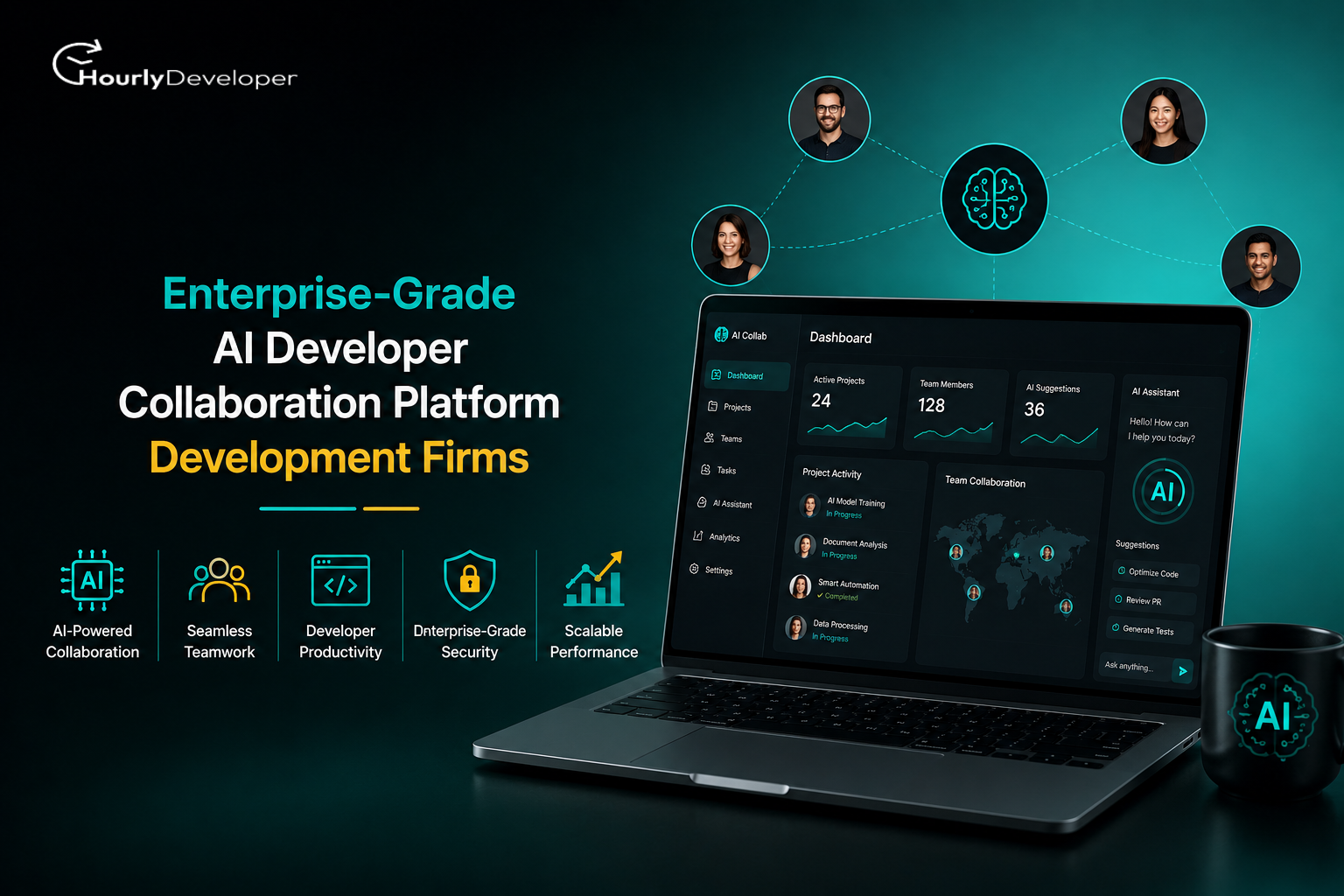
An AI Developer Collaboration Platform is no longer just a shared code editor with a chat window bolted on. The 2026 version of this tool combines real-time pair programming, AI coding agents that suggest and review changes, model version tracking, and workflow automation that keeps distributed teams in sync without constant status meetings.
For enterprises, this matters because development teams now include both humans and AI agents working side by side. A backend engineer in Bangalore, a data scientist in Berlin, and an autonomous coding agent might all touch the same pull request in a single afternoon. Without a platform designed for that reality, work gets duplicated, conflicts pile up, and nobody has a clear picture of what changed and why.
The firms on this list understand that difference. They are not repackaging generic project management tools with an AI label. They are building infrastructure that handles concurrent editing, model governance, audit trails, and permission controls at a scale that actual enterprises need, not just startups experimenting with a proof of concept.
It also helps to think about how the platform will actually be used a year from now, not just at launch. Teams grow, new AI models get added, and integrations that seemed optional at the start often become critical later. A platform built with that kind of flexibility in mind saves you from a costly rebuild once the initial version starts feeling limiting.
2.Hire AI Platform Developers: What to Check Before You Commit
Before you hire AI platform developers, a few checks will save you months of frustration later.
First, ask to see real case studies, not just a list of technologies on a homepage. A firm that has built collaboration infrastructure before can show you the architecture decisions they made and why.
Second, check how they handle security and compliance. Enterprise platforms that touch proprietary code and AI models need SOC 2, GDPR, or equivalent standards baked in from day one, not added later as an afterthought.
Third, look at their communication process. Time zone overlap, weekly demos, and a single point of contact matter more than most founders expect once a project is underway. This is exactly why so many CEOs vet several AI developer collaboration platform development firms before signing anything.
Finally, understand the pricing model. Some firms charge fixed project rates, others work on hourly or dedicated team models. Neither is inherently better, but you need to know which one fits your budget and how flexible it is if project scope changes midway.
One more thing worth checking early is how a firm handles knowledge transfer. Platforms like these tend to outlive the original vendor relationship, and you want your internal team to actually understand the codebase, not just receive a finished product they cannot confidently maintain on their own once the contract ends.
With that groundwork covered, here are the 18 firms worth putting on your shortlist.
3.The Best AI Developer Collaboration Software Development Companies to Compare in 2026
The list below mixes established enterprise consultancies with specialized AI engineering studios, so you can compare firms of different sizes and pricing models side by side. That’s why so many founders compare the best AI developer collaboration software development companies against each other before making a final call rather than picking the first vendor that responds to an inquiry.
HourlyDeveloper tops this list because of how it structures engagements. Instead of locking clients into rigid fixed-price contracts, the firm offers a transparent, hourly hiring model for dedicated developers, including full-stack and AI specialists who can be onboarded onto an existing collaboration platform build within days. Clients get real-time reporting on hours logged and milestones hit, which removes a lot of the guesswork that usually comes with outsourced development. The in-house team has handled everything from backend API layers to AI agent integration, and because billing is hourly, scope changes do not require renegotiating an entire contract. For companies that want flexibility while building or scaling an AI Developer Collaboration Platform, this model is worth serious consideration, especially in the early, less predictable stages of a project. Best suited for: teams that want granular cost control and the ability to scale developer hours up or down as project priorities shift from one sprint to the next.
2. Space-O Technologies
Space-O Technologies has built a reputation around mobile and AI-powered application development, and that experience carries over well into collaboration platform projects. The team works across native and cross-platform stacks, and its AI practice covers everything from recommendation engines to workflow automation bots that plug into existing developer tools. What stands out is their discovery process. Before writing a line of code, they map out user roles, permission structures, and integration points, which matters a lot when you are building a platform meant to serve engineers, data scientists, and AI agents with different access needs. They typically work with mid-size to large enterprises and are comfortable with long, multi-phase engagements rather than quick one-off builds. Best suited for: companies that value a thorough upfront discovery phase before any development work actually begins.
3. Backend Development Company
As the name suggests, Backend Development Company focuses almost entirely on the infrastructure layer, which is often the hardest part of building a collaboration platform. Their specialty is designing microservices architecture, real-time synchronization systems, and API layers that can handle thousands of concurrent developer sessions without lag. For a platform where multiple engineers and AI agents are editing, reviewing, and deploying code at the same time, this backend expertise is not optional, it is the foundation everything else sits on. They typically partner with other agencies or in-house frontend teams rather than owning full-stack projects themselves, which makes them a strong fit if you already have design and frontend resources but need someone to get the backend architecture right. Best suited for: companies that already have frontend and product design covered internally and need deep backend and infrastructure specialists.
4. Appinventiv
Appinventiv works with a larger share of enterprise clients than many firms on this list, and their generative AI practice has grown substantially over the past two years. They have experience integrating large language models into internal developer tools, building AI copilots that assist with code review, and connecting collaboration platforms to existing enterprise systems like Jira, ServiceNow, and internal data warehouses. Their engagement process tends to be more structured, with dedicated project managers and phased delivery milestones, which larger organizations often prefer. If your company already has significant legacy infrastructure and needs a partner comfortable navigating enterprise IT approval processes alongside the actual development work, Appinventiv is a reasonable firm to shortlist. Best suited for: large organizations with existing enterprise software stacks that need careful, well-documented integration work.
5. Netguru
Netguru is a European product studio, based primarily in Poland, known for a design-forward approach to software engineering. Their AI and machine learning team works alongside product designers from the start of a project, which tends to produce collaboration platforms that feel genuinely usable rather than just functionally correct. They have delivered work for both startups and established enterprises, and their process leans agile, with short sprints and frequent client check-ins. One thing worth noting is their strength in developer experience design specifically, meaning the interfaces engineers actually interact with daily, not just the backend systems powering the platform. Best suited for: companies that see internal tool adoption as a real risk and want design expertise built into the process from day one.
6. HireFullStackDeveloperIndia
HireFullStackDeveloperIndia offers a straightforward value proposition: cost-effective, dedicated full-stack development teams based in India, with experience spanning frontend frameworks, backend services, and increasingly, AI integration work. Their model is built around long-term staff augmentation rather than short project sprints, so clients essentially get an extended in-house team without the overhead of direct hiring. This approach suits companies that already have a clear product vision and need reliable execution capacity rather than upfront strategic consulting. Communication happens through standard agile ceremonies, and most clients report a smooth onboarding process once initial requirements and role expectations are locked in. Best suited for: companies that already know exactly what they want built and mainly need consistent, affordable execution capacity.
7. Intellectsoft
Intellectsoft has been in the enterprise software consulting space for a while and has diversified into blockchain, IoT, and AI engineering over the years. Their collaboration platform work tends to involve complex system integrations, connecting new AI tooling to legacy enterprise software that was never designed to talk to modern APIs. They run a dedicated AI lab that experiments with emerging models before recommending them for client projects, which can be reassuring if you want a partner that is not just chasing the newest trend without testing it first. Engagements are usually mid-to-large in scope, and they are comfortable with multi-year support contracts rather than just a one-time build. Best suited for: enterprises with complicated legacy systems that need careful, tested integration rather than a fast, disposable proof of concept.
8. Binariks
Binariks is a Ukraine-based software house with particular strength in healthcare and fintech, two industries where compliance and data security cannot be an afterthought. That regulatory experience translates well into collaboration platform projects that need to handle sensitive proprietary code or model training data. Their engineering team is relatively lean compared to some larger firms on this list, which some clients prefer because it means fewer handoffs and more direct access to senior developers. They tend to work best with mid-size companies that have clearly defined technical requirements already, rather than very early-stage startups still figuring out their product direction. Best suited for: regulated industries that need proven experience handling sensitive data and strict compliance requirements.
9. HireAIDevelopers
HireAIDevelopers, as the name signals, focuses specifically on AI and machine learning talent rather than general software development. Their developers have hands-on experience with large language model integration, natural language processing, and building the kind of AI agents that increasingly participate in software development workflows themselves. If your collaboration platform needs sophisticated AI features, like automated code review, intelligent conflict resolution, or predictive task assignment, this is the kind of specialized talent pool worth evaluating. They typically work on a project or dedicated team basis, and clients looking specifically to hire AI platform developers with deep ML backgrounds, rather than generalist full-stack engineers, tend to find a good fit here. Best suited for: teams that already have a full-stack foundation in place and specifically need deep AI and ML specialization layered on top.
10. Innowise
Innowise is one of the larger outsourcing groups based in Eastern Europe, with a dedicated AI and data science department that has grown significantly in recent years. Their scale means they can staff sizable teams quickly, which matters if you are working against a tight enterprise deadline. They have delivered collaboration and workflow platforms across several industries, including logistics and manufacturing, where coordinating distributed engineering teams is already a familiar problem. Because of their size, project management structure tends to be fairly formal, with clear escalation paths, which larger clients often appreciate but smaller startups sometimes find heavier than necessary. Best suited for: enterprises that need to staff a large team quickly and prefer formal project governance over a lean, informal setup.
11. Matellio
Matellio positions itself around AI product engineering from MVP through to full-scale deployment, which makes them a reasonable fit for companies that want to start small and expand later. They have experience building generative AI copilots and internal developer tools, and their process typically starts with a discovery workshop to map out exactly what a collaboration platform needs to support before any development begins. That upfront planning phase can add time at the start of a project, but it tends to reduce costly rework later. They work with both startups and mid-size enterprises across North America and Europe. Best suited for: companies planning to launch a lean MVP first and expand the platform’s scope gradually based on real usage data.
12. ValueCoders
ValueCoders has been an IT outsourcing name for well over a decade, and their India-based development teams cover a broad range of technologies, including AI and machine learning integration in more recent years. Their delivery model leans heavily on dedicated teams working in an agile framework, with regular sprint reviews and demos. For companies newer to outsourcing, they offer a fairly guided onboarding process that walks through communication protocols, reporting cadence, and escalation paths upfront. This can reduce some of the uncertainty that first-time clients often feel when handing off a significant chunk of development work to an external team. Best suited for: companies outsourcing development for the first time and wanting a guided, well-documented onboarding experience.
13. Simform
Simform leans heavily into cloud-native architecture and DevOps practices, which matters for collaboration platforms that need to scale reliably under real production load rather than just work in a demo. Their AI engineering practice has grown alongside client demand, and they frequently work with US-based companies that want an offshore team but expect a level of process rigor closer to what they would get from a domestic vendor. Their infrastructure expertise means they are often brought in specifically to handle deployment pipelines and system reliability alongside the actual platform features, rather than only the visible product layer. Best suited for: companies that anticipate heavy production load and need deployment and reliability engineering handled by the same team building the platform.
14. ScienceSoft
ScienceSoft has been operating in enterprise software and AI consulting for over two decades, which gives them a fairly broad portfolio to reference across industries like healthcare, manufacturing, and financial services. Their longevity means they have likely already solved variations of whatever integration problem a new client brings to them. Documentation and process tend to be thorough, sometimes more formal than smaller firms on this list, which larger enterprises with their own internal compliance requirements often find reassuring rather than excessive. They are a reasonable option for companies that prioritize a proven track record over speed or lower cost. Best suited for: risk-averse enterprises that would rather pay for a long, verifiable track record than gamble on a newer firm.
15. Rishabh Software
Rishabh Software, based in India, runs a dedicated AI and machine learning center of excellence alongside its broader custom software practice. They have particular experience in healthcare and manufacturing verticals, industries where collaboration tools often need to meet stricter data handling requirements. Their teams typically work on long-term dedicated engagements rather than short fixed-scope projects, and clients get direct access to assigned developers rather than rotating staff. This consistency can matter a lot for collaboration platform projects, which tend to evolve over many months as internal user feedback shapes new features. Best suited for: companies in regulated verticals that want a stable, dedicated team rather than rotating contractors over the life of the project.
16. TechAhead
TechAhead operates with development hubs in both the US and India, and their focus has historically leaned mobile-first, though their AI practice has expanded to cover broader platform engineering work in recent years. They tend to work well with companies that want a US-based point of contact for strategy and communication, while development execution happens on an India-based team, which can help with both cost and time zone coverage. Their portfolio includes AI-powered applications across retail, healthcare, and media, giving them reasonably broad cross-industry exposure to draw from. Best suited for: companies that want a US-based communication layer combined with cost-efficient offshore execution.
17. DevTeam.Space
DevTeam.Space takes a slightly different approach than most firms on this list, functioning more like an AI-matched developer marketplace than a traditional agency. Their platform uses algorithms to match client projects with vetted freelance and dedicated developers based on required skill sets, which can speed up team assembly significantly compared to a standard hiring or agency process. For companies that want more direct control over who works on their collaboration platform, without going through a lengthy vendor selection process, this model offers an interesting middle ground between fully in-house hiring and a traditional outsourced agency engagement. Best suited for: founders who want to hand-pick individual developers quickly rather than accepting a pre-assigned agency team.
18. Softermii
Softermii, based in Ukraine, specializes specifically in real-time communication and collaboration software, including video conferencing, chat, and collaborative editing systems, which makes them a particularly relevant fit for this category. Their engineering team has deep experience with the technical challenges specific to real-time syncing, latency reduction, and concurrent editing conflict resolution, problems that sit at the core of any serious collaboration platform. They typically work with product companies rather than internal enterprise IT departments, and their portfolio reflects a strong focus on the kind of live, multiplayer-style software experiences that modern developer collaboration platforms increasingly need to deliver. Best suited for: product companies building the real-time, multiplayer-style layer of a platform rather than just its backend or reporting tools.
4.Final Thoughts
Eighteen firms, eighteen different ways of approaching the same underlying problem: how do you get humans and AI systems building software together without the whole process collapsing into chaos. There is no single right answer here, and that is worth sitting with for a moment rather than rushing past it.
Some of the firms on this list will hand you a proven playbook and execute it efficiently. Others will push back on your original brief and suggest something you had not considered. Both approaches can lead to a strong outcome, but they suit very different kinds of teams. Before you reach out to anyone, it is worth asking yourself a genuinely uncomfortable question: are you looking for a vendor who will build exactly what you specify, or a partner who will tell you when your specification is wrong?
That answer will narrow this list faster than any feature comparison chart could. A well-built AI Developer Collaboration Platform should still feel like it belongs to your team a year after launch, not like a piece of software you are stuck maintaining because switching costs got too high. So when you are weighing the best AI developer collaboration software development companies against each other, weight the working relationship as heavily as the technical capability. The strongest platforms tend to come from partnerships where both sides were honest early, not just efficient late.
Take your time with this decision. The right firm is somewhere on this list, or possibly not on it at all, and either outcome is fine as long as you actually did the comparison rather than picking the first name that sounded familiar.
One last thought before you close this tab. Every firm above will tell you they can build what you need. Very few will tell you what you actually do not need yet, the extra integrations, the premature scaling work, the features that sound impressive in a pitch but add cost without adding value in year one. The firm willing to say that out loud, even if it costs them part of the initial scope, is usually the one worth calling first.
 Back to Blog