How Much Does It Cost to Hire AI-Powered Full Stack Developers?
Introduction
How Much Does It Cost to Hire AI-Powered Full Stack Developers?
1.What Makes an AI-Powered Full Stack Developer Different?
Before we get into numbers, it is worth understanding what separates a regular full stack developer from an AI-powered one. This is a distinction that directly affects the cost to hire full stack developers and the value they bring.
A traditional full stack developer handles both front-end and back-end development. They write code for what users see and what runs behind the scenes. An AI-powered full stack developer does all of that, and also integrates artificial intelligence capabilities into the product itself, uses AI developer tools to accelerate their own workflow, and often has hands-on experience with machine learning APIs, large language models, and intelligent automation systems.
When you hire AI developers at this level, you are not just getting someone who builds features. You are getting someone who can embed smarter behavior directly into your product, whether that means a recommendation engine, a conversational interface, automated workflows, or predictive analytics baked into the user experience.
That expanded skill set is one of the core reasons the full stack development cost for AI-integrated talent sits noticeably higher than traditional profiles.
2.AI-Powered Full Stack Developer Hourly Rates in 2026
These are not just developer rates. They reflect AI specialization on top of full stack expertise. The average cost of hiring AI-powered developers is typically 20 to 40 percent higher than a comparable non-AI developer at the same experience level.
Full stack developers hourly rates in the US market specifically have climbed compared to 2024, largely driven by the steep demand for AI integration skills and the relative shortage of developers who can genuinely deliver on both counts. This is not hype. This is the market moving in real time.
3.Hiring Models and How They Change the Full Stack Development Cost
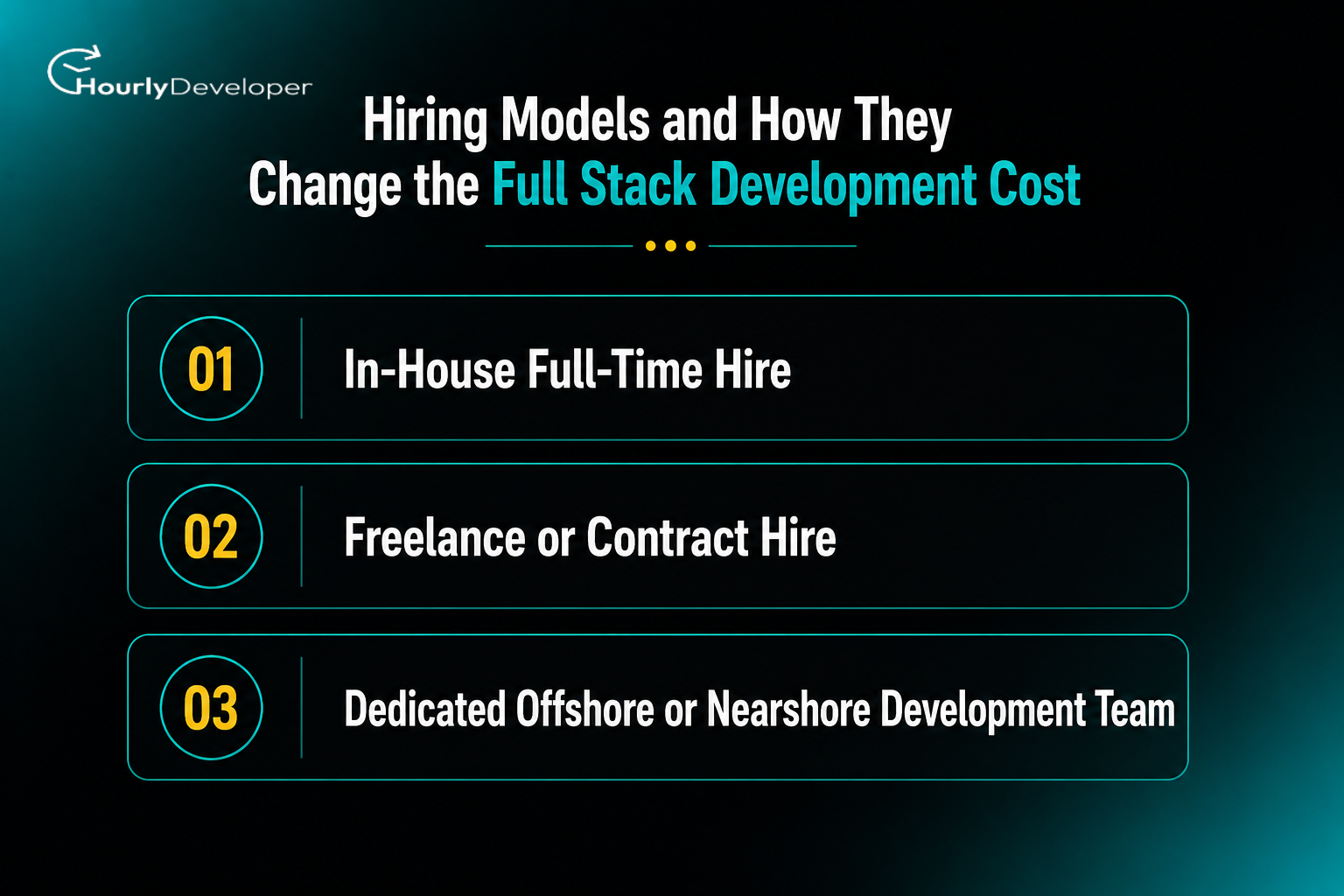
When you decide to hire full stack developers, the model you choose shapes your total spend more than the hourly rate alone. There are three primary ways businesses hire in 2026.
1. In-House Full-Time Hire
Bringing an AI-powered full stack developer on payroll in the US means you are looking at a total annual cost between $140,000 and $280,000 when you factor in salary, benefits, employer taxes, equipment, onboarding time, and ongoing training. Senior artificial intelligence developers with cross-domain expertise often command packages at or above the upper end of that range.
The upside is continuity, institutional knowledge, and alignment. The downside is time to hire (often three to five months in a competitive market) and the full burden of employment overhead.
2. Freelance or Contract Hire
Freelance AI-powered full stack developer hourly rates typically fall in the $50 to $180 range depending on experience and platform. Platforms like Toptal, Arc.dev, and Upwork serve as the main hiring pipelines here.
This model is excellent for well-scoped projects with defined deliverables. It becomes challenging when projects evolve frequently, require close collaboration, or demand confidentiality and IP protection at a higher level.
3. Dedicated Offshore or Nearshore Development Team
This is where the real cost optimization happens for many growing companies. Hiring AI developers through an established offshore partner lets you access senior-level talent at 40 to 60 percent lower rates than local markets, without sacrificing quality. A dedicated team based in India or Eastern Europe can deliver full stack development at a monthly retainer of $8,000 to $22,000 for a small team of two to four developers.
The key is choosing a partner that specializes in AI-powered builds, not just outsourced coding. That distinction determines whether you get a production-ready intelligent product or just a code dump to maintain.
4.What Actually Drives the Cost to Hire Full Stack Developers in 2026
Most cost guides give you a table and call it a day. But the table only tells you where the number starts. Here is what actually pushes that number up or brings it down.
AI Depth and Specialization
There is a meaningful gap between a developer who has used an OpenAI API once and one who can architect a multi-modal AI pipeline from scratch. The more specialized the AI skills required, specifically around fine-tuning models, building RAG systems, or integrating real-time inference engines, the more you will pay. Expect a 25 to 40 percent premium for genuinely senior artificial intelligence developers compared to generalist full stack talent.
Tech Stack Complexity
A developer working with React, Node.js, and a standard cloud setup costs less to hire than one who also needs to manage vector databases, LLM orchestration frameworks like LangChain or LlamaIndex, and real-time streaming infrastructure. Each layer of technical complexity adds to the full stack development cost.
Project Type: Greenfield vs. Legacy
Building a new product from the ground up is generally more predictable in cost. Adding AI capabilities to an existing legacy system is significantly more expensive because developers spend substantial time understanding, refactoring, and stabilizing code before they can build anything new on top of it. If you are in this situation, budget for a discovery and architecture phase before any active development begins.
Availability and Demand Pressure
The demand for developers who can genuinely build AI-first products has outpaced supply since 2024. In 2026, that gap has not fully closed, especially for senior AI developers with proven production experience. If you are hiring urgently or looking for a very specific skill combination, expect that timeline pressure to translate directly into cost pressure.
Data Privacy and Compliance Requirements
If your product handles sensitive user data and your AI systems interact with that data, you need developers who understand GDPR, HIPAA, or sector-specific compliance requirements. This kind of expertise adds a meaningful cost premium but also protects you from risks that could cost far more down the line.
5.Hidden Costs Most Businesses Overlook
When leaders look at the full stack developer cost, they typically focus on the headline rate. But the real cost of building with AI-powered talent includes several line items that rarely make it into a hiring estimate.
AI infrastructure costs: Usage fees for models via APIs from OpenAI, Anthropic, or Google can add $500 to $5,000 or more per month depending on scale. This is a direct operating cost that grows with your user base.
Vector database and storage: Semantic search and memory systems for AI apps require dedicated infrastructure. Costs here vary but should be factored into your full stack development cost 2026 planning.
Prompt engineering and iteration time: Getting AI features to behave reliably in production takes more testing and refinement than traditional feature development. Plan for this in your sprint estimates.
Monitoring and evaluation tooling: AI systems need ongoing oversight. Logging, evaluation pipelines, and drift detection tools are new cost centers that did not exist in traditional full stack projects.
Ramp-up time: Even a great developer needs two to four weeks to get productive on an existing codebase. If you hire AI developers repeatedly without retaining them, this cost compounds quietly.
6.Full Stack Development Cost 2026: Sample Project Budgets
To make this tangible, here is how the numbers look across different project types when you hire AI-powered full stack developers.
Project Type
Timeline
Team Size
Estimated Cost
AI-powered MVP (SaaS)
2 to 4 months
2 developers
$18,000 to $55,000
Enterprise AI feature addition
3 to 6 months
3 to 5 developers
$60,000 to $180,000
Full AI-native web platform
6 to 12 months
4 to 8 developers
$150,000 to $500,000+
AI chatbot or assistant integration
4 to 8 weeks
1 to 2 developers
$8,000 to $30,000
Data pipeline with AI analytics layer
2 to 3 months
2 to 3 developers
$25,000 to $75,000
These figures assume a mix of offshore and nearshore talent on dedicated engagement models. US-only teams will push these numbers significantly higher, sometimes by a factor of two or more.
7.How to Hire AI Developers Without Overpaying or Underinvesting
There is a real risk on both ends of this hiring decision. Overpaying for a developer whose AI skills are more buzzword than substance is a common trap. So is underpaying for a generalist developer who cannot actually integrate AI into a production environment.
Here is how to find the right balance when you hire AI-powered full stack developers.
Ask for deployed AI work, not just code samples.
Anyone can write a demo. Ask candidates or agencies to show you something that is actually running in production, handling real users, and managing edge cases. The difference between prototype experience and production experience in AI is enormous.
Test their AI product thinking, not just technical skill.
The best AI-powered full stack developers think about user outcomes, not just model outputs. In your screening process, give them a product scenario and ask them how they would design an AI feature for it. Watch whether they think about fallback behavior, model reliability, latency, and cost alongside functionality.
Define scope clearly before pricing anything.
AI-powered full stack developer hourly rates in 2026 can be misleading if you do not know exactly what you are scoping. A vague “build me an AI product” conversation will result in a vague estimate. Force clarity on architecture, integrations, data flows, and success metrics before any number is put on paper.
Do not skip the architecture phase.
For any project involving AI at the infrastructure level, budget for a discovery and architecture sprint before development starts. This is typically a two to four week engagement that costs $3,000 to $12,000 but saves multiples of that in rework and missteps later.
8.Choosing Between a Freelancer, an Agency, and a Dedicated Team
This is the decision that most impacts your actual experience and outcome, not just your budget.
A freelance artificial intelligence developer is the right choice when you have a clearly scoped, time-limited piece of work that does not require deep product context. They offer flexibility and are often faster to hire.
A development agency is best when you want a team with predefined processes, project management included, and accountability at the organizational level. Agency rates are higher per hour but often come with built-in quality controls.
A dedicated offshore team hits the sweet spot for companies that need consistent, ongoing development without the overhead of full-time employment. When you hire full stack developers on a dedicated model, they become functionally part of your team over time, learning your codebase, your users, and your product direction. The average cost of hiring AI-powered developers on this model runs 35 to 55 percent lower than comparable in-house talent.
AI coding tools have raised the baseline productivity of every developer on the market. A skilled AI-powered full stack developer using tools like Cursor, GitHub Copilot, or Claude for development is genuinely two to three times more productive than a developer from three years ago doing the same work without these tools. This is one reason why a single well-chosen developer can now do the work of what used to require two or three people.
At the same time, demand has intensified. Nearly every funded startup and digitally active enterprise is now competing for the same narrow pool of developers who can build AI features at a production level. This supply-demand tension is keeping rates elevated even as AI tools increase individual output.
The companies winning this hiring market are not necessarily paying the most. They are the ones with clear product visions, well-organized codebases, and structured hiring processes that allow talented developers to evaluate them as employers just as critically as they are being evaluated.
10.Final Thoughts: Spend Smart, Not Just Spend More
If there is one thing to take away from everything above, it is this: the full stack developer cost conversation has permanently changed. You are no longer just paying for code. You are paying for intelligence embedded directly into your product.
The founders and executives who approach this decision strategically, who define their scope clearly, choose the right engagement model, and evaluate talent on production depth rather than portfolio aesthetics, consistently get more for their investment than those who simply chase the lowest rate or the most impressive agency deck.
The opportunity to hire AI-powered full stack developers who can meaningfully accelerate your product roadmap is very real in 2026. The question is not whether you can afford to do it. The question is whether you can afford to keep building without that capability.
Start with clarity on what you are actually building, what AI capabilities it needs, and what timeline you are working toward. Everything else, including the budget, falls into place from there.
With a love for connecting with people and a flair for communication, Prachi's expertise in digital marketing is unmatched. Her strategic approach to campaigns ensures our brand's story reaches far and wide, making an impact on the lives of countless individuals.
Frequently Asked Questions
In most cases, yes. An AI-powered full stack developer can ship features that would otherwise require a separate data science or ML team. If your product roadmap includes any intelligent features, personalization, automation, or predictive capabilities, the additional cost typically pays for itself within the first few months of the product being live.
Ask them to walk you through a live AI system they have built and deployed. Genuine AI developers will discuss model selection trade-offs, latency challenges, failure modes, and cost-per-inference decisions. If someone can only talk about what a model does rather than how they managed it in a real environment, that is a strong signal their experience is mostly theoretical.
For a tightly scoped MVP, yes. In 2026, a senior AI-powered full stack developer using modern tooling can build, test, and ship a working product version faster than a small team could have in 2021. That said, sustained scaling beyond the MVP stage typically requires at least two developers to manage code quality, review cycles, and parallel work streams.
Underestimating the ongoing infrastructure and API costs. Many teams budget carefully for developer time and completely miss that their AI features will generate recurring cloud and model usage costs from day one. These costs scale with usage, so they should be built into your financial model from the start, not discovered after the product launches.
Enterprises retrofitting AI into legacy systems typically pay 30 to 60 percent more per equivalent feature compared to greenfield builds. The extra cost comes from discovery work, integration complexity, and often the need for additional cleanup of technical debt before AI layers can be safely added. This is not a reason to delay, but it must be priced in correctly from the start.
Find exceptional developers at Hourlydeveloper. Get the expertise, solutions, and teamwork you need for success. Hire developers easily and boost your projects today!
 Back to Blog