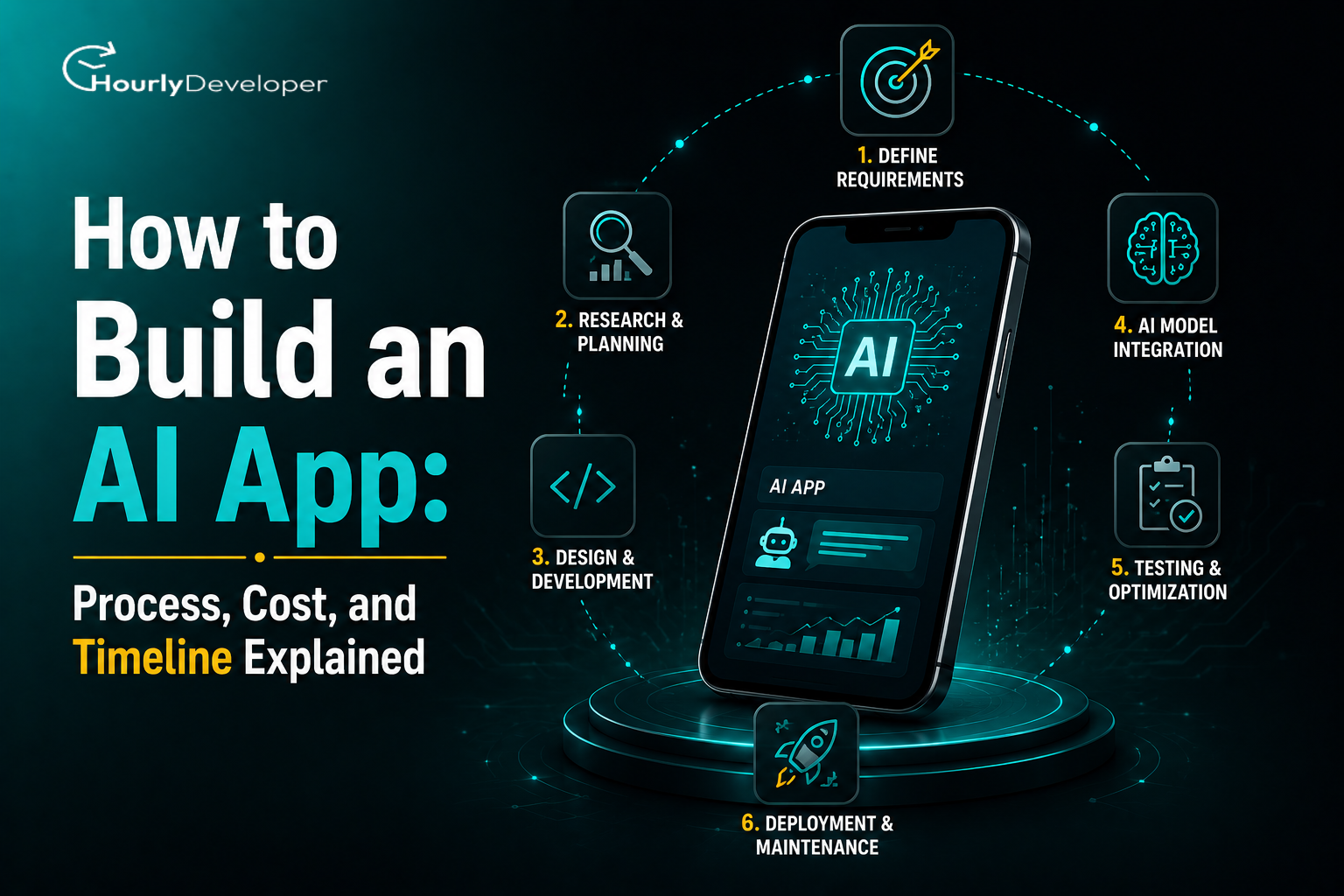
How to Build an AI App: Process, Cost, and Timeline Explained
Introduction
How to Build an AI App: Process, Cost, and Timeline Explained
1.What Qualifies as an AI App in 2026
You need to understand what you are actually building. The term AI app gets used loosely. A chatbot powered by a pre-built API is an AI-integrated app. A system that trains on your proprietary data to make predictions is a Machine Learning application development project. The two are not the same budget or the same team.
In 2026, AI apps typically fall into one of these categories:
Generative AI apps that create text, images, code, or audio based on user input
Predictive AI apps that analyze patterns and forecast outcomes, such as churn prediction or demand forecasting
Recommendation engines that personalize content or product suggestions based on behavior
Computer vision apps that process images or video for detection, classification, or analysis
Conversational AI systems that go beyond static chatbots to handle dynamic, context-aware interactions
Autonomous agent apps where AI takes multi-step actions with minimal human oversight
Each category has different infrastructure requirements, different model complexity, and different AI app development cost profiles. Knowing which one you are building is the first real decision of the project.
2.The AI App Development Process: Phase by Phase
There is a temptation to treat AI development like standard software development with an extra step at the end. In reality, the AI components shape every phase of the process, not just the model training phase.
Phase 1: Discovery and Problem Definition
Before a single line of code is written, the most important question is whether AI is actually the right tool for the problem. A good AI App Development Company will spend meaningful time on this. The discovery phase covers what data you have, what data you need, what the model needs to predict or generate, how success will be measured, and what happens when the model is wrong.
The last point is often skipped and almost always creates problems later. Every AI system produces incorrect outputs sometimes. Defining acceptable error rates and fallback behaviors at the start saves enormous rework down the line.
Typical duration: 2 to 4 weeks.
Phase 2: Data Strategy and Infrastructure
This is the phase that most project cost estimates undercount. AI software development runs on data, and getting that data into a clean, structured, labeled, and accessible state is frequently the most time-consuming and expensive part of the entire build.
If you are building on proprietary data, plan for a dedicated data engineering track that runs parallel to model development. If you are relying on third-party datasets or public models, you still need pipelines, storage, and governance structures that can support production scale.
Python AI development dominates this phase. Python’s ecosystem, including libraries like Pandas, NumPy, and TensorFlow, makes it the de facto standard for data manipulation and model development in 2026.
Typical duration: 3 to 8 weeks, often overlapping with design and backend work.
Phase 3: Model Development and Training
This is the core of any Machine Learning application development project. Depending on your use case, you might be fine-tuning an existing foundation model, training a custom model from scratch, or building an ensemble system that combines multiple models.
Fine-tuning a large language model for a domain-specific use case is faster and cheaper than custom training. But custom training gives you ownership of the model weights, tighter performance control, and no dependency on a third-party provider’s pricing or availability. In 2026, most mid-market AI apps choose fine-tuning with a hybrid architecture that falls somewhere between full customization and pure API dependency.
Model performance is measured iteratively. You will run experiments, adjust hyperparameters, retrain on cleaned data, and test again. Budget for this loop. It is not a sign that something has gone wrong. It is simply how this work functions.
Phase 4: Backend, APIs, and System Architecture
Once the model is functional, it needs to live inside a system. The backend handles data flow, user authentication, business logic, and the connections between your AI models and the rest of your product.
AI web application development adds specific complexity here. AI models, particularly large ones, have real-time inference requirements, meaning they need to return results fast enough to feel responsive. Managing model serving, load balancing, caching, and latency at scale is a backend engineering challenge that sits entirely separate from the model itself.
This is also where third-party integrations typically live: payment processors, communication tools, analytics platforms, and external data sources. Each integration adds scope, cost, and potential failure points.
Phase 5: Frontend and User Experience
AI mobile app development and web interfaces have a unique UX challenge that standard product design does not fully address: how do you design for non-deterministic outputs? When your app shows a user AI-generated content, a prediction, or a recommendation, the interface needs to communicate confidence, context, and recourse.
The best AI user experiences in 2026 are not just surfaces on top of models. They are designed to set expectations, explain outputs, and give users meaningful control. Teams that invest here see materially better user retention, not because the AI is better but because users understand and trust what it is showing them.
Phase 6: Testing, Validation, and Safety
AI testing is a different discipline from standard software QA. In addition to functional testing, you need model accuracy testing, bias and fairness audits, adversarial testing to probe for unexpected outputs, and performance benchmarking under production conditions.
For apps operating in regulated industries or handling sensitive data, this phase also involves compliance review. GDPR, HIPAA, and emerging AI-specific regulations in the EU and US are increasingly part of the launch checklist, not an afterthought.
Phase 7: Deployment and Monitoring
Launch is not the end of the project. It is the beginning of a new operational layer. AI apps require ongoing monitoring for model drift, which is the gradual degradation of model performance as real-world data shifts away from training data. A model that performs well at launch can underperform significantly three months later with no changes to the underlying code.
Monitoring infrastructure, retraining pipelines, and alerting systems are not optional additions. They are structural requirements for any AI app that needs to stay accurate over time.
3.AI App Development Cost: What You Are Actually Paying For
The question of how much does it cost to build an AI app in 2026 does not have a single answer, but it does have a framework. Cost is driven by three factors: the complexity of the AI components, the scale of the engineering required to support them, and the team structure you use to build it.
Here is a realistic breakdown of where budget goes across the major development phases:
Development Phase
Simple App
Mid-Complexity
Complex AI App
Discovery & Planning
$2,000 – $5,000
$5,000 – $12,000
$12,000 – $30,000
UI/UX Design
$3,000 – $7,000
$7,000 – $20,000
$20,000 – $50,000
AI Model Development
$8,000 – $20,000
$20,000 – $60,000
$60,000 – $200,000+
Backend & API Integration
$5,000 – $12,000
$12,000 – $35,000
$35,000 – $80,000
Frontend Development
$5,000 – $10,000
$10,000 – $30,000
$30,000 – $70,000
Testing & QA
$2,000 – $5,000
$5,000 – $15,000
$15,000 – $40,000
Deployment & DevOps
$1,500 – $4,000
$4,000 – $10,000
$10,000 – $30,000
4.The Hidden Costs That Inflate Budgets
Beyond development, there are cost categories that regularly catch founders off guard:
Data labeling and annotation: If your model needs labeled training data that does not yet exist, human labeling services can cost anywhere from $0.05 to $5 per data point depending on complexity. A custom computer vision model might need tens of thousands of labeled images.
Foundation model licensing: If you are building on top of commercial models, API costs at production scale can become a significant line item. A high-traffic app making hundreds of thousands of model calls per day can see monthly API bills that rival engineering salaries.
GPU infrastructure: Training and inference for large models requires GPU compute. Cloud GPU costs in 2026 remain high, particularly for training runs on large datasets.
Compliance and legal: For fintech, healthtech, or any app storing personal data, compliance work adds 10 to 20 percent to total project cost and is non-negotiable.
5.Team Location and Its Real Impact on Cost
Hiring patterns matter significantly to AI app development cost. A senior AI engineer in North America or Western Europe commands between $150 and $250 per hour. The same caliber of talent from Eastern Europe, India, or Southeast Asia typically bills at $40 to $80 per hour, with some specialized AI teams in Vietnam and Poland delivering exceptional work at $50 to $90 per hour.
This is not simply an arbitrage play. Offshore and nearshore teams that work well do so because of strong project management, clear communication protocols, and technical leadership, not just lower rates. The companies that save money hiring offshore are the ones that invest in structure. The ones that do not save money are the ones that treat it as a cost-cutting exercise with no other adjustments to how the project runs.
6.AI App Development Timeline: Realistic Expectations
Timeline is where expectations tend to diverge most sharply from reality. Most simple AI apps, using pre-built models and standard integrations, can ship in three to five months. Mid-complexity apps with custom-trained models typically take six to nine months. Enterprise-grade AI platforms with proprietary data pipelines, regulatory requirements, and multi-model architectures can take twelve to eighteen months for a production-ready v1.
Timeline is where expectations tend to diverge most sharply from reality. Most simple AI apps, using pre-built models and standard integrations, can ship in three to five months. Mid-complexity apps with custom-trained models typically take six to nine months. Enterprise-grade AI platforms with proprietary data pipelines, regulatory requirements, and multi-model architectures can take twelve to eighteen months for a production-ready v1.
Phase
Duration
Key Deliverable
Discovery & Architecture
2 – 4 weeks
Project blueprint, tech stack selection, data strategy
UI/UX Design
3 – 5 weeks
Wireframes, design system, clickable prototype
AI Model Building
4 – 12 weeks
Trained models, accuracy benchmarks, API endpoints
Backend Development
4 – 10 weeks
Core logic, integrations, cloud infrastructure
Frontend Development
4 – 8 weeks
Web or mobile interface, connected to backend
Testing & Iteration
3 – 6 weeks
Bug-free build, performance baselines, model validation
Launch & Monitoring Setup
1 – 3 weeks
Live deployment, dashboards, alerting systems
One important note on these timelines: the ranges assume a reasonably well-scoped project and an available, competent team. Unclear requirements, slow stakeholder feedback cycles, and data access delays are the three most common causes of timeline overruns in AI projects, and all three are on the client side.
7.Cost to Maintain an App in 2026: The Ongoing Investment
An AI app is not a one-time build cost. The cost to maintain an app in 2026, particularly an AI-powered one, involves an entirely different set of ongoing expenses that need to be factored into your business case before you write the first check.
Cost Item
Estimated Monthly Range
Notes
Cloud Infrastructure (AWS, GCP, Azure)
$200 – $3,000+
Scales with traffic and model serving load
AI Model Retraining
$500 – $5,000/quarter
Depends on data volume and frequency
Security & Compliance Audits
$300 – $2,000
Critical for apps handling personal data
Bug Fixes & Feature Updates
$1,000 – $8,000
Ongoing developer engagement required
Third-Party API Costs
$100 – $2,000+
OpenAI, payment gateways, maps, etc.
Monitoring & DevOps Tools
$100 – $800
Datadog, New Relic, or equivalent stack
A reasonable planning assumption is that annual maintenance will run between 20 and 35 percent of your initial development cost. For a $200,000 build, that is $40,000 to $70,000 per year in ongoing operational investment. The lower end of that range applies if the app is stable and traffic is modest. The higher end applies to apps that are actively growing, iterating on features, or operating in regulated environments.
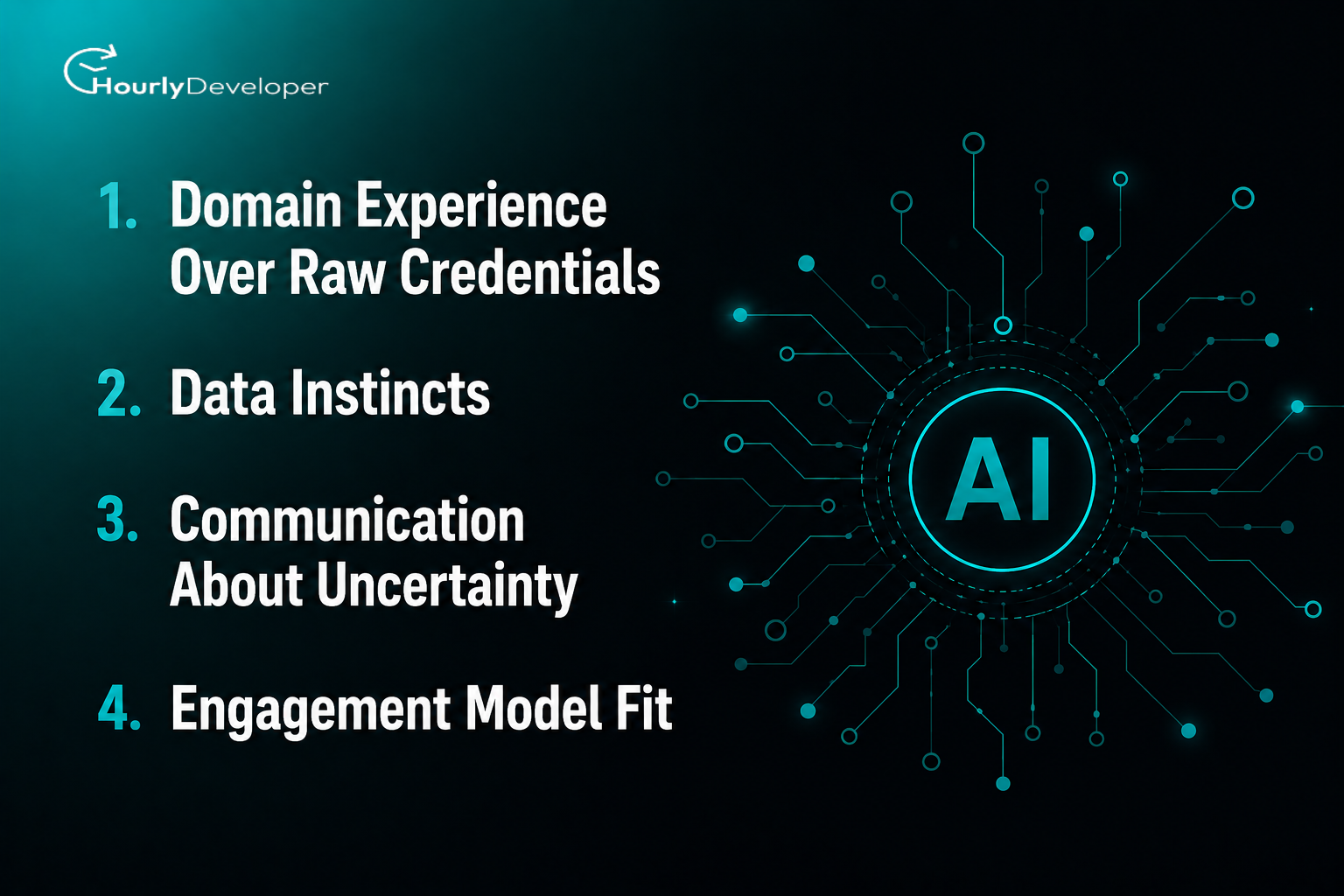
8.How to Hire AI Developers: What Matters Beyond the Resume
When you set out to hire AI developers, the evaluation criteria that matter in AI are different from standard software hiring. Technical skill is necessary but not sufficient. Here is what actually separates strong AI hires from expensive mistakes.
Domain Experience Over Raw Credentials
A developer who has built fraud detection systems for fintech has knowledge that a generalist AI engineer does not, even if both have the same degree or framework familiarity. In AI, domain context shapes modeling decisions in ways that are hard to teach on the job. Prioritize teams that have shipped in your vertical over teams that simply have an impressive portfolio of unrelated work.
Data Instincts
The best AI engineers are as comfortable in data pipelines as they are in model code. They ask about data quality before they ask about model architecture. They push back on optimistic data availability assumptions. They have an instinct for where training data will be insufficient or biased that comes from having been burned before.
Communication About Uncertainty
AI projects involve more uncertainty than standard software projects. A good AI development partner will communicate that uncertainty proactively, give you honest probability ranges, and surface risks before they become expensive problems. Be wary of teams that give you high confidence estimates early in discovery. They are either overconfident or they are telling you what they think you want to hear.
Engagement Model Fit
Whether you choose a dedicated AI App Development Company, a boutique specialist, or a hybrid team with freelance components depends on your project scale, your internal capabilities, and how much ongoing engagement you expect post-launch. Companies planning multiple AI products over time often benefit from a retained team structure. One-off builds are usually better served by fixed-scope engagements with clearly defined handoff deliverables.
9.What Separates AI Apps That Succeed From Those That Stall
Artificial Intelligence app development has a well-documented success pattern, and it has an equally well-documented failure pattern. After building and advising on AI products across industries, certain patterns repeat on both sides of the outcome spectrum.
The apps that succeed tend to start with a narrowly defined use case, almost frustratingly narrow, and expand from there. They invest in data infrastructure early, even when it feels boring compared to model work. They have product owners who understand enough about AI to have honest conversations with the technical team rather than just reviewing outputs. And they plan for iteration as a structural part of the product, not an admission of initial failure.
The apps that stall tend to scope too broadly from the start, treating AI as a feature set rather than a capability that needs to be earned. They underestimate data complexity. They confuse a successful demo with a production-ready system. And they set user expectations based on the demo rather than on realistic production performance.
These are not technology failures. They are planning and expectation failures that happen to occur in a technology context.
10.Choosing the Right AI App Development Company
The AI vendor market in 2026 is crowded, and the noise-to-signal ratio is high. A few things help cut through it.
Ask for case studies that show what happened after launch, not just what was built. Production performance, scale behavior, and maintenance reality are where the actual quality of a build shows up. Pre-launch demos are relatively easy to make impressive.
Understand how they handle model failure. Every AI model produces wrong outputs. How the team has handled that in past projects tells you more about their engineering maturity than any list of frameworks they know.
Evaluate their data engineering depth. Many AI shops are strong on model work but thin on data infrastructure. If your project involves complex data pipelines, that gap will cost you. Ask specifically how they have handled data quality, labeling, and pipeline scalability in prior work.
Finally, think about the team you will work with day to day, not just the team that pitches you. Ask who the actual engineers on the project will be. Ask how they structure client communication. The quality of the relationship and the clarity of communication determines outcomes as much as technical skill.
11.Conclusion
The Window Is Open. The Margin for Vague Plans Is Not.
Worldwide AI spending is projected to hit $2.52 trillion in 2026, a 44 percent increase over 2025. That number is not abstract. It represents the total sum of decisions being made by companies exactly like yours, every day, about where to invest and how fast to move.
Forty percent of enterprise applications will be integrated with task-specific AI agents by the end of 2026, up from less than five percent in 2025. That is not a gradual shift. That is an industry repricing what a competitive software product looks like, in real time.
The decision in front of you is not whether AI belongs in your product roadmap. That question already has an answer. The decision is whether you build with enough clarity and the right partners to be in the forty percent that ships something real, or the majority that spends the budget and extends the timeline without ever reaching production scale.
The companies that get this right in 2026 will not all have had the largest budgets. They will have had the clearest problem definition, the most honest conversations with their development partners, and the discipline to start narrow and expand from a working foundation.
That is not a technology advantage. It is a planning advantage. And it is entirely available to you right now.
Nikhil Patel, our dynamic Director, charts our course with innovative fervor and strategic acumen. With a sharp eye for opportunity, he steers our company's ascent with resolute determination. Nikhil's empathetic leadership unites us, igniting a collective drive for greatness and propelling us toward boundless success.
Frequently Asked Questions
Yes, but with trade-offs. You can use publicly available datasets, synthetic data, or fine-tune a foundation model with minimal data. The caveat is that apps built without proprietary data often lack a durable competitive advantage. If competitors can access the same datasets, your AI outputs will increasingly converge with theirs over time. Unique data is a long-term moat.
Freelancers offer flexibility and lower rates, but they typically cover one function, such as modeling or backend, not the full stack. AI app development requires coordinated expertise across data engineering, modeling, backend, and frontend. A company provides structured accountability, team redundancy, and end-to-end delivery. For anything beyond a simple proof of concept, a team structure usually de-risks the build more than a solo hire.
Model drift occurs when real-world data shifts away from the distribution the model was trained on. A recommendation engine trained on 2024 behavior may perform noticeably worse by late 2025 without retraining. Budget for quarterly model reviews and at least one to two retraining cycles per year. Costs vary from a few thousand dollars for small models to $20,000 or more for large-scale retraining runs.
The EU AI Act came into full enforcement in 2026, classifying AI systems by risk level and imposing compliance obligations accordingly. High-risk applications in healthcare, hiring, credit scoring, and critical infrastructure face significant documentation, transparency, and human oversight requirements. US-based builders should also monitor FTC guidance on AI-generated content and emerging state-level AI laws in states like California and Colorado.
Yes, if the scope is right. Apps that use existing foundation models via API, require no custom training, and focus on a single well-defined use case can be built within that range. The constraint is not ambition but architectural choice. Apps using pre-built AI services through providers like OpenAI, Google, or AWS avoid the bulk of model development cost and can reach market significantly faster and cheaper.
Find exceptional developers at Hourlydeveloper. Get the expertise, solutions, and teamwork you need for success. Hire developers easily and boost your projects today!
 Back to Blog