3.The List: 18 Companies Worth Shortlisting in 2026
Here is where we get to the part you actually came for. Below are the top AI university ERP software development companies and specialist teams currently active in this space, gathered from client reviews, portfolio depth, and how well each one seems to actually understand campus operations rather than just generic business software. They are listed in a mixed order on purpose, not ranked strictly first to last, so read through the details rather than just picking the first name.
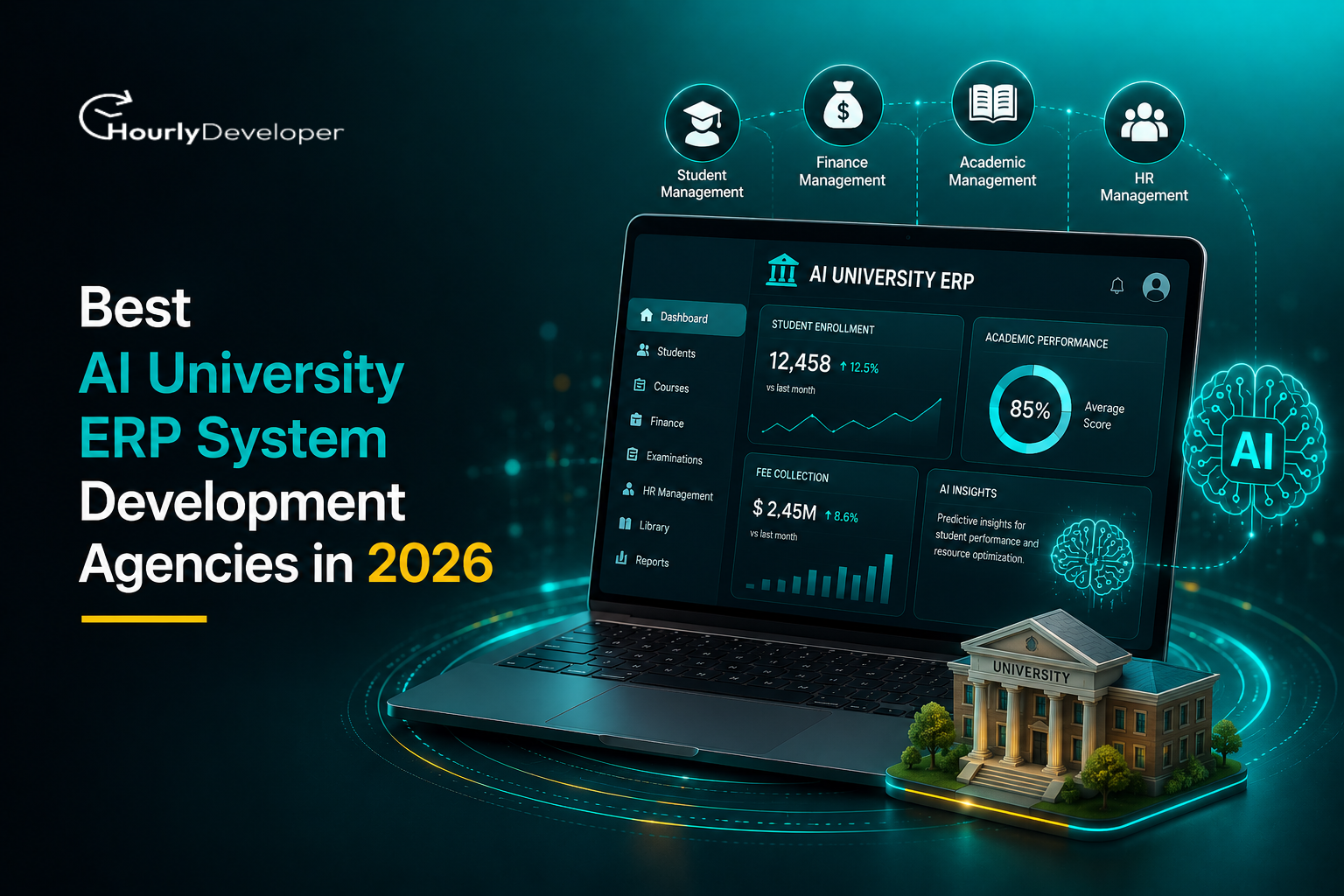
1. HourlyDeveloper
HourlyDeveloper.io is a developer hiring platform connecting businesses with machine learning and AI developers for flexible, short-term and ongoing projects. Its developer network covers deep learning, NLP, computer vision, and machine learning solutions.
Key services include:
• Machine Learning Developer Hiring.
• AI Developer Hiring.
• Dedicated ML Team Assembly.
• Deep Learning Development.
• NLP & Computer Vision Solutions.
• AI Model Development.
• Technical Skills Assessment.
• Flexible Developer Hiring.
Technology expertise: React, Node.js, JavaScript, PHP, Laravel, WordPress, Shopify, and other modern web technologies.
Best suited for: Startups, small and medium-sized businesses, ecommerce companies, SaaS businesses, and enterprises looking for flexible web design or development resources.
Why consider HourlyDeveloper.io: Its combination of web design, custom development, ecommerce expertise, and flexible developer engagement models makes it relevant for businesses looking for both design and technical development support.
Website: HourlyDeveloper.io
Company Profile:
- Founded: 2004
- Experience: 20+ years
- Headquarters: India (Serving clients across the USA, UK, Canada, Australia, and Europe)
- Employees: 250+
- Projects Completed: 1,000+
- Clients Served: 800+
- Countries Served: 10+
- Major Markets: UK, USA, Canada, Australia, and other international markets
- Hourly Rate: $25–$50 per hour
- Location: India, USA, and global remote teams
- Core Services: Web design, web development, ecommerce, AI, mobile apps, and DevOps
- Technology Expertise: React, Node.js, Python, WordPress, Flutter, education and AI APIs
- Industries Served: SaaS, ecommerce, fintech, healthtech, education, retail and logistics.
- Platforms: AI applications, Websites, web apps, SaaS products, marketplaces, and mobile apps.
- Engagement Models: Hourly, part-time, full-time, contract, and dedicated teams
- Certifications: ISO Certification
- Client Rating: 4.7/5
2. Backend Development Company
As the name suggests, this agency’s real strength is in the unglamorous but critical part of any campus platform: the backend architecture that keeps thousands of concurrent student logins, fee transactions, and exam result queries from crashing during peak season. They are a solid pick for universities that already have a front-end portal or mobile app they like and simply need a rock-solid, scalable backend rebuilt underneath it, with AI-based load prediction and automated fee reconciliation layered in. Their engineers tend to come from a systems-programming background rather than pure web development, which shows in how well their platforms handle exam-day traffic spikes without slowing down or timing out. They also tend to be a good fit for universities running multi-campus setups, since a lot of their backend work involves synchronizing student and fee data across several locations in near real time rather than treating each campus as a separate silo.
3. HireFullStackDeveloperIndia
This team focuses on end-to-end delivery, meaning one group of developers handles the student portal, the admin dashboard, the mobile app, and the AI layer, instead of splitting the project across multiple vendors. That single-team approach tends to reduce the miscommunication that often happens when a university’s frontend, backend, and AI vendors are three separate companies who barely talk to each other. They also offer a dedicated-hiring model, where a university can bring on two or three developers as an extended in-house team for six months or longer, which works well for institutions planning ongoing feature additions rather than a one-time launch. Universities that want one accountable point of contact for their entire AI university ERP software development project often gravitate toward this kind of full-stack setup, since it cuts down on the finger-pointing that happens when something breaks.
4. HireAIDevelopers
True to its name, this agency leads with its AI bench rather than general software development, and it shows in the depth of their machine learning offerings, from predictive dropout modeling to AI-driven timetable optimization that reduces faculty scheduling conflicts. They are a strong option for universities that already have a functioning ERP but want to bolt on genuinely intelligent features rather than rebuild everything from scratch, since they are comfortable integrating with whatever system is already in place instead of insisting on a fresh rebuild. Their team also spends a fair amount of time explaining how each model works and what data it needs, which administrators tend to appreciate when they are trying to justify a new feature to a board that is not particularly technical. If your main goal is to hire AI ERP software developers specifically for the intelligence layer rather than the whole platform, this is one of the more focused choices on this list.
5. Space-O Technologies
Space-O has been building custom software for over a decade and has expanded into higher education platforms with a particular focus on mobile-first campus apps. Their university projects usually pair a clean mobile experience for students with a more traditional admin backend, and they have started layering in AI chat support for common student queries like fee due dates and exam schedules. They are a comfortable choice for institutions that want their AI University ERP System to feel like a modern consumer app rather than an old-school enterprise tool, and their design team tends to spend extra time on the student-facing side of the app rather than treating it as an afterthought to the admin panel.
6. Appinventiv
Appinventiv works across several industries but has a dedicated education vertical that has delivered large-scale campus management systems for universities handling tens of thousands of students. Their approach leans heavily on data dashboards for administrators, giving vice chancellors real-time visibility into admissions funnels, fee collection, and faculty workload without digging through reports manually. Their AI modules tend to focus on forecasting, predicting next semester’s enrollment numbers based on historical patterns, seasonal admission spikes, and even likely hostel occupancy so facilities teams can plan ahead instead of scrambling closer to the start of term. Larger university systems with multiple affiliated colleges tend to be their sweet spot, since their platforms are built with that kind of scale in mind from the start.
7. Konstant Infosolutions
Konstant has quietly built a reputation for handling messy legacy data migrations, which is often the part universities dread most when switching systems. If a college has years of student records scattered across old software, spreadsheets, and paper archives, this is a team that has clearly done that unglamorous work before and built repeatable processes for it, pairing the migration with AI-based data cleaning to flag duplicate or inconsistent records automatically. Their project managers also tend to be upfront about realistic timelines for migration-heavy projects, which is a welcome change from vendors who quote an optimistic delivery date and then quietly slip it by a few months once the messy data shows up.
8. Debut Infotech
Debut Infotech brings a strong blockchain and AI hybrid background, which shows up in some interesting niche work like tamper-proof digital certificates and secure academic record verification for universities worried about credential fraud. Beyond that specialty, they also build fairly complete ERP modules covering admissions, fees, and hostel management, making them a reasonable pick for institutions that want both security-focused features and standard operational tools in one build. Universities dealing with international students, where degree verification requests come in from foreign employers or immigration authorities, tend to find their credentialing work particularly useful since it cuts down on the manual back-and-forth that usually comes with verifying a graduate’s records.
9. Suffescom Solutions
Suffescom has a broad portfolio across fintech and education, and their university projects usually reflect that fintech background through strong fee payment gateways and financial reconciliation tools. Their AI capabilities lean toward fraud detection in fee payments and predictive cash flow reporting for university finance teams, which is a slightly different angle than most agencies on this list who focus more on student-facing AI features. This makes them a sensible option for institutions where the finance office, rather than the registrar, is driving the push for a system upgrade in the first place.
10. Osiz Technologies
Osiz tends to attract universities looking for a more budget-conscious build without giving up on core AI features like automated attendance tracking through facial recognition or QR-based check-ins. They are often mentioned by smaller private colleges and institutes that need a capable system but do not have the massive budgets of large public universities, and their project scoping tends to be honest about which features actually deliver value at a smaller scale versus which ones are nice to have but can safely wait for a later phase.
11. Rejolut
Rejolut leans into emerging technology experimentation, and their education-sector work often includes AI-powered virtual assistants for student queries alongside more standard ERP functionality. They tend to work well with universities that want to pilot newer AI features, like generative chat support for admissions FAQs, without committing to a full platform overhaul first, since they are comfortable running a smaller proof-of-concept module alongside a university’s existing system before any larger commitment is made. That lower-pressure entry point tends to appeal to administrators who are curious about AI but still cautious about a full replacement project.
12. Antier Solutions
Antier has built a name in blockchain development but has extended that into secure, verifiable academic credentialing for universities, alongside more conventional ERP features like admissions and fee management. Their pitch tends to resonate with institutions that care specifically about credential security and want that baked into the core platform rather than added as an afterthought, particularly universities that have dealt with fake degree claims in the past and want a verification system that a third party can check independently without going through the registrar’s office every time.
13. Zealousys
Zealousys has a fairly hands-on approach to project discovery, spending real time mapping out a university’s actual workflows before writing any code, which tends to reduce the back-and-forth revisions that slow down a lot of ERP projects. Their AI features often center around smart notifications, alerting staff and students automatically about deadlines, fee dues, or exam schedule changes, and their onboarding process usually includes shadowing a few administrative staff members for a day or two just to see how things actually get done before any wireframes are drawn up.
14. Techahead
Techahead has a strong mobile app development background and brings that into their campus ERP work, usually delivering a polished student-facing app alongside the administrative backend. Their AI layer tends to focus on personalized academic recommendations, suggesting electives or study resources based on a student’s performance history, and their design sensibility tends to make the student app feel closer to a well-built consumer product than a typical enterprise tool, which matters more than universities sometimes expect when it comes to actual student adoption rates.
15. Matellio
Matellio positions itself as a technology consulting partner as much as a development shop, often starting university engagements with a discovery phase that maps out exactly which processes should be automated first. Their AI university ERP software development work tends to be modular, letting institutions add predictive analytics or chatbot support in phases rather than all at once, and their consulting-first approach tends to appeal to boards that want a documented rationale for each feature before approving budget, rather than a vendor simply building whatever seems technically interesting.
16. ValueCoders
ValueCoders has been around long enough to have a genuinely large portfolio across industries, and their education-sector clients range from small colleges to larger university systems. They tend to offer flexible engagement models, including dedicated development teams, which suits universities that want an ongoing technology partner rather than a one-time project delivery, and their account management tends to be a bit more structured than smaller boutique agencies, with regular progress reporting that larger institutions with formal procurement processes tend to appreciate.
17. Aglowid IT Solutions
Aglowid tends to focus on clean, well-documented codebases, which matters more than it sounds for universities planning to maintain and expand their ERP internally after launch. Their AI features usually cover attendance automation and basic predictive reporting, aimed at institutions that want a solid, maintainable foundation rather than a flashy but hard-to-manage system, and their handover documentation tends to be thorough enough that a university’s own IT staff can take over minor updates without needing to call the agency back for every small change.
18. Bacancy Technology
Bacancy rounds out this list with a strong dedicated-developer-team model, letting universities essentially hire a remote extension of their own IT department rather than commissioning a one-off project. This works well for larger university systems that expect to keep expanding their ERP for years and want continuity with the same engineers rather than starting over with a new vendor each time, and their contracts tend to be structured around long-term retainers rather than fixed project scopes, which fits institutions that view their campus platform as something that keeps evolving rather than a project with a firm finish line.
 Back to Blog