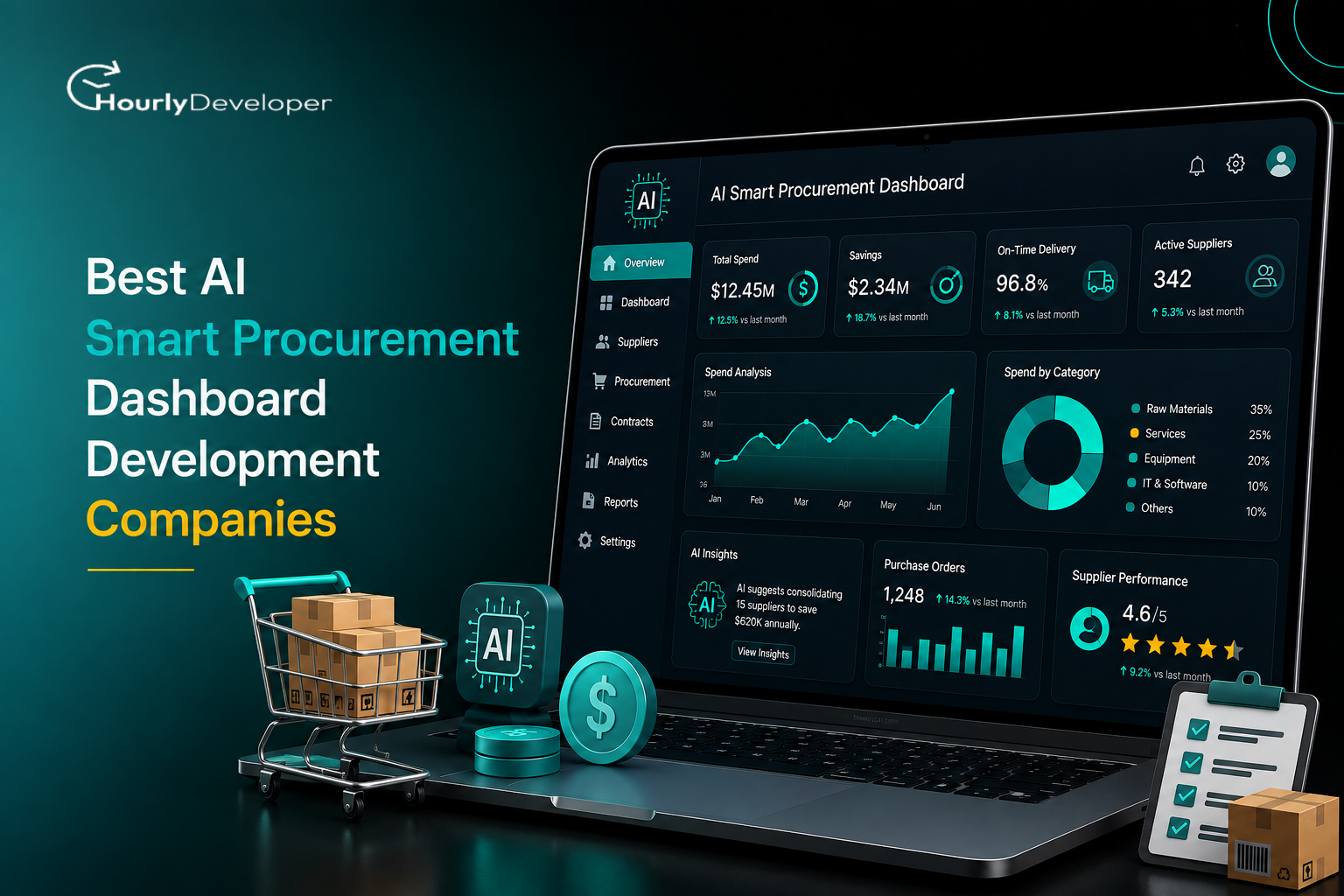
Best AI Smart Procurement Dashboard Development Companies
Introduction
Best AI Smart Procurement Dashboard Development Companies
1.What Actually Goes Into Strong AI Procurement Dashboard Development
Before comparing companies, it helps to know what you are actually paying for. Solid AI procurement dashboard development usually covers a handful of core pieces working together rather than one flashy feature. That includes spend visibility across every category and business unit, supplier risk scoring that updates as new data comes in, demand forecasting that accounts for seasonality, and approval workflows that route purchase orders to the right person automatically.
The AI layer is what separates a modern build from a repainted legacy tool. Good systems use machine learning to spot spending anomalies, predict price fluctuations for raw materials or services, and recommend consolidation opportunities across suppliers that a procurement team might not connect on their own. None of this matters if the interface is confusing, so the best builds also invest heavily in dashboards that a non technical buyer can read in seconds, not minutes.
There is also the question of how a dashboard handles exceptions, since real procurement never runs perfectly on rails. A supplier misses a delivery date, a purchase order gets flagged for manual review, or a contract needs a one time exception outside the normal approval chain. The better platforms build these scenarios in from the start instead of treating them as edge cases to patch later, because in practice they happen every single week rather than once a quarter.
2.How to Hire AI Procurement Software Developers Who Get It Right
If you are ready to hire AI procurement software developers, look past the portfolio screenshots first. Ask how they handle data integration with your existing ERP or accounting system, since most procurement failures trace back to messy data pipelines rather than bad algorithms. Ask about their approach to supplier data privacy too, because procurement dashboards often touch sensitive contract terms and pricing that competitors would love to see.
It also pays to ask for a plain answer on timelines and ongoing support. A dashboard that works on day one but breaks the moment your supplier list changes structure is not a finished product. The strongest teams below are transparent about this from the first call, which is a good early signal of how they will behave once the contract is signed.
One more thing worth checking is whether the team has actually worked inside procurement before, versus building generic business intelligence dashboards and relabeling them. Procurement has its own quirks, like three way matching between purchase orders, receipts, and invoices, or the way approval limits change depending on category and department. A developer who has never run into these details tends to build something technically correct but practically frustrating for the people using it every day.
3.Top AI Smart Procurement Dashboard Development Companies
HourlyDeveloper works on an hourly and dedicated team model, which makes it a practical starting point for founders who are not yet sure how big their procurement build needs to be. The team has delivered spend analytics tools, vendor scoring modules, and approval workflow systems for mid sized manufacturing and retail clients. What stands out is the flexibility on engagement size, since a company can start with one developer testing a proof of concept and scale the team as the dashboard grows. They also handle integration work with common ERP systems, which saves a lot of back and forth during the discovery phase.
Location: Dublin, Ireland with global delivery centers | Founded: 1989
Accenture runs large scale procurement transformation programs for enterprise clients, often bundling AI dashboard development with broader supply chain consulting. Their strength is in organizations with complex, multi region procurement operations that need a system connecting dozens of business units under one view. The tradeoff is cost and timeline, since projects here tend to run longer and require a bigger budget than most mid market companies want to commit to for a first build. Engagements often include a dedicated change management workstream too, since rolling out a new dashboard across many regional offices at once tends to fail without one.
Location: India with remote delivery worldwide | Founded: 2014
As the name suggests, this team leans heavily into the backend architecture that keeps a procurement dashboard reliable at scale. That matters more than most buyers realize, because a dashboard pulling live data from suppliers, inventory systems, and finance software needs a backend that will not choke under load. Their work includes building the data pipelines and API layers that feed AI models with clean, structured spend data, plus the security setup needed to keep contract and pricing information locked down. They usually pair this backend work with a smaller frontend team, so a client gets one accountable partner instead of coordinating between two separate vendors.
Location: Paris, France with offices worldwide | Founded: 1967
Capgemini brings deep experience in procurement analytics for large industrial and retail clients, often through long term managed service contracts rather than one off builds. Their dashboards typically include predictive spend modeling and supplier risk analysis tied into broader enterprise resource planning systems. This is a strong fit for companies that already have an established procurement function and want to layer AI capability on top of it, rather than starting from a blank slate. Their managed service option also means ongoing model tuning is included, rather than billed separately once the dashboard goes live.
This team builds procurement dashboards end to end, covering everything from the database design to the front end reporting layer a procurement manager actually opens each morning. Their full stack approach means fewer handoffs between separate frontend and backend vendors, which tends to shorten development cycles. Past work includes vendor management portals with AI driven risk flags and spend dashboards built for construction and logistics clients managing hundreds of active suppliers at once. They generally offer flexible engagement models too, ranging from a single developer for a small pilot to a full dedicated team for a larger rollout.
Location: Newtown, Pennsylvania with global engineering hubs | Founded: 1993
EPAM is known for pairing strong engineering talent with genuine data science depth, which shows up clearly in their procurement work. They have built forecasting models that account for currency shifts and commodity price volatility, useful for clients buying raw materials across multiple countries. Their teams are also comfortable working inside a client’s existing tech stack rather than pushing a proprietary platform, which some buyers prefer for long term flexibility. Larger clients often value their ability to staff a project quickly, since they can draw from engineering hubs across several continents.
HireAIDevelopers focuses specifically on the AI and machine learning components of procurement systems, including anomaly detection models that flag unusual invoice amounts or duplicate payments before they clear. They typically partner alongside a client’s existing development team rather than replacing it, adding the data science layer without requiring a full platform rebuild. This makes them a solid option for companies that already have a dashboard but need smarter forecasting or risk scoring bolted onto it. Their pricing tends to be structured around the specific model being built, which keeps costs tied to a defined scope rather than an open ended hourly arrangement.
ScienceSoft has a long history in enterprise software and has applied that experience to procurement analytics platforms with supplier scorecards and contract lifecycle tracking. Their dashboards often include compliance monitoring features, which matters for industries like healthcare or manufacturing where procurement decisions carry regulatory weight. Clients generally cite their documentation and structured delivery process as a reason to work with them on longer builds, and their support contracts typically extend well past launch to cover model retraining as spend patterns shift. This documentation heavy style also makes it easier to hand off maintenance to an internal team later if a client wants to bring the work in house.
Location: Ahmedabad, India with a US office | Founded: 2010
Simform builds custom procurement platforms with a focus on cloud native architecture, which keeps costs predictable as a dashboard scales with transaction volume. Their AI work includes demand forecasting models trained on a client’s historical purchase data, tailored rather than generic. They also run a discovery phase before development starts, which helps avoid the scope creep that often derails procurement software projects midway through. Their cloud native focus tends to appeal to companies expecting rapid growth in transaction volume over the next few years, since scaling infrastructure later becomes a much smaller headache when it was designed for that from the start.
Intellectsoft has built procurement and supply chain platforms for clients in construction, logistics, and manufacturing, industries where a missed shipment or delayed supplier payment carries real financial consequences. Their dashboards tend to emphasize real time visibility, pulling live updates from supplier systems rather than relying on batch data refreshes. This real time approach costs more to build but pays off for companies managing time sensitive supply chains where a delayed alert can mean a stalled production line. Their construction sector work in particular has shaped how they handle procurement for large, long running projects with many subcontractors.
DataEximIT offers AI procurement dashboard development services built around a client’s existing data infrastructure, focusing on clean data migration before any AI model gets trained on it. They have delivered spend visibility dashboards for retail and distribution clients, with particular attention to supplier consolidation reporting that helps procurement teams identify where they are paying different prices for the same goods across regions. Their pricing is generally competitive for mid sized businesses that want a solid build without the overhead of a large consulting engagement, and they typically stay involved after launch to fine tune the AI models once real usage data starts coming in.
Location: Austin, Texas with European delivery centers | Founded: 1993
SoftServe pairs procurement dashboard builds with broader data engineering work, which matters because most AI models are only as good as the pipeline feeding them. Their teams have worked on supplier risk platforms that pull in external data sources like credit ratings and news sentiment to flag suppliers before a problem hits. This external data integration is a differentiator compared to teams that only work with internal procurement records, and it tends to catch supplier problems weeks before they would show up in internal metrics alone. Their European delivery centers also give clients extended overlap hours for review calls and feedback sessions.
Location: Gujarat, India with a US presence | Founded: 2014
WebClues Infotech builds procurement and vendor management dashboards for small and mid sized businesses, often at a lower entry cost than the larger consulting firms on this list. Their AI features tend to focus on practical wins like automated invoice matching and duplicate payment detection rather than heavy predictive modeling, which suits companies that want fast, tangible returns before investing in a bigger build. Their fixed scope packages are also easier for a first time buyer to budget around compared to open ended hourly quotes, which helps founders who have never commissioned custom software before feel more confident about the total spend.
Location: Lviv, Ukraine with a US office | Founded: 2002
N-iX has delivered procurement analytics platforms for manufacturing and energy clients, industries with long supplier relationships and complex contract terms. Their approach usually starts with a data audit to understand what a client already has before recommending an AI model, which avoids wasted effort building forecasting tools on incomplete data. They also offer ongoing model retraining as part of their support contracts, useful since procurement patterns shift over time as a business adds new suppliers or enters new markets. Energy sector clients in particular have valued their handling of long term supply contracts with complex pricing clauses.
Iflexion builds procurement software with a strong focus on integration, connecting dashboards to ERP systems like SAP and Oracle without forcing a client to migrate off their existing tools. Their AI capabilities include spend categorization models that automatically tag purchases, cutting down the manual work procurement teams usually spend hours on each month. This integration first approach appeals to larger companies with established systems already in place that cannot afford downtime while a new dashboard gets built around their existing data. Their team also tends to document integration points thoroughly, which matters when an internal IT team eventually takes over support.
Location: Minsk, Belarus with a US sales office | Founded: 2004
Belitsoft has worked on procurement dashboards for logistics and distribution companies, with particular attention to multi currency spend tracking for clients buying across several countries. Their teams build custom reporting layers rather than relying on templated dashboard designs, which takes longer upfront but tends to fit a client’s actual workflow better than an out of the box solution once the team is actually using it day to day. Clients working across several currencies and time zones tend to appreciate the extra attention paid to that part of the build.
Location: Warsaw, Poland with global offices | Founded: 2007
Andersen builds procurement platforms with an emphasis on supplier collaboration features, including portals where vendors can submit invoices and track payment status directly. This reduces the email back and forth that often clogs up procurement departments. Their AI layer includes contract analysis tools that flag unfavorable terms before a renewal date, a feature that has saved clients from auto renewing at outdated pricing they had long since negotiated better terms for elsewhere. Their supplier portal work in particular tends to reduce the volume of routine status update emails procurement staff deal with each week.
Grid Dynamics brings genuine machine learning depth to procurement work, having built demand forecasting systems for large retail clients managing thousands of SKUs. Their procurement dashboards often include supplier diversification recommendations, using AI to flag when a company is overly dependent on a single vendor for a critical component. This risk focused approach is valuable for companies that got burned by supply chain disruptions in recent years and want to avoid repeating the same mistake with a single point of failure. Retailers with a wide product catalog in particular tend to benefit from how their models scale across thousands of individual SKUs at once.
Location: Denver, Colorado with European delivery teams | Founded: 1998
Itransition has delivered procurement and supply chain platforms across manufacturing, healthcare, and logistics sectors, with dashboards that include compliance tracking for regulated industries. Their AI features cover spend anomaly detection and supplier performance scoring, updated continuously rather than on a fixed reporting cycle. Clients generally note their thorough testing process, important for procurement systems where a bug could mean a missed payment deadline or a duplicated supplier invoice slipping through unnoticed. Their healthcare sector experience in particular has translated well into other regulated industries with similar compliance demands.
Location: Hyderabad, India with a US headquarters | Founded: 1995
Trigent Software builds procurement dashboards for mid market clients looking for a balance between features and cost, typically delivering core spend visibility and approval workflow tools before layering in more advanced AI forecasting. Their staged delivery approach lets clients see value early rather than waiting a year for a full platform, and they have worked across manufacturing, healthcare, and professional services procurement teams that needed a system built around approval hierarchies specific to each department. Smaller companies in particular tend to appreciate not having to commit to the full feature set on day one.
4.What to Check Before You Sign a Contract
Once you have a shortlist, the actual comparison comes down to a few practical questions rather than gut feel. Ask each company for a reference client in a similar industry, since procurement patterns in manufacturing look very different from procurement in professional services. Ask how they price ongoing AI procurement dashboard development services, because model retraining and data pipeline maintenance are recurring costs that some contracts bury in the fine print rather than stating upfront.
It also helps to ask what happens if your data is messier than expected, which is common. Some teams quote a clean build price and then charge extra once they discover your supplier records live across three disconnected spreadsheets. The companies worth hiring will tell you this during the discovery call rather than after the contract is signed, and that honesty is often the clearest signal of how the rest of the project will go.
Contract terms deserve a second look too. Find out who owns the underlying code and the trained models once the project ends, especially if you plan to bring maintenance in house later or switch vendors down the line. Some agencies build on proprietary frameworks that make an exit expensive, while others use standard, well documented stacks that any competent team could pick up afterward. That single detail can matter more than the initial price quote once you look a few years ahead, since a locked in vendor relationship tends to cost far more over time than a slightly higher rate on the first contract.
Finally, ask what a typical support ticket looks like once the dashboard is live. Some teams treat support as an afterthought handled by whoever is available, while others assign a dedicated point of contact who already understands your data and your procurement rules. That difference becomes very obvious the first time something breaks during a busy month end close, and it is far better to know the answer before signing than to find out the hard way.
5.Conclusion
There is no single best answer to which company on this list you should hire. A construction firm juggling dozens of subcontractors needs something different from a retail chain managing seasonal inventory spend, and the right AI Smart Procurement Dashboard build reflects that difference rather than fighting it. What matters most is picking a team that asks about your actual procurement problems before they start talking about features.
If you are still narrowing things down, start with two or three conversations rather than one. Bring your messiest data problem to the call and see how each team responds. The ones worth hiring will have specific questions, not just a sales pitch, and that difference tends to show up again once the real work begins.
The companies on this list range from large global consultancies to focused, specialized teams, and neither category is automatically the right choice. What matters is matching the size and style of the partner to the size and complexity of your own procurement operation, then holding them to a clear standard on data quality, timelines, and honest communication from the very first call.
With a love for connecting with people and a flair for communication, Prachi's expertise in digital marketing is unmatched. Her strategic approach to campaigns ensures our brand's story reaches far and wide, making an impact on the lives of countless individuals.
Frequently Asked Questions
Most builds take between 3 and 6 months depending on how many systems need to connect and how much historical data exists to train forecasting models. Simple spend visibility dashboards can launch faster, often in 6 to 8 weeks, while full platforms with supplier risk scoring and predictive analytics take longer to test properly.
Costs vary widely based on scope, ranging from $15,000 for a focused module to well over $150,000 for a full enterprise platform with custom AI models. Hourly engagement models often start around $25 to $60 per hour depending on region, while fixed price projects are quoted after a discovery phase.
Yes, and this is often cheaper than starting over. Many of the companies above specialize in adding AI layers, like anomaly detection or spend forecasting, on top of an existing ERP or procurement tool. This approach works well when the underlying data structure is already solid and only the intelligence layer is missing.
At minimum, they need 12 to 24 months of historical purchase order data, supplier payment records, and inventory or usage data if relevant. Cleaner data means faster development, while fragmented spreadsheets across departments usually add weeks to the discovery phase before any AI model training can begin in earnest, and results tend to improve as more history becomes available.
It depends on complexity and budget. Large consulting firms suit multinational operations with many business units, while smaller specialized teams often deliver faster and cheaper for a single business unit or mid sized company, without the layered management overhead that bigger firms typically add to a project, which matters most for founders on a tighter timeline.
Find exceptional developers at Hourlydeveloper. Get the expertise, solutions, and teamwork you need for success. Hire developers easily and boost your projects today!
 Back to Blog