1.Why the Right Development Partner Changes Everything
A recruitment platform is only as good as the matching logic behind it. Weak algorithms send irrelevant candidates to recruiters, and irrelevant candidates waste everyone’s time. Strong algorithms, on the other hand, learn from every application, every rejection, and every hire, getting sharper with use. That difference alone can decide whether your platform gets recommended by word of mouth or quietly abandoned after the first bad experience.
This is also why so many founders now choose to Hire AI job portal developers instead of stitching together a generic team. Specialized developers already understand resume parsing formats, candidate scoring models, applicant tracking integrations, and the compliance rules around storing personal data. That experience saves months of trial and error, and it usually shows up in a platform that feels finished rather than half built.
There is also a cultural difference worth noting. Generalist teams tend to treat AI as a feature to bolt on near the end of a project, almost as an afterthought once the core screens are done. Specialized teams build around the AI from day one, shaping the database structure, the candidate flow, and even the onboarding process around how the matching engine will eventually use that data. That upfront thinking is hard to retrofit later, which is exactly why the choice of partner matters so early in the process, not just at launch.
2.What to Check Before You Sign a Contract
Before committing to any firm, look past the portfolio screenshots. Ask how they handle model retraining as your user base grows. Ask what happens when their AI misclassifies a candidate, and how quickly that gets fixed. A firm that has real answers to these questions, rather than vague reassurances, is usually the one worth trusting with something as important as your platform’s core intelligence.
It also helps to ask about their post-launch support structure. A lot of firms are great at shipping a first version and then quietly disappear once the invoice is paid. Recruitment platforms need continuous tuning because hiring trends shift, job titles evolve, and candidate behavior changes with the market. The firms worth your time will talk openly about maintenance windows, retraining cycles, and how they plan to keep your matching engine sharp long after launch day. Pricing structure matters just as much. Some firms bill hourly, some work on fixed milestones, and some offer dedicated teams you retain month to month. None of these models is universally better, but the right one depends on how settled your product requirements already are.
3.Best AI Job Portal Platform Development Firms in 2026
Here is a closer look at the firms consistently recommended for building smart, scalable hiring platforms this year.
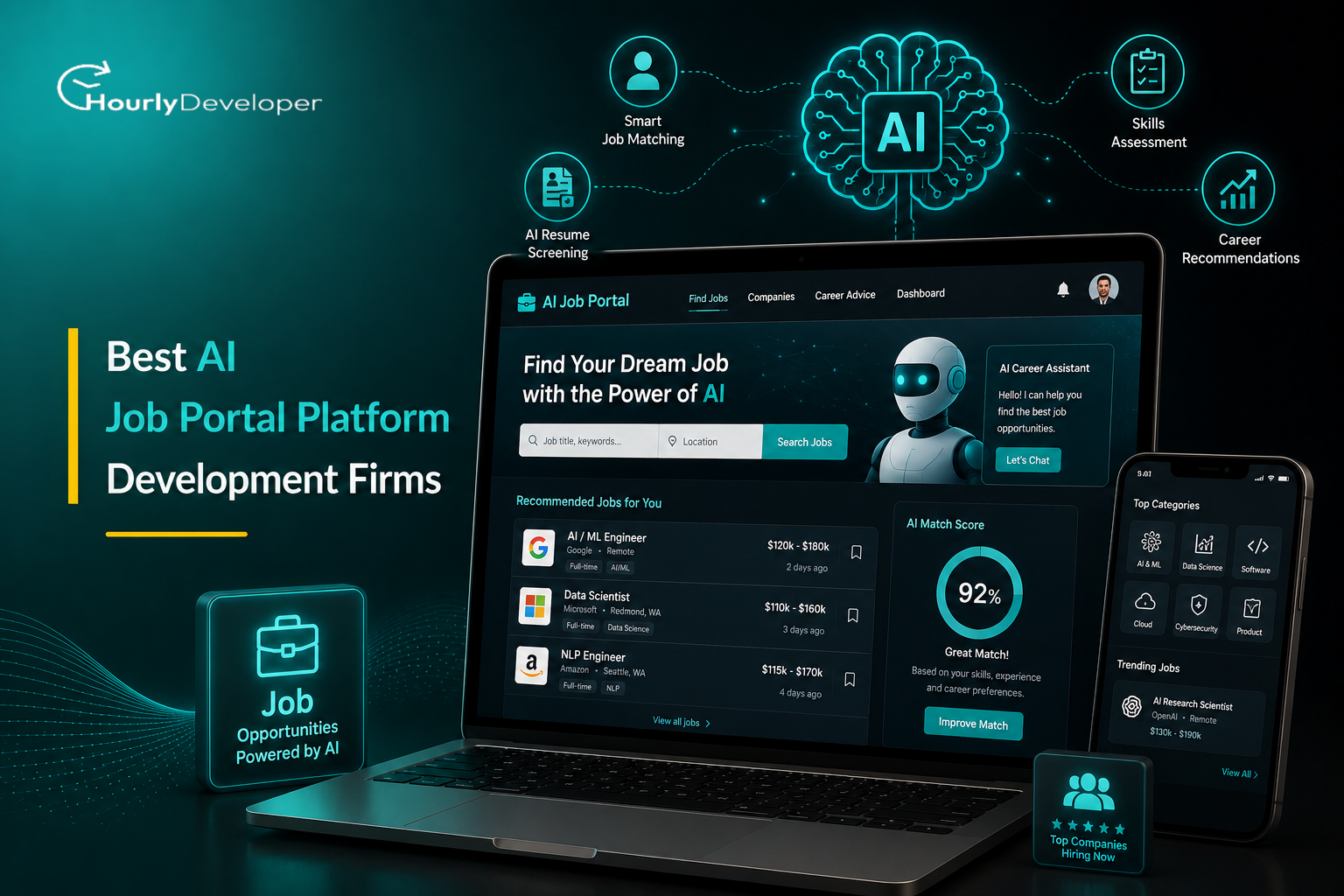
HourlyDeveloper has built a strong reputation for flexible, transparent engagement models where clients pay for actual hours worked rather than rigid project quotes. Their team specializes in AI Job Portal Platform builds that include resume parsing, candidate ranking engines, and recruiter dashboards. What sets them apart is the ability to scale a team up or down mid-project without losing momentum, which matters a lot for startups whose requirements shift as they grow. They are frequently the first name that comes up when founders ask where to Hire AI job portal developers without locking into a long-term contract.
Their reporting is also worth mentioning. Clients get regular time logs and sprint updates, so there is never a mystery around what was actually worked on that week. For early-stage founders who are still validating their idea and cannot commit to a six-figure fixed budget, this kind of transparent, pay-as-you-go structure tends to feel far less risky than a traditional agency contract.
WebClues Infotech has years of experience across custom web and mobile development, with a growing focus on AI-driven recruitment platforms. Their approach to job portal platform development leans heavily on clean UX combined with practical machine learning features like smart job recommendations and automated candidate screening. Clients often mention their structured project management process, which keeps timelines predictable even on complex builds involving multiple user roles like job seekers, recruiters, and admins. They typically assign a dedicated project coordinator for mid-size and larger engagements, which helps founders avoid the communication gaps that often slow down offshore development relationships.
DataEximiIT brings a strong data engineering background to recruitment technology, which shows in how thoughtfully they design the backend for large-scale applicant data. They are known for building platforms that handle heavy data loads without slowing down, an area where many smaller firms struggle. Their team is comfortable working with predictive analytics, candidate scoring models, and integration with third-party HR tools, making them a solid pick for companies planning to scale fast. They also tend to be transparent about data infrastructure costs upfront, which helps founders budget realistically instead of getting surprised by cloud expenses after launch.
As the name suggests, HireAIDevelopers focuses specifically on AI talent and AI-first product builds, including hiring and recruitment platforms. They tend to work well with founders who already have a clear product vision and simply need experienced engineers to execute it. Their strength lies in machine learning components such as natural language processing for resume screening and chatbot-based candidate support, both of which are becoming standard expectations for any modern job portal. Because the team is smaller and specialized, communication tends to be direct, with less back-and-forth through account managers than you might find at larger agencies.
HireFullStackDeveloperIndia is a good fit for founders who want one team handling the entire stack, from database architecture to frontend design to AI integration. Their full stack developers are experienced in building recruitment platforms end to end, which reduces the coordination headaches that come from working with separate frontend, backend, and AI vendors. Many clients choose them specifically because it simplifies communication during a long build. Their pricing tends to be competitive too, which makes them a common choice for founders working with a tighter early-stage budget who still want experienced hands across the stack.
Backend Development Company, as the name signals, specializes in the infrastructure layer that most flashy portfolios skip over. For an AI Job Portal Platform, that backend work includes secure resume storage, efficient search indexing, and APIs that can handle spikes in traffic during hiring seasons. They are often brought in by other agencies as a backend partner, which says a lot about how development teams themselves view their technical depth. If your platform’s biggest risk is performance under load rather than the front-end experience, this is the kind of team that will catch problems before your users ever notice them.
Matellio has a broad portfolio spanning enterprise software and AI product development, and their recruitment platform work reflects that enterprise-grade discipline. They tend to attract mid-sized and larger companies that need a job portal integrated with existing HR systems rather than a standalone product. Their process typically includes detailed discovery workshops before any code gets written, which some founders appreciate and others find slower than they expected. If your priority is getting the architecture right the first time rather than moving fast, that upfront planning phase usually pays off later in the project.
Konstant Infosolutions has been building web and mobile applications for a long time, and their recruitment technology work benefits from that broader experience. They offer flexible engagement models, including dedicated teams for founders who want ongoing development support rather than a one-time build. Their AI features usually focus on candidate matching accuracy and reducing time-to-hire for recruiters using the platform. Founders who are not sure yet whether they need a full build or a phased rollout often appreciate their willingness to start small and expand the scope gradually.
Biz4Group has built a name in AI and blockchain development, and their recruitment platform projects often include innovative touches like verified credential checks alongside standard resume matching. Founders looking for something beyond a conventional job board sometimes turn to them for these extra layers of trust and verification, which can be a real differentiator in competitive recruitment markets. Their experience across multiple emerging technologies also means they are comfortable adapting the roadmap as new AI capabilities become viable mid-project.
ValueCoders is a long-standing outsourcing partner known for disciplined project delivery and clear communication across time zones. Their recruitment platform builds tend to focus on reliability and maintainability over flashy features, which appeals to founders who want a platform that will not require constant firefighting after launch. They also offer post-launch support packages, useful for teams without an in-house technical lead. Their long track record means they have likely already solved problems similar to yours, which can shorten the learning curve considerably during the early weeks of a project.
Space-O Technologies has built a strong track record in mobile-first product development, which matters given how many job seekers now browse and apply through their phones. Their job portal platform development work often includes responsive design paired with AI-driven push notifications that alert candidates to relevant openings in real time. Recruiters using their platforms also get simplified mobile dashboards for faster candidate review. Given how much recruitment activity now happens on the go, this mobile-first mindset can noticeably improve engagement compared to platforms that treat mobile as an afterthought.
Debut Infotech has expanded significantly into AI and generative AI services, and their recruitment platform builds increasingly include conversational AI features like chatbot-driven candidate screening. Founders exploring more advanced automation, beyond basic resume parsing, often shortlist them for this reason. Their team is also comfortable working with cloud-native architectures, which helps platforms scale smoothly as user numbers grow. For founders who want their platform to feel genuinely intelligent rather than just automated, their generative AI experience often shows in small but meaningful touches throughout the product.
SoluLab combines AI expertise with blockchain and web development experience, giving them an interesting angle on recruitment platforms that need extra layers of data security. They work with startups as well as established businesses, adjusting their process depending on project size. Clients often highlight their responsiveness during development, particularly when requirements change mid-project, which happens often in fast-moving recruitment products. For platforms handling sensitive candidate documents or verification data, their added security expertise can be a meaningful advantage over more generalist teams.
Appventurez has a strong focus on app development paired with AI integration, making them a natural fit for founders who envision their AI Job Portal Platform primarily as a mobile experience. Their recruitment platform work typically includes intelligent job recommendations and streamlined onboarding flows designed to reduce candidate drop-off, a common problem on portals with clunky sign-up processes. They also spend meaningful time on UI polish, which matters when candidates are comparing your platform against slicker, better-funded competitors.
Rishabh Software has decades of enterprise software experience, which shows in the maturity of their development process for recruitment platforms. They are known for handling complex integrations, such as connecting a job portal with existing payroll or HR management systems, without disrupting a client’s existing workflows. This makes them a strong option for companies modernizing an older recruitment system rather than building from scratch. If your project involves migrating years of legacy candidate data into a new AI-driven structure, their experience with careful, low-disruption transitions can save considerable headaches.
OpenXcell brings deep AI and product engineering experience to recruitment platform builds, often working closely with founders during the early product strategy phase before development even begins. Their teams are comfortable building custom matching algorithms rather than relying on generic third-party models, which can lead to more accurate candidate recommendations tailored to a specific industry or niche. This custom approach usually costs more upfront, but it tends to pay off for platforms targeting a specialized talent pool where generic matching logic falls short.
Bacancy Technology offers dedicated development teams across a wide range of technologies, including AI and machine learning specialists suited for recruitment platforms. Their flexible hiring models, including monthly and hourly engagement, appeal to founders who are not yet ready to commit to a large fixed-scope project but still want experienced developers on hand. Their bench of specialists also makes it easier to bring in niche skills, like a data scientist for scoring models, without a lengthy hiring process on your end.
Zealous System rounds out this list with solid experience in custom software development, including recruitment and HR technology. Their approach tends to balance AI features with practical usability, ensuring that the intelligence built into a platform never comes at the cost of a confusing user experience for job seekers or recruiters. They are often chosen by founders who want a dependable, no-surprises development partner. Their communication style tends to be straightforward and jargon-free, which non-technical founders in particular tend to find refreshing during status calls.
4.Cost and Timeline Expectations for 2026
Pricing for an AI Job Portal Platform has shifted a fair amount over the past couple of years as AI tooling has matured. A basic MVP with resume upload, job listings, and simple keyword-based matching can still be built for a modest budget in a few weeks. But the moment real machine learning enters the picture, things like resume parsing models, predictive scoring, and personalized recommendations, the cost and timeline both increase because that work requires data preparation, model testing, and ongoing tuning rather than a one-time build.
Most founders working with the firms on this list should expect somewhere between three and eight months for a fully functional platform, depending on how many AI features are included at launch versus added later. It is often smarter to launch with a smaller, well-tested set of AI features and expand gradually based on real user behavior, rather than trying to launch every possible feature on day one. This phased approach also tends to be easier on the budget, since later phases can be funded once the platform is already generating some traction or revenue.
Geography plays a role in cost too. Teams based in regions with lower development costs can often deliver comparable quality at a fraction of the price charged by agencies in higher-cost markets, which is part of why so many of the firms on this list operate with distributed or offshore teams. That said, cost should never be the only deciding factor. A cheaper team that takes twice as long to fix bugs ends up costing more in the long run, both in money and in lost momentum.
5.Making the Final Decision
Choosing among the Best AI job portal platform development firms ultimately comes down to fit rather than a universal ranking. A firm that excels at enterprise integrations might not be the right choice for a scrappy startup that needs speed over polish. Similarly, a team built for rapid, flexible engagement might not suit a company that needs deep, long-term enterprise support. The smartest move is to shortlist three or four firms from this list, have real conversations about your specific goals, and pay close attention to how clearly they explain their process. A team that communicates well before the contract is usually a team that communicates well during the hard parts of the build too.
It also helps to talk to at least one past client if you can arrange it. Portfolios show finished work, but a quick reference call usually reveals how a firm handles delays, scope changes, and the inevitable disagreements that come up during any real project. Firms confident in their own delivery record are rarely hesitant to connect you with someone they have worked with before.
Recruitment technology is not slowing down, and the platforms that win in 2026 will be the ones built on genuinely smart AI, not just marketing claims of it. Whether you are validating an idea or scaling an existing product, the right development partner can be the difference between a platform people tolerate and one they actually recommend to others. Take the time to compare a few firms properly, ask the uncomfortable questions early, and you will end up with a partner who builds something worth being proud of, not just something that technically works.
 Back to Blog