1.Why AI Has Become Non Negotiable in Food Delivery
A decade ago, a food delivery app just needed to take an order, send it to a kitchen, and hand it to a driver. That bar has moved considerably. Customers compare wait time estimates across three apps before choosing one, and they notice immediately when a prediction is off by fifteen minutes.
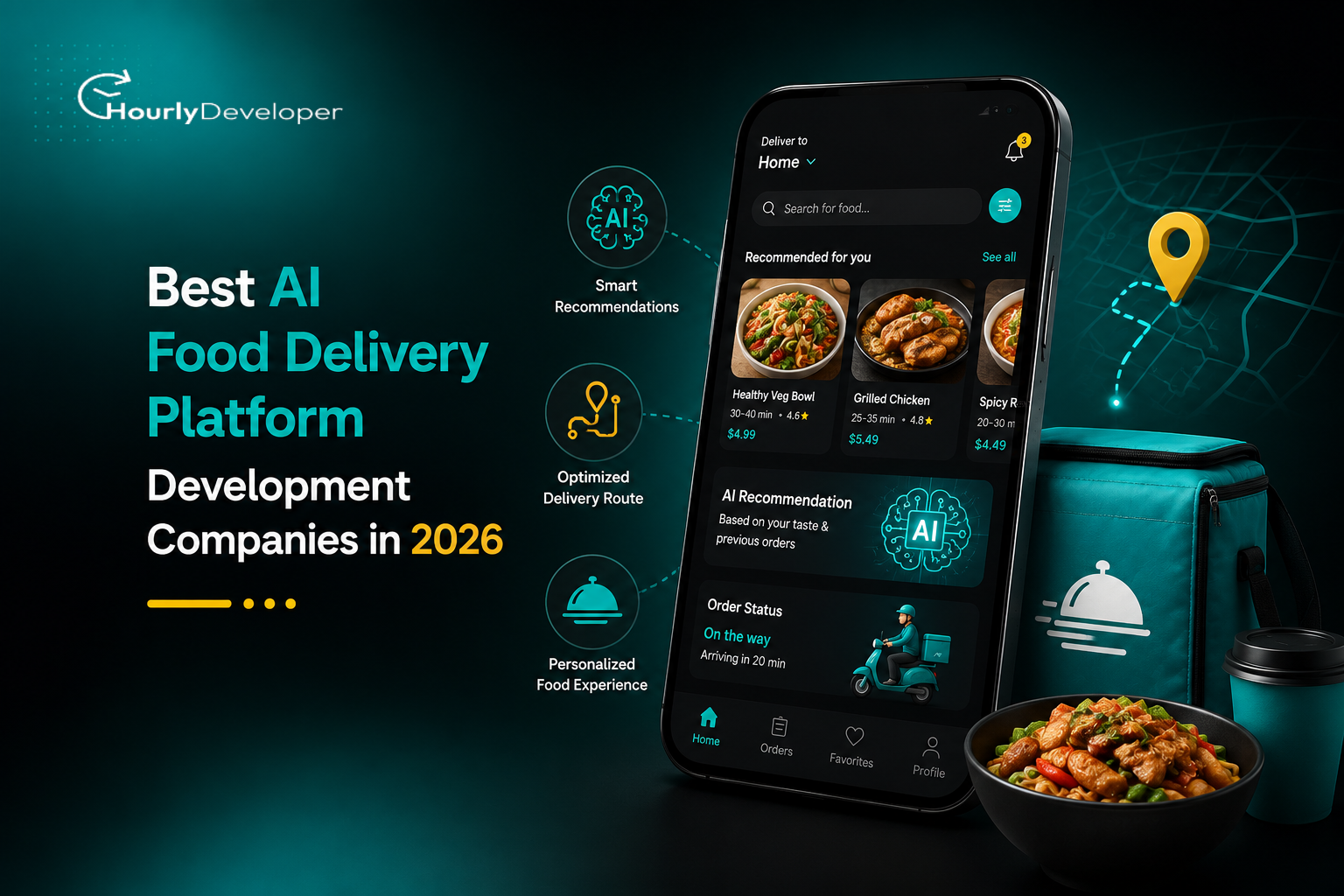
Building an AI Food Delivery Platform today usually means combining demand forecasting, dynamic pricing, route optimization, and personalized recommendations into one system that runs quietly in the background. Get it right and customers barely notice the technology, they just notice the app feels faster and smarter than the competition. Get it wrong and every small delay becomes a one star review.
2.What to Actually Check Before Hiring a Development Partner
Most comparison articles tell founders to check portfolio, pricing, and reviews. Fair enough, but that is table stakes. The sharper questions are whether the team has actually shipped machine learning features that survive production traffic, whether they can explain their architecture decisions in plain language, and whether they have a realistic answer for what happens six months after launch when the app needs to scale.
Cost matters too, and it varies widely depending on location, team seniority, and how much custom AI work is involved. A basic ordering app might start around $15,000, while a full platform with route optimization, demand prediction, and multi-vendor support can run well past $80,000. What matters more than the number itself is understanding what is included, because hidden costs around API usage, model retraining, and third party integrations tend to surface later rather than upfront.
With that context in place, here is a closer look at twenty companies worth considering for your next project.
4.A Quick Word on Budget and Timeline
Founders comparing quotes often assume a lower number means a better deal, but that is rarely how it plays out with an AI Food Delivery Platform build. Teams that quote unusually low numbers sometimes cut corners on testing, security, or the AI training data itself, which shows up later as bugs, slow predictions, or models that never quite learn user behavior correctly.
A reasonable range for a mid-sized project in 2026 sits between $40,000 and $120,000, depending on how much of the AI layer is custom built versus using existing services. Timelines typically run 4 to 8 months for a full featured platform, though a simpler minimum viable product can launch in 10 to 12 weeks with a focused team.
5.Making the Final Call
There is no single correct answer to which company is best. A founder building a hyperlocal delivery app in one city has very different needs than one launching a multi country marketplace with subscription features. The right move is narrowing this list down to three or four companies whose specialization actually matches your product, then having a real conversation about architecture, timelines, and what happens after launch.
Building an AI Food Delivery Platform is not really a one time project, it is closer to a partnership. The company you choose will still be involved when you need to retrain a model, add a new market, or fix something at 2am during a traffic spike. Pick the team you would actually want on the phone during that call, not just the one with the shiniest portfolio.
 Back to Blog