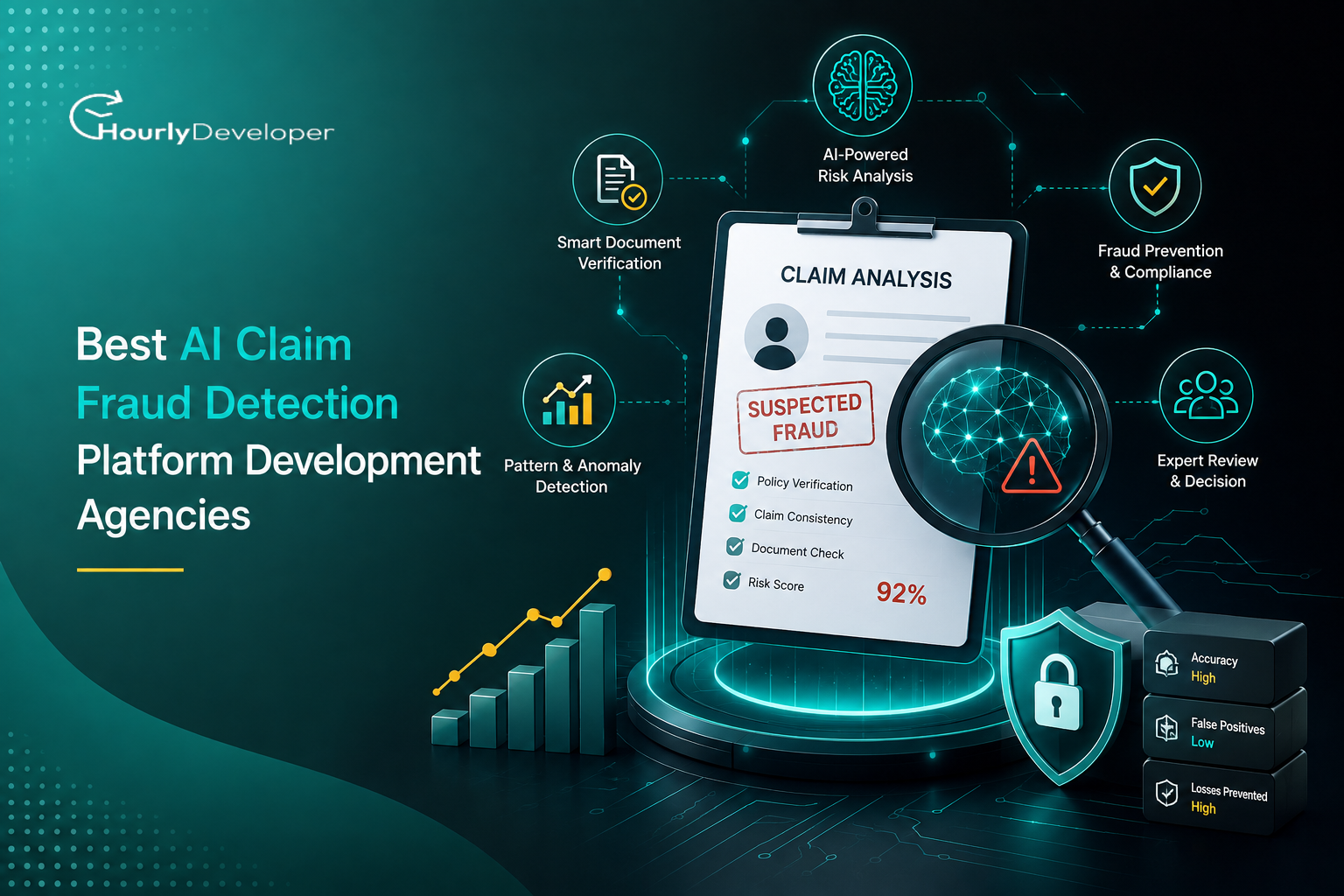
Best AI Claim Fraud Detection Platform Development Agencies
Introduction
Best AI Claim Fraud Detection Platform Development Agencies
1.What Changed in Fraud Detection Technology by 2026
A few years ago, most fraud detection tools were essentially rule based flags. If a claim crossed a dollar threshold or came from a zip code with a history of fraud, it got routed to a human reviewer. That approach still exists, but it now sits underneath a much smarter layer. Modern AI claim fraud detection software development projects combine natural language processing on claim notes, image forensics on submitted photos, and network analysis that can spot when the same repair shop, doctor, or witness shows up across dozens of unrelated claims.
The other shift is speed. Insurers do not want fraud caught six weeks after a payout. They want it flagged during intake, ideally before a check is cut. That single requirement changes almost everything about how these platforms get built, from the data pipeline to how the model is deployed, and it is a big part of why picking the right development partner matters so much more than it used to.
2.What a Development Partner Actually Needs to Bring
Not every software vendor that lists artificial intelligence on its homepage can actually deliver a working fraud model. When you evaluate the best AI claim fraud detection platform development agencies, look past the buzzwords and check for three things. First, real experience with insurance data, since claims data is messy, inconsistent across carriers, and often locked behind legacy cores like Guidewire or Duck Creek. Second, a track record in explainable machine learning, because regulators and internal auditors will ask why a claim got flagged, and a black box answer will not satisfy anyone. Third, comfort with compliance frameworks such as HIPAA for health claims or state specific insurance fraud reporting rules.
With that in mind, here are 15 agencies worth a closer look, mixed together rather than ranked strictly by size, since the right fit often depends more on your specific claim types and budget than on headcount alone.
3.Where Rules Based Systems Still Fall Short
It is worth being honest about the limits of even a well built platform. Static thresholds and simple rule sets miss coordinated fraud rings almost by design, since each individual claim in the ring can look perfectly ordinary on its own. It is only when you connect the claimant, the repair shop, the medical provider, and the witness across several supposedly unrelated claims that the pattern becomes visible. That kind of graph based detection is genuinely hard to build well, and it is one of the clearest signals that a development partner has done this kind of work before rather than only building single claim scoring models.
The agencies below vary quite a bit in how deep their graph and network analysis capability goes, so it is a fair question to ask directly during your first call rather than assuming every AI vendor covers it the same way.
4.The 15 Best AI Claim Fraud Detection Platform Development Agencies
India, with delivery teams serving US and European insurance clients remotely
Founded
2017
Team Size
180 plus developers across AI, backend, and full stack roles
Specialization
Flexible hourly and dedicated hiring for AI and claims software projects
HourlyDeveloper built its whole model around transparent, pay for what you use hiring, which is genuinely useful for insurers who want to pilot an AI Claim Fraud Detection Platform before committing to a large fixed price contract. You can bring on a small team to prototype a fraud scoring model, then scale up once it proves out on real claims data. Their developers have worked on document verification tools, claims triage dashboards, and anomaly detection scripts for auto and property insurers, and the hourly billing structure makes budget conversations with a finance team much simpler than a typical statement of work. Founders who have been burned before by vague fixed price quotes tend to appreciate seeing exactly what they are paying for each week.
San Francisco, United States, with delivery centers supporting global clients
Founded
2015
Team Size
50 plus certified AI engineers
Specialization
Agentic AI, large language models, and custom machine learning for regulated industries
Markovate has built a strong reputation among enterprise clients for generative AI and agentic workflows, and insurance is one of its named focus areas alongside healthcare and fintech. Their engineers tend to lean on large language models for claim note summarization and anomaly explanation, which pairs well with more traditional fraud scoring models. For a CEO who wants a partner that can talk fluently about both classic machine learning and newer generative AI techniques inside one platform, Markovate is a reasonable fit, though their project minimums tend to suit mid sized and larger insurers more than very early stage startups. Their AI consulting sessions upfront also help clarify scope before any code is written, which some clients find worth the extra planning time.
India, with remote delivery to North America and Europe
Founded
2015
Team Size
220 plus backend and full stack engineers
Specialization
Scalable backend architecture for high volume claims processing systems
Fraud detection models are only as good as the infrastructure feeding them, and Backend Development Company specializes precisely in that unglamorous but essential layer. They build the pipelines that pull claims data out of legacy cores, normalize it, and feed it into a fraud scoring engine fast enough to matter during intake rather than weeks later. If your existing systems are already generating fraud signals but nobody can act on them quickly because the backend cannot keep up, this is the kind of partner that fixes the plumbing before anyone touches the model itself. They also tend to design their systems with future growth in mind, so a pilot built for one claim type can scale to handle the full claims volume without a costly rebuild later.
Multiple offices including the United States, United Kingdom, Canada, and India
Founded
2011
Team Size
150 plus specialists across AI and software engineering
Specialization
AI augmented software development for fintech, healthcare, and regulated platforms
Debut Infotech has spent over a decade building software for regulated industries, and its more recent AI practice covers everything from LLM integration to intelligent process automation. Their work in fintech and healthcare translates reasonably well to insurance claims, since both sectors share the same core challenge of separating legitimate activity from manipulated data at scale. Clients researching AI claims investigation software development often mention Debut Infotech for its willingness to work with smaller startups as well as larger enterprises, which is not always true of firms this established. Their delivery centers across four countries also make round the clock development possible for insurers running tight rollout timelines.
India, serving global insurance and insurtech clients remotely
Founded
2017
Team Size
150 plus full stack and AI focused engineers
Specialization
End to end claims platform development with flexible team scaling
As the name suggests, HireFullStackDeveloperIndia is built around giving founders a complete team rather than making them stitch together separate frontend, backend, and AI vendors. For a claims platform, that matters because fraud detection rarely lives in isolation. It needs a dashboard adjusters can actually use, an API layer that talks to your policy admin system, and the underlying scoring model, all built to work together from day one. Their flexible hiring model also means you can start with one or two developers to validate an idea and expand the team only once the platform proves its value internally. It is a practical way to hire AI fraud detection developers without committing to a large team before you know your exact fraud patterns.
Custom AI and IoT solutions for enterprise clients
Matellio operates as an IT consulting firm with a strong custom AI development arm, and its client base spans manufacturing, logistics, and financial services in addition to insurance. Their approach tends to start with a discovery phase that maps out exactly where fraud is leaking in your current claims process before any code gets written, which some founders find slower than they expected but ultimately more useful than jumping straight to a model. They are a solid option for insurers who want a consulting led engagement rather than a pure build shop, and their experience across manufacturing and logistics gives them an outside perspective on fraud pattern detection that some insurance only vendors lack.
Mobile, AI, and blockchain application development across multiple industries
Quytech has been building mobile and enterprise applications since 2010 and has picked up AI and machine learning capability along the way, including work in healthcare and banking that overlaps meaningfully with claims fraud use cases. Their smaller size compared to some names on this list can be an advantage for founders who want more direct access to senior engineers rather than being routed through several layers of account management. They are a reasonable choice for a first phase pilot before a larger rollout, especially for insurers who want to keep the initial build tightly scoped and easy to review.
India, with delivery supporting clients across the US and Europe
Founded
2016
Team Size
90 plus AI focused engineers
Specialization
Dedicated AI developer hiring for machine learning and data driven platforms
HireAIDevelopers exists specifically for companies that want to hire AI fraud detection developers without going through a traditional agency retainer. You describe the problem, whether that is training a model on historical fraudulent claims or building an image forensics tool to catch altered photos, and they match you with engineers who have done that specific kind of work before. This model tends to suit insurtech founders who already have a product vision and mainly need execution capacity, rather than founders who need heavy strategic consulting from day one. Their matching process also lets you interview candidates directly before committing, which gives more visibility than a typical black box staffing arrangement.
Nicosia, Cyprus, with additional offices in Lithuania and the United States
Founded
2014
Team Size
80 plus data scientists and engineers
Specialization
Data science, predictive analytics, and cognitive computing including fraud detection
InData Labs is one of the more directly relevant names on this list, since risk assessment and fraud detection sit explicitly within their published service areas alongside predictive analytics and natural language processing. Their background as a data science first firm, rather than a general software shop that added AI later, shows up in how they approach a claims fraud project, usually starting with a rigorous look at what data actually exists and how clean it is before any model gets trained. For insurers sitting on years of historical claims data that has never been properly mined for fraud patterns, this is a strong starting point. Their published cognitive computing work explicitly lists risk assessment and fraud detection as a core competency rather than a side project, which is not something every firm on this list can claim.
McKinney, Texas, with global delivery centers across Eastern Europe
Founded
1989
Team Size
450 plus IT professionals
Specialization
Enterprise IT consulting, AI implementation, and large scale system integration
ScienceSoft brings decades of enterprise software history to the table, which matters when a fraud detection project needs to plug into a claims core system that is itself twenty years old. Their scale also means they can staff a large, multi region delivery team for insurers running fraud detection efforts across several countries at once. This depth comes with a more structured, enterprise style engagement process, so smaller startups may find faster moving partners elsewhere on this list, but larger carriers often value exactly that structure, particularly when compliance documentation and audit trails need to satisfy multiple regulators at once.
Noida, India, with a presence in the United States, United Kingdom, and UAE
Founded
2014
Team Size
1,200 plus professionals
Specialization
Enterprise AI consulting and mobile first application development
Appinventiv has grown into one of the larger AI development shops on this list, and its client roster includes several enterprise names that lend confidence to insurers considering a sizable, multi year engagement. Their team tends to approach an AI claim fraud detection platform project as a full product build rather than just a model delivery, covering the claimant facing mobile experience alongside the internal fraud scoring tools. That breadth is genuinely useful if your fraud detection effort is part of a larger digital claims transformation rather than a standalone tool, and their enterprise client history means they are comfortable navigating internal approval processes at large carriers.
India, with clients across healthcare, logistics, and financial services
Founded
2003
Team Size
100 plus developers and designers
Specialization
Full stack software development with a strong UI and UX focus
Konstant Infosolutions is known first for its client centric, agile delivery style and second for the quality of its user interface work, which is easy to overlook when evaluating a fraud detection platform but genuinely matters. Adjusters who are handed a confusing dashboard simply will not use it consistently, no matter how accurate the underlying model is. Konstant tends to spend real time on the reviewer facing side of a fraud platform, which is a detail worth asking any prospective vendor about directly. Their long history working across healthcare and logistics also means they are used to handling sensitive, regulated data with care.
Palo Alto, United States, with additional offices across ten global locations
Founded
2007
Team Size
150 plus engineers and architects
Specialization
Enterprise software engineering with dedicated AI and digital transformation practice
Intellectsoft leads every engagement with a senior architect who maps the full system before any code is written, an approach that suits fraud detection work well given how many moving parts a claims platform tends to have. Their client list includes Fortune 500 names across finance and healthcare, and their AI practice covers everything from custom model development to broader digital transformation work. For CEOs specifically researching AI claims investigation software development at an enterprise scale, Intellectsoft is a name that consistently comes up in comparison shortlists. Their architecture first process may add a bit of upfront time to a project, but it tends to reduce costly rework once real claims volume hits the system.
India, with offices in the United States and Canada
Founded
2010
Team Size
200 plus developers and designers
Specialization
AI powered mobile and web application development
Space O Technologies started as a mobile app shop and has steadily built out AI and machine learning capability alongside that core strength, which shows up in how polished their claimant facing apps tend to be compared to some purely backend focused firms. For insurers that need a strong mobile claims submission experience feeding directly into a fraud detection pipeline, rather than treating the two as separate projects, Space O is worth a conversation. Their fifteen years of shipped app experience gives them a good sense of what actually gets used by real customers, which shows up in claim submission flows that feel simple even when the fraud checks happening behind the scenes are fairly sophisticated.
India, serving clients across North America, Europe, and the Middle East
Founded
2014
Team Size
150 plus developers
Specialization
Custom web and mobile application development with AI integration
WebClues Infotech works across a wide range of industries, and its insurance and fintech projects tend to focus on connecting AI powered decisioning into existing customer facing platforms rather than building everything from scratch. That practical, integration first approach suits insurers who already have a claims management system in place and simply need an AI Claim Fraud Detection Platform layered on top of it, rather than a full system rebuild. Their pricing tends to sit in the mid range compared to larger enterprise focused firms on this list, making them a reasonable middle ground for insurers who have outgrown a small pilot but are not yet ready for an enterprise scale rebuild.
5.Questions to Ask Before You Sign
Once you have a shortlist, the conversation should move past portfolios and into specifics. Ask how the agency handles model explainability, since you will eventually need to justify a flagged claim to a regulator or an unhappy policyholder. Ask what happens when fraud patterns shift, because fraudsters adapt quickly and a model trained once and left alone will decay in accuracy within a year or two. And ask directly about their experience with your specific claim type, since auto fraud detection and health claims fraud detection rely on genuinely different data and techniques.
It is also worth asking how a team plans to hire AI fraud detection developers for your specific project rather than assigning generalists who happen to be available. The best agencies will be upfront about which engineers have handled insurance data before and which would be learning on your project, and there is nothing wrong with the second option as long as pricing and timelines reflect that honestly.
6.What This Usually Costs in 2026
Pricing varies enormously depending on scope, but a reasonable starting range for a first version of an AI Claim Fraud Detection Platform sits somewhere between $40,000 and $150,000, covering document verification, basic anomaly scoring, and an adjuster facing dashboard. More advanced platforms that include network analysis across claims, real time image forensics, and integration with multiple legacy systems can run well past $250,000, particularly for large insurers operating across several states or countries. Hourly rates among the agencies above range from roughly $18 to $70 an hour depending on location and team seniority, and dedicated hiring models like those from Hourly Developers or HireAIDevelopers tend to land toward the lower end of that range.
7.Red Flags Worth Watching For
A few warning signs come up often enough to mention directly. Be cautious of any agency that promises a finished fraud detection model without first asking detailed questions about your existing data, since that usually signals a generic template rather than a genuinely custom build. Be equally cautious of vague answers about how a model handles false positives, since an overly aggressive model that flags too many legitimate claims will frustrate customers and quietly get switched off within a few months of launch.
It also helps to ask what happens after launch. Some agencies treat delivery as the finish line and offer little ongoing support, while others build in a retraining and monitoring plan from the start. Given how quickly fraud patterns shift, a partner without a clear post launch plan is often more expensive in the long run than one whose upfront quote looks slightly higher.
8.Choosing the Right Partner for Your Platform
There is no single best choice among these fifteen agencies, since the right fit depends heavily on your claim volume, your existing systems, and how much you already know about the fraud patterns you are trying to catch. What matters more than any single vendor’s size or location is whether they can show you real, specific examples of AI claim fraud detection software development work, not just a generic AI portfolio with insurance mentioned as one line item among many industries.
If you are still narrowing things down, start with two or three conversations rather than one. Ask each agency the same questions about explainability, data requirements, and timeline, and pay close attention to which ones give you a straight answer instead of a sales pitch. The agencies covered here represent a solid, varied starting point among the best AI claim fraud detection platform development agencies operating in 2026, whether you need a small pilot team or a full enterprise rollout.
Fraud detection technology will keep evolving, and so will the tactics used against it. The insurers who come out ahead in 2026 will not necessarily be the ones with the single most advanced model, but the ones who picked a development partner willing to keep refining that model long after launch day. Take your time on this decision. The right partner will still be a strong fit two or three years from now, not just for the first release.
Digital Marketing Manager: With a passion for data-driven strategies and an instinct for spotting trends, Radhika navigates the virtual realm with finesse. Her commitment to staying ahead of the curve ensures our brand's message reaches the right audience at the right time.
Frequently Asked Questions
A first working version usually takes three to five months, covering data integration, a basic scoring model, and a reviewer dashboard. Adding image forensics, network analysis across claims, or integration with multiple legacy systems can extend that to eight months or longer. Timelines also depend heavily on how clean and accessible your existing claims data already is before development starts.
Most established agencies on this list have worked with HIPAA for health related claims and state specific fraud reporting rules, but compliance depth varies. Always ask for a specific example of a past project involving regulated insurance data, since genuine hands on experience differs a lot from a checklist of certifications listed on a website.
Yes, particularly through hourly or dedicated hiring models rather than fixed price enterprise contracts. Several agencies above, including smaller and mid sized teams, allow startups to begin with one or two developers and a narrow pilot scope, then expand only once the fraud detection approach proves measurable value on real claims.
At minimum, a reasonable volume of historical claims data with outcomes labeled as fraudulent or legitimate, since most models learn from past patterns. Supporting documents, adjuster notes, and any existing red flag rules also help. Agencies experienced in AI claims investigation software development can often work with imperfect or incomplete data during an initial pilot phase.
Strong platforms retrain periodically on new claims data and include human review loops so adjusters can flag missed patterns back into the system. Static models that never update tend to lose accuracy within a year or two as fraud tactics shift, so ask any prospective agency how often retraining happens and who owns that ongoing responsibility after launch.
Find exceptional developers at Hourlydeveloper. Get the expertise, solutions, and teamwork you need for success. Hire developers easily and boost your projects today!
 Back to Blog