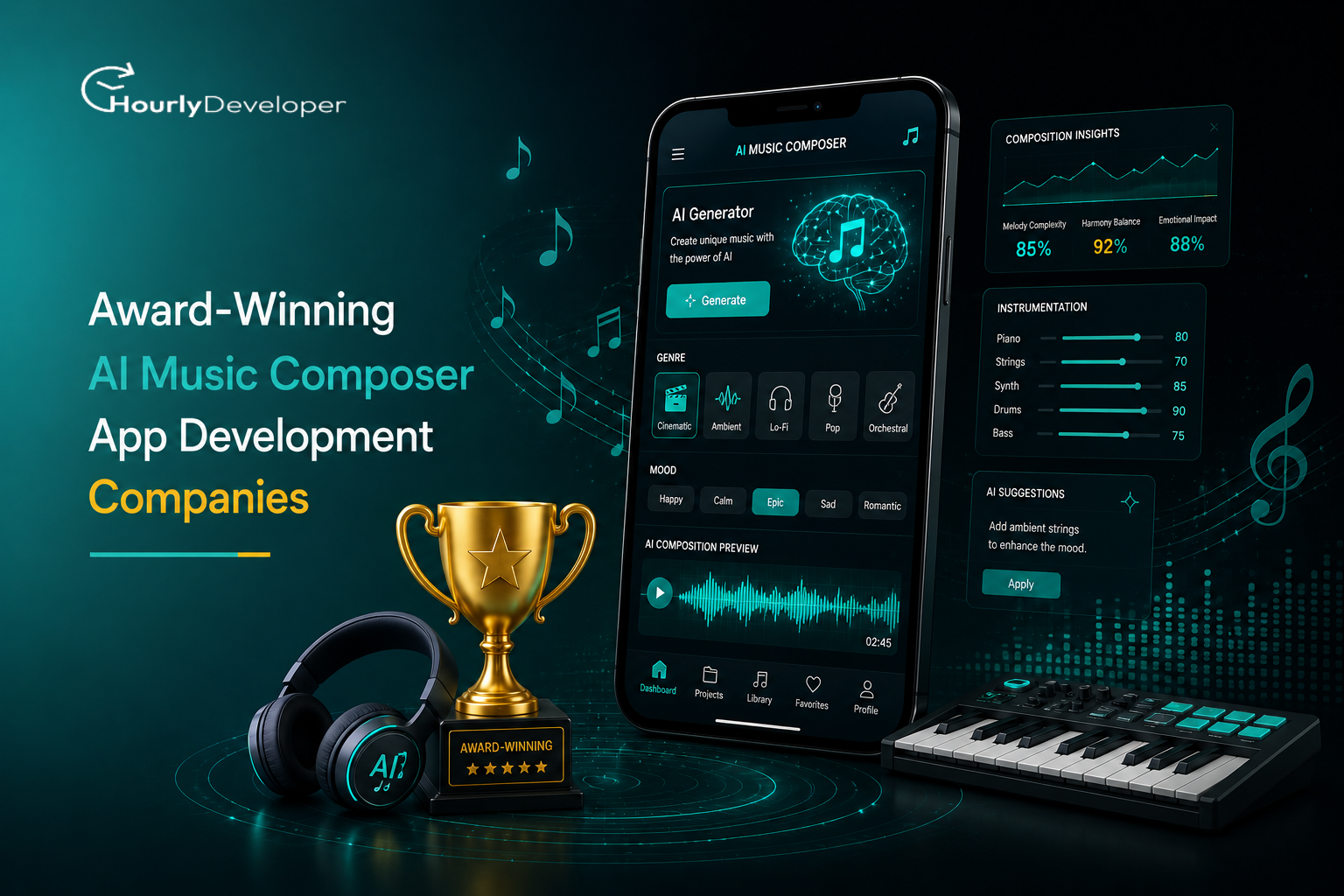
Award-Winning AI Music Composer App Development Companies
Introduction
Award-Winning AI Music Composer App Development Companies
1.Why AI Music Composer Apps Are Having Their Moment in 2026
A few years ago, AI generated music sounded like exactly what it was, technically correct but emotionally flat. Newer transformer based models have closed a lot of that gap, and the result is an app category that is finally good enough for real use cases, not just demos shown on a stage.
Podcasters want royalty free background scores without paying a composer for every episode. Game studios want adaptive soundtracks that shift with gameplay in real time. Independent artists want a co writer that never runs out of ideas at 2 a.m. Marketing teams want on brand jingles produced in hours instead of weeks. Each of these needs a slightly different technical approach, which is exactly why the field has room for so many capable, differentiated companies rather than one dominant player.
There is also a business reason 2026 feels different from even two years ago. Cloud GPU costs have come down enough that real time generation is financially viable for consumer apps, not just enterprise tools with deep budgets. That single shift has opened the door for more teams to build genuinely responsive, low latency music apps instead of ones that make users wait several minutes for a render and then quietly close the tab.
It also means the field has gotten more crowded, which is good for buyers but makes picking the right partner harder. A company that built a great chatbot last year is not automatically qualified to build a music generation engine this year. Audio has its own set of technical demands, from sample rate handling to instrument layering, that a general purpose AI team may never have touched before.
None of this is purely academic for a founder holding a budget. Every one of these shifts changes what a realistic project timeline and cost estimate looks like compared to even 18 months ago, which is exactly why it is worth comparing several development partners side by side rather than signing with the first team that returns a proposal. A short paid discovery phase with two finalists is often the cheapest insurance a founder can buy before a much larger build begins.
2.What to Check Before You Hire AI Music App Developers
Before signing anything, ask to see actual audio output from a company’s past projects, not just a pitch deck full of screenshots. A generative music engine either sounds convincing or it does not, and no amount of UI polish can hide a model that produces flat, repetitive compositions.
It is also worth asking directly how a team plans to hire AI music app developers internally for your project, meaning whether you get dedicated engineers who stay on the account for its full duration or a rotating pool that changes every few sprints. Continuity matters more in generative AI work than in most other software categories, since so much of the quality comes from iterative fine tuning that benefits from institutional memory.
Finally, get clarity on licensing and data provenance early. A company that cannot explain what data trained its model, or how generated tracks are licensed for commercial use, is a bigger legal risk than a slightly higher hourly rate.
It also helps to ask a development partner how they measure success on a project like this. A team that only talks about sprint velocity and ticket counts is thinking about your app the way it would think about any other software product. A team that also talks about listening tests, genre coverage, and user retention on generated tracks is thinking about it the way a music product actually needs to be evaluated, which tends to produce a noticeably better end result.
3.15 Award-Winning AI Music Composer App Development Companies
Here is a closer look at the companies shaping this space right now, mixed deliberately rather than ranked strictly by size, since the right partner depends heavily on your budget, timeline, and the specific kind of music app you are trying to build. Some entries lean toward large scale delivery capacity, others toward tighter, more specialized teams, and both approaches show up regularly among genuinely capable partners in this space. Read each profile with your own project’s scale and timeline in mind rather than treating the order as a ranking.
HourlyDeveloper built its reputation around a simple idea, letting clients bring on experienced AI and mobile engineers by the hour instead of committing to a fixed project scope upfront. For a category like an AI Music Composer App, where the right feature set often only becomes clear after a few rounds of user testing, that flexibility genuinely matters. The team covers everything from model integration and audio pipeline engineering to the mobile front end, and clients frequently start small, testing a single generation feature, before scaling the engagement once the concept proves out. It is a practical entry point for founders who are not ready to sign a large fixed bid contract but still want senior level development talent from day one, and it removes much of the friction that usually comes with trying to hire AI music app developers on a traditional retainer. Clients also point to the transparency of hourly billing itself, since it is easy to see exactly what a sprint went toward, whether that was model tuning, audio pipeline work, or interface polish.
Appinventiv is a Noida headquartered digital engineering company founded in 2015 that has grown into a 1,600 plus person organization with offices across the US, UK, UAE, and Australia. Its AI practice has delivered generative AI and machine learning projects across entertainment, healthcare, and fintech, and the company has picked up recognition including Deloitte Technology Fast 50 honors in recent years, part of what earns it a place among genuinely award-winning AI music composer app development companies rather than just another large agency. For a music composer app specifically, Appinventiv brings strength in scalable cloud architecture, which matters a lot once a generative model needs to serve thousands of concurrent requests without lag. The company also runs a dedicated generative AI division internally, which is useful if your project needs both a custom model and a polished consumer facing app built under one roof.
As the name suggests, this team specializes in the unglamorous but critical part of an AI Music Composer App, the infrastructure that sits behind the interface. That includes model hosting, audio file processing pipelines, queue management for generation requests, and the APIs that connect a mobile or web front end to the AI engine. Founders who already have a design partner or front end team often bring in Backend Development Company specifically to make sure the heavier lifting, like handling GPU load during peak usage or storing large volumes of generated audio efficiently, does not become a bottleneck later in the product’s life. It is a good fit for teams that have already validated their idea and now need the technical foundation strengthened before scaling to a larger user base.
Chetu is a US based custom software company founded in 2000 and headquartered in Sunrise, Florida, with more than a dozen offices spanning the US, Europe, and Asia. With over 2,800 developers on staff, Chetu has built a reputation for delivering deeply customized, industry specific software rather than templated products, which suits clients who need an AI music app tailored to a very particular workflow, such as sync licensing tools for film studios or custom audio editors for streaming platforms and podcast networks. Its scale also means it can staff a project quickly without the long ramp up time that smaller boutique teams sometimes need, which matters when a client is racing to capture a market window.
HireFullStackDeveloperIndia focuses on exactly what its name promises, giving clients access to full stack engineers who can move fluidly between the machine learning layer, the backend services, and the user facing app itself. That range is genuinely useful for an AI Music Composer App, because the front end waveform visualizer, the generation logic, and the account and payment system all need to talk to each other constantly, and having one team fluent across all three layers tends to cut down on integration headaches significantly over the course of a build. It also tends to keep communication simpler for a founder, since there are fewer handoffs between separate specialist teams.
Fingent is a global software company founded in 2003, headquartered in Kochi with additional offices in New York, Boston, Dubai, and Melbourne. The company’s work spans enterprise software, cloud computing, and applied AI and machine learning across many industries. Fingent’s strength for an audio focused product lies in its enterprise grade delivery process, which tends to appeal to clients building a music composer app as part of a larger media or entertainment platform rather than as a standalone consumer app, where governance and compliance requirements are often just as important as the AI itself. Founders working with regulated media partners often value this discipline more than raw development speed, particularly when the app needs to integrate with an existing content management or rights management system.
Konstant Infosolutions has been in operation since 2003 and today runs out of Jaipur, India with an additional US presence in California. Over more than two decades, the company has built a broad portfolio across mobile app development, AI and machine learning, and AR and VR projects, and it is regularly listed by review platforms such as Clutch and The Manifest among established mobile development firms. Its long track record makes it a safer bet for founders who prioritize stability and proven delivery over cutting edge experimentation, especially on a first generative AI project. Its long operating history also means most common project risks have already been faced and worked around at least once before, from scope creep to app store rejection issues.
HireAIDevelopers exists specifically for teams that need machine learning expertise without hiring a full time AI department. Its engineers work on the generative models themselves, tuning them for musical coherence, rhythm accuracy, and genre specific style, which is the single hardest technical piece of building any credible AI Music Composer App. Founders who already have a mobile app shell in place but need the AI engine built or improved often turn to this team for a focused, model centric engagement rather than a full ground up rebuild. This kind of focused engagement tends to be more cost efficient than hiring a full agency when the app itself is already largely built, since the scope stays narrowly focused on the AI layer itself.
Quytech was founded in 2010 and is headquartered in Gurugram, India, where it has grown into a 200 plus person AI and mobile development company with more than 1,000 delivered projects for clients including Deloitte and Honda. Quytech has published detailed case studies specifically on AI music generator apps, covering everything from RNN and GAN based composition models to real time audio rendering, which gives prospective clients an unusually clear look at how the team approaches this exact type of build before signing a contract, something that separates it from many of the best AI music composer app development companies that only talk about capability in the abstract. Its client roster spanning entertainment, hospitality, and enterprise sectors also suggests a team comfortable adapting its AI work to different creative briefs, rather than applying one rigid template to every project it takes on.
Space-O Technologies is an Ahmedabad based mobile, web, and software development company with more than a decade of delivery experience across iOS and Android platforms. In recent years the company has shifted a meaningful part of its portfolio toward AI powered software, positioning itself as a partner for businesses that want intelligent, scalable applications rather than simple utility apps. That AI first pivot makes it a reasonable option for founders comparing options who also want strong native mobile execution alongside the generative engine. Its decade plus of app store experience also tends to shorten the review and launch process for a new title, which can matter more than founders expect when a launch date is already public.
Founded in 2011 and headquartered in Ahmedabad, Hyperlink InfoSystem has delivered more than 4,500 apps for over 2,700 clients worldwide, with additional offices in New York, London, Canada, France, and the UAE. The company works across AI, IoT, blockchain, and AR and VR, and its sheer delivery volume means it has almost certainly encountered most of the technical curveballs that come up in an audio generation product, from streaming latency to cross platform playback quirks on older devices. That breadth of experience often translates into fewer surprises during QA on a new build, since most edge cases have likely already surfaced on an earlier project.
Matellio is a San Jose headquartered IT consulting firm founded in 2014 that specializes in IoT, artificial intelligence, and machine learning solutions for enterprise clients. Its smaller, more consultative team structure tends to suit founders who want closer, more senior level involvement throughout the build rather than being routed through a large account management layer, which can matter a great deal when the product hinges on getting a generative model’s output to actually sound good rather than merely functional. Its enterprise IoT background also brings useful experience connecting AI systems to hardware, relevant for smart speaker or in car music integrations, an area many pure mobile shops rarely touch.
JPLoft is a music and entertainment focused app development company known for building feature rich, custom music streaming and creation platforms across iOS, Android, and cross platform frameworks. The team has direct experience integrating AI powered song recommendation engines and audio personalization features into existing apps, which makes it a natural fit for clients who want to add generative composition tools onto a product that already has a music streaming foundation in place and an existing user base to serve. Its UI and UX background also tends to shine in apps where discovery and browsing matter as much as generation itself, which is often the case for music apps competing for daily attention against established streaming platforms.
ManekTech has documented case study experience building an AI music generator and editor app that combined RNN, GAN, and VAE models to produce original soundtracks from voice and data inputs, alongside cross platform iOS and Android delivery. That published, verifiable project history is useful for founders who want to see evidence of prior work in this exact niche rather than relying on a general capabilities pitch that has not actually been tested in production. The company also brought in musicians and sound engineers to validate AI output during that build, a quality control step worth asking any prospective partner whether they follow too, since AI output without human review tends to need far more revision cycles later.
TekRevol positions itself as a digital product engineering company with a specific focus on music AI app development, and its public content addresses some of the thornier parts of the category head on, including data privacy in personalized recommendations and the computing demands of real time music generation. For founders who want a partner that clearly understands the ethical and technical trade offs unique to AI composed music, that upfront transparency is a meaningful signal worth weighing alongside price and delivery timeline. TekRevol’s content also frequently references the underlying model families, GANs, RNNs, and transformers, which suggests genuine technical depth rather than marketing language borrowed from elsewhere, a small detail that is often a reliable signal during early vendor research.
4.Conclusion
If there is one thing this list makes clear, it is that there is no single correct way to build an AI Music Composer App. A founder chasing a lightweight, mood based songwriting tool for short form video creators needs a very different partner than a game studio building adaptive, real time soundtracks, and both need something different again from a streaming platform bolting generative features onto an existing catalog.
What matters more than picking the single biggest name on this list is matching a company’s actual delivery history to your specific use case. Ask to see prior audio or generative AI work, not just a general mobile app portfolio. Ask how they handle model training data and copyright exposure, since that question tends to separate teams who have actually shipped a music AI product from those who have not. And be honest with yourself about whether you need a full team or whether a smaller, hourly engagement is enough to validate the idea first before you commit further budget.
The category is still moving fast, and among the companies covered here, the ones willing to publish real case studies, have transparent pricing conversations, and give honest answers about model limitations tend to be the strongest choices, whether you are drawn to the established names or the more specialized teams built specifically around music AI.
Take the time to speak with two or three shortlisted teams before committing, request references from a completed audio or generative AI project specifically, and treat the first conversation as a chance to judge technical depth, not just enthusiasm. That single extra step tends to save far more time and budget than it costs.
Music is one of the more emotionally demanding categories for AI to get right, since listeners notice when something feels slightly off even if they cannot articulate why. That is precisely why the development partner behind an AI Music Composer App matters as much as the underlying model itself, and why a rushed vendor choice tends to show up in the finished product far more visibly than it would in a typical business app.
Ayush, the visionary Director leading our team towards new horizons. With a passion for innovation and a keen eye for opportunities, Ayush drives our company's growth with unwavering determination. His strategic thinking and empathetic leadership inspire us all to achieve greatness together.
Frequently Asked Questions
A basic version with one or two generation modes and a simple mobile interface usually takes 3 to 5 months. Adding features like real time rendering, multi instrument control, or licensing management can extend that to 7 to 9 months, depending on how much custom model training the project needs before launch.
It depends on the budget and goal. Larger, well funded projects often justify training a custom model for a distinct sound signature. Many smaller projects instead integrate an existing generation API and focus development effort on the user experience, licensing logic, and audio post processing layer instead, which shortens the timeline considerably.
Cloud GPU usage for generation requests is usually the largest recurring cost, followed by audio storage, model retraining as the catalog grows, and standard app maintenance. Many companies on this list offer monthly retainer plans specifically to cover these ongoing technical needs after the initial launch, which helps founders budget more predictably.
Yes, in most cases. Teams with prior music app experience, such as JPLoft or ManekTech, typically integrate a generation module as an additional feature layer rather than rebuilding the core app, provided the existing backend can handle the added processing load, though older infrastructure sometimes needs targeted upgrades done first.
Reputable companies build in clear output licensing terms from the start, often training models on licensed or royalty free datasets and adding audit trails for generated tracks. This is worth confirming directly with any shortlisted company before development begins, since practices still vary considerably across the wider industry, and assumptions here can get expensive later.
Find exceptional developers at Hourlydeveloper. Get the expertise, solutions, and teamwork you need for success. Hire developers easily and boost your projects today!
 Back to Blog