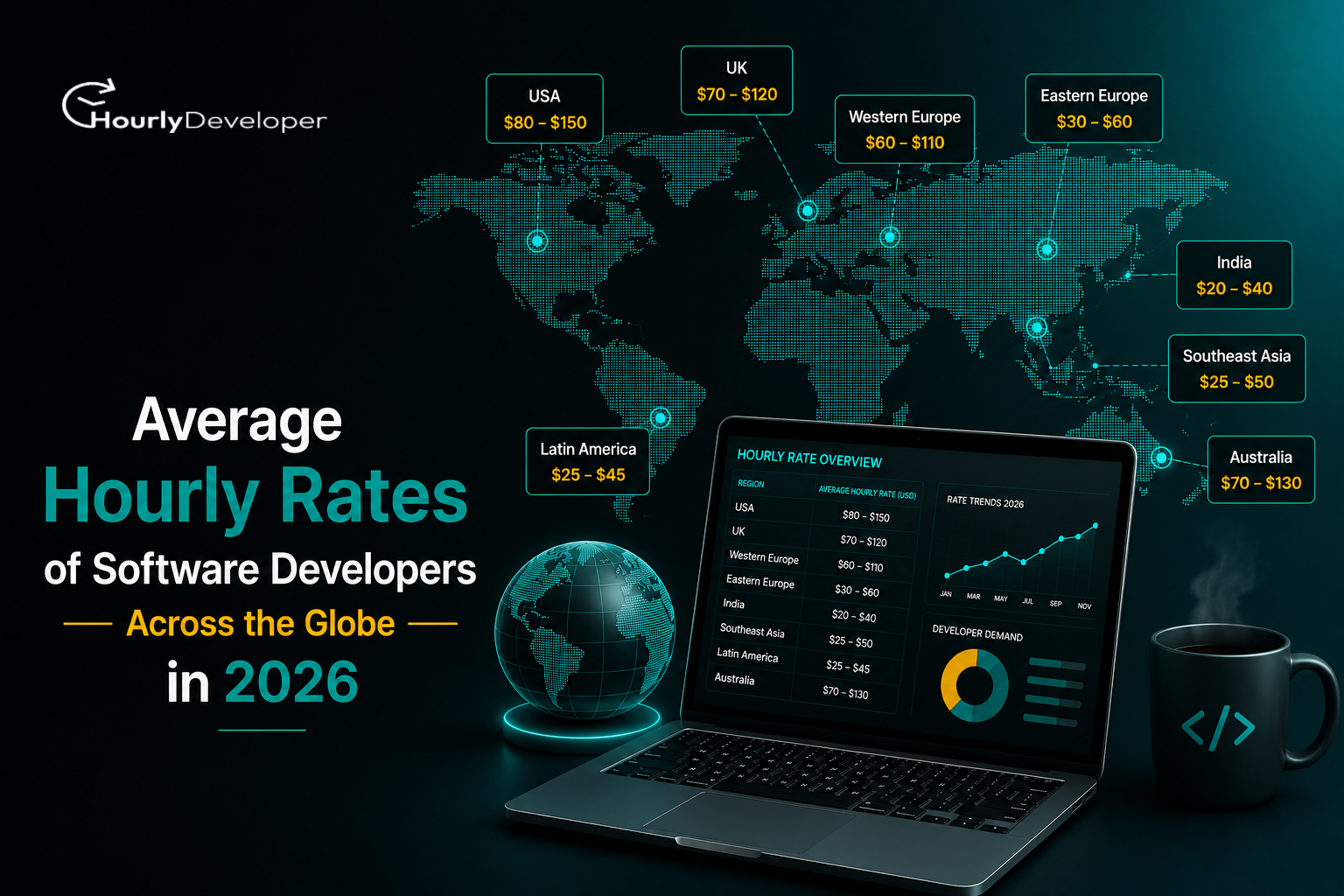
Average Hourly Rates of Software Developers Across the Globe in 2026
Introduction
Average Hourly Rates of Software Developers Across the Globe in 2026
1.Why the Rate You See Is Rarely the Rate You Pay
Most rate guides hand you a number and move on. The honest version of this conversation starts with a confession: software developer hourly charges quoted on a website almost never match the final invoice. There are three reasons for that, and decision makers rarely hear about any of them until after signing a contract.
First, published rates are usually the entry point, not the average. A company advertising thirty dollars an hour for full stack developer hourly rates is talking about the cheapest developer on their bench, not the one who will actually run your project. Second, currency and tax exposure shift the real cost by region, sometimes by ten to fifteen percent, depending on how the contract is structured. Third, the rate almost never includes the ramp up period, which is the two to four weeks a new developer spends just understanding your codebase, your tools, and your business logic before they become fully productive.
None of this means rate cards are useless. It means you should read them as a starting position for a negotiation, not as a final price tag.
There is a fourth reason that rarely gets discussed openly, and it has to do with how agencies allocate their best people. The developer profile on the proposal deck and the developer who actually shows up on day one are sometimes different people, especially at larger outsourcing firms juggling several active accounts. This is not always dishonest, it is simply how staffing works when demand spikes. The lesson for a decision maker is straightforward. Ask for the actual resume of the person assigned to your project before signing, not a generic profile pulled from a sales deck. A reputable vendor will not hesitate to share this, and hesitation itself is useful information.
It also helps to understand that rate cards are built around averages across an entire portfolio of clients, not your specific project. A company that primarily builds simple marketing websites will price differently than one that primarily builds complex fintech platforms, even if both list similar hourly numbers on their homepage. Always ask what kind of projects that rate typically applies to, because the answer often reveals whether your project fits their comfort zone or sits outside it.
2.Software Developer Hourly Rates by Country in 2026
Here is where most guides stop after a single table. We will give you the table, but also tell you what each region is actually good at, because the cheapest country on the list is not always the smartest choice for your project.
Region / Country
Junior (USD/hr)
Mid Level (USD/hr)
Senior (USD/hr)
United States
35 to 55
60 to 95
90 to 160
Canada
30 to 50
55 to 85
80 to 130
United Kingdom
30 to 50
55 to 90
85 to 140
Western Europe
28 to 48
50 to 80
75 to 120
Eastern Europe
20 to 35
35 to 60
55 to 90
India
12 to 22
22 to 40
35 to 65
Southeast Asia
15 to 25
25 to 42
40 to 70
Latin America
20 to 35
30 to 55
50 to 90
Middle East
22 to 38
38 to 65
60 to 100
Australia and New Zealand
32 to 52
55 to 88
85 to 135
Read this table as a range of average hourly rates of software developers across the globe in 2026, not as a fixed price. A senior developer in India working on a niche AI integration can easily out earn a mid level generalist in Eastern Europe. Skill scarcity beats geography almost every time once you move past basic CRUD work.
3.What Most Guides Leave Out About Country Pricing
Time zone overlap has a price tag of its own. A developer who can join your daily standup live is often worth paying three to five dollars more per hour than one who only hands off async updates.
Tax treaties matter more than people realize. Hiring through certain Eastern European entities can mean lower employer side tax burden compared to similarly priced talent in parts of Latin America.
English fluency is not evenly distributed even within a single country. Major tech hubs like Krakow, Ho Chi Minh City, or Bangalore often carry a five to ten percent premium over smaller cities in the same country for senior roles.
Currency volatility has started showing up as a line item. Some agencies in 2026 now quote in a blended currency basket to protect themselves, which quietly raises the effective rate for the client.
There is also a quieter trend worth flagging. Several countries that were considered purely low cost destinations a few years ago have started developing genuine specialization rather than just cheaper generalist labor. Poland and Romania, for instance, have built strong reputations specifically around fintech compliance work, which means their senior rates now sit closer to Western European pricing for that niche, even though their general software development costs remain lower across the board. The same shift is happening in Vietnam around embedded systems and IoT work. If your project happens to match a region’s emerging specialty, you may end up paying a premium compared to that country’s general average, but you are also getting people who have solved your exact category of problem many times before, which often saves money in the long run through fewer mistakes and faster delivery.
Another detail that rarely makes it into rate guides is how public holidays and working week length affect billed availability. A developer in a country with twenty five annual leave days and a thirty five hour standard week will, on paper, complete fewer billable hours per year than one in a market with fewer mandated holidays. This does not change the hourly rate itself, but it does change how many hours you should expect across a quarter, which matters when you are planning a deadline rather than just a budget.
4.Hourly Rates by Developer Role: Full Stack, Frontend, and Backend
Most decision makers assume a developer is a developer. That assumption gets expensive fast. Full stack developer hourly rates, frontend developer hourly rates, and backend developer hourly rates differ not just by skill, but by how replaceable that skill is in 2026.
Developer Role
Junior (USD/hr)
Mid Level (USD/hr)
Senior (USD/hr)
Frontend Developer
18 to 30
32 to 55
50 to 85
Backend Developer
20 to 32
35 to 60
55 to 95
Full Stack Developer
22 to 35
38 to 65
60 to 105
Mobile App Developer
20 to 34
36 to 62
58 to 100
AI and ML Engineer
28 to 45
50 to 85
80 to 150
DevOps Engineer
25 to 40
45 to 75
70 to 120
5.Why Full Stack Costs More Than the Sum of Its Parts
On paper, hiring one full stack developer instead of a separate frontend and backend specialist sounds cheaper. In practice, full stack developer hourly rates carry a premium of roughly fifteen to twenty five percent over a single specialist rate, because you are paying for breadth, context switching ability, and the reduced coordination overhead of not needing two people to sync constantly. For small projects this premium is worth it. For large products with deep technical complexity on both ends, two focused specialists working in parallel often finish faster and cheaper overall, even though their combined rate looks higher on paper.
Backend developer hourly rates have quietly climbed faster than frontend rates in 2026. The reason is not glamorous. It is database architecture, API security, and the sheer number of systems now expected to talk to AI services in real time. Frontend work has become more templated thanks to component libraries and design systems, which has slightly cooled frontend developer hourly rates relative to backend and infrastructure roles.
There is a practical test we recommend before deciding between a full stack hire and two specialists. Sketch your product roadmap six months out. If the frontend and backend work genuinely need to happen at the same pace, in parallel, with frequent independent iteration, specialists usually win on speed. If your roadmap is more sequential, meaning the backend needs to mostly stabilize before the frontend layer gets serious attention, a single full stack developer following the work from one end to the other often avoids the handoff friction that comes from splitting ownership across two people who were never in the same room when the original decisions were made.
Mobile development sits in its own category that many cost guides lump in with general app development, which understates its true price. Native iOS and Android work each carry their own learning curve, their own review cycles through app stores, and their own testing overhead across device fragmentation, particularly on Android. A developer comfortable shipping cross platform frameworks like Flutter or React Native can sometimes undercut native specialists on hourly rate while still covering both platforms, which is why cross platform skills have become unusually valuable for startups trying to launch on a tight runway.
6.The Cost Drivers Nobody Puts in the Rate Card
This is the part most cost guides skip entirely, and it is the part that actually determines your real software development costs. An hourly rate is one input among several. Here are the variables that quietly move your total spend by twenty to forty percent without ever showing up in the original quote.
Hidden Cost Factor
Typical Impact on Total Spend
Onboarding and ramp up time
Adds 5 to 15 hours of billed time before real output begins
Communication overhead across time zones
Can add 10 to 20 percent to project timelines
Code review and QA cycles
Often 15 to 25 percent of total development hours
Tooling, licenses, and infrastructure
Frequently underquoted by 10 to 20 percent
Scope changes mid project
Can add 20 percent or more if not capped contractually
Post launch support and bug fixes
Usually 15 to 20 percent of the original build cost annually
If a vendor’s quote does not mention at least three of these six items, ask why. A quote that looks suspiciously clean is usually a quote where the gaps get filled in later, after you are already committed.
Communication overhead deserves a closer look because it is the cost driver decision makers underestimate most consistently. When a team spans more than two time zones, every decision that needs sign off from both sides effectively gets delayed by a day, not by hours. Over a three month build, that delay compounds into real schedule slippage even though nobody on the team was technically idle at any point. The fix is not always cheaper labor in your own time zone. Sometimes it is simply building a tighter decision making process with fewer approval layers, so that the time zone gap stops being the bottleneck.
Post launch support is the cost category that surprises founders the most, mainly because launch day feels like the finish line when it is really the starting line for a different kind of spend. Bug fixes, security patches, server scaling, and small feature requests do not stop once the product ships. Budgeting fifteen to twenty percent of your original build cost annually for ongoing support is a reasonable baseline, and any vendor who tells you a product needs zero maintenance after launch is either inexperienced or not being fully transparent about how software actually behaves once real users start touching it.
7.Freelancer, Agency, or In House: How the Model Changes the Math
The same skill level can carry three very different price tags depending on how you structure the engagement. This is often the single biggest lever decision makers overlook when comparing software development costs across vendors.
Engagement Model
Relative Hourly Cost
Best Suited For
Independent Freelancer
Lowest, but variable quality
Small, well defined tasks with clear specs
Outsourcing Agency
Mid range, predictable
Full product builds needing accountability
Dedicated Development Team
Mid to high, consistent output
Long term products needing continuity
In House Hire
Highest all in cost
Core product teams needing full ownership
This is exactly where the decision to hire dedicated developers tends to pay off for founders running a product that will live for years, not months. A dedicated team costs more per hour than a freelancer, but you are not paying for new ramp up time every few weeks, and you are not gambling on whether the same person will be available next sprint.
If your need is genuinely short term, decide to hire remote software developers on a project basis instead. The flexibility usually outweighs the slightly higher coordination cost, especially for a single feature build or a time boxed audit.
A detail worth sitting with is how each model handles risk differently rather than just cost. Freelancers absorb almost none of your project risk, which is precisely why they tend to be cheapest. If something goes wrong, your only recourse is finding a replacement and starting over with someone new. Agencies absorb more risk because their reputation depends on delivery, which is part of what you are actually paying for in the higher rate, not just the developer’s time. Dedicated teams sit in between, offering continuity without the full overhead of in house employment, which is why so many growth stage companies in 2026 are choosing this model specifically to hire software developers for products expected to evolve continuously rather than ship once and sit untouched.
In house hiring remains the right call when the work touches your core intellectual property so closely that outside access becomes a genuine business risk, or when the role requires deep, ongoing context that is expensive to rebuild every time a contract ends. The all in cost of an in house hire typically runs thirty to fifty percent above the base salary once you factor in benefits, equipment, recruitment, and management time, which is the comparison founders most often forget to run before assuming an internal hire is automatically cheaper than an external one.
8.What's Actually Changing the Numbers in 2026
Rates do not move in a vacuum. A handful of shifts specific to 2026 are reshaping average hourly rates of software developers across the globe in ways that did not exist even two years ago.
AI assisted coding has compressed timelines for routine work, which has flattened junior rates in saturated markets while senior architecture and review skills have become scarcer and pricier.
Demand for developers who can integrate large language models into existing products has created a new premium tier, often charging thirty to fifty percent above standard backend rates.
Nearshoring has grown sharply across Latin America and parts of Eastern Europe as companies prioritize real time collaboration over the absolute lowest rate.
Hourly billing itself is being challenged. More agencies are shifting toward outcome based or milestone based pricing for well scoped projects, partly because clients got tired of unpredictable invoices.
Specialized compliance heavy industries such as fintech and healthtech are paying a consistent ten to twenty percent premium for developers who already understand the regulatory landscape.
There is one more shift worth naming because almost nobody is talking about it directly yet. Clients are increasingly asking vendors to prove AI usage transparency, meaning they want to know how much of the delivered code was generated with AI assistance versus written manually, partly to assess long term maintainability and partly to negotiate rates accordingly. Some forward thinking agencies have started offering a slightly reduced rate for work where heavy AI assistance is disclosed upfront, since the client is effectively paying for review and architecture rather than raw typing speed. This is a meaningful departure from how hourly billing has worked for the past two decades, and it is likely to reshape software development costs further as the practice becomes more standardized over the next few years.
9.A Simple Way to Decide What You Should Actually Pay
Instead of chasing the lowest number on a rate card, run your decision through three questions. First, how long will this team need to exist. A six week project and a three year product roadmap should never be priced using the same logic. Second, how much real time collaboration do you actually need versus how much you assume you need. Many founders pay a location premium they do not really require. Third, what does a mistake cost you. If a bug in your product costs you customers or compliance fines, the cheapest hourly rate is rarely the cheapest outcome.
Once you have honest answers to those three questions, comparing software developer hourly charges across vendors becomes a much shorter conversation, because you are no longer comparing numbers in isolation. You are comparing numbers against what you actually need them to do.
It also helps to run a simple sanity check on any quote that feels unusually low. Ask the vendor directly what is excluded from the rate. A confident vendor will list it without hesitation, things like project management hours, QA cycles, or infrastructure costs. A vendor who gets vague or defensive when asked this question is signaling that those costs exist and will surface later, just not in writing yet. This single question has saved more founders from budget surprises than any rate comparison spreadsheet ever could, because it forces transparency before money changes hands rather than after.
10.The Real Takeaway Behind All These Numbers
Here is the part nobody tells founders early enough. The cheapest hourly rate and the cheapest project are almost never the same thing. We have seen companies pay forty percent less per hour and still end up spending more overall, simply because nobody accounted for the ramp up time, the rewrites, or the support burden that showed up six months after launch.
So if you take one thing away from this entire breakdown, let it be this. Use the rate tables to set realistic expectations, not to make the final call. The decision that actually saves money is matching the right engagement model, the right skill level, and the right time zone to the actual shape of your project. Get that match right, and the hourly number stops being scary and starts being just another input you already know how to read.
Ravi Patel, the dynamic Director at the helm of our team's journey towards excellence. Fueled by boundless creativity and a knack for seizing opportunities, Ravi propels our company forward with resolute determination. His strategic acumen and compassionate guidance empower us to reach unprecedented heights as a cohesive unit.
Frequently Asked Questions
Usually not by default. Most quoted hourly rates cover hands-on coding time only. Project management, QA coordination, and client communication are often billed separately or bundled into a higher blended rate, so always ask whether oversight hours are included before comparing two quotes side by side.
Niche skill scarcity plays a bigger role than years of experience. A five year backend developer skilled in legacy systems may charge less than a three year developer who specializes in AI integration, simply because demand for that specific skill currently outpaces the available talent pool worldwide.
It depends on project complexity. For smaller builds, one full stack hire often costs less overall despite a higher hourly rate, since you avoid coordination overhead. For complex products needing deep frontend and backend work simultaneously, two specialists working in parallel frequently finish faster at a similar total cost.
A realistic buffer is twenty to thirty percent above the base quote. This covers onboarding time, scope adjustments, and the inevitable extra QA cycles that rarely appear in an initial estimate but consistently show up once development actually begins.
Yes. Fixed price projects often bake in a risk premium since the vendor absorbs scope uncertainty, while dedicated hourly contracts tend to reflect a more accurate real time cost. Long term dedicated arrangements also typically unlock lower effective rates through volume based discounts.
Find exceptional developers at Hourlydeveloper. Get the expertise, solutions, and teamwork you need for success. Hire developers easily and boost your projects today!
 Back to Blog