How Much Does an AI-Powered Website Redesign Cost in 2026?
Introduction
How Much Does an AI-Powered Website Redesign Cost in 2026?
1.Why 2026 Is a Different Year for Website Redesign Budgets
Until recently, redesigning a website was a relatively contained exercise. You refreshed the design, updated the content, maybe improved the navigation, and handed it off. The AI component, if it existed at all, was usually a third-party widget someone bolted on at the end.
That model has essentially collapsed. Buyers now expect Artificial Intelligence website development to be baked in from the architecture stage, not added as an afterthought. The practical consequence of this is that redesigns in 2026 involve a completely different set of decisions, and therefore a completely different pricing logic.
Three shifts are driving this in a meaningful way:
AI infrastructure is no longer optional for competitive digital presence. Visitors have been conditioned by personalized experiences on platforms like Amazon and Netflix. A static brochure site now feels visibly dated in a way it did not two years ago.
The cost of AI capabilities has dropped significantly, but integration complexity has not. Open-source models and cloud-based APIs have made certain AI features accessible at lower raw cost, but embedding them cleanly into an existing architecture still requires genuine engineering skill.
The vendor landscape has fragmented. You now have generalist web agencies adding AI features, specialist AI Software Development Companies entering the web space, and offshore teams that have gotten genuinely competitive on both quality and price. Comparing quotes across these three types of vendors without a shared framework is nearly impossible.
2.The Real Cost Breakdown: What You Are Actually Paying For
When an AI Development Company gives you a proposal, the total number is a composite of several distinct cost components. Understanding which components are driving the price in your specific proposal is the first step to evaluating it honestly.
1. Design and UX Strategy
This covers the visual redesign, wireframing, user journey mapping, and the foundational UX architecture. In a standard redesign this typically runs between $8,000 and $25,000 depending on the size of the site and the agency tier. What changes in an AI-powered redesign is that the UX strategy has to account for dynamic content zones, personalization triggers, and conversational interface design. Expect this component to run 20 to 40 percent higher than a traditional redesign UX cost.
2. Frontend Development
Converting the design into a live, responsive, production-ready frontend. The complexity here increases when the frontend needs to handle real-time data rendering, AI-driven layout variations, and integration with personalization APIs. A clean frontend build for a mid-size business site in 2026 typically runs $12,000 to $35,000. Sites with heavy AI interactivity can push this into the $40,000 to $60,000 range.
3. AI Feature Integration
This is the line item that varies most wildly between proposals and deserves the most scrutiny. The cost depends entirely on which AI capabilities are being built and at what depth.
AI Feature
Complexity Level
Estimated Cost Range (USD)
AI chatbot integration (FAQ level)
Low
$3,000 to $8,000
AI chatbot integration (conversational, CRM-linked)
Medium
$10,000 to $25,000
Personalized content engine
Medium to High
$15,000 to $45,000
AI-powered search with intent matching
Medium
$8,000 to $20,000
Generative AI content generation (landing pages)
High
$20,000 to $60,000
Predictive recommendations engine
High
$25,000 to $70,000
Full AI-native site architecture
Very High
$80,000 to $200,000+
These ranges assume integration into an existing or redesigned frontend. Building the AI layer from scratch on proprietary infrastructure adds significant cost and timeline. Most businesses working with a reputable AI Web Development Services provider are leveraging existing APIs and frameworks, which is what keeps costs in the lower to mid range.
4. Backend Infrastructure and Data Plumbing
AI features do not run on air. They require a backend that can store user behavior data, pass it to the AI layer, receive outputs, and render them in real time without slowing the site down. For businesses that do not already have this infrastructure, building it is one of the most underquoted components in typical proposals.
Budget $10,000 to $30,000 for a solid backend infrastructure build if you are starting from a relatively basic setup. Businesses with existing data infrastructure and well-documented APIs can often reduce this significantly.
5. CMS and Content Operations Integration
Your team still needs to manage the site. An AI-powered site that requires a developer to touch every content update is a liability, not an asset. Proper integration with a headless CMS, combined with training your content team to work alongside AI-generated content workflows, is a genuine cost that rarely gets a standalone line item in proposals.
Expect $5,000 to $15,000 for CMS selection, configuration, and workflow setup. Factor in an additional $3,000 to $8,000 for team training and documentation if your organization is new to AI-assisted content operations.
6. Testing, QA, and Performance Optimization
AI features introduce a new category of testing requirement. You are not just checking that buttons work and forms submit. You are verifying that the AI is responding correctly across a wide range of inputs, that personalization logic is not surfacing inappropriate content to certain user segments, and that the overall site performance has not been compromised by the additional processing load.
Allocate 12 to 18 percent of your total project budget for QA in an AI-powered redesign. On a $100,000 project, that is $12,000 to $18,000. Underinvesting here is where companies end up with live sites that behave unpredictably under real traffic conditions.
3.Total Budget Ranges by Project Type
Putting these components together, here is how AI website redesign cost in 2026 typically breaks down across four common project profiles:
Project Profile
What Is Included
Typical Total Budget (USD)
Starter AI Redesign
Refreshed design, basic AI chatbot integration, standard CMS
$18,000 to $40,000
Mid-Market AI Redesign
Full design overhaul, personalization engine, AI search, CRM integration
$50,000 to $95,000
Enterprise AI Redesign
Custom AI layer, generative content tools, predictive features, multi-language
$100,000 to $250,000
AI-Native Web Platform Build
Ground-up build with AI as core architecture, proprietary model fine-tuning
$200,000 to $500,000+
These are not worst-case numbers. They reflect what businesses are actually spending when projects are scoped properly and delivered by a competent AI Development Company. Projects that come in below these ranges are typically either narrower in scope than originally presented or are cutting corners on infrastructure and testing.
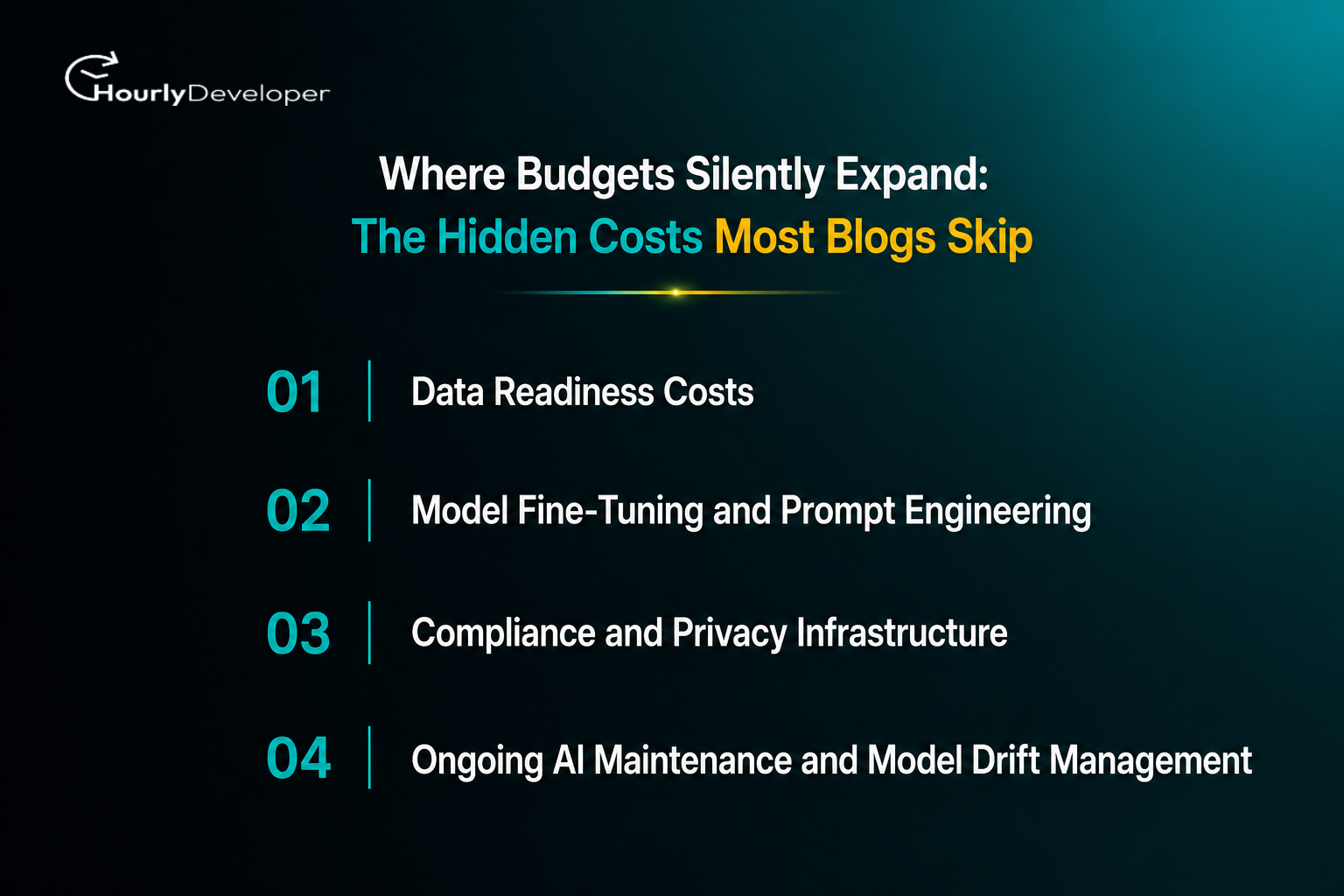
4.Where Budgets Silently Expand: The Hidden Costs Most Blogs Skip
This is the section most cost guides gloss over because it requires acknowledging that AI website development is genuinely more complex to estimate than traditional web development. Here are the costs that regularly appear mid-project:
Data Readiness Costs
Personalization engines and recommendation systems need data to work from. If your current site has not been systematically collecting behavioral data, or if the data you have is fragmented across multiple systems, you need to fix that before the AI features can function correctly. Data audits, migration work, and event tracking implementation can add $8,000 to $25,000 to a project that did not budget for it upfront.
Model Fine-Tuning and Prompt Engineering
Out-of-the-box AI models are not tuned for your brand voice, your audience, or your product category. Getting them to behave the way you actually want requires skilled prompt engineering and sometimes lightweight model fine-tuning. This work is often quoted separately or not quoted at all in initial proposals. Budget $5,000 to $20,000 for this depending on the number of AI features being deployed.
Compliance and Privacy Infrastructure
AI features that track user behavior, personalize content, or store conversation history have compliance implications that vary by region. GDPR in Europe, PDPA in Asia, and evolving AI-specific regulations in multiple jurisdictions mean you may need consent management infrastructure, data retention policies, and legal review that your standard web agency is not equipped to handle. Factor in $5,000 to $15,000 for compliance architecture if you are operating across multiple regions.
Ongoing AI Maintenance and Model Drift Management
AI models do not stay calibrated forever. User behavior changes, your product catalog changes, your audience segments shift. Without active monitoring and periodic retraining, your AI features degrade in quality over time in ways that are difficult to detect until they are causing real problems. Plan for an ongoing maintenance budget of 15 to 20 percent of your initial AI development cost annually.
5.Offshore vs Onshore vs Hybrid: How Vendor Choice Changes Your AI Website Development Cost
The geography and model of your development partner has a significant impact on what you pay for AI Web Development Services. Here is a realistic picture of what each model delivers and at what cost:
Vendor Model
Hourly Rate Range
Best Suited For
Key Trade-offs
US or UK Based Agency
$120 to $250/hr
Enterprise projects with complex compliance needs
Highest cost, strong communication, local accountability
Hire AI Developers Offshore (India, Eastern Europe)
$35 to $80/hr
Mid-market projects with clear specs
Cost advantage, quality varies widely by vendor
Hire Full Stack Developer India Model (Dedicated Team)
Hybrid Model (Strategy onshore, execution offshore)
$60 to $120/hr blended
Complex projects needing both quality and cost control
Best of both but requires experienced coordination
The offshore model has matured considerably. Companies like HireFullStackDeveloperIndia, Backend Development Company, and WebClues Infotech are delivering work that competes with mid-tier Western agencies at 40 to 60 percent of the cost. The differentiator is no longer raw capability but communication quality, project management discipline, and the depth of AI-specific expertise within the team.
When you Hire AI Developers through a reputable offshore or nearshore partner, the real risk is not skill quality. It is misaligned expectations during the discovery phase, which is why investing in a thorough scoping engagement before signing a full contract is worth every dollar.
6.What to Look for When Evaluating an AI Development Company
Not every agency that calls itself an AI Development Company has actually delivered AI-powered web projects at scale. Here is what separates the vendors worth talking to from the ones who are learning on your budget:
They ask about your data infrastructure before they ask about your design preferences. AI features without clean data are promises without foundations.
They can show you live examples of AI chatbot integration or personalization engines they have built, not just mockups or case study screenshots.
They have a defined process for model selection and prompt architecture. Generative AI development companies that treat the AI stack as a black box cannot troubleshoot it when things go wrong.
They price QA and testing as a dedicated component, not an afterthought. Any proposal that bundles testing into a vague line item is a flag.
They are honest about what AI cannot do well yet. A vendor that promises every feature without acknowledging limitations is selling enthusiasm, not expertise.
Companies worth evaluating include HireAIDevelopers, DataEximIT, and HireFullStackDeveloperIndia for offshore engagements, and any of the larger generative AI development companies for enterprise-scale projects where compliance and integration complexity are primary concerns.
7.How to Structure Your Budget as a Decision-Maker
If you are coming into this with a fixed budget, here is a practical way to think about allocation:
Budget Component
Recommended Allocation
Discovery, Strategy, and Scoping
10 to 15 percent
Design and UX
15 to 20 percent
AI Feature Development
25 to 35 percent
Backend Infrastructure
15 to 20 percent
QA, Testing, and Performance
12 to 18 percent
CMS Integration and Training
5 to 10 percent
Contingency (for scope changes)
10 to 15 percent
The contingency line is the one most executives push back on. It feels like budgeting for failure. It is actually the opposite. AI website development projects consistently reveal complexity during build that was not visible during scoping. Having a contingency budget means that complexity gets addressed properly rather than cut to stay within a number that was never realistic.
8.Choosing the Right Partner: Key Questions to Ask Before You Sign
Before you commit to an AI Development Company or a team of offshore developers, run these questions through the evaluation process:
Can you walk me through how you approached AI architecture on a recent project at a similar scale? What data pipeline did you use and how did you handle model drift?
What happens when the AI behavior diverges from expected outputs six months post-launch? What is your support and maintenance model?
How do you handle user privacy and consent for behavioral data collected by AI personalization features?
What is your process when mid-project complexity reveals that the initial scope was underestimated?
Can you separate the AI development cost from the general web development cost in your proposal so we can evaluate them independently?
Vendors who answer these questions with specifics are worth advancing. Vendors who answer with generalities are telling you something important about how the project will go.
9.Conclusion
Here is the honest version of where things stand in 2026. The technology to build a genuinely intelligent, adaptive, personalized website has never been more accessible. The gap between a compelling AI-powered site and a conventional one has never been more commercially visible. And the number of vendors claiming to offer AI Web Development Services has never been higher.
What has not changed is the basic principle that underlies every successful technology investment: you get what you plan for. The AI website development cost you end up paying is a direct reflection of how clearly you defined what you were trying to build and how carefully you vetted the team you trusted to build it.
Whether you are looking to Hire AI Developers for a contained integration project or evaluating AI Software Development Companies for a complete platform rebuild, the single most valuable thing you can do before signing anything is to get extremely specific about what success looks like twelve months after launch. Not the features. The outcomes. The metrics. The user behaviors you want to change.
Vendors who can engage with that conversation seriously are the ones worth writing a check to. The rest are selling a website.
Nainesh Pandya, our astute Director, navigates our team toward unprecedented success. With a fervent dedication to innovation and a sharp business acumen, Nainesh propels our company forward with resolute determination. His strategic foresight and compassionate guidance motivate us to scale new heights collaboratively.
Frequently Asked Questions
Yes, but not in a straightforward way. Page count matters less than data complexity and integration surface area. A 20-page site with deep CRM integration and behavioral tracking requirements can cost more to redesign with AI than a 100-page marketing site with no backend dependencies. Always scope based on functional complexity, not page volume.
Yes, and in many cases this is the smarter approach. Starting with a single high-impact AI feature, such as AI chatbot integration or intelligent search, lets you validate ROI before committing to a full AI layer build. Modular architecture from the start is essential here so later additions do not require rebuilding the foundation.
For a mid-market project, plan for five to eight months from discovery to launch. Enterprise projects with proprietary AI model development can run twelve to eighteen months. The AI testing and calibration phase alone adds four to six weeks over a standard web project. Compressed timelines almost always result in AI features that underperform at launch.
A web agency adds AI as a capability layer on top of traditional web development. A dedicated AI Development Company starts from the AI architecture and works outward. For projects where AI is central to the value proposition rather than a supplementary feature, the latter tends to produce better results but comes with higher coordination requirements and often higher cost.
For most mid-market businesses, a SaaS-based AI layer through providers like OpenAI, Google Vertex, or AWS Bedrock is the cost-effective choice. Proprietary model ownership only makes commercial sense when your data is sufficiently unique, your usage volume is very high, or your compliance requirements prohibit sending data to third-party infrastructure.
Find exceptional developers at Hourlydeveloper. Get the expertise, solutions, and teamwork you need for success. Hire developers easily and boost your projects today!
 Back to Blog