1.Why Node.js Dominates Real-Time App Development
Before getting to know about hiring strategy, it’s worth understanding why Node.js has become the go-to choice for real-time application architecture because understanding the technology helps you evaluate the talent.
Node.js operates on a non-blocking, event-driven I/O model. In plain terms, this means it doesn’t sit around waiting for one request to finish before handling the next one. It juggles thousands of concurrent connections efficiently, making it ideal for apps where data is constantly flowing — think live sports scores, real-time notifications, collaborative document editing, or IoT device monitoring.
Compare this to traditional server-side languages that spawn a new thread for every connection. At scale, that model eats memory and degrades performance fast. Node.js sidesteps that problem entirely using its single-threaded event loop.
Add to this the fact that Node.js uses JavaScript; the same language that runs in the browser and you’ve got a unified language stack across frontend and backend. This is exactly why companies that invest in Node.js Development often pair it with the MEAN stack (MongoDB, Express.js, Angular, Node.js) to build end-to-end JavaScript applications. And it’s why the demand to hire MEAN Stack Developers and Node.js specialists has grown in parallel.
The numbers back this up too. Node.js is used by over 6.3 million websites globally, and companies like Netflix, LinkedIn, Uber, and Trello have all built core real-time features on it. When LinkedIn moved its mobile backend to Node.js, they went from running 30 servers to just 3 — while handling double the traffic. That’s not a marketing claim; that’s a documented architectural win.
2.The Real Skills Gap
Most job descriptions for Node.js developers read like a generic checklist: “3+ years of Node.js, experience with REST APIs, knowledge of databases.” These requirements are baseline, not differentiating. They’ll get you a developer who knows Node.js — but not necessarily one who knows how to build real-time systems at scale.
When you hire NodeJS Developers for real-time applications specifically, you need to go deeper.
WebSocket and Socket.io proficiency is non-negotiable. Real-time communication between client and server relies on persistent connections — not the request-response cycle of traditional HTTP. A developer who hasn’t built with WebSockets or Socket.io has never really built a real-time system.
Event-driven architecture understanding matters more than framework familiarity. Node.js’s power comes from its event loop. Developers who understand this deeply write efficient, non-blocking code. Those who don’t will accidentally write synchronous blocking operations that kill performance exactly when you need it most.
Message queues and pub/sub systems are the unsung heroes of real-time. Real-world real-time apps use Redis Pub/Sub, RabbitMQ, Kafka, or similar tools to handle messaging between services. If your developer has never worked with these, you’ll hit scalability walls fast.
Database fluency — both relational and NoSQL. Real-time apps often use MongoDB for its flexibility, but they also need Redis for caching and in-memory data access. A good hire will know when to use which, and why.
Clustering and load balancing. Node.js is single-threaded, which means on multi-core servers, you need clustering strategies to take full advantage of hardware. Developers who understand this prevent performance bottlenecks before they happen.
When you hire Backend Developers for real-time systems, this is the depth you should be testing for. Not just “Do you know Node.js?” but “Have you built systems that stay performant under real load?”
3.Where to Look: The Right Channels to Hire NodeJS Developers
The sourcing strategy matters as much as the interview process. Here’s where companies consistently find strong Node.js talent in 2026.
- Dedicated tech hiring platforms like Toptal, Arc.dev, and Lemon.io pre-vet developers through technical screenings, which saves hiring teams significant time. These platforms work best for companies that need to move fast and can’t afford a three-month hiring cycle.
- Freelance marketplaces like Upwork and Freelancer give you access to a wide talent pool, but the vetting responsibility shifts entirely to you. You’ll find great developers here — but you’ll have to dig through noise to find them.
- Partnering with a NodeJS Development Company is often the smartest move for product companies that need a full team rather than individual contributors. A quality Node.js development firm brings developers, architects, QA engineers, and project managers under one roof. They’ve already built the team you’re trying to assemble. This model is especially effective for Real-Time App Development Services where the scope is well-defined and timelines are aggressive.
- LinkedIn and GitHub remain underrated sourcing channels. GitHub in particular tells you things a resume never will — open source contributions, code quality, and how a developer thinks through problems. Search for contributors to popular Node.js libraries or Socket.io repositories and you’ll find developers who are genuinely invested in the ecosystem.
- Tech community platforms like Stack Overflow Jobs, Hacker News (“Who’s Hiring” threads), and Dev.to have active communities of developers who are often open to new opportunities and tend to be self-directed learners.
4.Hiring Models: Freelancer vs. Full-Time vs. Development Partner
One of the most consequential decisions you’ll make isn’t who to hire — it’s how to hire. The three primary models each carry real tradeoffs.
- Freelance / contract Node.js developers work well for specific, scoped projects — building a real-time notification module, adding WebSocket support to an existing app, or handling a short-term development sprint. They’re flexible and often cost-effective. The risk: availability isn’t guaranteed, and project continuity can suffer if the engagement ends abruptly.
- Full-time in-house developers give you maximum control, deep product knowledge over time, and cultural alignment. If Node.js development is central to your long-term product roadmap, building an in-house team is the right call. The tradeoff is time — recruiting, onboarding, and ramping up can take months.
- Engaging a NodeJS Development Company sits between these two. You get a dedicated team that works exclusively on your project, with the flexibility to scale up or down based on project phases. For companies building Real-Time App Development Services for the first time, this model de-risks the engagement significantly. The agency handles team management; you own the product direction.
The decision often comes down to one question: Are you building a product feature or a product company? A feature gets a contractor. A company needs a team.
5.The Real Cost of Hiring Node.js Developers: A Complete Breakdown
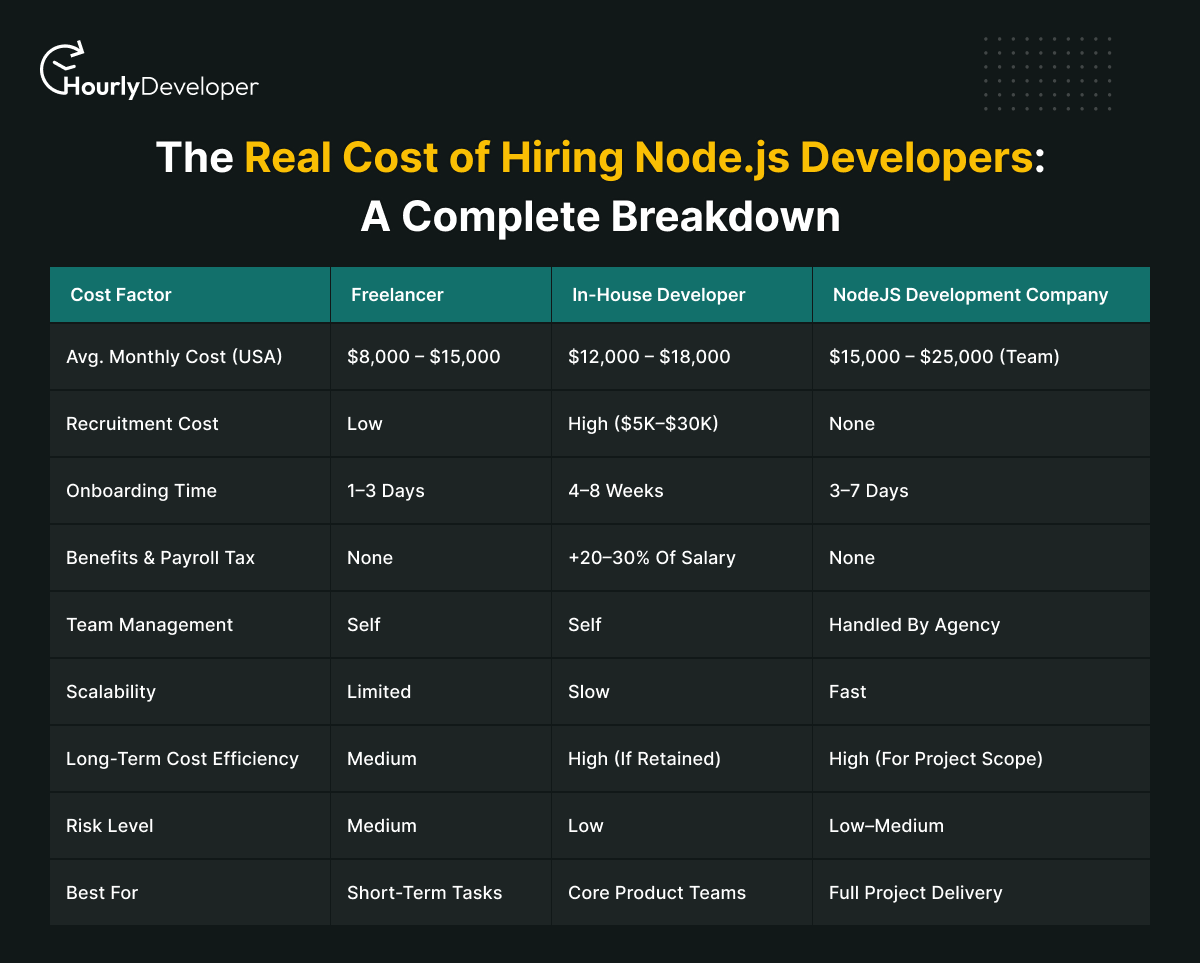
Most hiring decisions start with one number; the developer’s rate. But that number rarely tells the full story. Whether you’re comparing a freelancer to a full-time hire or weighing offshore options against local talent, the true cost of hiring goes much deeper than a monthly invoice.
Here’s a transparent breakdown to help you budget smarter.
| Cost Factor |
Freelancer |
In-House Developer |
NodeJS Development Company |
| Avg. Monthly Cost (USA) |
$8,000 – $15,000 |
$12,000 – $18,000 |
$15,000 – $25,000 (team) |
| Recruitment Cost |
Low |
High ($5K–$30K) |
None |
| Onboarding Time |
1–3 days |
4–8 weeks |
3–7 days |
| Benefits & Payroll Tax |
None |
+20–30% of salary |
None |
| Team Management |
Self |
Self |
Handled by agency |
| Scalability |
Limited |
Slow |
Fast |
| Long-Term Cost Efficiency |
Medium |
High (if retained) |
High (for project scope) |
| Risk Level |
Medium |
Low |
Low–Medium |
| Best For |
Short-term tasks |
Core product teams |
Full project delivery |
6.Hourly Rates by Country
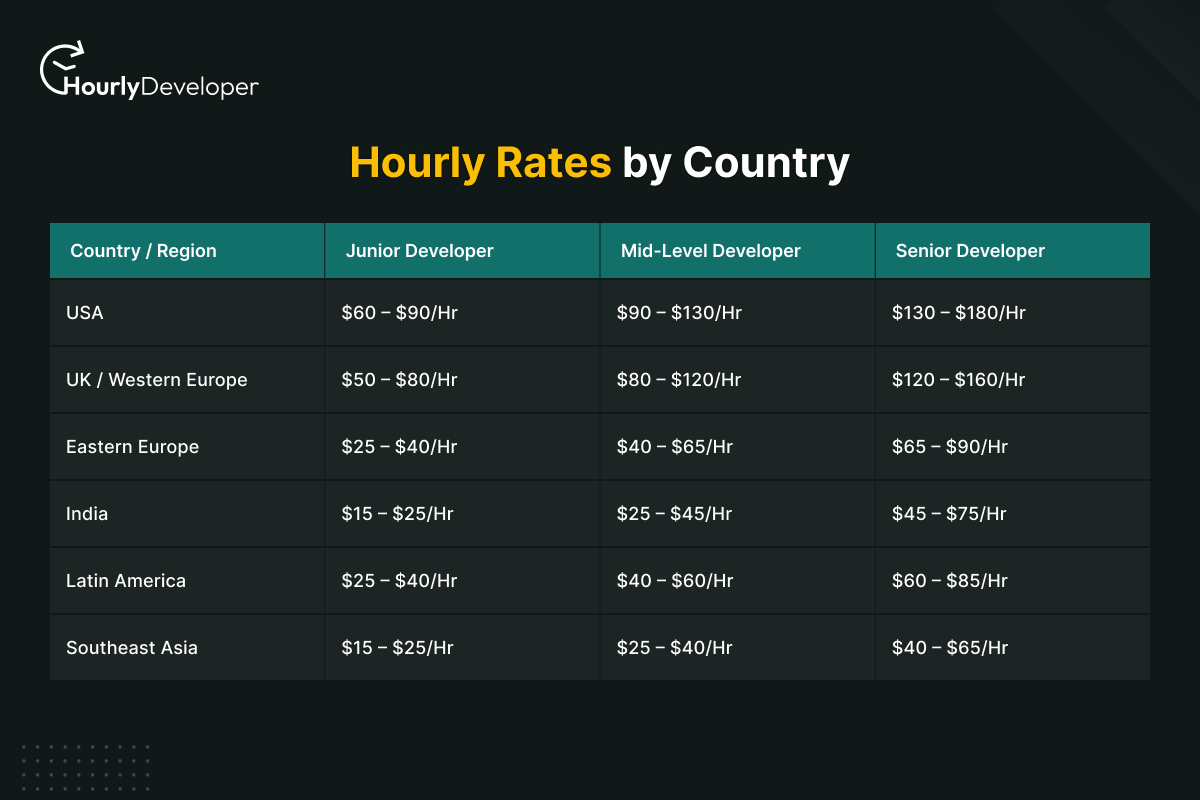
Developer rates vary significantly across geographies and the gap between regions has stayed wide in 2026. Here’s what you can realistically expect to pay based on experience level and location:
| Country / Region |
Junior Developer |
Mid-Level Developer |
Senior Developer |
| USA |
$60 – $90/hr |
$90 – $130/hr |
$130 – $180/hr |
| UK / Western Europe |
$50 – $80/hr |
$80 – $120/hr |
$120 – $160/hr |
| Eastern Europe |
$25 – $40/hr |
$40 – $65/hr |
$65 – $90/hr |
| India |
$15 – $25/hr |
$25 – $45/hr |
$45 – $75/hr |
| Latin America |
$25 – $40/hr |
$40 – $60/hr |
$60 – $85/hr |
| Southeast Asia |
$15 – $25/hr |
$25 – $40/hr |
$40 – $65/hr |
A few things worth noting:
- Eastern Europe and Latin America offer the best balance of cost, timezone overlap with the USA, and English communication quality.
- India remains the most cost-effective option for senior talent, with a large, mature Node.js developer pool.
- USA-based developers command premium rates, but for client-facing products where real-time collaboration matters, the investment often pays off.
- Rates from a NodeJS Development Company are typically bundled — you’re paying for a team, not an individual, which changes the per-output cost calculation entirely.
7.The Hidden Costs of a Bad Hire
This is the number nobody puts in their hiring budget — and it’s usually the most expensive line item of all.
Hiring the wrong Node.js developer doesn’t just cost you their salary. It costs you time, momentum, and in real-time app development, it can cost you your product’s reliability.
Here’s what a bad hire actually costs:
- Recruitment Do-Over: $5,000 – $30,000 Job postings, recruiter fees, interview hours across your team, background checks — you pay all of this twice when the first hire doesn’t work out.
- Lost Development Time: 4 – 12 Weeks The average time lost between identifying a bad hire, offboarding them, and getting a replacement up to speed. In real-time app development, that’s not just lost time — it’s missed deadlines and delayed launches.
- Technical Debt Cleanup: $10,000 – $50,000+ Poor Node.js code in real-time systems compounds fast. Blocking operations in async functions, unhandled WebSocket errors, missing rate limiting — fixing bad architecture costs significantly more than writing it right the first time.
- Performance & Reliability Damage A real-time app that drops connections, lags under load, or loses data events doesn’t just frustrate users — it destroys trust. The cost of users churning because of a reliability issue that traces back to poor development is nearly impossible to quantify.
- Manager Bandwidth: 20 – 40 Hours Performance management, additional code reviews, constant course-correction, and exit processes eat deep into leadership time that should be spent on product decisions.
- Security Vulnerabilities Node.js real-time apps handle sensitive data in transit constantly. A developer who doesn’t understand secure WebSocket handling or input validation can introduce vulnerabilities that cost far more to remediate than to prevent.
8.What This Means for Your Hiring Budget
The cheapest hire is rarely the most cost-effective one. A senior Node.js developer at $75/hour who ships clean, scalable real-time architecture is a better investment than a junior at $25/hour who ships something you’ll spend six months fixing.
Budget with the full picture in mind:
- Factor in recruitment, onboarding, and ramp-up time — not just the monthly rate.
- If you’re going offshore, account for the management overhead of running a distributed team.
- If you’re partnering with a NodeJS Development Company, compare their bundled rate against the true all-in cost of an in-house hire — including benefits, taxes, tooling, and time-to-productivity.
The right hire costs money upfront. The wrong one costs far more over time.
9.How to Evaluate Node.js Developers: The Interview Playbook
Technical interviews for Node.js roles are often too focused on trivia and too light on real engineering judgment. Here’s a better approach:
- Start with an architectural conversation, not a whiteboard problem. Ask candidates to walk you through a real-time system they’ve built — what were the bottlenecks, how did they handle connection drops, and what would they do differently today? A developer who can answer this clearly has genuine depth, not just tutorial-level exposure.
- Test event loop understanding practically. Give them a code snippet with a subtle blocking operation inside an async function and ask them to identify the issue. This tests whether they understand the event loop at the execution level, not just conceptually.
- Assign a take-home task that mirrors your actual problem. Ask them to build a small real-time feature: a live counter, a basic chat endpoint, or a notification system using Socket.io. Review not just whether it works, but how it’s structured: error handling, code organization, and whether they considered edge cases.
- Ask about scaling decisions. “How would you scale this if you suddenly had 100,000 concurrent users?” separates engineers from coders. Strong Node.js developers will talk about horizontal scaling, load balancing, Redis for session management, and message queues without needing to be prompted.
- Check their JavaScript fundamentals. Since Node.js runs JavaScript, strong JS knowledge is the foundation of everything else. Closures, prototypal inheritance, promises vs. async/await, and the event loop are all fair game. When you hire JavaScript Developers for the Node.js ecosystem, this layer of evaluation is non-negotiable.
10.Offshore vs. Local: The Geography Question
If you’re specifically looking to hire NodeJS Developers in USA, you’re entering a competitive market where senior developers command $120,000–$180,000+ annually. The talent pool is strong, communication overhead is minimal, and timezone alignment is easy. But it comes at a significant cost.
Offshore hiring particularly from India, Eastern Europe, and Latin America offers meaningful cost advantages. Senior Node.js developers in these markets often cost 40–60% less than their US counterparts, with no meaningful drop in technical quality if you hire strategically.
The practical middle ground that many companies use: hire a technical lead in-house (often US-based) and build a distributed team of Node.js developers in cost-effective geographies. This keeps quality control tight while keeping burn rate manageable.
If you go the offshore route, time zone overlap is the single most important operational factor. A team 10–12 hours ahead with no overlap window creates communication debt that slows everything down. Look for teams that can commit to at least a 4-hour daily overlap with your core hours.
11.Best Companies to Hire NodeJS Developers in 2026
If you’re evaluating development partners rather than individual hires, the market in 2026 has matured considerably. Here are the types of firms worth your attention and what to look for in each.
- Full-stack product studios that specialize in real-time applications. These firms have built their practice around Node.js and often have Socket.io, WebRTC, and real-time database experience deeply integrated into how they work. They’re ideal if your project is product-led and needs both frontend and backend expertise delivered cohesively.
- Node.js-specialist agencies that focus exclusively on backend and API development. If you already have a frontend team and need experienced backend muscle, these shops are highly efficient. Many of the best companies to hire NodeJS Developers in 2026 operate in this niche with deep expertise, fast onboarding, and established processes that reduce your risk.
- Boutique offshore development firms with strong Node.js track records, particularly from India and Eastern Europe. Look for firms with demonstrated portfolio work in real-time systems, not just generic web applications. Client reviews on Clutch.co and G2 are reliable filters when you know what to look for.
- When evaluating any of these partners, ask for specific examples of real-time applications they’ve built. Look at their GitHub, if available. Ask how they handle incidents, what’s their on-call protocol, how do they debug production WebSocket issues? These questions reveal operational maturity, not just technical knowledge.
12.Red Flags to Watch for During Hiring
Hiring the wrong Node.js developer is expensive not just financially, but in the technical debt they leave behind. Watch for these warning signs.
A developer who can’t explain the event loop in plain terms is working from memorized patterns, not understanding. This becomes a serious problem when something breaks in production and they need to reason from first principles.
Portfolios with no real-time applications are a signal worth probing. Building a blog in Node.js is not the same as building a live collaborative editor. Ask pointed questions about the kinds of systems they’ve actually shipped, not just the technologies they’ve touched.
Overconfidence about scaling is another red flag. Developers who say “Node.js handles scaling automatically” don’t understand the problem. Scaling is always a deliberate engineering decision; it doesn’t happen by default, and experienced developers know this.
Finally, poor communication is a compounding risk in distributed teams. Node.js development for real-time systems involves constant coordination between frontend, backend, infrastructure, and QA. A technically brilliant developer who can’t communicate clearly will create more problems than they solve.
13.Building a Long-Term Node.js Team That Actually Works
The best companies don’t just hire individual developers — they build engineering cultures where Node.js talent thrives and stays. A few principles that make this work in practice.
Invest in clear technical standards early. Define how your team handles async errors, how they structure real-time event handlers, and how they write tests for WebSocket behavior. Standards reduce variability and make code reviews meaningful rather than arbitrary.
Keep your developers close to the problem. Node.js developers who understand the business domain write better architecture. A developer who knows why low latency matters to your users will make better technical decisions than one who’s just executing tickets in isolation.
Don’t skip documentation. Real-time systems have complex state management. Without clear documentation of event flows, connection lifecycles, and data schemas, new developers spend weeks reverse-engineering what should have been written down on day one.
And invest in growth. The Node.js ecosystem moves fast — new versions, new patterns, new tooling. Developers who stay current are worth significantly more over time than those who learn Node.js once and coast indefinitely.
14.Conclusion
Real-time applications set a high bar. Users expect instant feedback, zero lag, and zero dropped updates — and they don’t care what’s happening on the server to make that possible. That pressure falls squarely on the developers you hire.
Getting this right means going beyond job titles and years of experience. It means understanding the specific skills that real-time Node.js development demands, evaluating candidates against real engineering problems, choosing the right hiring model for your context, and building toward a team that gets sharper over time.
Whether you decide to hire NodeJS Developers in USA, partner with a NodeJS Development Company, or build a distributed team with offshore talent — the strategy you follow matters as much as the developers you ultimately choose.
The good news: Node.js talent is genuinely plentiful in 2026. The market has matured, the tooling is excellent, and the community is strong. If you know what you’re looking for and how to evaluate it, you’re already ahead of most companies trying to do the same thing.
 Back to Blog