You have a product roadmap, limited runway, and features that must ship quickly—so you can’t spend months testing whether hiring remote developers in India actually works.
Skip the obvious: India has strong, skilled developers. You already know that. The real question is cost, role fit, common hiring mistakes, and what smart companies are doing differently in 2026.
This guide focuses on the real story behind hiring decisions—beyond vendor pitches and surface-level recommendations.
1.Why 2026 Is a Different Ballgame for Hiring Remote Developers in India
The global remote hiring market has matured considerably. Three years ago, companies were still figuring out how to manage distributed teams and whether productivity actually held up outside a shared office. That conversation is mostly settled now.
What has changed in 2026 is the caliber of what you are getting when you hire remote developers in India. The developers entering the workforce today are not just writing functional code. They have grown up building with AI-assisted tools, they understand product thinking, and many have shipped production-grade applications before they even join their first company.
India currently produces roughly 1.5 million engineering graduates annually, but more importantly, the quality filter has improved. Top-tier Indian developers have worked with Y Combinator companies, contributed to open-source projects with thousands of GitHub stars, and led architecture decisions at scale. The stereotype of cheap but average is simply outdated.
That said, variability still exists. Knowing how to identify and hire the right tier is everything. We will get to that.
2.Which Roles Make the Most Sense to Hire Remotely from India
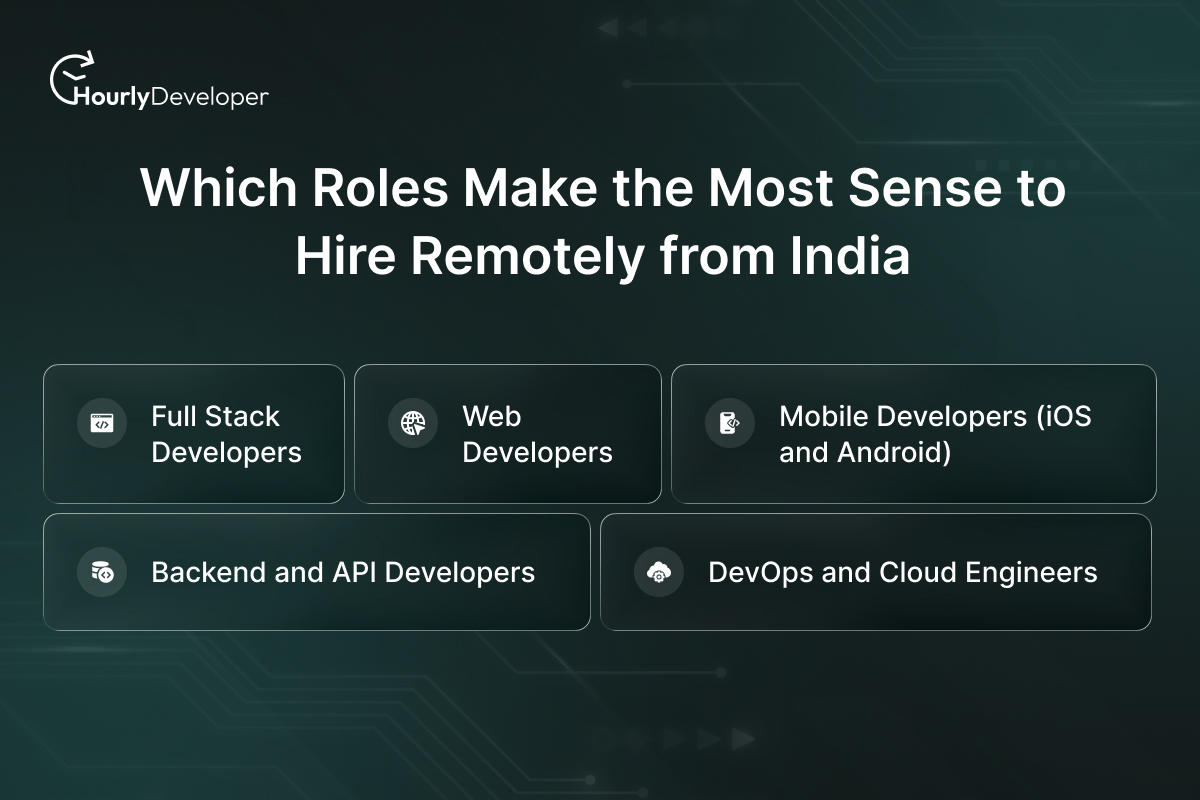
Not every role is equally suited to a remote engagement model. Here is how to think about it based on what companies are actually doing well in 2026.
Full Stack Developers
This is where the value proposition is strongest. When you hire full stack developers from India, you are typically getting someone who can own a feature end to end, communicate across the frontend and backend stack, and reduce the coordination overhead you would otherwise carry with a two-person team. Full Stack Developers India are in high demand for a reason: they compress timelines and reduce handoffs.
The most in-demand full stack profiles in 2026 center around React or Next.js on the frontend combined with Node.js, Python, or Go on the backend. Developers with experience in cloud-native architecture, especially AWS or Google Cloud, command a premium but justify it in reduced DevOps overhead.
Web Developers
If you are looking to hire web developers for product work, India has deep talent across both modern JavaScript frameworks and backend web technologies. What separates the top tier here is not just technical execution but the ability to think about performance, accessibility, and long-term maintainability, not just feature delivery.
One thing worth noting: the gap between a web developer who ships features quickly and one who ships them well has widened. Developers who have worked in product-led companies, where they are exposed to user feedback loops and business context, tend to deliver better output than those who have only worked in service-model engagements. Ask about that when you are evaluating candidates.
Mobile Developers (iOS and Android)
React Native and Flutter developers out of India are particularly strong for startups that need cross-platform parity without doubling the engineering team. Native iOS and Android specialists are available but slightly harder to find at the right price-quality intersection.
Backend and API Developers
For companies building data pipelines, microservices, or complex API ecosystems, India has excellent backend engineering talent. Node.js, Python, and Java remain dominant. Rust and Go expertise is growing quickly among senior developers.
DevOps and Cloud Engineers
An often overlooked hire, but one that delivers significant cost savings. Experienced DevOps engineers in India can manage your infrastructure, CI/CD pipelines, and cloud cost optimization at a fraction of what equivalent US-based talent would cost.
3.What You Actually Pay: A Realistic Look at Developer Rates in India (2026)
Let us get specific. The cost to hire developers in India varies significantly based on experience level, specialization, and engagement model. Here is a practical breakdown based on current market data.
| Role |
Junior (0-2 yrs) |
Mid-Level (3-5 yrs) |
Senior (6+ yrs) |
| Full Stack Developer |
$15 – $25/hr |
$28 – $45/hr |
$50 – $80/hr |
| Frontend (React/Next.js) |
$12 – $22/hr |
$25 – $40/hr |
$45 – $70/hr |
| Backend Developer |
$14 – $24/hr |
$28 – $44/hr |
$48 – $75/hr |
| Mobile (Flutter/RN) |
$15 – $25/hr |
$30 – $48/hr |
$52 – $80/hr |
| DevOps/Cloud Engineer |
$18 – $28/hr |
$32 – $52/hr |
$55 – $90/hr |
| Tech Lead / Architect |
N/A |
$45 – $65/hr |
$70 – $110/hr |
These are hourly rates for individual contractors or freelancers. If you are working through an agency or a dedicated team model, expect to add a 20 to 40 percent margin on top of developer costs for management overhead, benefits, and company margins.
Monthly fixed costs for a dedicated developer through a reputable firm tend to fall between USD 2,500 and USD 6,000 depending on the seniority and specialization. Compare that to a mid-level developer in the US or UK who might cost USD 8,000 to USD 14,000 monthly, fully loaded.
4.Monthly Salary Benchmarks for Full-Time Engagements
| Role |
Monthly Cost (USD) |
US/UK Equivalent |
| Junior Full Stack Developer |
$1,800 – $2,800 |
$5,000 – $7,500 |
| Mid Full Stack Developer |
$3,000 – $5,000 |
$8,000 – $12,000 |
| Senior Full Stack Developer |
$5,500 – $8,000 |
$13,000 – $18,000 |
| Tech Lead |
$7,000 – $11,000 |
$15,000 – $22,000 |
| DevOps Engineer (Mid) |
$3,200 – $5,500 |
$9,000 – $13,000 |
5.The Hidden Costs Nobody Talks About (Until It Is Too Late)
Here is where most blogs stop giving you useful information. They show you the rate card and leave. But the real cost of hiring remote developers in India is not just the hourly rate or monthly fee. There are several dimensions that experienced operators pay close attention to.
Onboarding Time and Lost Productivity
A developer who bills from day one is not necessarily productive from day one. Depending on the complexity of your codebase, expect three to six weeks of lower output while a new remote developer gets up to speed. For a $5,000 per month developer, that is potentially $3,000 to $5,000 in productivity cost you need to factor in.
Communication Overhead
The time-zone gap between India (IST) and North America (ET or PT) is real. India is 9.5 to 13.5 hours ahead, depending on your location. Companies that manage this well build deliberate async workflows. Companies that do not end up in a cycle of late-night calls and delayed feedback loops that quietly kill velocity. This is a process cost, not just a time cost.
Churn and Rehiring
India’s tech job market is competitive. Senior developers, especially those with in-demand skills, receive frequent offers. If you are not paying at the higher end of the range and creating genuine growth opportunities, expect churn. The average time to rehire and ramp up a replacement developer is 4 to 8 weeks. That is a real budget line item.
Legal and Compliance Setup
If you are hiring individual contractors directly from India, you need to handle compliance properly. Cross-border contractor agreements, IP assignment clauses, and tax documentation all require attention. Mistakes here can become expensive. Many companies that hire dedicated developers India go through an agency or EOR (Employer of Record) specifically to avoid this complexity.
Tool and Infrastructure Costs
Remote work requires investment in collaboration infrastructure. Licenses for Slack, Notion, Jira, GitHub, Figma, and CI/CD tooling add up. For a team of five remote developers, this typically runs USD 400 to USD 800 per month in additional tooling overhead.
6.Engagement Models: What Actually Works in 2026
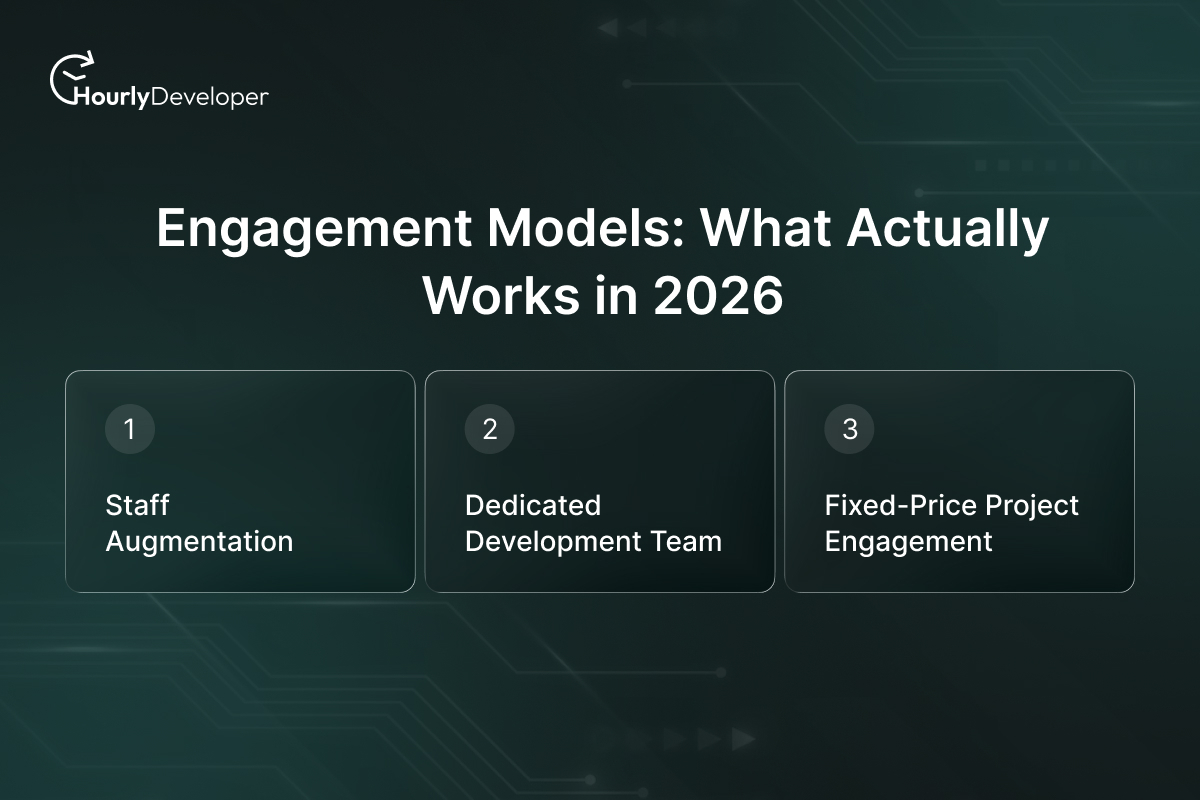
How you structure the engagement is as important as who you hire. Here are the three primary models companies use when they hire dedicated developers India.
- Staff Augmentation
You work with an agency to add one or more developers to your existing team. They integrate into your workflows, your tools, and your communication channels. The agency handles HR, payroll, and benefits. You direct the work. This works best when you have a strong internal tech lead who can provide context and code review. Without that, the quality of output depends almost entirely on the quality of the developer assigned.
- Dedicated Development Team
You contract an entire team, typically including developers, a QA engineer, and a project manager or scrum master, from a vendor who manages the team on your behalf. You set the goals and priorities. They execute. This model is more appropriate for companies building a distinct product stream or lacking internal development capacity entirely. The best company to hire remote developers in India 2026 for this model will assign senior developers who have worked on similar problem domains before.
- Fixed-Price Project Engagement
You define the scope, the vendor prices and deliver the project. This sounds predictable but carries hidden risks. Scope tends to expand, discovery uncovers new complexity, and fixed-price projects often end up costing more through change orders than a time-and-materials engagement would have. We would generally advise against fixed-price models for anything more complex than a well-defined, low-ambiguity project.
7.How to Identify the Right Company to Hire Remote Developers in India
If you are going through a vendor rather than hiring directly, the quality of the company you work with matters as much as the quality of the individual developer. Here is what to actually look for.
Technical depth in your specific domain. A company that primarily builds e-commerce apps may not be the right fit for a fintech API platform. Ask for work samples, GitHub profiles, and references from clients in your industry.
Transparent developer assignment. The best company to hire remote developers in India will let you interview the specific developers assigned to your project before you commit. If a vendor will not allow that, consider it a yellow flag.
Communication practices. Ask how the team handles daily standups, asynchronous updates, and urgent issues. A vendor with a structured communication protocol is far more reliable than one that relies on ad hoc messaging.
Retention and team stability. Ask directly: what is the average tenure of developers on their team? High turnover on the vendor side means your project carries constant ramp-up risk.
Pricing transparency. Be wary of vendors who are vague about what is included. Understand exactly what you are paying for: developer time, project management, QA, revisions, and code review.
8.What Smart Operators Are Doing Differently When They Hire Full Stack Developers from India
After watching dozens of companies navigate this hiring process well and poorly, there are clear patterns in what works.
The companies that get the most out of remote developer relationships in India are not the ones who negotiate the hardest on price. They are the ones who invest in context sharing upfront. They write detailed technical briefs, share architecture documentation, and spend the first two weeks onboarding thoroughly rather than rushing to productivity.
They also hire slightly above their budget ceiling rather than right at it. The difference in output between a $3,800 per month developer and a $4,500 per month developer can be enormous, and the delta in cost is often recovered within the first month of productivity difference.
Smart operators also treat their offshore developers as team members, not vendors. That sounds soft, but it has a measurable impact. Developers who are included in sprint planning, product discussions, and occasional company updates ship better code and stay longer. Attrition on remote teams drops significantly when developers feel genuine ownership over what they are building.
And when it comes to hiring full stack developers specifically, the best operators look for a demonstrated ability to reason about trade-offs, not just technical skill execution. A developer who can tell you why they would use a specific architecture pattern for your use case is more valuable than one who simply executes tasks quickly.
9.What Is Shifting in 2026: Trends That Affect Your Hiring Decision
A few developments are meaningfully reshaping the remote developer hiring landscape in India this year.
- AI-native developers are commanding a premium. Developers who can work fluently with AI coding assistants like GitHub Copilot, Cursor, and Claude Code are completing tasks faster and writing more consistent code. When you hire web developers or full stack developers from India in 2026, ask specifically about their AI tooling workflow. It is becoming a real differentiator.
- The mid-market talent squeeze. The three to five year experience bracket is the most competitive tier right now. US, European, and Australian companies are all fishing in the same pond, and mid-level developers in India have options. This is pushing rates up for that tier specifically, more so than junior or senior levels.
- Tier-2 cities are rising. Historically, most remote hiring from India drew from Bangalore, Hyderabad, and Pune. In 2026, cities like Jaipur, Coimbatore, Indore, and Kochi are producing strong developer talent, often at lower rates than the tier-1 city premium would suggest. If your vendor has access to talent in these cities, that can be a meaningful cost advantage without quality compromise.
- Async-first culture is now a genuine differentiator. Developers who have worked with distributed-first companies, and therefore know how to communicate clearly in writing, document their decisions, and operate without hand-holding, are significantly more effective on remote teams. This is now something to explicitly screen for.
10.A Practical Decision Framework for CEOs and Founders
Before you move forward, run through these questions with your team.
- Do you have internal technical leadership who can direct, review, and mentor a remote developer? If not, you need either a senior developer or a managed team model, not individual contributors.
- Is your development work well-defined enough for a remote engagement, or does it require constant in-person collaboration? Remote works best when requirements can be expressed clearly and asynchronously.
- What is your true tolerance for the ramp-up period? If you need someone shipping in week one, you will likely be disappointed. Build two to four weeks of onboarding time into your project plan.
- Are you prepared to invest in the relationship? Regular check-ins, clear feedback, growth opportunities, and a sense of team membership dramatically improve outcomes with remote developers.
- What engagement model fits your risk profile? Staff augmentation is lower risk for companies with internal tech capacity. Dedicated teams carry more upfront commitment but more comprehensive capability.
11.The Real Opportunity Here Is Not Just Cost Savings
Here is the thing about hiring remote developers in India that most companies discover six months in: the initial appeal was the cost, but the actual value turned out to be something different.
When you build the engagement thoughtfully, what you end up with is a team that is genuinely invested in your product, capable of moving fast, and often more technically well-rounded than you expected. The cost advantage is real, the savings relative to equivalent Western talent are substantial, but the developers you are working with are not simply cheaper versions of someone else. They are skilled professionals building careers and taking genuine pride in the work they ship.
The companies that tap into that reality, rather than just treating remote hiring as an arbitrage play, consistently report better outcomes. Lower churn, higher velocity, and products that hold up under scrutiny.
If you are serious about hiring remote developers in India in 2026, the mechanics are well understood at this point. The infrastructure exists, the talent is there, and the models are proven. What separates a good outcome from a mediocre one is the quality of your decision-making at the start: who you hire, how you structure the engagement, and how seriously you take the relationship once it begins.
That part is entirely in your hands.
 Back to Blog