Back to Blog


Getting a website or app built can feel overwhelming — one person for the frontend, another for the backend, someone else for databases, and yet another for deployment. Before your project even begins, you’re already managing too many people. That’s why many businesses choose to Hire Full Stack Developers, the true all-rounders who can design, code, integrate, and deploy your entire product from end to end. In this blog, we’ll break down in the simplest way how hiring full stack experts can save you time, reduce costs, and make your development journey far smoother.
1.Who Are Full Stack Developers?
Think of a full stack developer as the all-rounder of the tech world — someone who doesn’t just play one position but can handle the entire field. When a business wants to build a website or web app, there are usually two big parts:
✔ The front end — what users see
✔ The back end — what happens behind the scenes
Most developers specialize in only one of these. But a Full Stack Developer? They know both — and they connect everything beautifully. They understand how the buttons on your website work, how the database stores information, how the server processes data, and how the whole system talks to each other. They can move between design, logic, code, APIs, and deployment without missing a beat.
2.Roles and Responsibilities of a Full Stack Developer
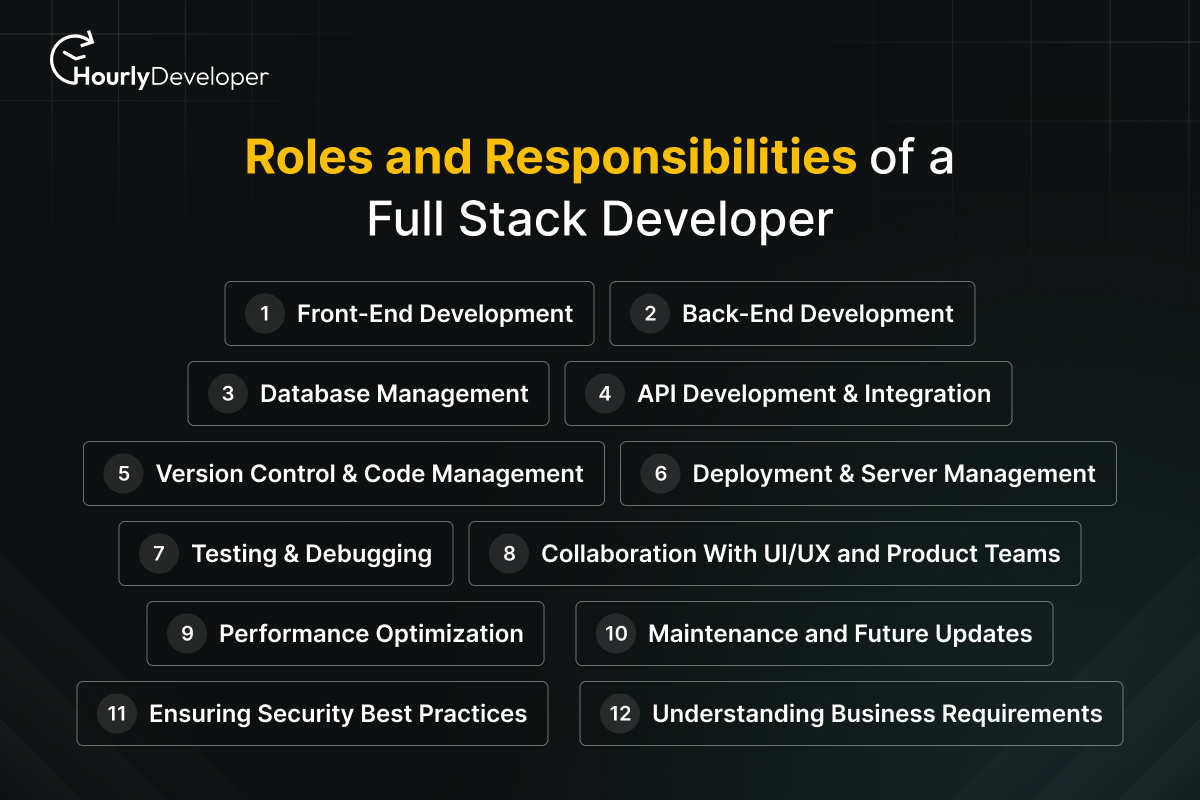
1. Front-End Development
Full stack developers create everything that users see and interact with on a website or app. This includes layouts, buttons, forms, menus, animations, and overall page styling. They ensure the design looks clean, loads fast, and works smoothly on mobile, tablet, and desktop.
2. Back-End Development
They also build the “invisible” part of the application — the side that handles logic, processing, and data flow. This includes server-side coding, creating APIs, handling user authentication, managing payments, and making sure everything works exactly as it should in the background.
3. Database Management
Full stack developers design and manage the database where all information is stored. They create efficient structures, write queries, optimize performance, and ensure data is handled securely. Their role also includes deciding whether to use SQL or NoSQL based on the project’s needs.
4. API Development and Integration
They build APIs to connect different parts of the application and also integrate third-party services like payment systems, SMS gateways, email tools, maps, or login providers. This helps the application communicate smoothly with external systems.
5. Version Control & Code Management
Full stack developers use tools like Git to manage code changes, collaborate with team members, and ensure the project stays organized. This makes development faster and reduces the chances of errors breaking the entire application.
6. Deployment and Server Management
Once the application is built, developers also handle deployment — bringing the product live on hosting platforms or cloud services. They set up servers, monitor performance, manage environments, and make sure everything runs securely and without interruption.
7. Testing and Debugging
They test both the front end and back end to catch issues early. This includes checking for bugs, verifying feature functionality, fixing errors, and improving weak areas. Their goal is to ensure the application runs smoothly before and after launch.
8. Collaboration With UI/UX and Product Teams
Full stack developers work closely with designers, product managers, and stakeholders to understand requirements. They translate ideas into working features and often suggest improvements that make the user experience simpler, faster, and more intuitive.
9. Performance Optimization
They continuously work on improving application speed, reducing load time, and cleaning up the code. They also optimize database queries and server responses to make sure the product performs well even as users and data grow.
10. Maintenance and Future Updates
After the product goes live, full stack developers handle updates, bug fixes, new feature additions, and improvements. They help the application grow steadily and stay compatible with new technologies and user expectations.
11. Ensuring Security Best Practices
Security is a big responsibility. Full stack developers protect the system from vulnerabilities by writing secure code, strengthening authentication, encrypting data, and monitoring suspicious activity.
12. Understanding Business Requirements
Beyond just coding, they take time to understand the business goals behind a project. This helps them build solutions that match the company’s objectives and provide real value to users.
3.Why Modern Businesses Prefer Full Stack Developers
The way technology is evolving, companies don’t want to hire five different specialists for tasks that one skilled developer can handle. Full stack developers bring end-to-end expertise that helps businesses move faster.
Here’s why they are becoming the first choice of companies worldwide.
1. They Understand the Complete Product Lifecycle:
This means they don’t just write code — they understand how the entire system works together.
- Frontend (user interface)
- Backend (server, APIs, logic)
- Database operations
- Cloud deployment
- Version control
- Testing and debugging
2. Faster Development, Fewer Dependencies
When one developer or a small full-stack team handles the entire project, there is no waiting for different specialists to finish their part. This speeds up delivery and eliminates communication gaps.
3. Cost-Effective for Startups and Growing Businesses
Instead of hiring separate frontend, backend, and DevOps engineers, you can simply Hire Full Stack Developers who can manage multiple roles. This is especially helpful for startups with limited budgets. This reduces:
- Hiring costs
- Training costs
- Project delays
- Team overhead
4. Ability to Solve Problems Holistically
Full stack developers understand how every part of an application connects. So instead of fixing just one issue, they often prevent multiple problems before they happen.
4.Why You Should Hire Full Stack Developers for Modern Web Solutions
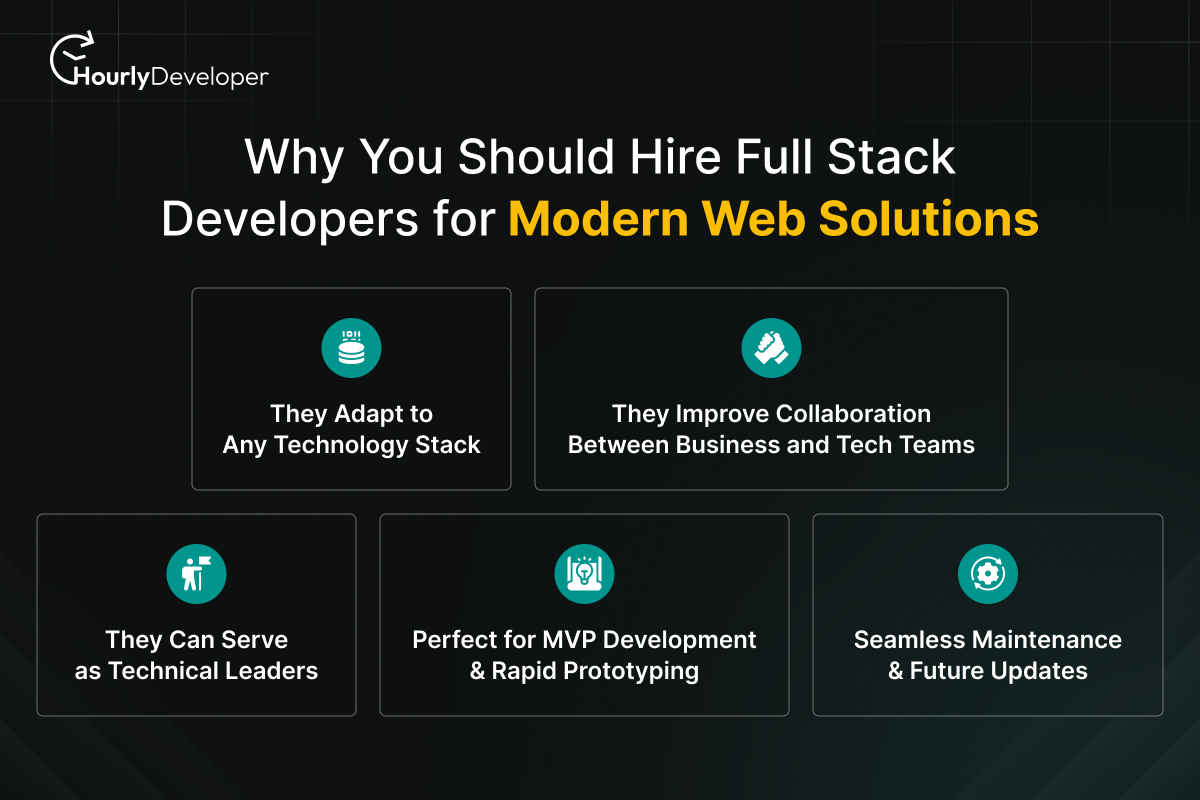
Whether you’re building a web dashboard, marketplace, fintech app, learning portal, or any kind of on-demand platform — full stack developers bring a unique advantage. They don’t just write code… they help you build complete, modern, scalable web solutions that actually work in the real world.
Let’s break down why they’re such a powerful addition to any development team:
1. They Adapt to Any Technology Stack
In today’s tech world, things change fast — new frameworks come out, old ones get outdated, and business needs shift overnight. Full stack developers are great at navigating this because they already understand multiple technologies.
They can switch between front-end, back-end, APIs, databases, and cloud without getting stuck. This flexibility keeps your project moving smoothly, even when requirements evolve. No need to
hire different specialists for every tiny change — one skilled full stack dev can handle most of it.
2. They Improve Collaboration Between Business and Tech Teams
If you’ve ever felt frustrated explaining your idea to developers, you’re not alone. This is where full stack developers shine. Since they understand both user experience and technical logic, they naturally act as translators between different teams.
They can talk design with your UI/UX team, discuss features with your product team, and dive deep into code with the tech team — all without confusion in the middle. This reduces delays, misunderstandings, and back-and-forth communication. Everything becomes smoother and faster.
3. They Can Serve as Technical Leaders
Full stack developers don’t just write code — many of them think like architects. They understand how all the pieces of your app fit together, so they often end up taking ownership of important decisions like:
- Architecture planning
- Choosing the right tech stack
- Mapping the feature roadmap
- Planning performance and scalability
- Ensuring the system is secure and stable
This leadership is extremely valuable, especially if your business doesn’t have a CTO or a senior tech advisor yet. Their guidance can help you avoid expensive mistakes and build a strong technical foundation from day one.
4. Perfect for MVP Development & Rapid Prototyping
If you’re building an MVP, hiring full stack developers is one of the smartest moves you can make. Why?
Because they help you:
- Build faster
- Spend less on developers
- Prioritize features that matter
- Launch an initial version quickly
- Test your idea with real users
Instead of coordinating multiple developers, you get one person who handles both front and back end. This speed is crucial when you’re trying to validate an idea or impress investors.
5. Seamless Maintenance & Future Updates
Launching the first version of your app is just the beginning. Every product needs improvements, bug fixes, new features, and performance enhancements over time.
Full stack developers make this process incredibly easy because they already understand the entire system — not just one part of it. So when your app grows or your market changes, they can update it smoothly without breaking things.
This means fewer dependencies, fewer delays, and fewer surprises in the future.
5.Why Many Companies Hire Dedicated Developers in India
Businesses across the USA, UK, Europe, and Australia often choose to Hire Dedicated Developers in India — and it’s not just because of cost. India has become a global technology hub with a strong mix of talent, professionalism, and innovation. Here’s a detailed look at why global companies prefer Indian developers:
1. Cost Advantage Without Compromising Quality
Hiring developers in India gives businesses access to top-tier talent at a much more affordable rate than Western markets. The best part? You’re not sacrificing quality. Indian developers are known for their strong technical knowledge, hands-on experience, and ability to deliver scalable solutions. This cost-benefit allows companies to reinvest the savings into marketing, design, or faster growth.
2. Large & Diverse Talent Pool
India has one of the world’s largest communities of skilled IT professionals. You can find experts across almost every digital domain, including:
- Full Stack Development
- Cloud & DevOps
- AI, ML & Data Engineering
- Mobile App Development
- Cybersecurity
- UI/UX Engineering
- QA & Automation Testing
This huge talent pool makes it easy to assemble a well-rounded development team for any project — from small MVPs to enterprise-grade platforms.
3. Flexible Hiring Models That Fit Any Business
One of the biggest reasons companies Hire Dedicated Developers India is flexibility. You’re not locked into rigid contracts. You can hire:
- Hourly developers for short-term tasks
- Monthly developers for ongoing work
- Project-based teams for end-to-end delivery
- Full-time dedicated developers to act as an extension of your in-house team
This flexible model allows businesses to control costs, scale teams quickly, and bring in additional talent whenever needed — without the overhead of traditional hiring.
4. High English Proficiency
Clear and smooth communication is essential in software development — especially for complex projects. Most Indian developers are fluent in English, making collaboration easier across calls, documentation, feedback sessions, and daily stand-ups. This reduces misunderstandings and makes the development process much more efficient.
5. Time Zone Advantage for Faster Delivery
When companies in the USA, UK, or Europe work with Indian teams, they gain a natural time-zone advantage.
While you sleep, your development team continues building your product. This “round-the-clock” workflow speeds up delivery timelines and ensures faster turnarounds — especially when deadlines are tight.
6. Strong Work Ethic & Commitment
Indian developers are known for their dedication, adaptability, and problem-solving mindset. They’re comfortable handling complex tasks, tight deadlines, and large-scale projects. Many international companies appreciate how Indian teams go the extra mile to ensure smooth delivery and long-term results.
7. Expertise Across Modern Technologies
Whether your project needs cutting-edge AI automation, cloud-native development, microservices, API integration, or real-time apps — Indian developers are already trained in the latest tools and frameworks.
They stay updated through certifications, hackathons, community forums, and continuous learning programs.
8. Strong IT Infrastructure & Global Experience
India’s IT outsourcing ecosystem has matured over 20+ years. Developers here are used to working with international clients, global standards, agile methodologies, and modern project management tools like Jira, Asana, Slack, and GitHub. This means you get a team that understands both technology and global business expectations.
9. Easy Team Scalability
Need to scale your team from 2 to 10 developers in a month? It’s completely doable in India. The availability of skilled professionals allows businesses to expand fast — without lengthy hiring cycles.
10. Proven Track Record in Outsourcing
Leading brands — from startups to Fortune 500 companies — have successfully outsourced to India for years. This long history makes India one of the most reliable and trusted outsourcing destinations worldwide.
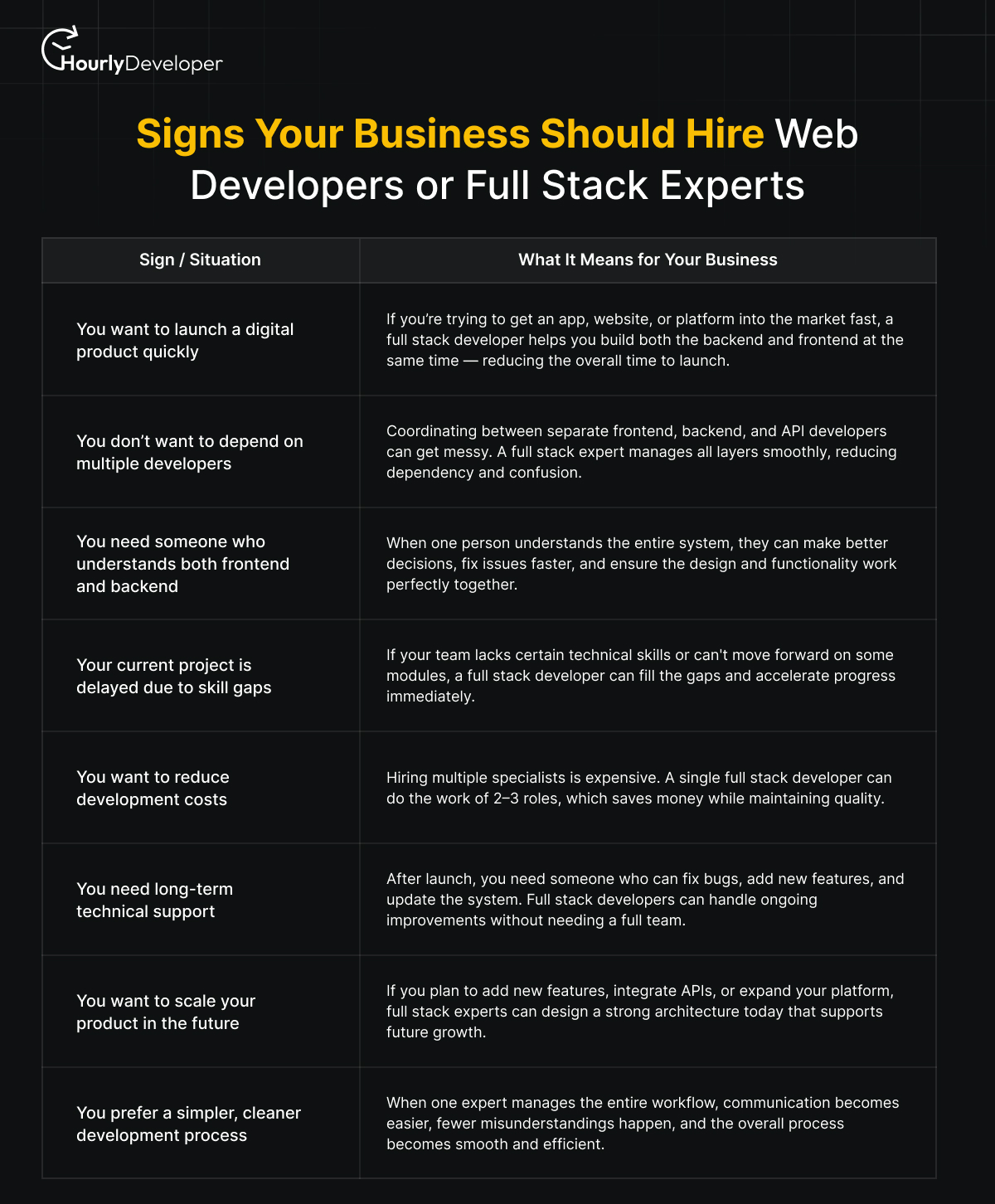
6.Signs Your Business Should Hire Web Developers or Full Stack Experts
7.What to Look For When You Hire Full Stack Developers
Hiring a full stack developer isn’t just about checking a few technical skills. You want someone who understands your product, works well with your team, and can turn your idea into a real, working solution. Here’s what you should look for:
A. Technical Skills (They Must Know the Full Toolkit)
A good full stack developer should be comfortable working on every layer of your product. This usually includes:
- Front-end frameworks (like React, Angular, or Vue)
These control what users see on the screen — the design, layout, and interactions. - Back-end languages (Node.js, Python, PHP, Java, etc.)
This is the engine that powers your app — login systems, payments, dashboards, data logic. - Databases (SQL, MongoDB, PostgreSQL)
They should know how to store, structure, and retrieve data efficiently. - APIs and integration
They must know how to connect your app with third-party services — payments, maps, SMS, analytics, etc. - Git/GitHub
This ensures clean, safe, and organized code that can be tracked and improved. - Basic cloud deployment (AWS, Azure, DigitalOcean)
They must be able to launch your app online and keep it running smoothly.
B. Problem-Solving Ability (Not Just Coding — Smart Thinking)
Full stack developers face challenges almost every day. A good one won’t just write more code — they’ll solve problems quickly.
Look for someone who can:
- Debug issues without panic
- Suggest simpler or faster solutions
- Think creatively when something breaks
- Improve your product’s performance
A great full stack developer doesn’t just “fix bugs.” They understand the root issue and prevent it from happening again.
C. Communication Skills (They Should Speak Human, Not Only Tech)
You don’t need someone who uses complicated technical words every minute.
You need someone who can:
- Explain things in simple, clear language
- Understand your business requirements
- Communicate progress honestly
- Ask the right questions
- Share ideas politely and confidently
D. Portfolio or Work Samples (Proof of Real Experience)
The best full stack developers have real work to show. This can include:
- Websites they built
- Web apps they developed
- GitHub repositories
- Case studies or links to live projects
- Screenshots or feature breakdowns
A strong portfolio tells you more than a resume ever will. If they have built something similar to your idea — that’s a huge bonus.
E. Understanding of Business Goals (Not Just Code — Strategy Too)
A great full stack developer doesn’t just build features.
They understand why those features matter.
They should know:
- Who your users are
- What problem your product solves
- How your business plans to grow
- Why certain features matter more than others
When a developer understands your business vision, they make smarter technical decisions. This leads to a product that’s not only functional — but successful.
Bonus Qualities to Look For (Optional But Very Helpful)
If you want someone truly exceptional, also check if they:
- Keep learning new technologies
- Work well in Agile teams
- Follow clean coding practices
- Care about UI/UX experience
- Are comfortable with deadlines
- Have a positive, solution-oriented mindset
8.Why Hiring a Full Stack Development Company Is a Smart Choice
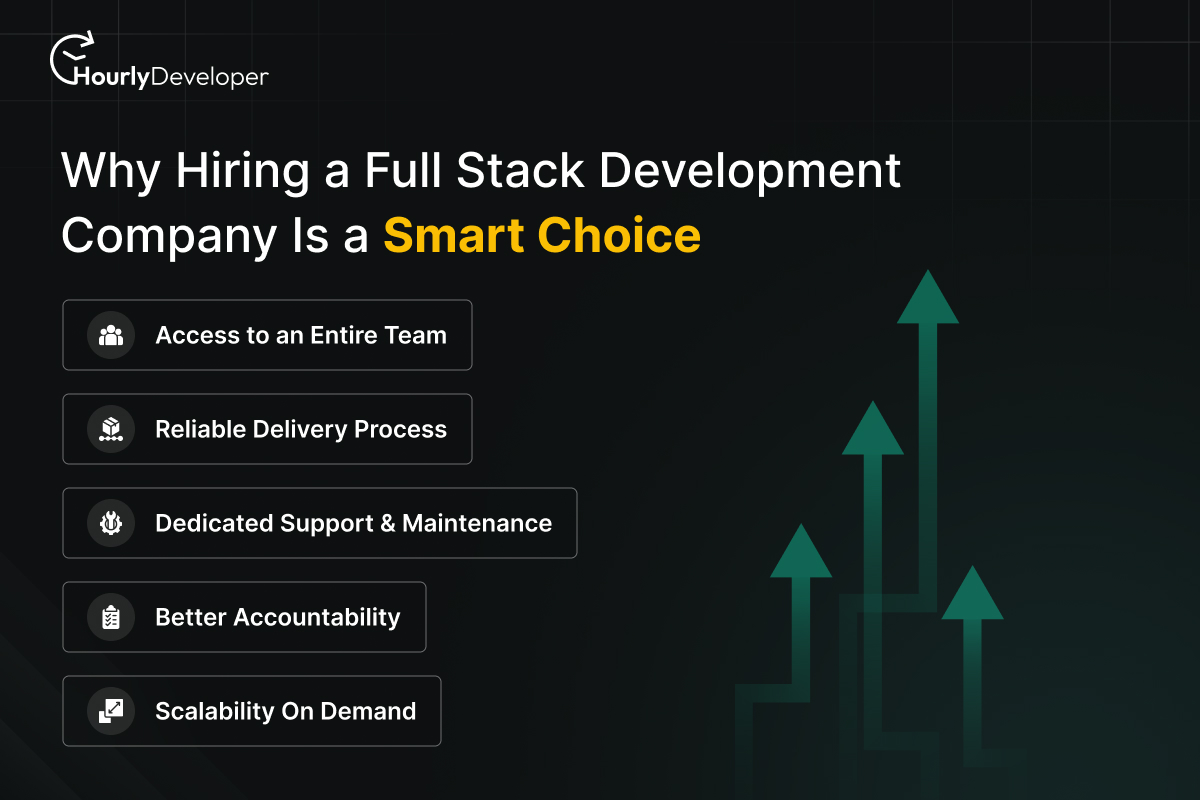
When businesses need to build modern, scalable web products, they often wonder whether to hire a single developer or work with a professional Full Stack Development Company.
In most cases, choosing a company turns out to be the smarter, safer, and more efficient option — especially for long-term or complex projects.
Here’s why:
1. Access to an Entire Team
When you partner with a full stack development company, you don’t just get one developer — you get a complete team of experts under one roof. This usually includes:
- Full stack developers
- UI/UX designers
- QA testers
- Project managers
- DevOps engineers
This means your product gets the benefit of multiple skill sets working together. Every part of your project — design, development, testing, deployment — is handled by specialists. You never have to hire multiple freelancers on your own or worry about coordinating different people. Everything is taken care of for you.
2. Reliable Delivery Process
A professional company follows a proper, organized workflow instead of working randomly. Most companies use:
- Agile methodology
- Sprint planning
- Daily or weekly updates
- Quality testing at each stage
- Performance optimization before launch
This structured approach ensures your project stays on track, timelines are respected, and you always know what’s happening. No surprises, no hidden delays.
3. Dedicated Support & Maintenance
A big advantage of choosing a full stack development company is ongoing support.
Even after your website or app goes live, the company continues to help with:
- Bug fixes
- Updates
- New feature development
- Security patches
- Performance improvements
So you’re not left alone after launch — you have a reliable team to manage your product as it grows.
4. Better Accountability
With a company, accountability is much higher compared to hiring individual developers or freelancers.
A company has:
- Contracts
- SLAs (service agreements)
- Fixed milestones
- Internal teams
- Project managers to monitor work
This means they take responsibility for quality, deadlines, and results. If something goes wrong, they fix it — no excuses, no disappearing act.
5. Scalability On Demand
Your project needs may change over time.
You may start with 2 developers but need 5 later. Or you may want to add a designer for a new feature. A full stack development company can scale the team instantly whenever your project grows.
You don’t need to search, interview, or hire new people again — the company handles team expansion smoothly and quickly.
9.Examples of What Full Stack Developers Can Build
Full stack developers can build almost any web-based solution, including:
- eCommerce platforms
- CRM systems
- ERP solutions
- Booking systems
- On-demand applications
- SAAS platforms
- Job portals
- Learning management systems
- Social networking features
- Data dashboards
- Payment systems
- AI-powered applications
No matter what industry you are in — retail, healthcare, travel, finance, education, real estate — full-stack developers can create custom solutions tailored to your needs.
10.Final Thoughts: The Smart Way Forward
If you’re serious about building a modern, fast, and scalable web product, hiring Full Stack Developers is honestly one of the best choices you can make. They can handle everything — from the screens your users see to the backend engine that keeps everything running. It makes the entire development process smoother and much less stressful for you.
And if you want the perfect balance of quality + affordability, choosing to Hire Dedicated Developers in India is a great move. You’ll find talented professionals who understand global standards, communicate well, and deliver excellent results.
For bigger or long-term projects, working with a Full Stack Development Company is even better. You get a full team — developers, designers, testers, project managers — all working together with a proper process and a clear plan. That means better speed, better quality, and fewer headaches for you.
To keep it simple:
Better speed + lower cost + smarter development = Full stack developers.
So if you’re planning your next digital product — whether it’s a web app, a dashboard, an online platform, or something totally new — this is the perfect time to Hire Web Developers or a full stack team that can take your idea and turn it into something real, powerful, and ready for the market.
Just focus on your vision — the right team will build the rest.

With a pen in hand and creativity in her heart, Nidhi crafts compelling narratives that captivate our audience and leave them wanting more. Her versatile writing style effortlessly adapts to various genres, ensuring our message resonates with readers from all walks of life.
Frequently Asked Questions
It depends on your project. If you need end-to-end development or have a limited budget, a full stack developer is the best choice. If you’re building something highly technical, like complex AI or heavy data systems, you may need specialists. Many companies start with a full stack developer and add specialists later as the product grows.
They usually understand basic UI/UX principles, such as layout, usability, and responsive design. While they may not create highly advanced designs like a dedicated designer, they can build clean, practical interfaces that users find easy to interact with. Their design knowledge helps them collaborate well with designers and implement ideas accurately.
The time depends on the project’s complexity. A simple website may take 3–4 weeks, while a medium-sized web app can take 2–3 months. Large platforms with advanced features may require several months. The benefit of hiring a full stack developer is that the process is faster because one person handles most of the core tasks.
The cost of hiring a full stack developer depends on their experience, location, and the complexity of your project. Developers in countries like India often offer more affordable rates while still delivering quality work. You can choose hourly, monthly, or project-based pricing depending on what fits your budget and the type of work you need.
Project cost is usually calculated based on the features you need, the technology stack, timelines, and the overall complexity. If your project has advanced functionality or requires custom integrations, the cost will increase. Developers or agencies often provide a detailed estimate after understanding your requirements so you know exactly what you’re paying for.
Table of content
- Introduction
- Who Are Full Stack Developers?
- Roles and Responsibilities of a Full Stack Developer
- Why Modern Businesses Prefer Full Stack Developers
- Why You Should Hire Full Stack Developers for Modern Web Solutions
- Why Many Companies Hire Dedicated Developers in India
- Signs Your Business Should Hire Web Developers or Full Stack Experts
- What to Look For When You Hire Full Stack Developers
- Why Hiring a Full Stack Development Company Is a Smart Choice
- Examples of What Full Stack Developers Can Build
- Final Thoughts: The Smart Way Forward
Hire Developers!
Find exceptional developers at Hourlydeveloper. Get the expertise, solutions, and teamwork you need for success. Hire developers easily and boost your projects today!