1.First, Let us Talk About Why Java Still Makes Sense in 2026
People have been predicting Java is on its way out for about fifteen years now. It keeps not happening. In 2026, Java remains one of the most widely used programming languages for backend systems, enterprise platforms, fintech infrastructure, healthtech data pipelines, and large-scale SaaS products.
Part of the reason is stability. Java does not change so fast that your codebase becomes unrecognizable every two years. Part of it is the ecosystem. The tooling, the libraries, the community, all of it is mature and battle-tested. And part of it is the language itself, which has genuinely gotten better. Java 21 and 22 brought in virtual threads through Project Loom, pattern matching, record classes, and sealed interfaces. These are not cosmetic changes. They change how you architect systems.
If you are building something that needs to be fast, scalable, and maintainable over a long horizon, Java backend development services are still one of the most solid choices you can make. The question is just who does the building.
Something worth knowing: The Java developer market in 2026 is not short of developers. It is short of developers who understand modern Java. Knowing the difference matters a lot when you are evaluating companies.
2.What Most People Get Wrong Right at the Start
Here is a thing that happens constantly. Someone decides they need Java development services, they search for a company, they look at five or six agency websites, they read similar-sounding case studies, they pick whoever has the most impressive client logos, and then they wonder three months later why the project feels off.
The mistake is treating the search like a vendor selection instead of a hiring decision. When you hire a development company, you are not buying a product. You are entering a working relationship that will shape your product for months or years. The things that make a vendor relationship good are completely different from the things that make a development relationship good.
A good vendor delivers on spec. A good development partner tells you when the spec is wrong. That distinction sounds small but it changes everything about how you should evaluate and choose. The best Java developers for hire in 2026 are not the ones with the longest list of technologies on their profile but the ones who ask the hardest questions about your product before they write a single line of code.
3.The Java Technology Stack Is Not One Thing Anymore
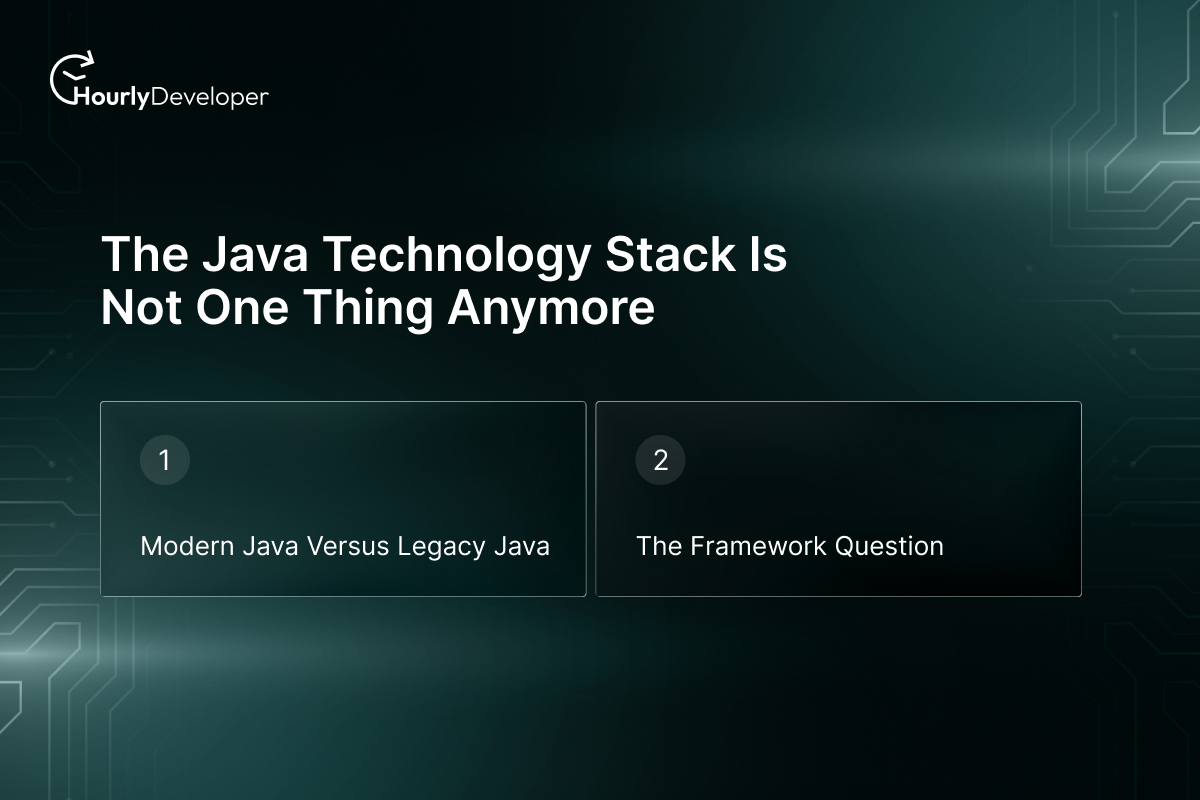
When someone says they offer Core Java development, that phrase covers a huge range of actual capability. Before you hire anyone, you need to understand what version of Java and what surrounding stack actually matches your project needs.
- Modern Java Versus Legacy Java
In 2026, a team working with Java 21 and using virtual threads for concurrency is solving problems in a fundamentally different way than a team still defaulting to Java 8 patterns. Neither is automatically wrong for every project, but you need to know which world your potential partner lives in.
Ask them directly: what Java version do they typically build on today, and what made them choose it? If they cannot answer that question with a clear rationale, they are probably just using whatever they learned on their last project without much critical thought.
Spring Boot is still the dominant framework for Java backend development in 2026, but it is not the only option. Quarkus has grown significantly, especially for cloud-native and serverless use cases. Micronaut has a solid following for microservices that need fast startup times. Helidon has grown in the Oracle ecosystem.
A company that only knows Spring Boot is not necessarily underqualified. Spring Boot handles a massive range of use cases well. But if your project has specific requirements around startup time, memory footprint, or cloud-native design, you want a company that knows why they chose the framework they chose, not just one that reaches for the most familiar tool.
4.The Cloud and Infrastructure Layer
Java backend development in 2026 almost always means cloud deployment. Whether that is AWS, Azure, or GCP, your development company should be comfortable talking about containerization, orchestration with Kubernetes, infrastructure as code, and CI/CD pipelines. These are not separate specializations anymore. They are part of how modern Java development actually works.
If a company says they just write the code and leave DevOps to someone else, that is a valid model sometimes. But make sure you actually have someone handling the DevOps piece, because a beautifully written Java service that nobody can properly deploy is not useful to you.
5.How to Choose a Java Development Company the Right Way
Most people evaluate companies by looking at their website, their case studies, and their client list. These things are fine to look at, but they are the most curated, most polished version of a company you will ever see. Here is how to look past that.
Their GitHub Tells You More Than Their Website
Any development company worth hiring has some public-facing code. It might be open source contributions, internal tools they have shared, sample projects, or demo repositories. Go find it. Look at how they write commit messages. Look at how their READMEs are structured. Look at whether their open source projects are maintained or just abandoned after the first push.
The way a team writes code when they think only other developers will see it is much closer to how they will write your code than the polished screenshots on their marketing page.
How They Handle a Technical Conversation
In your first technical call, pay attention to whether the team asks questions or just answers them. A development company that is genuinely good at what they do will ask hard questions about your system. They will want to know about your current architecture, your data volumes, your user patterns, your deployment environment.
A company that skips straight to telling you how great they are and what technologies they use is showing you they are more interested in closing a deal than understanding your problem. That dynamic usually continues throughout the project.
The Team They Show You in Sales vs. the Team You Get
This is one of the most common frustrations in outsourced development and it happens across regions and price points. You have an impressive technical call with a senior architect. You are sold. You sign. And then the senior architect is involved for maybe an hour a week in an oversight capacity while a team of junior and mid-level developers actually builds your product.
There is nothing inherently wrong with a mixed-seniority team. Junior developers need to learn on real projects and senior developers often cannot be on every line of code. What is wrong is when this is not disclosed. Before you sign anything, ask specifically: who will be writing the code day to day? What is their experience level? Will the person who ran your technical interview be actively involved in the project?
A trustworthy company answers these questions without blinking. An evasive answer is your signal to slow down.
6.The Engagement Model Question Nobody Talks About Honestly
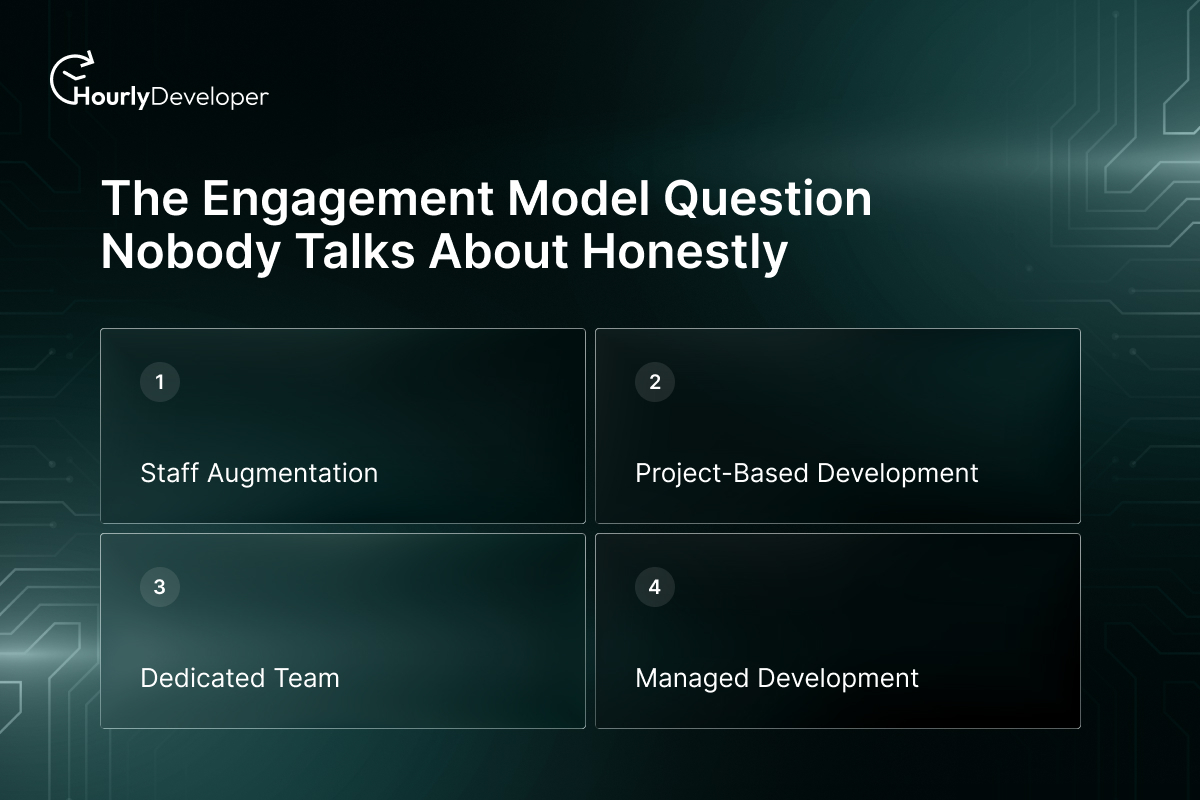
When you hire Java development company, you are also choosing a working structure. Most companies offer a few options, and most companies have a financial incentive to steer you toward the one that generates the most revenue for them. Understanding the options helps you push back intelligently.
You bring in individual Java developers who work within your team, under your processes, using your tools. This model works well when you have strong internal technical leadership and you just need more capacity. It does not work well when you need direction, architecture guidance, or someone to own a delivery outcome.
- Project-Based Development
You define a scope, they deliver it. This sounds clean and simple, which is why it is popular. The reality is that most software projects do not have stable enough requirements to make project-based development smooth. You will either overpay for the buffer the company builds in, or you will find yourself in scope disagreements every few weeks.
It works best for focused, well-defined work with low uncertainty, like building a specific integration, adding a defined feature set, or a migration with a clear start and end state.
A full team works exclusively on your product under your direction. This is the highest-investment model and it makes sense for complex, long-running products where continuity and context accumulation matter. It is overkill for a six-week engagement.
The company takes on not just writing code but also project management, sprint planning, architecture decisions, and delivery accountability. This is appropriate when you do not have internal technical leadership and you need a partner who can drive as well as build. The risk is that you hand over a lot of control, so the trust bar needs to be high.
A tip that almost no hiring guide gives you: Ask the company which engagement model they would not recommend for your situation. A partner that can tell you clearly why a particular model would be wrong for your project is showing you they have your interests in mind. One that just agrees with whatever you suggest is showing you they do not.
7.What a Good Java Development Company Does Before Writing a Single Line of Code
This is genuinely one of the best signals of quality. Watch what happens in the first one to two weeks of a new engagement.
A good Java development company starts with discovery. They review your existing codebase if there is one. They document the architecture they plan to build before they start building it. They define the API contracts. They set up proper environments for development, staging, and production. They establish coding standards and review processes. They make decisions about logging, monitoring, error handling, and exception management before those decisions need to be made under pressure.
A less capable company just starts coding. The immediate output looks impressive because progress feels fast. But three months later you start finding the gaps. The logging is inconsistent. The error messages are not actionable. The staging environment is different enough from production that bugs only appear in production. The code that looked fast at the start is now the hardest part of the codebase to change.
Discovery and setup are not billing padding. They are the foundation that everything else gets built on. If a company tries to skip this phase to show you early results, that is worth pushing back on.
8.Red Flags That Are Easy to Miss
Some red flags are obvious. A company with no verifiable portfolio. A team that cannot explain basic Java concepts. A proposal that was clearly copied from a template with your name pasted in. Those ones you will catch.
Here are some that are easier to miss:
- They never push back on anything you say. A development company that agrees with every requirement, every timeline, and every scope decision without questioning any of them is not being agreeable. They are being risk-averse. They are telling you what you want to hear because it is easier than having an uncomfortable conversation now. That approach always causes a more uncomfortable conversation later.
- Their communication is great during sales and gets vague after signing. Pay attention to how quickly they respond before you are a client. Then ask them what their communication cadence looks like during a live project. Request specific examples: what does a weekly update look like? How do they escalate blockers? How do they communicate delays? If the answers are vague, the reality will be vaguer.
- They cannot talk about a project that went wrong. Ask every company you seriously consider: what is a project that did not go as planned, and what did you learn from it? Companies that have never made a mistake either have not done enough work, or they are not being honest. Companies that can talk about failures and articulate what changed because of them are companies that actually learn and improve.
- Their team turnover is high but they do not mention it. High turnover in a development company is one of the biggest risks to your project. When developers leave mid-engagement, you lose institutional knowledge, you lose velocity, and you spend weeks onboarding replacements. Ask directly how long their average developer has been with the company and what their retention rate looks like. A good company will answer without defensiveness.
- They treat security and testing as optional add-ons. In 2026, security is not a phase you add at the end of a Java backend development project. It is embedded in how the code is written from day one. Same with testing. If a company presents unit testing, integration testing, and security reviews as things you can add or remove based on budget, treat that as a serious quality signal.
9.The Questions You Should Actually Be Asking
Most hiring guides give you generic questions. Here are the ones that actually reveal something useful:
- What Java version are you building on for new projects right now and why that version specifically?
- How do you handle breaking changes when a dependency gets updated mid-project?
- Walk me through what happens when a developer on my project resigns. What is your continuity plan?
- What does your code review process look like and who has veto power on a PR?
- How do you manage the line between what is technically possible and what is actually the right solution?
- What monitoring and observability tooling do you set up by default and why?
- Have you ever recommended that a client not use Java for something, and what was that conversation like?
- How do you handle a situation where the client is wrong about a technical decision?
The last two are the most revealing. A company that has never steered a client away from a bad technical decision is a company that takes orders. You want a company that takes responsibility.
10.The AI Layer in Java Development in 2026
This needs to be addressed directly because it is now unavoidable. Every credible Java development company in 2026 is using AI-assisted development tools. GitHub Copilot, Amazon CodeWhisperer, and a range of newer tools are part of how modern development teams work. The question is not whether they use them but how.
A mature company has a clear policy on this. They can tell you which tools they use, what their code review process looks like for AI-generated code, and critically, what their policy is on whether your proprietary code or business logic gets submitted to external AI systems during development. This last point is a real IP risk that most clients do not think to ask about.
Ask any serious candidate: what is your AI tool policy and how does it apply to client code? If they do not have a clear answer, that is a gap. Either they have not thought about it or they have not documented it. Neither is great.
11.A Quick and Honest Note on Budget
Cost matters and it would be dishonest to pretend it does not factor into this decision. The broad reality in 2026 is that Java development services vary significantly depending on where the team is based, how mature the company is, and what kind of engagement you are entering into. You can find teams across a wide range from budget-friendly to premium depending on the region, seniority mix, and scope.
What is more useful than obsessing over the hourly number is understanding what you are actually comparing when you look at two proposals. Scope differences, seniority differences, what is included versus billed separately, and how each company handles changes all affect the real cost of an engagement far more than the rate on the first page.
Find a company whose quality of work and way of operating matches what you need. Then have an honest conversation about the budget. That order matters.
12.What a Good Handoff Looks Like
One thing most people forget to think about when hiring a Java development company is what happens at the end. Whether you are handing the code back to an internal team, transitioning to a different vendor, or entering maintenance mode, the quality of the handoff reveals a lot about how the company worked throughout the engagement.
A well-run Java development project ends with clean, documented code that another developer can pick up without months of archaeology. It ends with an architecture document that explains why key decisions were made, not just what they were. It ends with a test suite that a new developer can run and trust. It ends with deployment documentation that someone who was not on the original project can follow.
When you are evaluating a company early on, ask them what their handoff package looks like for a completed project. Ask to see an example if they can share one. The answer tells you a great deal about how organized and thoughtful they are during the actual build, not just at the end.
13.How to Actually Compare Multiple Companies
You are probably shortlisting three to five companies. Here is how to compare them in a way that leads to a real decision rather than just defaulting to whoever seemed most confident in the sales call.
- Compare their questions, not just their answers. The best companies ask hard questions back. They want to understand your users, your constraints, your existing systems, and your post-launch plans. A company that just answers your questions and presents a proposal is an order-taker. A company that challenges your thinking and brings its own perspective is a partner.
- Pay for a discovery sprint before committing. Before you sign a long-term engagement with anyone, pay for a one to two week paid discovery phase. Treat it like a working interview. You will learn more about how a company actually operates in those two weeks than you will from ten sales calls.
- Look at how they write, not just what they say. The proposal document itself is information. Is it clear? Does it address your specific situation or is it a template with your name inserted? Are there inconsistencies? Does it show they actually read and understood your brief? The quality of written communication in sales tends to predict the quality of written communication during delivery.
- Talk to their past clients, but ask better questions. Everyone provides references who will say positive things. The useful questions are: What was the biggest mistake they made and how did they handle it? Did estimates turn out to be accurate? How did they handle scope changes? Would you trust them with something more complex?
14.Before You Sign: Things to Verify
Use this as a quick sanity check before you commit to anyone:
- You have spoken directly to at least two past clients, not just read written testimonials.
- You know the names of the specific developers who will be assigned to your project.
- You understand what the onboarding process looks like for new team members if someone leaves.
- The IP ownership clause in the contract clearly assigns ownership of your code to you.
- You know what the exit clause looks like and what you receive if the engagement ends early.
- You have seen actual code written by this team and someone technical on your side has reviewed it.
- The company has answered every question you asked without deflecting or going vague.
- You have a clear escalation path documented for when things go wrong.
- The engagement model they proposed actually fits your project needs, not just their revenue preferences.
- You feel comfortable having a difficult conversation with them, because at some point you will need to.
15.Final Thought
Hiring a Java development company is one of those decisions where the downside of getting it wrong is much larger than most people anticipate going in. The wrong partner does not just deliver bad code. They cost you time while you figure out it is bad, more time while you find someone else, and even more time while the new team learns what the old team built.
The right partner does something that is hard to fully appreciate until you experience it. They make your product better than you would have made it alone. They bring perspective, they push back when you are wrong, they build things that are easy to change as your understanding evolves. Fortunately, the best Java developers for hire in 2026 are out there, and they tend to find each other inside companies that have built real delivery processes, not just polished sales decks.
That kind of partner exists. There are genuinely excellent Java development companies out there doing careful, thoughtful work in 2026. The process of finding them is the whole point of a guide like this one. Take your time with it. The early investment in finding the right fit pays back many times over once the actual work begins.
 Back to Blog