1.Who Is a Blockchain Developer?
A blockchain developer is a software professional who builds applications and systems based on blockchain technology. Unlike traditional apps that rely on a centralized server, blockchain applications run on a distributed network where data is stored across multiple computers instead of a single server. This makes blockchain applications transparent, secure, and tamper-resistant.
But what does a blockchain developer actually do every day?
A blockchain developer writes smart contracts, designs decentralized applications (dApps), creates blockchain protocols, works with cryptographic algorithms, and ensures that systems operate securely without depending on a central authority. Their work requires deep knowledge of how blockchains work—everything from consensus mechanisms and hashing to token standards and network architecture.
2.Types of Blockchain Developers
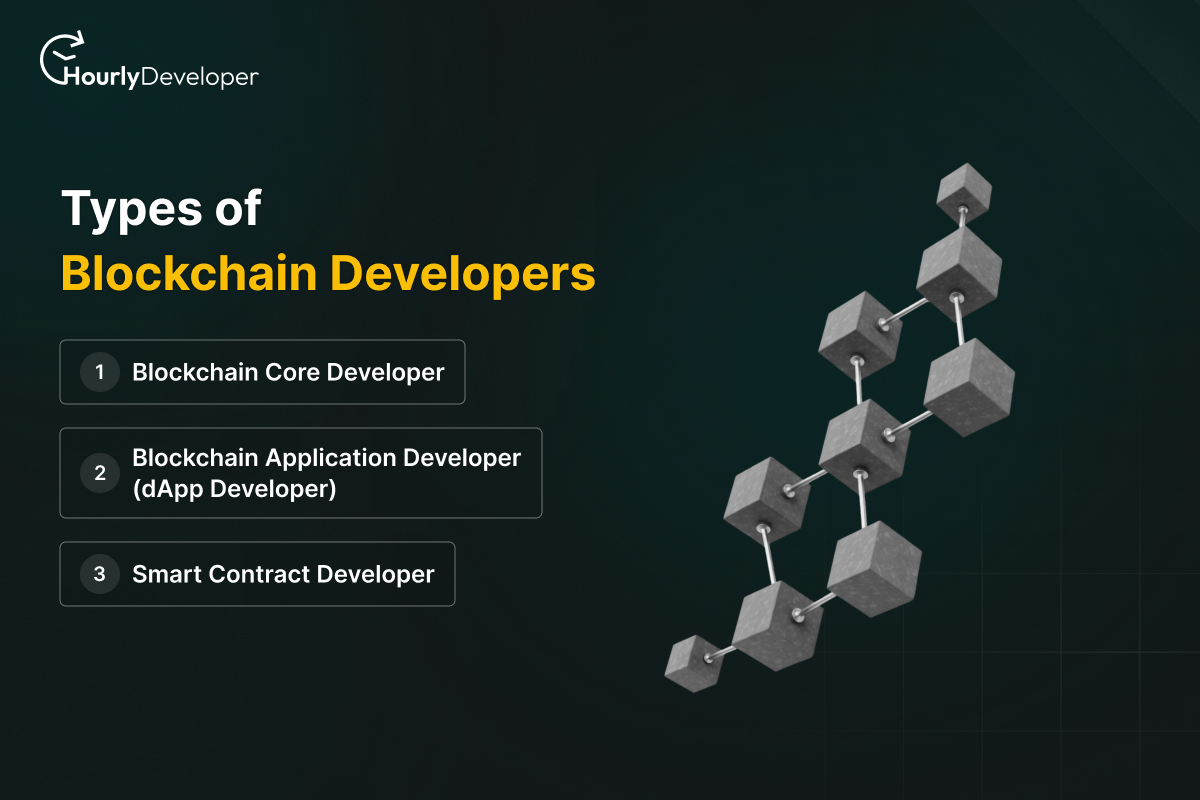
Although the term “blockchain developer” looks simple from the outside, it covers multiple specialized roles.
1.Blockchain Core Developer
These developers work on the blockchain itself. They deal with low-level components such as consensus algorithms, networking layers, block structures, and node communication. They usually work with languages like C++, Rust, Go, and sometimes Python.
A blockchain core developer:
- Designs the fundamental architecture of a blockchain
- Improves network performance and throughput
- Develops consensus protocols like Proof of Stake, Proof of Work, etc.
- Ensures security and scalability of the network
- Works on features like sharding, layer-2 scaling, and data compression
These developers work closest to the heart of blockchain technology.
2. Blockchain Application Developer (dApp Developer)
A dApp developer works on the application layers built on top of blockchains. Instead of modifying the blockchain itself, they create software that interacts with smart contracts and blockchain networks.
Their responsibilities include:
- Building decentralized applications
- Connecting front-end interfaces to smart contracts
- Using blockchain SDKs and APIs
- Managing wallet integrations
- Handling user authentication via wallets instead of passwords
They work with tools like Web3.js, Ethers.js, React, Node.js, and Third-party blockchain APIs.
3. Smart Contract Developer
This role focuses entirely on writing and deploying smart contracts. These are self-executing pieces of code that run on the blockchain when specific conditions are met.
Smart contract developers:
- Write smart contracts using Solidity (Ethereum), Rust (Solana), or Move (Aptos)
- Ensure contracts are secure and free of vulnerabilities
- Handle token creation (ERC-20, ERC-721, ERC-1155, SPL tokens, etc.)
- Perform audits, testing, and gas optimization
- Deploy and manage contract upgrades
This role requires attention to detail because even a small mistake can lock millions of dollars permanently.
Now that you know the different types of blockchain developers, picking the right one feels a lot less mysterious, doesn’t it? Whether you want someone who can tame smart contracts or build a full dApp universe, you can always hire blockchain developers or team up with a blockchain development company to bring your Web3 idea to life.
3.Key Skills of a Blockchain Developer
A blockchain developer must understand a combination of software engineering, cryptography, and distributed systems. Their job is more complex because they often work with code that cannot be changed once deployed.
Key skills include:
- Strong understanding of cryptographic hashes and encryption
- Knowledge of consensus mechanisms
- Experience with smart contract languages
- Ability to create decentralized apps that interact with blockchain nodes
- Understanding of gas optimization, security, and auditing
- Familiarity with blockchain networks like Ethereum, Solana, Polygon, BNB Chain, and Hyperledger
This role requires patience, precision, and lots of practice with blockchain tools and protocols.
4.Who Is a Full-Stack Developer?
A full-stack developer is a software engineer who works on both the front end (client-facing interface) and the back end (business logic, servers, and databases). They build complete applications from start to finish, making them one of the most versatile roles in the software industry.
These developers understand how users interact with an application and how that information travels to the server, gets processed, stored, and then returned back to the user. Instead of specializing in just one area, they know enough of both ends to manage an entire project.
What Does “Full-Stack” Mean Today?
In today’s tech world, full-stack development includes:
- Front-end development: HTML, CSS, JavaScript, React, Angular, Vue
- Back-end development: Node.js, Python, Java, Ruby, PHP
- Databases: MySQL, PostgreSQL, MongoDB
- DevOps skills: Git, Docker, CI/CD pipelines
- Cloud platforms: AWS, Google Cloud, Azure
Full-stack developers can create responsive web interfaces, design APIs, manage servers, and deploy applications. They are essential for web and mobile app development because they can handle multiple layers of an application independently.
Responsibilities of a Full-Stack Developer
Although the tools may vary, their responsibilities follow a clear flow:
- Designing intuitive user interfaces
- Writing server-side logic
- Connecting the front end and back end
- Managing databases and data storage
- Securing applications using authentication and authorization
- Testing and debugging
- Deploying applications to cloud platforms
- Maintaining and updating the codebase
Full-stack developers mainly work on Web2 applications, meaning apps that rely on centralized servers and databases. Just hire full stack developers or partner with a full stack development company to bring your ideas to life.
5.Core Differences Between Blockchain Developers and Full-Stack Developers
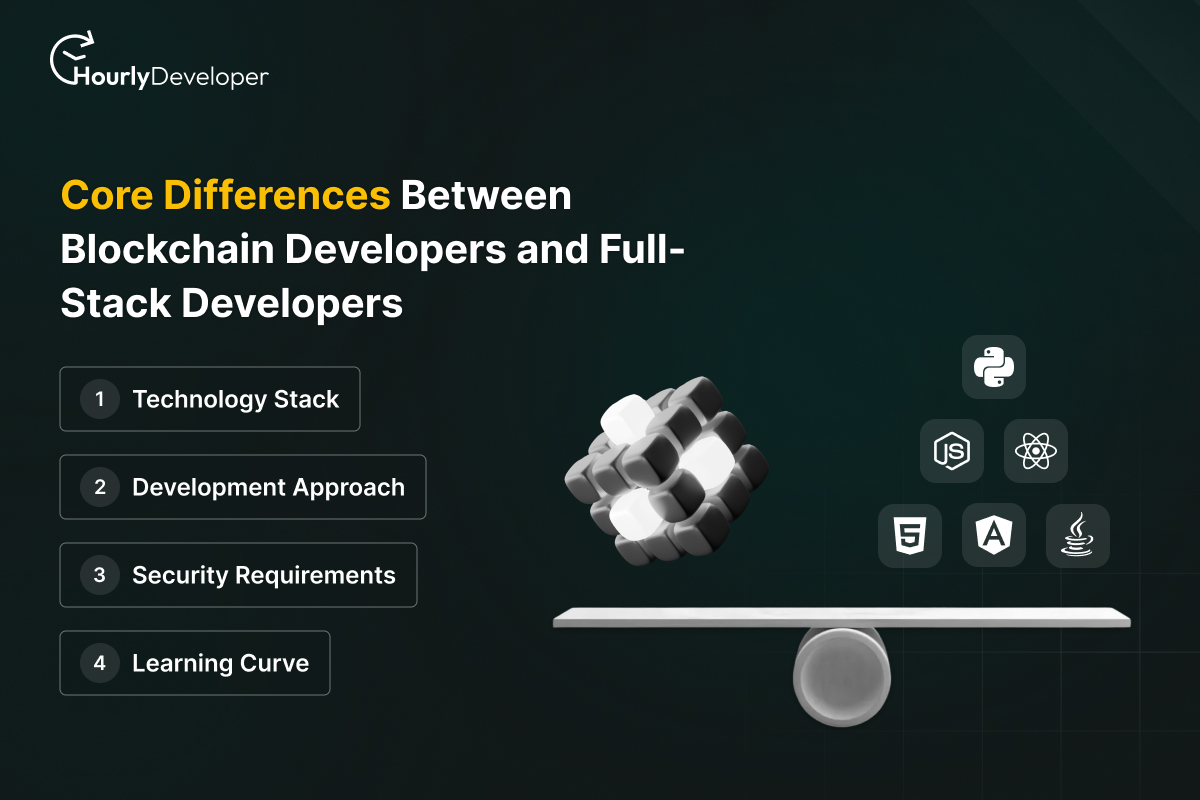
Now that we understand both roles, it becomes much easier to compare them. Even though both write code and build applications, the environments they work in are vastly different.
Below is a full explanation of how they differ.
4.1 Technology Stack
A full-stack developer uses traditional web technologies—React, Node.js, Python, SQL—and relies on centralized servers for executing logic.
A blockchain developer uses decentralized networks where no single party controls the database or execution. They work with smart contracts, cryptographic tools, wallets, nodes, and blockchain frameworks.
4.2 Development Approach
A full-stack app runs on a server. If something breaks, you can fix it and redeploy.
A blockchain smart contract, once deployed, cannot be changed unless designed with upgradeability in mind. This makes blockchain development far more sensitive and high-risk.
4.3 Security Requirements
Full-stack security deals with protecting servers, preventing SQL injection, and securing APIs.
Blockchain security is much more unforgiving. A vulnerability in a smart contract can cause irreversible financial loss. That’s why blockchain developers must understand cryptographic security, smart contract auditing, and attack prevention deeply.
4.4 Learning Curve
A full-stack developer can start with basic HTML, CSS, and JavaScript and build complexity over time.
A blockchain developer requires understanding distributed systems, cryptography, and the internal logic of blockchains, making the learning curve steeper.
6.Career Scope and Job Demand
By 2026, the job market for developers has evolved in a very clear direction: both blockchain developers and full-stack developers are in demand, but for completely different reasons. Companies across the world are not choosing one over the other—they’re hiring based on the type of product they’re building. As Web2, Web2.5, and Web3 all continue to grow side-by-side, the need for both roles is stronger than ever.
Below is a simple and complete breakdown of how the market looks in 2026.
1. Market Demand for Blockchain Developers vs. Full-Stack Developers
A. Blockchain Developers
The demand for blockchain developers in 2026 has grown significantly due to the rise of real-world blockchain use cases, not just crypto projects. More companies now want blockchain as part of their product architecture, especially for transparency, automation, and security.
Key contributors to rising demand:
- Expansion of decentralized finance (DeFi 2.0)
- Growth of tokenized assets, loyalty programs, and digital identity solutions
- Enterprises integrating blockchain for supply chain audits and compliance
- Governments experimenting with digital public infrastructure and on-chain services
- Increase in cross-chain application development
As a result, blockchain developer job listings have grown to nearly 2x of what they were in 2024, especially for smart contract engineers, blockchain architects, and dApp developers.
B. Full-Stack Developers
Full-stack developers remain the most hired type of developer globally. Almost every company needs a full-stack team because websites, dashboards, mobile apps, internal tools, and SaaS platforms still form the base of modern businesses.
Reasons for steady demand:
- Continuous growth of digital-first businesses
- Rise of AI-powered applications that still rely on strong front-end + back-end systems
- Expansion of cloud-native and microservices-based systems
- Every Web3 project still needs a Web2-style user interface
Full-stack developers have a stable and universal demand across all industries, making them one of the safest long-term career choices.
2. Industries Hiring Each Role in 2026
A. Industries Hiring Blockchain Developers
In 2026, blockchain developers aren’t only hired by crypto startups. They’re now needed across sectors that value transparency, automation, and trustless systems.
Common industries:
- Finance & Banking (DeFi, digital payments, CBDCs)
- Supply Chain & Logistics
- Healthcare (secure patient records and identity)
- Gaming (on-chain assets, NFTs, digital economies)
- Real Estate (tokenized property ownership)
- Cybersecurity companies
- Government & public infrastructure
- Energy & carbon credit tracking
- Insurance (automated claims via smart contracts)
Blockchain developers are now part of mainstream tech hiring—not just startups, but every innovative blockchain development company that wants to stay ahead of the curve. Their expertise helps businesses turn complex ideas into real, working products.
B. Industries Hiring Full-Stack Developers
Full-stack developers continue to work across the widest range of industries because every business needs a digital product to operate.
Industries with high demand:
- SaaS companies
- E-commerce
- Fintech
- EdTech
- HealthTech
- Logistics & retail
- Media, entertainment, and OTT platforms
- Hospitality and travel platforms
- AI and automation startups
Any organization that builds a website, a dashboard, or an app needs full-stack talent—making it the most universal tech role of 2026. With the right full stack development company, you can turn even the simplest idea into a polished digital product.
3. Salary Comparison
Salaries vary by country, company size, experience, and tech stack, but some general trends are clear for 2026.
A. Blockchain Developer Salaries
Blockchain developers typically earn higher salaries because:
- The role is more specialized
- Fewer developers know blockchain deeply
- Smart contract errors can be extremely costly
- The learning curve is steeper
On average, blockchain developers earn 20% to 45% more than full-stack developers with similar experience.
B. Full-Stack Developer Salaries
Full-stack salaries remain strong and stable because demand is high and continuous. While salaries may not match blockchain’s upper range, full-stack developers benefit from:
- Steady job availability
- More entry-level opportunities
- Broader industry demand
- More companies hiring globally
In 2026, full-stack developers still earn competitive pay, especially those skilled in modern frameworks like Next.js, Node.js, Python, or cloud-native technologies.
4. Remote and Global Opportunities in 2026
A. Remote Work for Blockchain Developers
Blockchain development is naturally global because Web3 companies often operate without physical offices. In 2026:
- Over 70% of blockchain developer roles are remote-first
- Many projects hire internationally
- Payments often include crypto options
- Developers can work with teams across the US, Europe, UAE, Singapore, and Korea
Blockchain continues to offer some of the most location-independent career options.
B. Remote Work for Full-Stack Developers
Full-stack developers enjoy excellent remote opportunities too, though hybrid models are more common in large enterprises.
In 2026:
- Mid-sized and startup companies hire full-stack developers remotely
- Opportunities increase for AI-powered web development
- International companies continue outsourcing full-stack teams
- Freelancing and contract work remain strong
Remote work is stable, and many companies maintain a flexible work culture post-2024.
7.When Should Companies Hire Blockchain Developers?
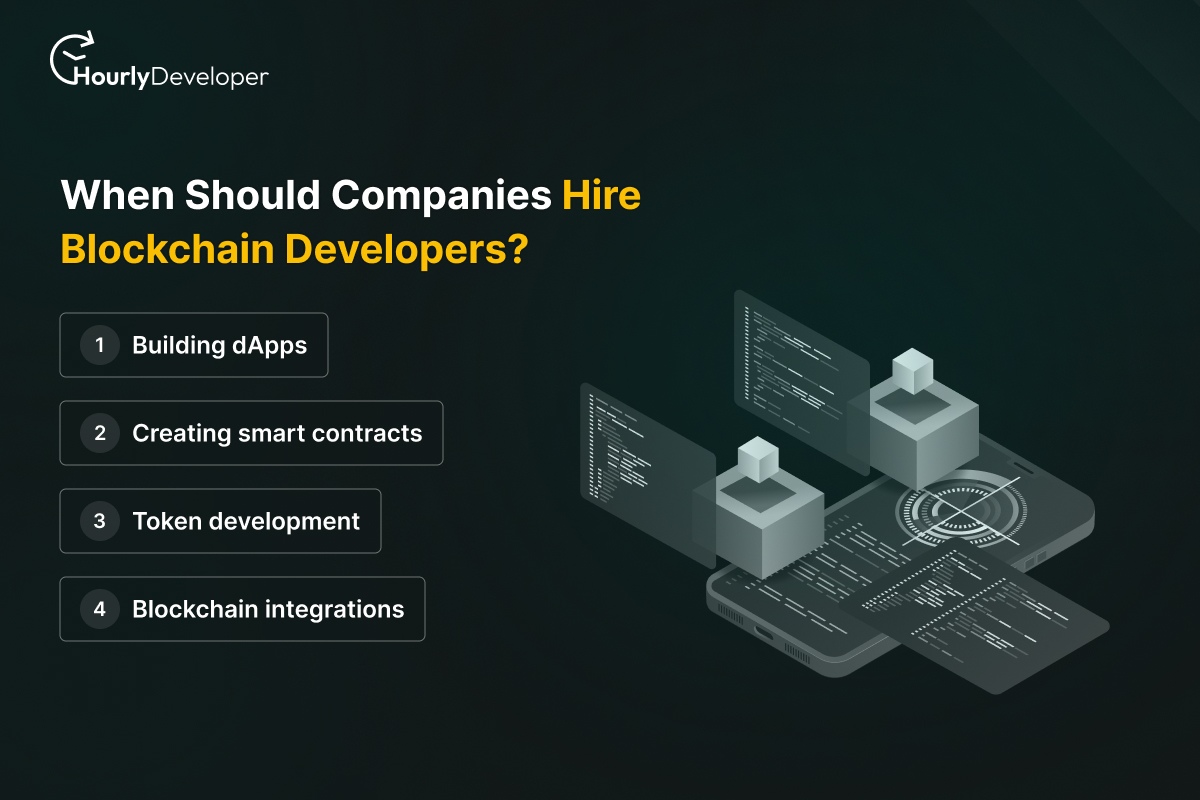
Hiring a blockchain developer makes sense when a business wants to use blockchain technology for trust, security, transparency, or decentralization.
Ideal scenarios:
A. Building dApps
When companies want applications that don’t rely on a single server or authority.
Examples: finance apps, gaming apps, identity apps, supply chain apps.
B. Creating smart contracts
Smart contracts help automate processes. They work on their own once the conditions are met.
Example: payments release automatically, no middleman needed.
C. Token development
Useful when companies want to:
- Launch their own crypto token
- Build a reward or loyalty system
- Create NFTs or digital assets
C. Blockchain integrations
When they want to add blockchain features into existing systems.
Examples:
- Secure payment gateways
- Transparent product tracking
- Verified digital identity
- Immutable data storage
When blockchain is NOT needed:
Blockchain is an advanced technology, but it’s not useful for every project.
If the system only needs:
- A simple database
- Normal authentication
- Basic transactions
- Quick development at low cost
…then blockchain may be unnecessary and expensive. In such cases, a regular backend developer is enough.
8.When Should Companies Hire Full-Stack Developers?
Full-stack developers are great for building complete applications because they understand both frontend (UI) and backend (server, database).
Ideal scenarios:
1. Web apps
If a business wants a modern website or an interactive web platform, a full-stack dev can handle everything from layout to backend logic.
2. SaaS products
These apps run online and need smooth user experience plus strong backend systems.
A full-stack developer manages dashboards, databases, APIs, and user accounts.
3. Mobile apps
They can work with frameworks like React Native or Flutter to create apps for Android and iOS using one codebase.
4. MVP development
Startups choose full-stack developers because they can:
- Build quickly
- Handle multiple layers of development
- Reduce hiring costs
- Launch an early version to test the market
When a full-stack developer may not be enough:
Some projects require deep expertise that goes beyond general development:
- Advanced blockchain systems
- AI/ML applications
- Heavy data analysis or data engineering
- High-security financial systems
In such cases, specialized developers are needed.
9.Can a Full-Stack Developer Become a Blockchain Developer?
Yes—full-stack developers are already halfway there because they understand how apps work from end to end.
Skill transition path:
A full-stack developer can shift into blockchain by gradually learning:
- Smart contract languages
- How decentralized networks operate
- How blockchain differs from normal backend systems
Overlapping skills:
They already know:
- JavaScript / TypeScript
- APIs and backend logic
- Databases
- Version control
- Architecture and problem-solving
These skills make the transition smoother. To fully become blockchain developers, they need to learn:
1. Solidity or Rust
Solidity is used for Ethereum.
Rust is used for blockchains like Solana and Polkadot.
2. Decentralized systems
How nodes communicate, how transactions are validated, how networks reach consensus.
3. Cryptography basics
Understanding:
- Hash functions
- Public/private keys
- Digital signatures
These are essential for blockchain security.
With consistent practice and hands-on projects, a full-stack developer can become a strong blockchain engineer.
10.Which Role Is Right for You?
Choosing between a blockchain developer and a full-stack developer depends entirely on what your product needs today and how you expect it to grow in the future. Both roles are valuable, but they solve different problems. Here’s how you can decide.
1. Choose a Blockchain Developer If Your Project Requires Trust, Security, or Decentralization
Hire blockchain developer when your product depends on features like:
- Smart contracts
- Transparency and auditability
- Automation without middlemen
- Digital assets, tokens, or NFTs
- Secure ownership and identity
- On-chain transactions
This role is ideal if your business is building or integrating:
- DeFi platforms
- dApps (decentralized applications)
- Crypto payment systems
- Blockchain-based supply chain tracking
- Tokenized assets or loyalty systems
- Web3 login or identity verification
Good fit if:
Your product’s value depends on security, transparency, or decentralization—not just normal app features.
Not a good fit if:
You just need a regular database, authentication, basic payments, or a fast MVP. Blockchain will only increase cost and complexity.
2. Choose a Full-Stack Developer If You Need a Complete Web or Mobile Application
Hire full-stack developer when your focus is:
- Building user interfaces
- Creating dashboards, forms, and workflows
- Managing server logic and databases
- Rapid development and iterations
- Launching a product quickly
- Improving existing apps
This role is ideal for:
- SaaS products
- Web apps and portals
- E-commerce platforms
- Company websites
- Internal dashboards
- Mobile apps (via React Native/Flutter)
- MVPs for startups
Good fit if:
You want someone who can take your idea and turn it into a fully functional app from scratch.
Not a good fit if:
Your project depends heavily on blockchain logic or requires advanced on-chain architecture.
11.How to Decide Quickly (Simple Hiring Checklist)
A. Hire Blockchain Developer If:
✔ You’re building something that involves crypto, tokens, NFTs, smart contracts, or decentralized identity
✔ You want security, automation, or ownership features that can’t be managed by a normal backend
✔ You need someone who understands consensus, cryptography, and Web3 architecture
✔ Your project must run on Ethereum, Solana, Polygon, or another blockchain
B. Hire Full-Stack Developer If:
✔ You’re building a typical application—web, mobile, or SaaS
✔ You need someone who can create UI + backend + database structures
✔ Your main priority is speed, features, and user experience
✔ You want a flexible developer who can handle many tasks in one role
12.What If You’re Still Unsure?
Here’s the simplest way to decide:
- If your business idea cannot function without blockchain → hire blockchain developer.
- If your idea can run perfectly on a normal database → hire full-stack developer.
Most projects need a full-stack developer. Only technically specialized or Web3-focused projects require blockchain developers.
Hiring Both? When It Makes Sense
Some companies hire both roles when building hybrid systems—for example:
- A normal web/mobile app (built by a full-stack dev)
- Connected to blockchain smart contracts (built by a blockchain dev)
This gives you the best of both worlds: Smooth user experience + secure decentralized logic.
13.Quick Comparison: Blockchain Developer vs Full-Stack Developer (2026)
| Category |
Blockchain Developer |
Full-Stack Developer |
| Core Focus |
Decentralized systems, smart contracts, on-chain logic |
Frontend + backend development for web and mobile apps |
| Primary Skills |
Solidity/Rust, cryptography, consensus, token standards, blockchain architecture |
JavaScript/TypeScript, React, Node.js, databases, APIs, UI/UX basics |
| What They Build |
dApps, smart contracts, tokens, Web3 integrations |
Websites, SaaS products, dashboards, mobile apps, MVPs |
| Learning Difficulty |
High—requires strong logic and understanding of distributed systems |
Moderate—clear learning path with many resources |
| Development Style |
Security-first, precise, gas-optimized coding |
Feature-focused, user-driven, fast iteration cycles |
| Key Strength |
Trust, transparency, automation, decentralization |
Flexibility, speed, complete end-to-end app development |
| Industries Hiring |
Finance (DeFi), gaming, identity, supply chain, real estate tokenization, Web3 startups |
E-commerce, SaaS, healthcare, education, fintech, agencies, enterprise IT |
| Salary Trends |
Higher due to talent shortage and niche skills |
Stable, competitive, depends on experience and tech stack |
| Best For |
Complex logic, blockchain-based workflows, secure automation |
General apps, product development, fast MVPs, business platforms |
| Career Outlook |
Fast-growing, specialized, high demand across Web3 and enterprise blockchain |
Evergreen, widely applicable, strong demand across industries |
| Remote Opportunities |
Very high—most Web3 teams are global |
High—remote development widely accepted |
14.Cost to Hire: Blockchain Developer vs Full-Stack Developer
When companies plan a tech project, one of the first questions they ask is:
“How much will it cost to hire the right developer?”
The answer depends on the role, skills, and complexity of the work. Blockchain development and full-stack development have very different cost structures, and understanding these differences helps companies budget realistically.
1. Cost to Hire Blockchain Developer
Blockchain developers generally cost more because the skill set is rare, complex, and highly specialized. Their work involves smart contracts, cryptography, decentralized architecture, and security—areas where a single mistake can be expensive.
Typical hiring ranges (global averages):
- Freelancers / Contractors: Higher due to niche expertise
$60 – $180 per hour
- Full-time developers (annual):
$90,000 – $220,000 per year
(Top-tier engineers can exceed this)
- Web3 specialists & senior smart contract auditors:
$200,000 – $350,000+ per year
Why they cost more:
- Limited talent pool
- High risk work (smart contract errors can cause millions in losses)
- Advanced skills like Solidity, Rust, cryptography, tokenomics
- Strong demand from fintech, DeFi, gaming, and enterprise blockchain projects
If your project depends on security, automation, or on-chain logic, the investment in a blockchain developer is worth it.
2. Cost to Hire Full-Stack Developer
Full-stack developers are more affordable because the talent pool is larger and the work is more common across industries. They handle UI, backend, APIs, and databases—everything you need to build a traditional web or mobile application.
Typical hiring ranges (global averages):
- Freelancers / Contractors:
$25 – $75 per hour
- Full-time developers (annual):
$55,000 – $140,000 per year
- Senior engineers with 7+ years experience:
$120,000 – $180,000 per year
Why they cost less:
- More developers available worldwide
- Plenty of learning resources and training programs
- Roles are common in startups, enterprises, agencies, SaaS companies
- Work complexity is lower compared to blockchain engineering
For most web, SaaS, and mobile projects, a full-stack developer is the more economical and practical choice.
Hidden Costs Companies Should Know
Regardless of which developer you hire, there are additional expenses businesses often forget:
- Project management
- Design (UI/UX)
- Cloud hosting or blockchain node infrastructure
- Maintenance and updates
- Security audits (especially for blockchain projects)
- Testing and QA
Blockchain projects usually require smart contract audits, which can cost anywhere from $5,000 to $50,000+ depending on complexity.
Full-stack projects often need ongoing maintenance but rarely require major audits.
So, Which One Is More Cost-Effective?
A. Choose a Blockchain Developer if:
Your core product runs on blockchain, needs transparency, involves tokens, or requires secure automation.
B. Choose a Full-Stack Developer if:
Your app mainly needs standard features—logins, dashboards, forms, payment gateways, or performance-focused interfaces.
In simple words:
- Blockchain developers are more expensive, but necessary for Web3 projects.
- Full-stack developers are more affordable, and perfect for 90% of digital products.
15.Conclusion
Choosing between a blockchain developer and a full-stack developer doesn’t have to feel like solving a puzzle with missing pieces. It’s simply about matching the right talent to the kind of product you want to build. If you’re planning a Web3 product, smart contracts, or token features, you’ll love working with skilled blockchain developers or a dependable Blockchain Development Company. And when it comes to web apps, dashboards, or mobile products, a full-stack developer—or an experienced Full Stack Development Company—keeps everything running smoothly.
Think of it like this:
Blockchain developers build the “trust layer,” while full-stack developers build the “experience layer.” One makes your system secure and decentralized; the other makes it usable, beautiful, and ready for real users.
In the end, both roles matter—just for different reasons. Choose wisely, and your tech dream might just turn into the next big success story.
 Back to Blog