1.Who are Blockchain Developers?
Blockchain developers are software engineers who build applications, systems, and solutions using blockchain technology. They work on things like smart contracts, decentralized apps (DApps), crypto wallets, tokens, NFTs, and even full blockchain networks.
In simple words, they are the people who create secure, transparent, and decentralized digital systems where data can’t be changed or hacked easily.
Some work on building the logic behind blockchains, while others create the apps that run on them. They need strong skills in coding, security, cryptography, and blockchain tools.
2.Why Blockchain Developers Are So Hard to Find
Before you hire blockchain developers, it helps to understand why the market is so competitive.
- Blockchain is still a niche skill
Unlike web or mobile development, blockchain development requires knowledge of cryptography, distributed systems, tokenomics, and smart contracts. Only a limited number of developers have mastered all these.
- The technology evolves very fast
Within blockchain, new frameworks and platforms emerge every year—Ethereum, Hyperledger, Solana, Polygon, Polkadot, Avalanche, and more. Developers need constant learning, and not everyone can keep up.
- High demand, limited supply
Businesses in fintech, gaming, logistics, AI, cybersecurity, and even government sectors are investing in blockchain solutions. This creates huge competition for skilled developers.
- Many developers lack real-world experience
A lot of candidates know Solidity or Web3 basics but have never worked on a production-level blockchain app, which makes hiring risky.
- Most blockchain projects need specialized knowledge
Things like consensus algorithms, gas fees optimization, on-chain/off-chain architecture, and integration with wallets require developers with deep expertise.
This makes finding the “right” developer tough — but hiring the right one can make or break your blockchain product.
3.What Exactly Does a Blockchain Developer Do?
When companies begin their search to Hire Blockchain Developers, they often struggle to understand what tasks these professionals actually handle. Blockchain is still a relatively new field, and the role of a developer can vary depending on the project, industry, and blockchain platform being used. But in general, a skilled blockchain developer works on everything from smart contracts to node configuration to security audits.
Here’s a deeper breakdown of what competent Blockchain App Developers should be able to do:
1.Build Smart Contracts
Smart contracts are automated programs that run on blockchain networks like Ethereum, Solana, and Polygon.
A good developer knows how to:
- Write secure, optimized smart contracts using languages like Solidity, Vyper, or Rust
- Follow best practices for reducing gas costs
- Use standard protocols like ERC20 (tokens), ERC721 (NFTs), and ERC1155 (multi-tokens)
- Perform contract testing using tools like Truffle, Hardhat, or Foundry
- Deploy and maintain smart contracts in a live environment
Since smart contracts cannot be edited after deployment, the developer must ensure every line of code is error-free, secure, and well-tested.
2. Create Decentralized Applications (DApps)
Blockchain developers build DApps that run on decentralized networks instead of traditional servers. This includes:
- Backend logic connecting with blockchain nodes
- Frontend interfaces using React, Next.js, or Vue
- Connecting UI elements with smart contracts through Web3 libraries
- Designing seamless user experiences for wallet-based logins
- Handling transaction flows, confirmations, signing requests, and error messages
A good DApp developer ensures the platform feels smooth and user-friendly—even though the backend uses complex blockchain logic.
3. Work With Blockchain Protocols
Different blockchains work differently. A skilled developer understands:
- Consensus mechanisms like Proof of Stake (PoS) or Proof of Work (PoW)
- How transactions are validated
- How nodes communicate in a distributed network
- Layer-2 scaling solutions like Optimistic Rollups or zkRollups
- Cross-chain bridges and interoperability solutions
These concepts help them build applications that are scalable, efficient, and aligned with how the specific blockchain behaves.
4. Integrate Wallets and Payments
Blockchain apps rely heavily on wallets for authentication and transactions.
A developer must know how to integrate:
- MetaMask
- WalletConnect
- Phantom (Solana)
- Coinbase Wallet
- Trust Wallet
And handle features such as:
- Generating and managing private/public keys
- Collecting user signatures for smart contract functions
- Handling token transfers
- Managing gas fees and network switching
- Ensuring secure login systems
This is a crucial part of Web3 development because wallets act as the “identity layer” for blockchain users.
5. Build Custom Blockchain Solutions
Many enterprises need blockchain for internal processes rather than public networks.
Developers should be able to create:
- Private permissioned blockchains using Hyperledger, Quorum, or Corda
- Supply chain tracking systems
- Decentralized finance (DeFi) protocols
- Blockchain-based healthcare data systems
- Tokenized loyalty reward systems
- NFT marketplaces or asset tokenization platforms
- Blockchain-based voting or identity verification systems
This requires both technical and strategic understanding to ensure the solution fits the business goals.
6. Manage Node Setup and APIs
Nodes are the backbone of blockchain networks. A blockchain developer should:
- Set up full nodes, archive nodes, or validator nodes
- Connect applications with RPC endpoints
- Use API tools like Alchemy, Infura, Moralis, or QuickNode
- Optimize node performance, uptime, and synchronization
- Troubleshoot network or transaction issues
- Ensure reliable communication between frontend and blockchain
Node management requires deep technical knowledge and hands-on experience.
7. Ensure Security
Security is one of the most important aspects of blockchain development.
A developer must know how to:
- Identify smart contract vulnerabilities
- Prevent common attacks like reentrancy, overflows, underflows, and phishing
- Follow audit standards before deployment
- Run automated tests and manual code reviews
- Integrate hardware wallets and secure key storage
- Build secure authentication flows for users
Since blockchain transactions are irreversible, even a minor bug can lead to huge financial losses. This is why hiring experienced developers—or a reliable Blockchain Development Company—is so important.
8. Handle Testing, Debugging, and Deployment
A blockchain developer should not only write code but also:
- Test smart contracts across multiple networks
- Deploy DApps on mainnet and testnets
- Debug issues related to gas, network fees, or failed transactions
- Continuously monitor performance and security
- Provide updates and upgrades after launch
This ensures the blockchain application runs smoothly long-term.
9. Collaborate With Designers, Product Teams, and Security Experts
Blockchain projects are teamwork-heavy. A good developer must be able to:
- Explain technical details to non-technical stakeholders
- Work closely with UI/UX designers
- Coordinate with security auditors
- Help businesses choose the right blockchain approach
- Suggest improvements for long-term scalability
Communication skills are as important as technical skills in blockchain development.
10. Stay Updated With the Latest Trends
Blockchain technology changes quickly. A good developer must stay updated with:
- New blockchain platforms
- Layer 2 scaling solutions
- Updated token standards
- New consensus algorithms
- The latest security vulnerabilities
- Emerging tools and frameworks
This ensures they can deliver modern, future-ready solutions.
A blockchain developer is not just a coder — they are an engineer, architect, strategist, and security expert rolled into one. These are complex responsibilities, and only developers with genuine experience can handle them.
This is why businesses often partner with a professional Blockchain Development Company offering full Blockchain Development Services. It reduces risk, guarantees quality, and ensures your blockchain project is handled by skilled professionals.
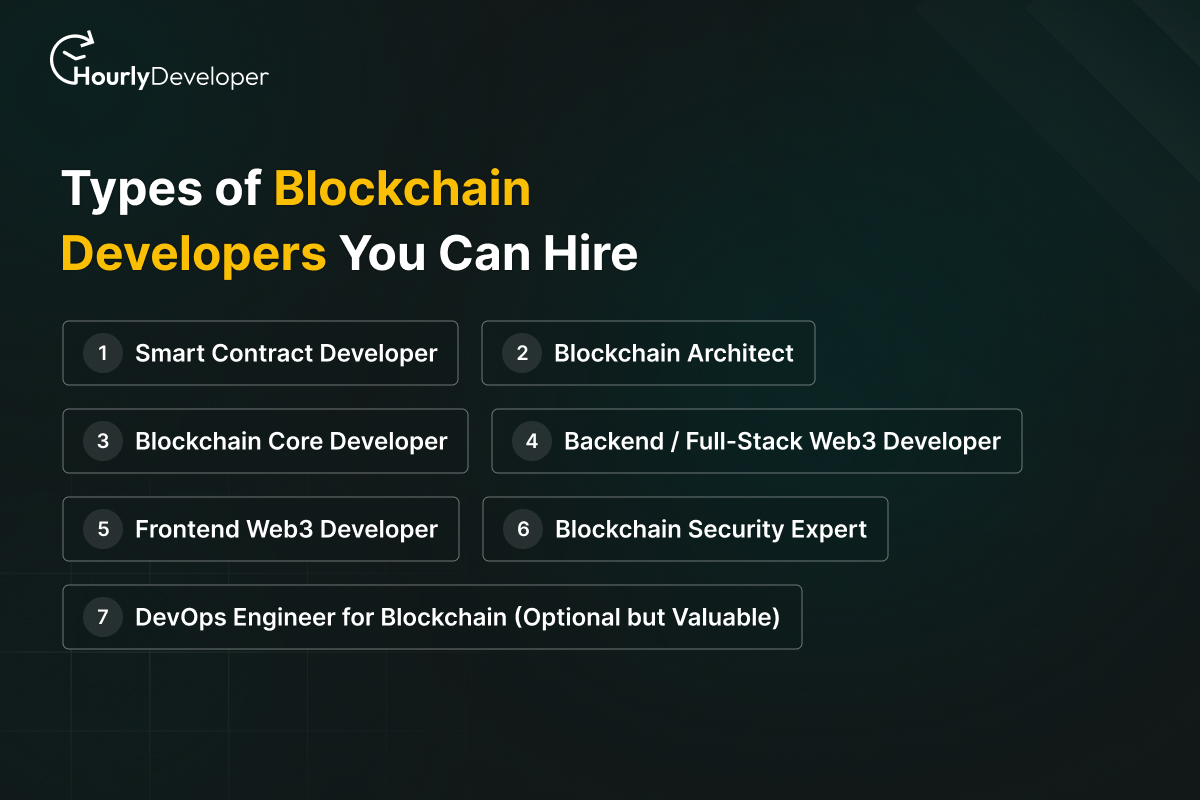
4.Types of Blockchain Developers You Can Hire
Every blockchain project is different—some need simple smart contracts, while others require complex decentralized systems, private blockchain networks, or high-security financial applications. That’s why the type of developer you hire matters so much.
Depending on your goals, timeline, and technical requirements, you may need one or more of the following specialists:
1.Smart Contract Developer
A Smart Contract Developer focuses on writing the core logic that powers decentralized applications. They work with languages such as:
- Solidity (Ethereum, BNB Chain, Polygon)
- Rust (Solana, NEAR, Polkadot)
- Vyper (Ethereum alternative to Solidity)
Their responsibilities include:
- Creating secure and optimized smart contracts
- Implementing token standards like ERC20, ERC721 (NFTs), ERC1155, SPL tokens, or custom tokens
- Performing rigorous testing using Hardhat, Foundry, or Truffle
- Deploying smart contracts on testnets and mainnets
- Ensuring gas efficiency and preventing vulnerabilities
- Handling upgrades with proxy contracts (if required)
If your project involves tokens, NFTs, decentralized finance (DeFi), staking, governance, or automated workflows, you definitely need a smart contract developer.
2. Blockchain Architect
A Blockchain Architect handles the “big picture” technical planning for your project. They design the entire system and make decisions that affect performance, scalability, and security.
They work on:
- Choosing the right blockchain platform (Ethereum, Hyperledger, Polygon, Solana, etc.)
- Designing the system architecture and data flow
- Selecting or creating the consensus mechanism
- Planning tokenomics for utility or governance tokens
- Deciding how smart contracts, databases, and frontends interact
- Creating documentation and development guidelines
If you’re building a large-scale or enterprise project—like a DeFi platform, supply chain system, Web3 marketplace, or identity solution—an architect is essential. They ensure the system is built right from the foundation.
3. Blockchain Core Developer
A Blockchain Core Developer works at the deepest level of blockchain technology. Instead of building apps on a blockchain, they build or improve the blockchain itself.
They specialize in:
- Designing and developing consensus algorithms
- Improving blockchain performance and scalability
- Creating new blockchain protocols
- Working with cryptography, network layers, and distributed databases
- Maintaining and optimizing nodes and validators
- Integrating cross-chain communication
If you want to create your own blockchain network, a custom private blockchain, or work on protocol-level innovation, you need a core developer.
4. Backend / Full-Stack Web3 Developer
A backend or full-stack Web3 developer connects your blockchain logic with your application’s backend systems.
They handle:
- Server-side logic
- APIs and database management
- Authentication using wallets
- Integration with blockchain nodes
- Transaction processing flows
- Off-chain data storage (IPFS, Filecoin, Arweave)
- Smart contract interaction via Web3.js or Ethers.js
These developers ensure the blockchain and traditional backend work smoothly together. If you’re building a DApp with dashboards, analytics, user profiles, or admin panels, you need a Web3 backend or full-stack developer.
5. Frontend Web3 Developer
A Frontend Web3 Developer brings your project to life through clean, modern, and interactive user interfaces.
They work with:
- React, Next.js, Vue, Angular
- Web3.js, Ethers.js, wagmi, RainbowKit
- UI frameworks and Web3 wallet connectors
- Real-time data display from blockchain networks
Their responsibilities include:
- Building responsive and user-friendly DApp interfaces
- Creating dashboards, forms, charts, and transaction views
- Integrating wallet login features
- Displaying smart contract data on the UI
- Ensuring smooth onboarding and ease of use
Since blockchain products can feel complicated, a skilled frontend developer ensures your users enjoy a simple, intuitive experience.
6. Blockchain Security Expert
Security is the most critical part of blockchain development. Even a small bug in a smart contract can cause millions in losses.
A Blockchain Security Expert helps protect your project through:
- Smart contract audits (manual + automated)
- Penetration testing
- Detecting vulnerabilities such as reentrancy, overflows, access-control issues, and logic flaws
- Reviewing cryptographic implementations
- Providing reports and patching fixes
- Ensuring compliance with blockchain security standards
Security experts are essential for DeFi, NFTs, token sales, staking platforms, and any app involving real money.
7. DevOps Engineer for Blockchain (Optional but Valuable)
For larger blockchain projects, you may also need a DevOps engineer who specializes in:
- Managing cloud environments
- Maintaining validator nodes and RPC servers
- Automating deployments
- Monitoring uptime and performance
- Scaling blockchain infrastructure
They ensure your blockchain solution runs smoothly in production.
5.Choosing the Right Developer Type Depends on Your Project Goals
Here’s a quick guide:
- Building a token or NFT project? → Hire a Smart Contract Developer
- Building a full DApp? → Hire Full-Stack Developer + Frontend + Smart Contract Developer
- Building a private or enterprise blockchain? → Hire a Blockchain Architect + Core Developer
- Building a DeFi platform? → Hire Smart Contract Developer + Security Expert
- Building a new blockchain protocol? → Hire Core Developers
- Need reliable long-term development? → Hire a Blockchain Development Company that provides complete Blockchain Development Services
When you choose the right mix of developers, your project becomes faster, safer, and more scalable.
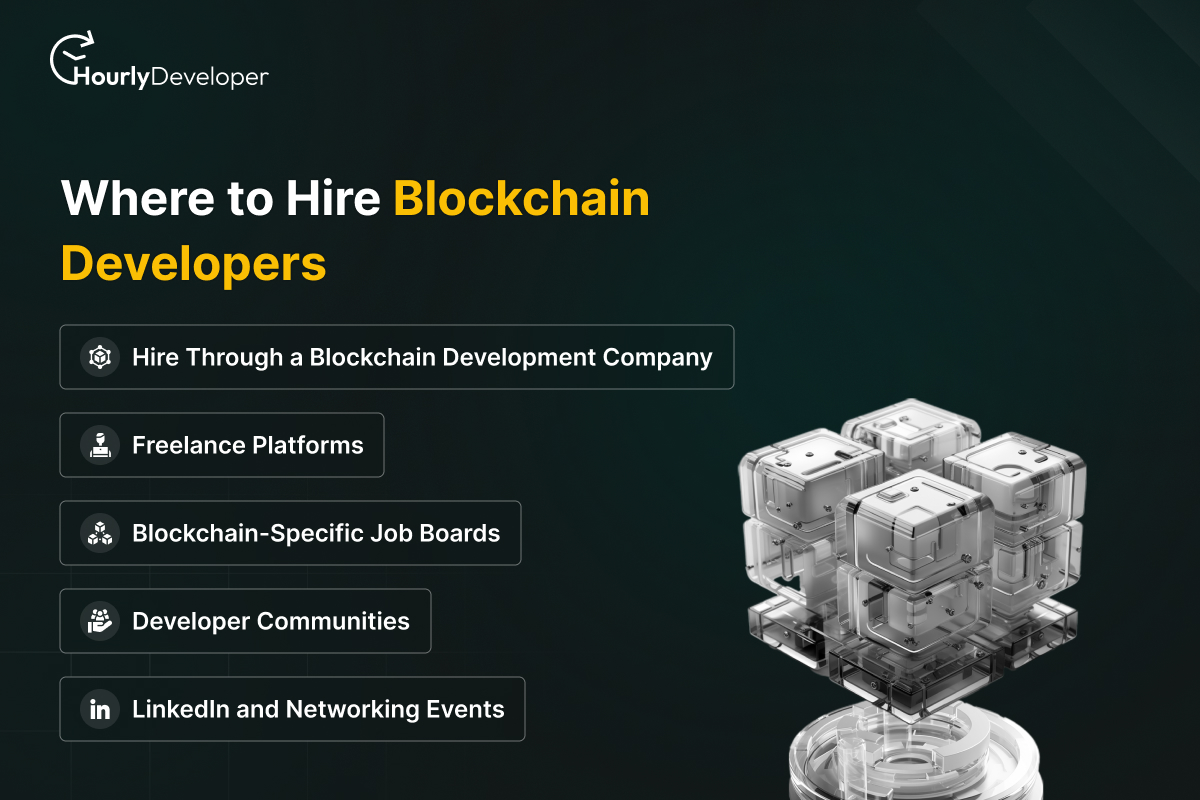
6.Where to Hire Blockchain Developers
Finding skilled blockchain developers can be challenging, especially because the demand is so high and the talent pool is still relatively small. However, there are reliable places where you can find professionals who understand Web3, smart contracts, decentralized systems, and security.
Below are the best platforms and methods to hire top blockchain talent, depending on your budget, project timeline, and technical needs.
1.Hire Through a Blockchain Development Company
This is the most trusted, reliable, and risk-free option—especially if you’re building a serious blockchain project.
A professional Blockchain Development Company provides everything under one roof, including:
- Verified and experienced Blockchain App Developers
- Team members familiar with DeFi, NFTs, metaverse, supply chain, gaming, and enterprise blockchain
- Well-established coding standards and security guidelines
- Strategy and consulting teams to help plan the product
- Full Blockchain Development Services including design, development, auditing, testing, and deployment
- Continuous maintenance and upgrades after launch
Why choose this option?
- No need to interview multiple developers individually
- No risk of hiring inexperienced or fake Web3 candidates
- Faster delivery due to ready-made workflows
- Ability to scale your team anytime
- Higher security and accountability
For businesses that want quality and consistency, hiring a company is usually the safest bet.
2. Freelance Platforms
If you want short-term help or have a small budget, freelance platforms are a good place to start. You can find blockchain freelancers on:
- Upwork
- Toptal
- Fiverr
- Freelancer
- Guru
Pros:
- Flexible pricing
- You can hire for specific tasks (e.g., one smart contract, UI update, small audit)
- Faster hiring since freelancers are readily available
Cons:
- Skill levels vary widely
- Some freelancers exaggerate their Web3 experience
- Harder to manage large projects
- Higher chances of delays or communication gaps
- No long-term accountability
Freelancers work well for small tasks, but for full-scale projects, you may need a team rather than an individual.
3. Blockchain-Specific Job Boards
If you’re a startup or want someone full-time, blockchain-focused job boards are a great option. These platforms are filled with developers already working in Web3.
Popular platforms include:
- CryptoJobs
- AngelList (Wellfound)
- Remote3
- Web3Career
- CryptoJobList
- Blockchain Headhunters
Here, you typically find developers who:
- Have worked on real blockchain products
- Stay updated with the latest Web3 trends
- Are genuinely passionate about decentralized tech
These job boards are perfect for hiring long-term in-house blockchain talent.
4. Developer Communities
If you want to find developers who are actively building and contributing to open-source blockchain projects, developer communities are the best place to look. These communities allow you to see real code, genuine contributions, and honest collaboration.
Strong communities include:
- GitHub – Explore open-source repositories and check contributors’ profiles
- StackExchange / StackOverflow – Find developers solving real-world Web3 issues
- Reddit Blockchain & Web3 Groups – Engage in community discussions
- Discord Web3 Servers – For Solana, Ethereum, Polygon, Avalanche, and general dev channels
- Telegram Crypto Dev Groups – Popular for Web3, DeFi, and NFT dev communities
Why look here?
- You can verify a developer’s skills through their contributions
- These developers are often genuinely passionate about Web3
- Many of them work on the latest blockchain frameworks and tools
If you’re looking for innovative and hands-on developers, communities are a goldmine.
5. LinkedIn and Networking Events
Don’t underestimate the power of professional networking. Many top blockchain developers are active on LinkedIn and attend tech events.
Where to connect with them:
- LinkedIn job postings
- Direct outreach to developers with verified experience
- Web3 hackathons
- Blockchain conferences (ETHGlobal, DevCon, Web3 Summit)
- University blockchain clubs and coding competitions
- Meetups and community gatherings
These events attract developers who:
- Are passionate about exploring new blockchain innovations
- Have hands-on experience building apps during hackathons
- Are eager to collaborate on real-world projects
You can evaluate their communication skills, passion, teamwork, and technical strengths in person.
7.Which Option Should You Choose?
- For high-security, long-term, or enterprise-level projects → Hire a Blockchain Development Company
- For small tasks or short-term requirements → Freelancers work well
- For in-house hiring → Blockchain job boards & LinkedIn
- For developers passionate about open-source work → GitHub & community platforms
Choosing the right platform depends on your project’s complexity, budget, and timeline. But no matter where you hire from, always evaluate a developer’s real skills, portfolio, and problem-solving abilities.
8.How to Hire Blockchain Developers
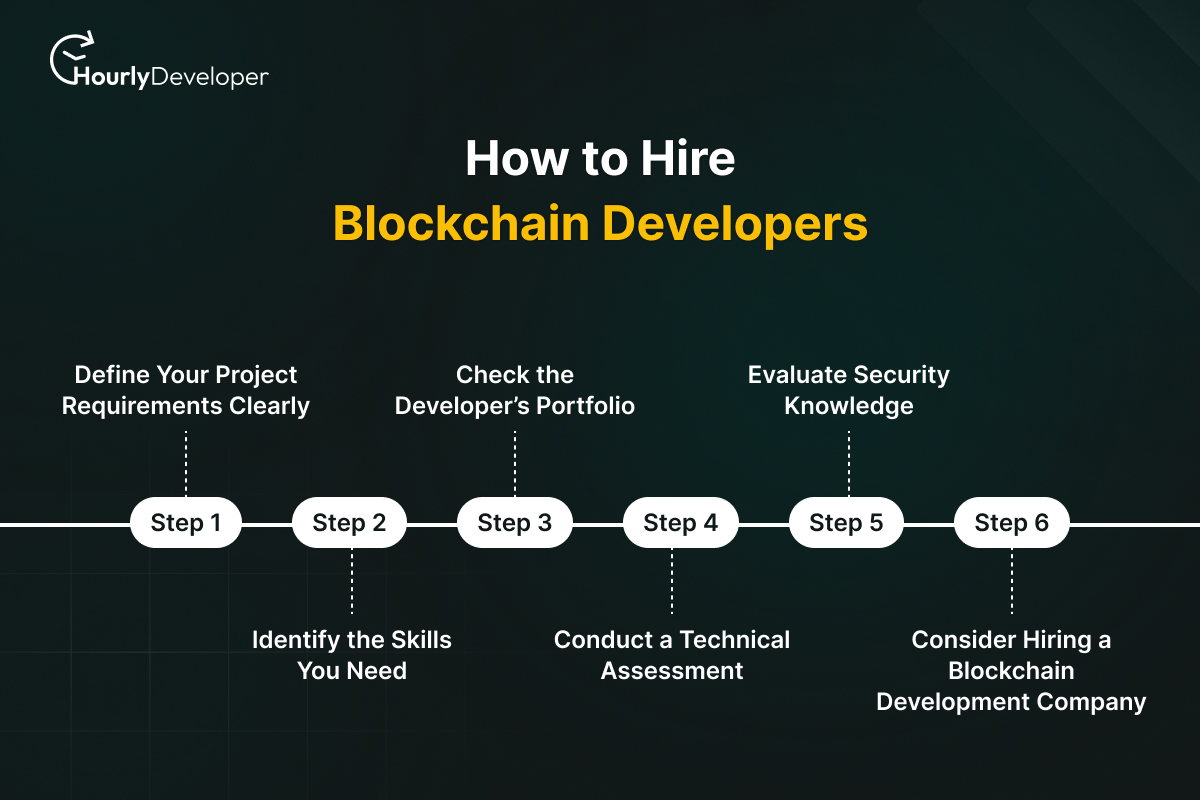
Here is a practical step-by-step method to hire the best talent:
Step 1: Define Your Project Requirements Clearly
Before hiring anyone, be clear about what you are building.
Ask yourself:
- What problem is the solution solving?
- Do you need a public or private blockchain?
- Which platform will you build on (Ethereum, Hyperledger, Solana, Polygon)?
- Do you need smart contracts, DApps, tokens, or NFTs?
- What is your timeline and budget?
A Blockchain Development Company can help you define this if you’re unsure.
Step 2: Identify the Skills You Need
A strong blockchain developer should know:
Technical Skills
- Solidity, Rust, Go, JavaScript, Python
- Smart contract development
- DApp development
- Web3 libraries (Web3.js, Ethers.js)
- Node operation and network configuration
- Token standards
- Blockchain architecture
Soft Skills
- Problem-solving
- Logical thinking
- Security awareness
- Communication skills
- Ability to work in fast-paced environments
Step 3: Check the Developer’s Portfolio
Always look for:
- Past Blockchain projects
- Smart contract code on GitHub
- Experience with real clients
- Experience with your chosen blockchain platform
A developer with a strong portfolio is always a safer choice.
Step 4: Conduct a Technical Assessment
Give candidates tasks such as:
- Writing a smart contract
- Building a small DApp
- Testing or optimizing gas usage
This shows their real skill level.
Step 5: Evaluate Security Knowledge
Blockchain apps face several risks:
- Smart contract bugs
- Reentrancy attacks
- Phishing attacks
- Private key misuse
Your developer should know how to avoid these vulnerabilities.
Step 6: Consider Hiring a Blockchain Development Company
If all this feels overwhelming, or if you don’t have a technical team, partnering with a Blockchain Development Company is the smartest choice.
They offer:
- Experienced blockchain app developers
- Faster development
- Guaranteed project security
- 24/7 support
- Structured workflows
- Scalable Blockchain Development Services
Companies ensure project delivery without you needing to hire multiple individuals.
9.Benefits of Hiring Blockchain Developers Through a Company
1. Fully-managed development
When you hire through a blockchain development company, you don’t need to spend time on hiring, training, or supervising developers. The entire development cycle — from planning to coding to deployment — is handled by the company, giving you a smooth, hands-off experience while you stay focused on your business goals.
2.Access to a complete team
A company gives you much more than just developers. You get access to designers, architects, QA testers, DevOps engineers, and project managers who all work together as a coordinated unit. This ensures stronger communication, consistent quality, and faster progress across every part of your project.
3. Faster delivery
Since companies already have reusable code modules, pre-built templates, and established workflows, they can deliver blockchain projects much faster than freelancers or an in-house team starting from scratch. Their experience helps speed up development without compromising quality.
4. Better security
Security is crucial in blockchain projects, and companies have specialists who follow strict best practices. They perform audits, code reviews, and vulnerability testing to make sure your smart contracts and applications are safe from hacks, bugs, and financial risks.
5. Scalable solutions
As your project grows, a company can instantly scale your development team by adding more developers or resources. This flexibility means you can expand your product, build new features, and manage higher user loads without facing hiring delays.
6. Cost-effective
Hiring a full in-house blockchain team can be extremely expensive due to high salaries, training, and infrastructure costs. A development company gives you access to experts at a fixed, predictable price, making it a more affordable option for startups and enterprises.
7. Consistent support and maintenance
Even after the project launches, blockchain apps need updates, fixes, and improvements. Companies offer long-term support and maintenance packages to ensure your system stays secure, functional, and compatible with new technologies.
8. Reliable quality and documentation
Professional companies follow standardized coding practices and maintain proper documentation, version control, and progress reporting. This gives you a future-ready project that’s easy to scale, upgrade, or hand over to another team if needed.
10.Red Flags to Avoid When Hiring Blockchain Developers
Make sure to avoid developers who:
- Only learned blockchain from tutorials: Theory is very different from real-world development.
- Cannot show code samples or GitHub: Transparency matters.
- Do not understand security: Blockchain without security is a disaster.
- Overpromise unrealistic timelines: Blockchain takes time, especially smart contract auditing.
- Say they can work on “any” blockchain easily: Each chain needs a different experience.
Choosing the wrong developer can cause major losses, security breaches, or product failure.
11.How a Good Developer Improves Your Blockchain Project
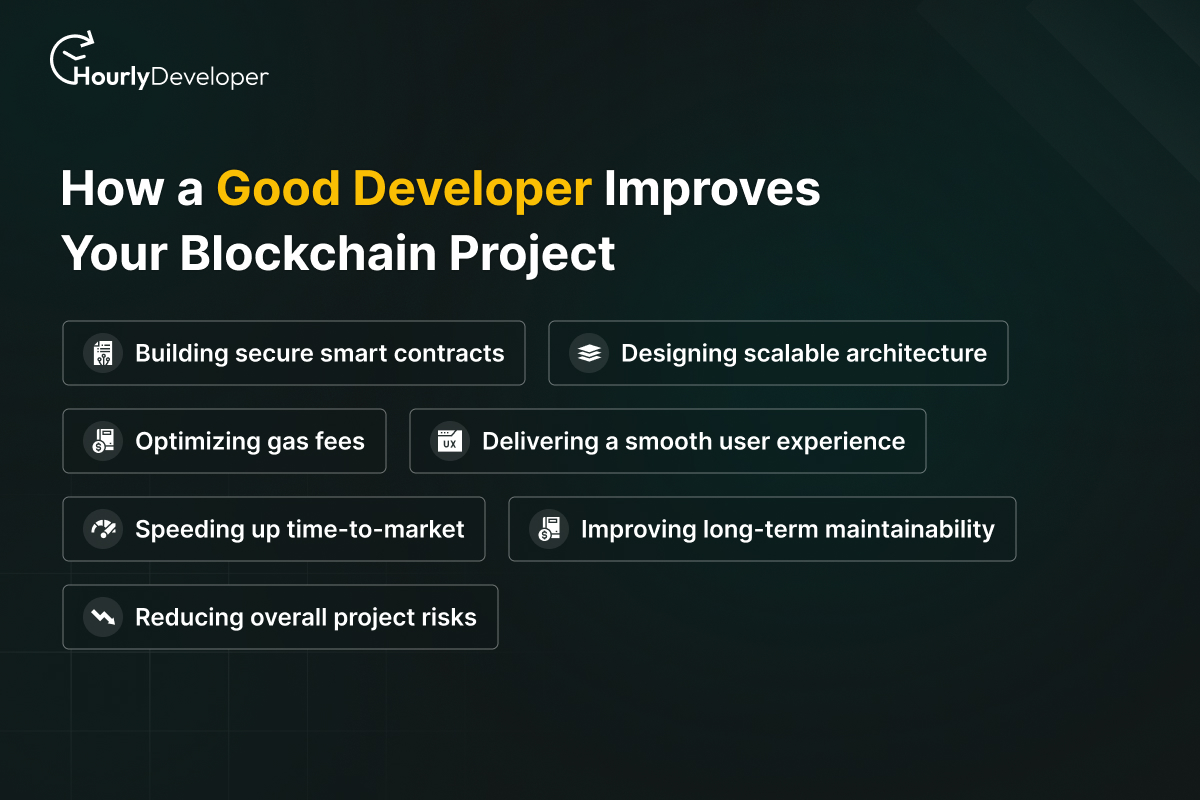
1.Building secure smart contracts
A good blockchain developer writes smart contracts that are safe and free from errors. This helps protect your project from hacks, money loss, or misuse. With the right developer, your contracts are checked, tested, and reliable.
2.Designing scalable architecture
Experienced developers build your system in a way that it can grow easily. Even if thousands of users start using your app, it will still run smoothly. This helps your project stay strong as your business becomes bigger.
3. Optimizing gas fees
Gas fees can be very expensive if the code is not written well. A skilled developer knows how to write clean, efficient code that uses less gas. This saves money for both you and your users and makes your app faster and more affordable.
4. Delivering a smooth user experience
Good developers understand how to make your app easy to use. They connect the backend and frontend properly so that actions like connecting a wallet, signing a transaction, or buying a token feel simple and quick. This gives your users a much better experience.
5. Speeding up time-to-market
When you hire an expert developer, your project gets completed faster. They already know the right tools and methods, so they do not waste time figuring things out. This helps you launch your idea sooner and get ahead of your competitors.
6. Improving long-term maintainability
A good developer writes clean and organized code. This makes it easy to update your project later, add new features, or fix issues. You won’t need to rebuild everything from scratch because the foundation will be strong.
7. Reducing overall project risks
Blockchain projects deal with money and sensitive data. Skilled developers follow best practices and test everything properly. This reduces chances of bugs, failures, or security problems, giving you more peace of mind.
12.Top Blockchain Development Services You Can Use
1. Smart Contract Development
A Blockchain Development Company can help you create custom smart contracts that fit your business needs. These contracts are tested for security, performance, and accuracy. The company can also audit your existing smart contracts to make sure they are safe from errors and hacks.
2. DApp Development
If you want to build a decentralized application, a company can handle the entire process—from planning the idea to designing the UI and developing the backend. They make sure your DApp works smoothly, connects well with wallets, and offers a great user experience.
3. NFT Marketplace Development
For businesses looking to enter the NFT space, companies provide complete NFT marketplace development. This includes features like minting, listing, buying, selling, bidding, royalties, and wallet integration. You get a platform similar to OpenSea or Rarible, built according to your needs.
4. Token Development
Whether you need a utility token for payments, a governance token for voting, or a security token for investment, companies can create tokens based on popular standards like ERC-20, ERC-721, ERC-1155, and more. They also help with tokenomics planning and deployment.
5. Private Blockchain Development
Some businesses, especially enterprises, need private or permissioned blockchains for secure internal operations. Companies can build these custom networks to help with supply chain tracking, identity management, healthcare data, and financial systems.
6. DeFi Development
DeFi is one of the fastest-growing areas in blockchain. A development company can build decentralized exchanges (DEXs), lending and borrowing platforms, yield farming systems, staking platforms, and DeFi wallets. These solutions help businesses enter the finance sector without relying on banks.
7. Blockchain Integration Services
If you already have an existing system, a company can help you integrate blockchain features like payments, verification, data tracking, or tokenization. This makes it easy to add blockchain benefits without rebuilding everything from scratch.
8. Consulting and Strategy
Choosing the right blockchain, tools, and technology stack can be confusing. Blockchain Development Companies offer consulting services to analyze your business goals, recommend the best blockchain ecosystem, and create a roadmap for smooth development.
9. Ongoing Support and Maintenance
After your project goes live, companies provide regular updates, bug fixes, monitoring, and new feature additions. This ensures your product stays secure, up to date, and ready for future growth.
13.How Much Does It Cost to Hire Blockchain Developers?
The cost of hiring blockchain developers depends on a few key factors. The experience level of the developer matters because senior developers charge more but work faster and deliver better quality. The complexity of your project also affects the price—simple smart contracts cost less, while advanced DeFi apps or NFT platforms cost more. Location is another factor, as developers in the US or Europe usually charge higher rates compared to developers in countries like India.
Finally, your timeframe also impacts the cost. If you need the project urgently, the price may increase due to faster delivery requirements.
Average hourly rates (approx.):
- Junior Developer: $30–$50/hr
- Mid-Level Developer: $50–$100/hr
- Senior Developer: $100–$200/hr
- Blockchain Development Company: Custom monthly or project-based pricing
Hiring through a company often gives better value due to speed, expertise, and guaranteed quality.
14.Final Thoughts: Hiring Blockchain Developers Doesn’t Have to Be Hard
Finding good blockchain talent may feel challenging, but with the right approach, you can hire blockchain developers who bring real value to your project. Whether you hire freelancers, full-time employees, or work with a professional Blockchain Development Company, the key is to evaluate skills, experience, and security knowledge.
If you want faster delivery, reliable support, and expert-level Blockchain App Developers, partnering with a company offering complete Blockchain Development Services is often the best and safest choice. It saves time, reduces risk, and ensures your blockchain product is built the right way from day one.
A great blockchain developer can turn your idea into a powerful, scalable, future-ready solution — and now you know exactly how to find the right one.
 Back to Blog