Finding the real cost of app development in Germany is harder than it should be. Most online guides offer outdated estimates, broad pricing ranges, and very little practical insight. This blog breaks down the actual factors influencing app development costs in Germany in 2026, including Android and iOS app pricing, Flutter and React Native development costs, and the difference between hiring local developers and working with an offshore mobile app development company. By the end, you will have a much clearer understanding of what to expect before planning your app budget.
1.First, Understand What You Are Actually Paying For
Most cost estimates treat app development like a commodity, where you describe what you want, someone quotes you a number, and you either accept it or shop around. The reality is more layered than that.
When you hire mobile app developers or engage a mobile app development company, you are not just buying hours. You are buying discovery and scoping work, architecture decisions, UI and UX design, frontend development, backend engineering, database setup, third-party integrations, testing and QA, deployment and DevOps, and the ongoing cost of maintaining everything after launch.
Every single one of these has its own cost footprint, and skipping or underfunding any of them will cost you more later. That is the part most budget guides leave out entirely.
2.What Does It Actually Cost to Build an App in Germany in 2026?
Let us start with the honest answer: it depends heavily on complexity, team location, and technology choices. But here are realistic numbers based on current 2026 market rates.
| App Complexity |
Local German Team |
Offshore Dev Team |
Timeline |
| Simple MVP (5 to 8 screens) |
EUR 30,000 to 70,000 |
USD 10,000 to 25,000 |
8 to 12 weeks |
| Mid-Level App |
EUR 80,000 to 180,000 |
USD 28,000 to 70,000 |
3 to 6 months |
| Complex App or Platform |
EUR 200,000 to 500,000 |
USD 70,000 to 200,000 |
6 to 14 months |
| Enterprise Grade App |
EUR 500,000 and above |
USD 180,000 to 400,000 |
12 months or more |
Figures reflect 2026 market rates. Local German team rates range from EUR 90 to EUR 150 per hour. Offshore rates vary based on team seniority and engagement model.
Android App Development Cost in Germany
If you are building exclusively for Android, your cost will generally be 10 to 20 percent lower than a full cross-platform project, but only if you are building a truly native Android app. Most businesses today do not build exclusively for one platform because the market share split between Android and iOS in Germany means you would be leaving a significant portion of your users behind.
Android app development companies typically charge between EUR 85 and EUR 130 per hour in Germany for native Kotlin development. For a mid-complexity Android app built locally, expect to land between EUR 65,000 and EUR 130,000.
iOS App Development Cost in Germany
iOS app development cost in Germany sits slightly higher than Android in most cases, primarily because Swift developers with senior-level experience command a premium. Hourly rates for dedicated iOS developers in Germany range from EUR 90 to EUR 145 per hour. A mid-complexity iOS app from a local agency will typically run EUR 70,000 to EUR 140,000.
The real question most businesses face is not Android versus iOS. It is whether to build separate native apps for each platform or go with a cross-platform approach instead.
3.Cross-Platform App Development: Flutter vs React Native in 2026
This is where you can make a genuinely strategic cost decision. Cross-platform app development using Flutter or React Native allows you to build one codebase that runs on both Android and iOS. In 2026, this has become the dominant approach for startups and mid-sized businesses building consumer or B2B apps.
Flutter App Development
Flutter, backed by Google, has matured significantly. Flutter app development allows teams to ship pixel-perfect UIs on Android, iOS, web, and even desktop from a single Dart codebase. In 2026, Flutter is particularly popular in Germany for fintech, logistics, and retail apps because of its performance profile and consistent visual output across devices.
A mid-complexity Flutter app from an offshore mobile app development company will typically cost between USD 30,000 and USD 75,000 in 2026. The same app built locally with a German agency using Flutter could run EUR 90,000 to EUR 170,000.
The savings from Flutter come not just from the single codebase but from the reduced QA burden since there is one codebase to test rather than two. This is a factor that gets underweighted in most cost comparisons.
React Native Development
React Native development remains a strong choice, especially for teams that already have JavaScript or TypeScript developers. React Native development uses a JavaScript bridge to render native components, which gives a more native feel than older hybrid approaches while still allowing code sharing.
In 2026, React Native is used widely by android app development companies and iOS shops alike as a cross-platform strategy. Cost-wise, React Native projects are typically in a similar range to Flutter, with slightly higher maintenance costs over time due to the JavaScript bridge architecture, though this gap has narrowed with the introduction of the new architecture in recent React Native versions.
4.Which One Should You Choose?
For new projects starting in 2026, Flutter tends to be the stronger recommendation for applications where visual consistency, animation quality, and long-term performance matter. React Native is a better fit when your existing team is JavaScript-heavy and you want to keep the stack consistent with your web product.
Both choices will significantly reduce your total app development cost in Germany compared to building separate native apps, often by 30 to 50 percent on the overall project budget.
5.The Hidden Costs Nobody Puts in Their Estimates
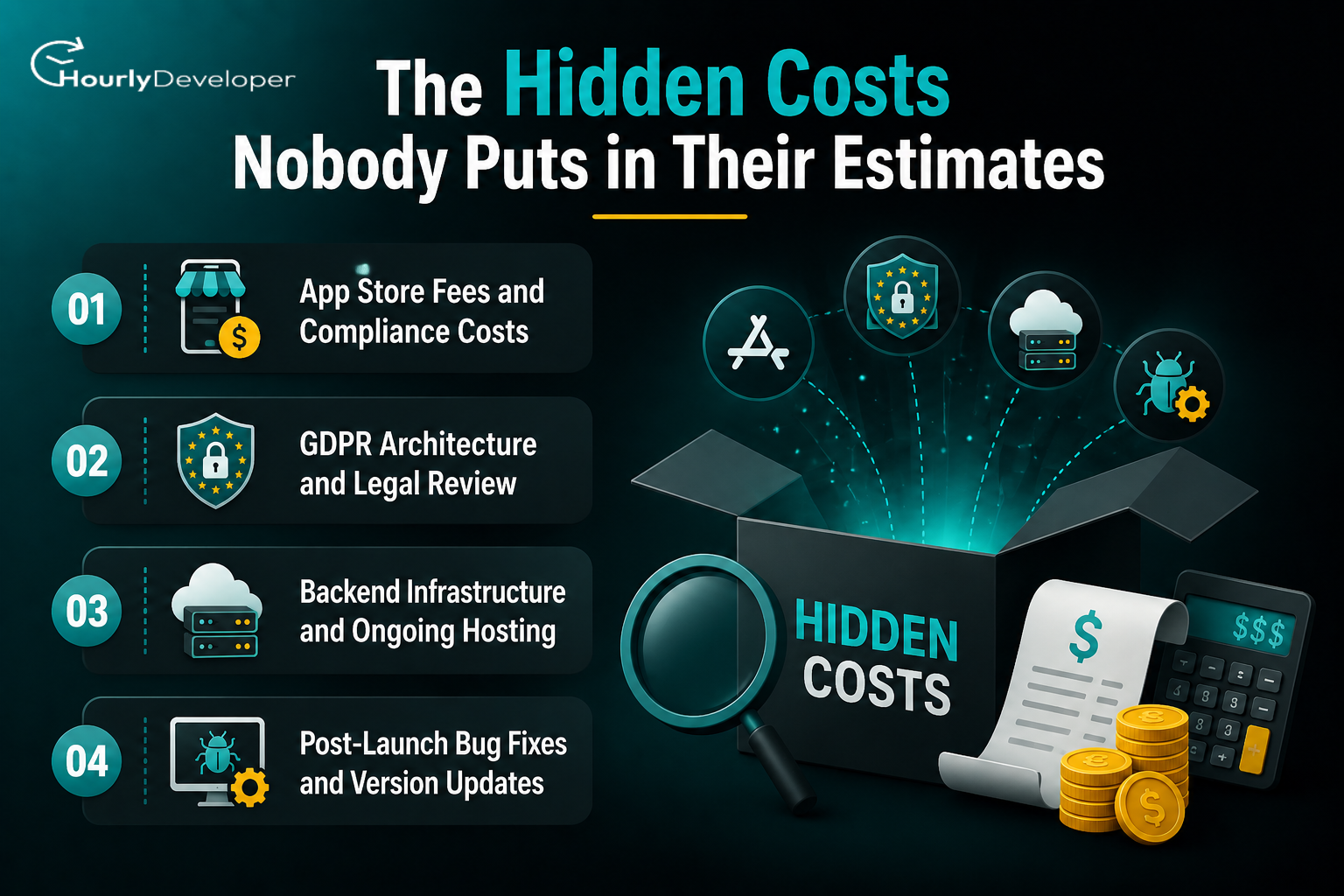
This is the part that trips people up. You get a quote, you budget accordingly, and then six months in you are looking at invoices you did not plan for. Here is what actually happens.
App Store Fees and Compliance Costs
Both Apple and Google charge developer account fees and take a percentage of in-app revenue. But beyond that, Apple’s App Store review process for German apps that handle user data has become more stringent in 2026. Apps dealing with health data, financial transactions, or personal information face extended review cycles and sometimes require compliance documentation. Budget two to four weeks for app store review cycles, which directly affects your time to revenue.
GDPR Architecture and Legal Review
How much does it cost to build an app in Germany that is fully GDPR compliant? More than you think, if you do not plan for it upfront. GDPR-compliant architecture requires privacy by design, data minimization logic, user consent flows, right-to-erasure functionality, and data processing agreements with every third-party service your app uses. A proper GDPR compliance layer adds 15 to 25 percent to your development scope.
On top of that, a legal review of your privacy policy, terms of service, and data processing agreements by a German attorney familiar with digital products costs between EUR 2,000 and
EUR 8,000 depending on complexity.
Backend Infrastructure and Ongoing Hosting
Your app needs a backend, and that backend needs infrastructure. In Germany, many apps use AWS Frankfurt, Google Cloud Frankfurt, or Hetzner for data residency requirements. Monthly infrastructure costs for a mid-scale app start at EUR 300 to EUR 800 per month and scale significantly with user volume. After 12 months of operation, this line item alone can represent EUR 5,000 to EUR 15,000 in cumulative cost that was not in the original development quote.
Post-Launch Bug Fixes and Version Updates
This is the cost that silently eats budgets. Real-world user behavior always surfaces issues that testing did not catch. Budget a minimum of 15 to 20 percent of your original development cost for the first six months post-launch for fixes, performance improvements, and OS version compatibility updates.
6.How Much Does It Cost to Hire App Developers in Germany vs Offshore?
The cost to hire app developers in Germany versus hiring through an offshore mobile app development company is one of the most impactful financial decisions you will make in this process.
| Developer Level |
Germany (per hour) |
India (per hour) |
Eastern Europe (per hour) |
| Junior Developer |
EUR 50 to 70 |
USD 15 to 25 |
EUR 25 to 40 |
| Mid-Level Developer |
EUR 70 to 100 |
USD 25 to 45 |
EUR 40 to 65 |
| Senior Developer |
EUR 100 to 145 |
USD 45 to 70 |
EUR 60 to 90 |
| Tech Lead or Architect |
EUR 130 to 170 |
USD 65 to 90 |
EUR 80 to 110 |
Rates are 2026 estimates. India rates reflect engagement through a structured mobile app development company rather than individual freelancers.
The decision to hire mobile app developers locally versus offshore is not purely financial, but the financial reality is hard to ignore. On a six-month project requiring a team of four developers, the difference between a local German team and a comparable offshore team can range from EUR 150,000 to EUR 350,000.
The question then becomes: what do you give up when you go offshore? In 2026, the honest answer is less than you might expect, provided you choose a well-structured mobile app development company with European client experience rather than managing individual freelancers.
7.What the Mobile App Development Cost in Germany 2026 Conversation Is Really Missing
Here is the insight most blogs skip entirely: the largest cost variable in app development is not developer hourly rates. It is decision quality at the early stages of a project.
Companies that spend three to four weeks doing proper discovery, writing detailed specifications, and validating assumptions before any code is written typically spend 30 to 40 percent less overall than companies that rush into development and iterate their way through fundamental scope questions at developer rates.
This means the most cost-effective thing you can do before hiring anyone is to get crystal clear on what you are building and why. What problem does it solve? Who is the exact user? What does the minimum viable version actually need to do? What can be deferred to a second version?
A one-week paid discovery sprint with a senior product consultant costs EUR 3,000 to EUR 8,000. That same discovery work, done reactively during development at developer rates, can cost EUR 30,000 to EUR 80,000 in wasted iterations and rework.
8.Choosing the Right Mobile App Development Company: What Actually Matters
When you are evaluating a mobile app development company, whether local or offshore, the pitch deck and client logos tell you very little. Here is what actually predicts whether the engagement will go well.
- They Ask More Questions Than You Do in the First Meeting
A development partner who immediately starts talking about timelines and tech stacks before deeply understanding your business problem is prioritizing their workflow over your outcome. The best partners ask about your users, your business model, your competitive landscape, and your constraints before they say anything about code.
- They Have Done Something Similar Before
Not just in terms of technology but in terms of domain complexity. Android app development companies that have built for the German healthcare sector understand the certification requirements, the data sensitivity expectations, and the integration complexity with German health infrastructure in ways that a generalist shop does not.
- They Are Transparent About Risks
Every project has risks. A partner who gives you a clean, smooth estimate with no caveats is either inexperienced or not being honest. The best mobile app development companies flag where the uncertainty is, explain what they do not know yet, and tell you how they will resolve those unknowns.
- Their References Are Reachable
Ask for two or three client references from similar projects. Actually call them. Ask specifically about what went wrong, how the team handled problems, and whether they would hire the team again. That conversation will tell you more than any portfolio.
9.Germany-Specific Factors That Affect Your App Development Cost
Building for the German market carries specific requirements that add cost regardless of where your development team is located.
- German language localization is not just translation. It involves adapting UI layouts for longer German words and compound nouns that break standard English-sized input fields and buttons.
- German users expect explicit cookie consent flows and transparent data usage explanations. Building these properly takes additional development time.
- If your app integrates with German banking systems or payment infrastructure, expect additional certification and integration costs. German banks use specific APIs and security standards that require experienced developers.
- Apps in certain sectors in Germany, particularly medical devices, financial services, and services for children, require specific regulatory compliance that adds significant scope and cost.
- The German App Store and Google Play Store have region-specific requirements for data handling disclosures that need to be built into the app itself, not just the store listing.
10.A Real Decision Framework: How to Approach Your App Budget
Rather than giving you a number and calling it a day, here is a practical way to approach the mobile app development cost conversation in Germany for 2026.
- Start with a fixed discovery budget of EUR 5,000 to EUR 15,000. Use this to produce detailed specifications, wireframes, and a technical architecture document. This document becomes your scope and your protection.
- Get three quotes based on the same specification document. Not rough estimates, but actual quotes based on defined scope. This makes comparison meaningful.
- Evaluate technology options explicitly. Ask each vendor what cross-platform app development approach they recommend and why. If they push native without a strong justification, that may be a red flag.
- Build a contingency into your budget of at least 20 percent above the quoted scope. Scope changes are not a sign that something went wrong. They are a sign that you are learning from real development.
- Treat post-launch costs as part of the product budget, not a separate line item. Apps are not finished when they launch. They are products that need ongoing investment.
11.The Bottom Line: What You Should Take Away From This
Building an app in Germany in 2026 is a significant investment. The cost to build an app in Germany ranges from EUR 30,000 for a simple MVP to well over EUR 500,000 for a complex enterprise platform, depending on scope, team, and technology choices.
The most important thing this blog can leave you with is this: the companies that build apps successfully are not necessarily the ones with the biggest budgets. They are the ones that invest in clarity upfront, make deliberate technology choices, choose partners based on fit rather than price alone, and treat the app as a product to be built and operated over time rather than a project to be finished.
Whether you decide to work with a local German agency, a specialized mobile app development company overseas, or a hybrid team combining both, that decision should come from a clear-eyed assessment of your product needs, your timeline, and your budget reality rather than from habit or assumption.
The tools exist. The talent exists. The question is how clearly you can define what you want to build, and how smart you are about who you trust to build it.
 Back to Blog